Dental Marketing Attribution Models: How to Choose the Right One for Your Practice
Posted on 5/23/2026 by WEO Media |
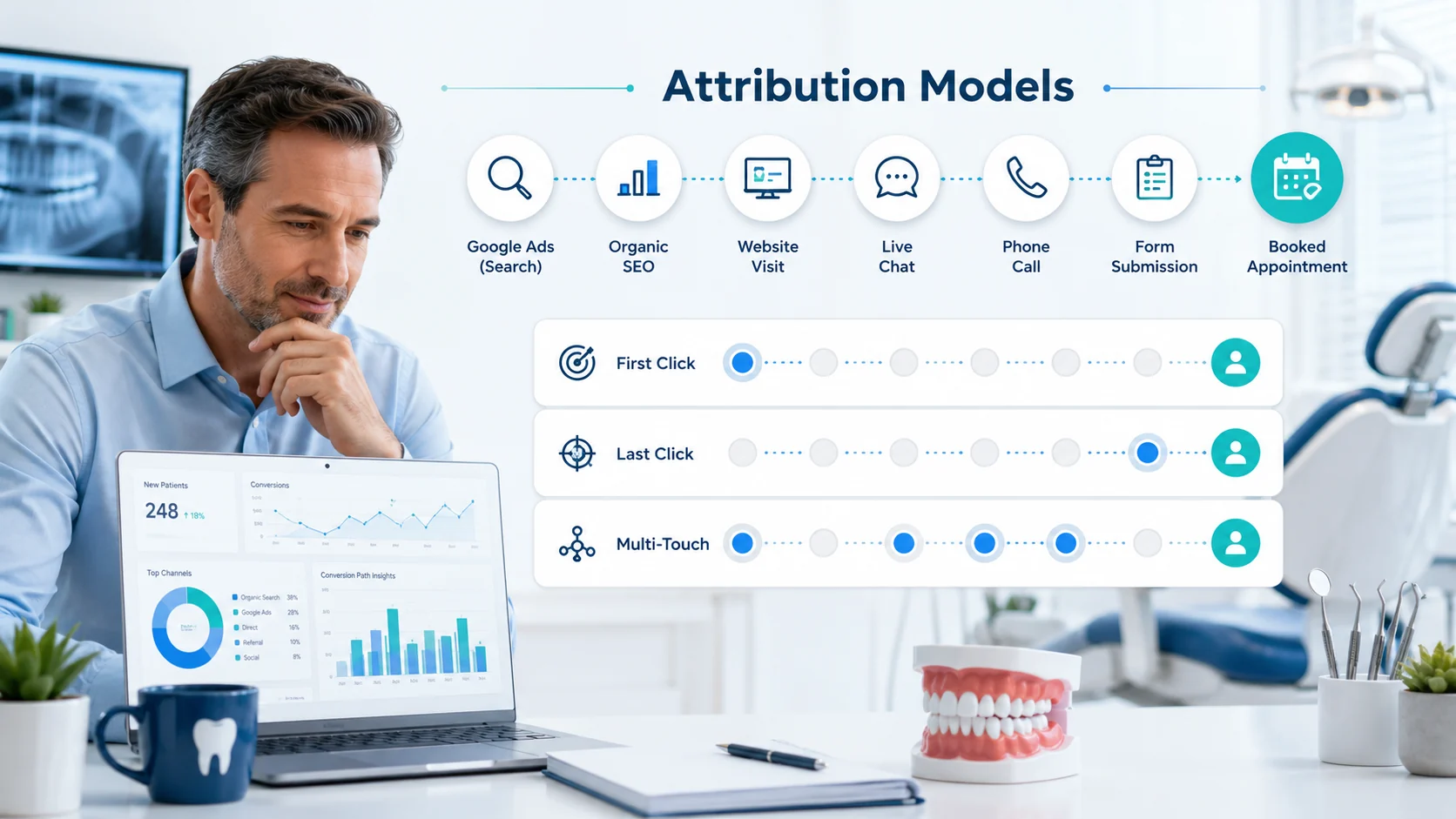 Pick the dental marketing attribution model for your practice that matches how patients actually decide—not the default your analytics tool happened to set. Dental marketing attribution models assign credit across the channels (organic search, paid ads, reviews, referrals, direct) that move a patient from first touch to booked appointment, and the right one depends on whether your practice runs short-cycle services like cleanings or long-cycle services like implants and clear aligners. Pick the dental marketing attribution model for your practice that matches how patients actually decide—not the default your analytics tool happened to set. Dental marketing attribution models assign credit across the channels (organic search, paid ads, reviews, referrals, direct) that move a patient from first touch to booked appointment, and the right one depends on whether your practice runs short-cycle services like cleanings or long-cycle services like implants and clear aligners.
The pattern is predictable: a patient searches “dentist near me,” reads your reviews, clicks a Google Ad two weeks later, then calls after a coworker recommends you. Single-touch attribution gives 100% of the credit to whichever channel happened last (or first) and zero to the rest. That distorts spend decisions, kills assisting channels by accident, and makes SEO or reviews look weak when they were doing the heavy lifting earlier in the journey.
Running paid ads and tracking conversions, but the numbers don’t line up with your booked appointments? The model is usually the issue—not the campaigns.
Below, you’ll learn how each of the six common attribution models works, which one fits short-cycle vs long-cycle dental services, what changed in GA4 and Google Ads in 2023 and 2024, how to connect calls and CRM data into the picture, and the most common attribution mistakes that lead to bad budget decisions.
Written for: dental practice owners, office managers, and in-house marketing coordinators who want to stop guessing which channel earned the patient.
TL;DR
If you only do six things, do these:
| • |
Stop relying on last-click alone - it overcredits the final channel and hides everything that built awareness and trust earlier
|
| • |
Match the model to the service cycle - short-cycle visits (cleanings, fillings) tolerate last-click; long-cycle services (implants, ortho) need time-decay or position-based thinking
|
| • |
Know what GA4 actually offers - Google deprecated first-click, linear, time-decay, and position-based models across both GA4 and Google Ads in 2023; data-driven and last-click variants are what’s left
|
| • |
Connect calls to attribution - dynamic number insertion (DNI) ties a phone call back to the channel that drove it; without it, you’re missing the majority of your conversions
|
| • |
Mark booked appointments as key events - GA4 renamed “conversion events” to “key events” in March 2024; the attribution model only learns from events you mark
|
| • |
Treat “How did you hear about us?” as a soft signal - patients consistently misremember; use it as a tiebreaker, not the source of truth |
Table of Contents
What marketing attribution actually means for dental practices
Marketing attribution is the process of assigning credit to the channels and touchpoints in your dental marketing funnel that contribute to a patient booking an appointment. For a single-visit cash transaction, that’s simple. For dentistry—where a patient may research for weeks, compare reviews, ask a coworker, and verify insurance before calling—it’s a multi-touch problem.
Why “How did you hear about us?” doesn’t solve it: patients consistently misremember. A new patient who Googled you three times, read your reviews, and saw a retargeting ad will often say “Google” or “a friend” at intake. The intake form captures the last memorable touch—not the journey. Practices that rely only on intake answers tend to overcredit referrals and undercredit the SEO and paid media that did the assist work.
What attribution does:
| • |
Connects sessions to outcomes - links a website visit, click, or call back to the channel that drove it
|
| • |
Assigns credit across touchpoints - distributes value based on a model (last-click, first-click, linear, time-decay, position-based, or data-driven)
|
| • |
Informs spend decisions - tells you which channels deserve more budget, less, or a different role in the funnel
|
| • |
Separates assist work from closing work - reviews and organic search often assist; branded search and direct often close |
What attribution doesn’t do: it doesn’t fully capture offline word-of-mouth referrals that bypass digital channels, it doesn’t measure intent perfectly, and it doesn’t replace good clinical reputation. Treat attribution as a steering tool for intake and marketing decisions—not as a verdict on which channel “won.”
> Back to Table of Contents
The six attribution models (with dental examples)
Every attribution model takes the same patient journey and slices the credit differently. Here’s a worked example we’ll reuse for each one: a patient finds your practice through organic search (Day 1), clicks a Google Ad (Day 5), reads reviews on Google (Day 9), and calls after seeing a retargeting ad (Day 12).
Last-click attribution
The final touch before booking gets 100% of the credit. In the example, the Day 12 retargeting ad gets all of it; organic search, the Google Ad, and reviews get zero.
What it favors: bottom-funnel channels like branded search, retargeting, and direct traffic. What it hides: top-funnel awareness work—the channels that introduced the patient to you weeks earlier.
When it’s acceptable for dental: short-cycle, low-consideration visits (emergency exams, same-week cleanings) where the patient’s journey is genuinely short. When it’s dangerous: for implant, ortho, or cosmetic cases where consideration spans weeks or months.
First-click attribution
The first touch gets 100% of the credit. In the example, organic search gets everything; the Google Ad, reviews, and retargeting get zero.
What it favors: awareness channels—SEO, content, top-of-funnel social. What it hides: the channels that closed the appointment, which usually look weak under this model.
When it’s acceptable for dental: brand-new practices trying to understand which channels are introducing them to the local market. When it’s dangerous: as a general default, because it underweights the channels actually converting demand.
Linear attribution
Every touchpoint gets equal credit. In the example, each of the four touches gets 25%.
What it favors: balanced views across the funnel. What it hides: the reality that not every touch matters equally—a brand search after twelve ad exposures is different from a brand search after one.
When it’s acceptable for dental: as a starting model when you don’t have enough volume for data-driven attribution. When it’s dangerous: when it lulls you into thinking every channel is contributing equally and you stop optimizing.
Time-decay attribution
Touchpoints closer to the booking get more credit; earlier touches get less. In the example, the Day 12 retargeting ad gets the largest share and Day 1 organic search the smallest, with the Google Ad and reviews in between.
What it favors: mid- and bottom-funnel channels, with some credit retained for awareness. What it hides: the genuine importance of early discovery for long-consideration services.
When it’s acceptable for dental: long-cycle services where the closing window matters most—clear aligners, full-arch implants, cosmetic cases. When it’s dangerous: for short-cycle services where time-decay just mimics last-click.
Position-based (U-shaped) attribution
The first and last touches get 40% each; the middle touches split the remaining 20%. In the example, organic search and the retargeting ad each get 40%, while the Google Ad and reviews split the remaining 20%.
What it favors: the channels that introduce the patient and the channels that close the booking. What it hides: the weight of middle-funnel assist channels like reviews—which dental patients consistently cite as decisive.
When it’s acceptable for dental: when you want to credit both discovery and conversion equally, especially for new-patient acquisition campaigns. When it’s dangerous: if your middle-funnel work (reviews, content, retargeting) is doing the persuasion you’re not crediting it for.
Data-driven attribution
A machine learning model analyzes your actual conversion paths and assigns credit based on which touchpoints statistically contribute to bookings. Different patient journeys get different credit distributions based on patterns in your data.
What it favors: whichever channels your data shows are actually moving patients toward booking—not a fixed rule. What it hides: very little, but the model needs sufficient conversion volume to learn from, and its credit logic isn’t fully transparent.
When it’s acceptable for dental: most multi-channel practices with reasonable conversion volume. When it’s dangerous: for very small practices below the volume threshold, because GA4 silently falls back to last-click without telling you (more on this in what changed in GA4 and Google Ads below).
> Back to Table of Contents
What changed in GA4 and Google Ads (and what it means for your reporting)
Google Analytics 4’s attribution capabilities are not the same as the conceptual models above—and Google made the same changes inside Google Ads. Two shifts from the last two years matter for every dental practice running paid media and analytics.
Four models were deprecated across both platforms in 2023: Google removed first-click, linear, time-decay, and position-based attribution from Google Ads (June–September 2023) and then from GA4 properties (October–November 2023). The models that remain in GA4 are data-driven attribution (the default), paid and organic last click, and Google paid channels last click. Google Ads similarly offers only data-driven and last click. The four deprecated models still exist as conceptual frameworks for thinking about multi-touch journeys, and they’re still available in non-Google platforms (Meta Ads Manager, HubSpot, and third-party attribution tools like CallRail or WhatConverts), but they no longer appear in either Google product.
“Conversions” became “key events” in March 2024: GA4 renamed conversion events to key events. The change is more than cosmetic—the attribution model only learns from events you explicitly mark as key events. If your booked-appointment event isn’t marked, attribution can’t credit any channel for it. Audit your key events before you trust any attribution report.
Data-driven attribution has a volume threshold: GA4 generally needs a minimum of 400 conversions in a 28–30 day window for the data-driven model to actually run. Below that threshold, GA4 silently reverts to last-click attribution without a banner or warning in the interface. Your reports keep updating; your settings still say “data-driven.” You just aren’t getting data-driven results. What this means for dental practices: a single-location general practice booking fewer than ~400 trackable conversions a month is probably looking at last-click attribution under a different label.
The practical implication: if you stay inside Google’s products, you’re effectively choosing between data-driven (when you have volume) and last-click (when you don’t). For the other models, you have three options:
| 1. |
Compare available models side by side using GA4’s Advertising workspace Model Comparison report, which shows the same conversions credited under each model GA4 still offers
|
| 2. |
Export GA4 data to BigQuery and build first-click, linear, time-decay, or position-based models in SQL or a BI tool against your raw event data
|
| 3. |
Use a third-party attribution platform (CallRail, WhatConverts, HubSpot, Meta Ads Manager for paid social) that still supports the full range of conceptual models on top of your call, form, and ad-platform data |
> Back to Table of Contents
How to choose an attribution model for your practice
There’s no single right answer—the model should match your service mix, your conversion volume, and how long your typical patient takes to decide.
If your practice is mostly short-cycle services
Cleanings, exams, fillings, and emergency visits are typically decided in days, not weeks. The patient journey is short and direct.
Recommended starting point: data-driven attribution if you have enough conversion volume to clear the GA4 threshold; last-click is acceptable as a fallback when volume is too low.
Why: a short journey doesn’t need a complex model to slice; the channels that close the booking are usually the channels doing the meaningful work.
If your practice is mostly long-cycle services
Implants, full-arch reconstruction, clear aligners, veneers, and complex cosmetic cases often involve weeks or months of consideration. Patients shop, save, consult specialists, and verify benefits before they book.
Recommended starting point: data-driven attribution in GA4 (it adapts to long paths), supplemented by time-decay or position-based thinking outside GA4—either in a third-party attribution tool or via a BigQuery export.
Why: the closing channel matters, but so does the first touch that opened the consideration. A long journey is exactly where last-click attribution does the most damage by erasing weeks of discovery work.
If your practice has a mixed service menu
Most general practices fall here—a steady stream of hygiene and routine care alongside higher-ticket cases that close on a longer timeline.
Recommended starting point: data-driven attribution at the property level, with secondary views by service type or campaign when volume allows.
Why: a single model rarely fits every service. Data-driven adapts to each journey, and segmenting by channel and source lets you see the cycle-specific patterns underneath the property-level numbers.
A pattern we commonly see: a general practice running data-driven attribution discovers that organic search drives the majority of hygiene bookings but only assists on implant cases, while paid search closes implant cases that organic search introduced. The model surfaces both roles. Last-click reporting would have killed the SEO budget by accident.
> Back to Table of Contents
How to set up dental marketing attribution tracking
Picking a model only matters if your tracking infrastructure feeds it accurate data. Three pieces have to work together: GA4, call tracking, and your practice management system or CRM.
Configure GA4 properly
Google Analytics 4 is the reporting layer for almost every dental practice. A few essentials:
| • |
Mark booked appointments as key events
- the model only learns from events you mark; un-marked form submissions and phone calls don’t feed attribution
|
| • |
Set up cross-domain tracking - if your appointment scheduler lives on a separate subdomain or third-party booking site, you’ll lose attribution without cross-domain configuration
|
| • |
Verify UTM hygiene - every paid campaign, email, and partner link should use consistent UTM parameters (source, medium, campaign) so channels group correctly
|
| • |
Compare models in the Advertising workspace - GA4’s Advertising section includes a Model Comparison report that shows the same conversions credited across the available models side by side
|
| • |
Check your data-driven threshold - if you’re below ~400 conversions in 28 days, assume you’re effectively on last-click regardless of the label |
Add call tracking with dynamic number insertion
Dental practices still book the majority of new patients by phone. Without call tracking, the channel that drove the call disappears from your attribution data.
How dynamic number insertion (DNI) works: a small script swaps the phone number on your website based on the visitor’s traffic source. A visitor from Google Ads sees one tracking number, a visitor from organic search sees another, and a direct visitor sees yet another. When the call comes in, the source is captured and can be pushed back into GA4 as a key event.
What to track on each call:
| • |
Source channel - which traffic source triggered the number swap
|
| • |
Call duration and outcome - so you can filter qualified calls from quick hang-ups
|
| • |
Booked vs not-booked status - the only outcome that should count as a conversion for attribution
|
| • |
Recording or transcript (where permitted) - for staff coaching and lead-quality verification, with required consent disclosures under applicable two-party-consent state laws |
Connect your practice management system or CRM
The final piece is closing the loop between a lead and a kept appointment. GA4 and call tracking know about the inquiry; only your practice management system knows whether the patient showed up, was clinically appropriate, and accepted treatment.
What “closing the loop” looks like in practice:
| 1. |
Capture the source field in your PMS or CRM at lead creation, pulled from GA4 or call tracking
|
| 2. |
Update the record when the patient books, when they keep the appointment, and when treatment is accepted
|
| 3. |
Push outcomes back to GA4 as offline conversions using the Measurement Protocol or a CRM integration, so the attribution model learns from the actual outcome—not just the initial click
|
| 4. |
Report on kept appointments and accepted treatment, not only bookings—these are the outcomes that actually fund your practice |
> Back to Table of Contents
Common attribution mistakes in dental marketing
Most attribution problems aren’t about picking the wrong model—they’re about feeding the model bad inputs or misreading the outputs.
The most common mistakes we see:
| • |
Trusting intake form answers as the source of truth - patients misremember; the form captures the most memorable touch, not the journey
|
| • |
Ignoring calls in attribution data - if a majority of new patients book by phone and you don’t have call tracking, your reporting is missing the majority of your conversions
|
| • |
Using last-click for long-cycle services - implant and ortho cases involve weeks of consideration; last-click reliably credits the wrong channel
|
| • |
Comparing branded and non-branded search head-to-head - branded search converts highest because the patient already decided; non-branded search did the work that created the brand search
|
| • |
Killing “low-converting” channels too quickly - reviews, organic search, and content often assist rather than close; last-click reports make them look weaker than they are
|
| • |
Not realizing GA4 has switched you to last-click silently - if you’re below the data-driven threshold, your reports still say “data-driven” but the math is last-click
|
| • |
Attribution windows that don’t match the service cycle - GA4’s default key event lookback is 90 days (configurable to 30 or 60); for very long-cycle services like full-arch implants, even 90 days can truncate the journey, while 30 days is usually plenty for cleanings and emergency visits
|
| • |
Not segmenting new vs returning patients - returning-patient attribution looks artificially clean (they already know you); blend them and you’ll mis-budget acquisition
|
| • |
Treating attribution data as gospel - it’s a steering tool, not a verdict; weigh it against booked production, kept-appointment rate, and clinical fit |
> Back to Table of Contents
How to act on attribution data without making bad decisions
Attribution is only useful if it changes what you do next. A few principles for acting on the data without overcorrecting.
Look for shifts, not snapshots
A single month of attribution data is noisy—especially for practices booking fewer than 100 new patients per month. Track the trend over a rolling 90 days before reallocating budget. What we typically find: month-to-month swings of 10–20% in channel credit are normal noise, not signal.
Protect assisting channels
The most common attribution mistake is cutting an assisting channel because it looks low-converting under last-click. Before cutting any channel, ask: what does the data-driven (or position-based) model say about its assist role? If it disappears, do downstream conversions on other channels drop?
A practical test: pause the channel in a single market or for a defined window (2–4 weeks), then watch whether the channels it was assisting hold steady. If branded search drops when SEO is paused, SEO was doing real work.
Match reporting cadence to decision cadence
Weekly attribution reports for a small practice usually create more noise than insight.
Suggested cadence:
| • |
Monthly - channel-level performance review with rolling 90-day trend
|
| • |
Quarterly - budget reallocation decisions, with attribution model comparisons in GA4’s Advertising workspace
|
| • |
Annually - strategic channel mix review, with cycle-specific analysis by service line |
Combine attribution with booked production
A booked appointment isn’t a kept appointment, and a kept appointment isn’t accepted treatment. The reporting hierarchy that matters: attribution → bookings → kept appointments → accepted treatment → collected production. If a channel attributes well but its bookings rarely produce treatment, that’s a lead-quality signal, not a model failure.
> Back to Table of Contents
Get attribution working for your practice
Attribution done right turns “we think our marketing is working” into “we know which channels are driving which patients, and we can prove it.” WEO Media - Dental Marketing helps practices configure GA4, add call tracking, integrate the CRM, and match the right model to your service mix so spend decisions are based on signal rather than guesswork.
To start a conversation about attribution and reporting for your practice, call us at 888-246-6906, schedule a consultation, or visit our dental marketing services page.
> Back to Table of Contents
FAQs
What is the default attribution model in GA4?
Data-driven attribution is the default model in Google Analytics 4. It uses machine learning to analyze your actual conversion paths and assigns credit based on which touchpoints contribute to bookings. To run as designed, GA4 generally needs at least 400 conversions in a rolling 28 to 30 day window. Below that threshold, GA4 silently falls back to last-click attribution without changing the label in your reports, so smaller practices may be looking at last-click data while believing they have data-driven insights.
Why is last-click attribution misleading for dental practices?
Last-click gives 100% of the credit to the final touchpoint before booking and zero to everything before it. For dental services with multi-week consideration cycles, like implants, clear aligners, or cosmetic cases, the closing channel often is not the channel that did the persuasion work. Last-click reports tend to overcredit branded search and retargeting while underweighting the organic search, reviews, and content that built the trust earlier in the journey.
Did Google really remove first-click, linear, time-decay, and position-based attribution?
Yes, across both products. Google deprecated all four of those attribution models in Google Ads between June and September 2023 and in GA4 between October and November 2023. The models still available are data-driven attribution and last click (with paid and organic last click and Google paid channels last click variants in GA4). The deprecated models remain useful as conceptual frameworks for thinking about multi-touch journeys, and they are still supported in non-Google platforms like Meta Ads Manager, HubSpot, and third-party attribution tools such as CallRail or WhatConverts, but they no longer appear in either Google Ads or GA4.
How does call tracking work with attribution?
Dynamic number insertion (DNI) is the most common method. A small script swaps the phone number shown on your website based on the visitor’s traffic source, so a visitor from Google Ads sees one tracking number, an organic visitor sees another, and so on. When the call comes in, the source channel is captured and can be sent back into GA4 as a key event, so attribution models include phone bookings alongside online form submissions instead of leaving them out entirely.
What lookback window should I use for dental implants vs cleanings?
Match the window to the service cycle. GA4 offers 30-day, 60-day, and 90-day key event lookback windows, with 90 days as the default. For short-cycle visits like cleanings, exams, or emergency appointments, the 30-day setting is usually sufficient. For long-cycle services like implants, full-arch reconstruction, or clear aligners, keep the 90-day default and verify your typical consideration window does not exceed it. There is also a separate 30-day default for acquisition events (first visit), which you can lower to 7 days if needed.
Can I trust "How did you hear about us?" answers?
Treat them as a soft signal, not the source of truth. Patients consistently misremember their journeys. A patient who searched three times, read your reviews, and saw a retargeting ad may answer “Google” or “a friend” because that was the most memorable touch. The intake answer is useful as a tiebreaker between channels or as a cross-check on word-of-mouth and referral volume, but digital attribution (GA4 plus call tracking) should be your primary source of truth.
How do I attribute referral patients in my data?
Pure offline word-of-mouth referrals usually arrive as direct traffic or branded search in GA4, because the referred patient types your name or visits your URL directly. Add an intake-form question that captures the referring patient’s name when applicable, and tag those records as referrals in your practice management system. Do not try to force them into the digital attribution model; track them as a separate channel and review their volume alongside your digital results.
Is data-driven attribution worth using for a small dental practice?
Data-driven attribution only runs in GA4 when you have sufficient conversion volume, generally at least 400 conversions in a 28-day window. Practices below that threshold are silently switched to last-click attribution without a notification in the interface. If your practice is below the threshold, your practical options inside GA4 are last-click reporting (with the understanding that it overcredits closing channels), or building richer attribution outside GA4 using call tracking platforms, your CRM data, or a BigQuery export with custom models in a BI tool.
Should I compare attribution models before changing my marketing budget?
Yes. GA4’s Advertising workspace includes a Model Comparison report that shows the same conversions credited across the models currently available in GA4 (data-driven and last-click variants). Before reallocating budget, compare them and look for channels that perform very differently under each model. A channel that looks strong under one and weak under another is usually playing a specific funnel role (assist vs close) rather than failing. Make budget decisions on the model that best matches your service cycle, but use the comparison to avoid blind spots. |
|