How DSOs Should Structure Marketing Teams for Scale
Posted on 12/23/2025 by WEO Media |
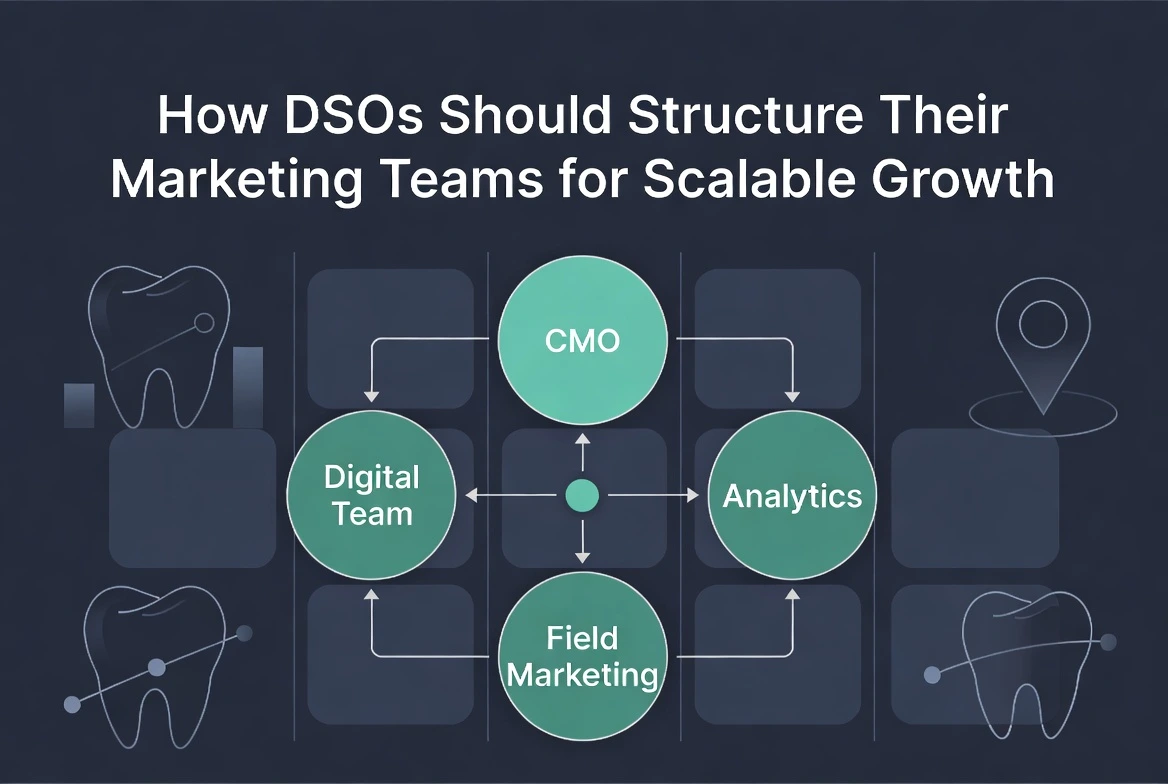 As Dental Support Organizations expand, the structure of their marketing teams becomes a central determinant of scalable, predictable growth. The most successful DSOs organize marketing not as a collection of isolated tasks, but as an integrated operational system aligned with patient acquisition, retention, and brand governance. Drawing on industry-wide patterns observed by WEO Media - Dental Marketing, DSOs benefit most when their marketing function matures in tandem with organizational complexity—ensuring that strategy, data, execution, and reporting evolve coherently rather than reactively. As Dental Support Organizations expand, the structure of their marketing teams becomes a central determinant of scalable, predictable growth. The most successful DSOs organize marketing not as a collection of isolated tasks, but as an integrated operational system aligned with patient acquisition, retention, and brand governance. Drawing on industry-wide patterns observed by WEO Media - Dental Marketing, DSOs benefit most when their marketing function matures in tandem with organizational complexity—ensuring that strategy, data, execution, and reporting evolve coherently rather than reactively.
Why Marketing Structure Matters for DSOs at Every Growth Stage
A DSO’s marketing organization influences how reliably locations attract patients, maintain brand consistency, and sustain competitive performance. As DSOs grow, each added location introduces new operational variables: market conditions, service mixes, provider capacity, and local search visibility. Without a structured marketing framework, these variables compound—often resulting in inconsistent patient flow, inefficient spend, and fragmented reporting.
Structured marketing teams help centralize data, standardize messaging, and improve cross-location coordination. Our dental marketing experts frequently see that DSOs with clearer role definitions and reporting lines achieve faster onboarding for new locations and more accurate forecasting, both of which contribute to smoother scaling.
Ultimately, sound organizational design ensures that DSOs grow deliberately rather than chaotically, with marketing functioning as a strategic driver rather than a reactive support unit.
Marketing Org Structures for DSOs by Growth Stage
Because DSOs grow at different speeds and operate under different constraints, no single structure fits all. Instead, organizations benefit from adjusting their marketing roles and workflows based on size, location distribution, and growth goals.
Stage 1 – Emerging DSOs (1–10 Locations)
Early-stage DSOs typically adopt a lean structure in which strategic oversight and foundational execution are the primary needs. At this stage, clarity of ownership is more important than breadth of specialization.
| • |
Marketing Director - Oversees budgeting, brand consistency, and vendor coordination; often manages both strategy and execution.
|
| • |
Marketing Coordinator - Assists with campaign scheduling, digital tasks, and communication across locations.
|
| • |
External Agency Support - Supplements execution with SEO, paid media management, analytics, and design expertise. |
For DSOs at this scale, our dental marketing agency often sees the greatest impact from establishing foundational systems—shared reporting dashboards, standardized messaging, and unified tracking—to prevent later operational bottlenecks.
Stage 2 – Growth-Focused DSOs (10–40 Locations)
As a DSO expands across regions, the marketing function must begin specializing. Centralizing core digital functions while maintaining field touchpoints becomes increasingly important for managing volume and variation.
| • |
VP or Head of Marketing - Sets strategic direction, supports forecasting, and leads cross-department alignment.
|
| • |
Digital Marketing Manager - Oversees SEO, paid ads, website health, and analytics.
|
| • |
Content & Communications Manager - Ensures unified patient messaging, brand voice, and content strategy.
|
| • |
Regional Marketing Managers - Bridge field operations and central marketing to support market-level execution.
|
| • |
Creative/Design Specialist - Maintains brand visuals and assists with campaign assets. |
This hybrid structure balances efficiency with market sensitivity. Our dental marketing company has observed that this phase benefits from clear SOPs, as repeatable workflows allow teams to scale without overextending internal bandwidth.
Stage 3 – Large, Multi-State DSOs (40–100 Locations)
At this scale, DSOs often operate across diverse markets with varying competitive pressures. Effective marketing teams shift toward deeper specialization and departmental structure, enabling them to manage operational volume while maintaining quality.
| • |
Chief Marketing Officer (CMO) - Leads enterprise-wide brand governance and strategic integration with operational leadership.
|
| • |
Patient Acquisition Team - Focused on new patient growth through SEO, paid media, conversion optimization, and testing.
|
| • |
Retention & Patient Experience Team - Manages recall systems, communications, and loyalty initiatives.
|
| • |
Marketing Operations (MOPS) Team - Handles CRM administration, automation, tracking, and attribution modeling.
|
| • |
Creative & Brand Team - Produces scalable multimedia assets and maintains visual consistency.
|
| • |
Field Marketing Team - Supports openings, community partnerships, and market-specific initiatives. |
At this stage, our dental marketing experts frequently emphasize the importance of attribution accuracy, as DSOs often manage multiple channels and high patient volumes, requiring precise insight into which initiatives drive measurable outcomes.
Stage 4 – Enterprise-Level DSOs (100+ Locations)
Enterprise DSOs operate similarly to national consumer brands. Their marketing organizations resemble full-scale departments with defined leadership layers, advanced analytics, and sophisticated operational frameworks.
| • |
CMO + Senior Directors - Oversee acquisition, retention, brand, and operations divisions.
|
| • |
Analytics Division - Provides modeling, forecasting, and enterprise reporting to guide executive decisions.
|
| • |
Centralized Media Buying - Manages large-scale budgets across digital, traditional, and hybrid channels.
|
| • |
Creative Studio - Produces brand and campaign assets at volume while maintaining standards.
|
| • |
Advanced Field Marketing Network - Closely integrated with operations for market launches and local strategy. |
Here, scalability depends on cross-departmental alignment, shared data ecosystems, and advanced reporting frameworks—areas where our dental marketing agency often collaborates with DSOs seeking to refine mature systems.
Centralized vs. Decentralized Marketing Models
A core strategic question for DSOs is determining how much marketing responsibility should live at the corporate level versus the local or regional level. The right model varies by size, culture, and growth strategy.
| • |
Centralized Marketing - Delivers brand consistency, unified digital strategy, and cost efficiency; best for SEO, paid media, analytics, and major campaigns.
|
| • |
Decentralized (Field-Driven) Marketing - Supports market nuances, community engagement, and location-level agility.
|
| • |
Hybrid Models - Common among mid-to-large DSOs, combining centralized digital strategy with localized activation. |
Our dental marketing company frequently recommends hybrid models for organizations seeking predictable performance without compromising local relevance.
Ensuring Consistency Across Locations While Scaling
Maintaining consistency across many locations requires DSOs to standardize systems and workflows that guide both digital operations and patient-facing communication.
| • |
Standardized Brand Guidelines - Ensure coherent identity across visuals, messaging, and patient touchpoints.
|
| • |
Unified Technology Stack - Aligns CRM, analytics tools, call tracking, and automation for consistent reporting.
|
| • |
Cross-Location Playbooks - Provide repeatable processes for onboarding, event planning, and communication workflows.
|
| • |
Centralized Reporting - Offers leadership visibility into performance trends and resource allocation.
|
| • |
Field Marketing Integration - Supports nuanced execution while ensuring adherence to enterprise standards. |
This combination of centralized strategy and structured local involvement forms the backbone of scalable marketing operations.
Strategic Perspective on Scalable DSO Marketing
Effective DSO growth relies on marketing structures that balance specialization, operational clarity, and cross-location coordination. As seen through the work of WEO Media - Dental Marketing, DSOs achieve the strongest outcomes when they adopt systems that support both enterprise-wide strategy and localized flexibility. By establishing clear roles, refining reporting lines, and investing in scalable workflows, DSOs position their marketing teams to operate as engines of sustainable, predictable expansion.
FAQs
Why do DSOs benefit from centralizing core marketing functions?
Centralization allows DSOs to standardize branding, streamline workflows, and maintain consistent performance measurement across all locations. When functions like SEO, paid media, and analytics are centrally managed, DSOs avoid duplicated efforts and reduce variability in patient acquisition outcomes. Centralization also supports stronger forecasting because all data flows through unified systems.
When should a DSO add regional or field marketing roles?
Field or regional marketing roles become valuable once a DSO operates across multiple markets or surpasses roughly 10–15 locations. At this stage, localized market differences—competition, demographics, community ecosystems—matter more, and regional marketers help bridge local needs with centralized strategy. These roles also improve communication loops between operations and marketing.
What is the biggest marketing challenge DSOs experience as they scale?
The most common challenge is maintaining consistency while increasing volume—more locations, larger budgets, more patient touchpoints, and more complex reporting. Without standardized processes and clear ownership, DSOs often struggle with fragmented analytics, unclear attribution, and uneven performance across locations. A structured marketing org helps mitigate these issues early.
How does organizational maturity affect a DSO’s marketing performance?
As DSOs mature, the complexity of marketing increases—requiring more specialized roles, more refined workflows, and more sophisticated reporting. Early-stage DSOs can operate effectively with generalists, while mid- to large-scale systems need specialists for acquisition, retention, analytics, and field operations. DSOs that evolve their marketing structure in alignment with growth typically see stronger and more predictable performance outcomes.
Should DSOs outsource or build internal marketing teams?
Most DSOs use a hybrid approach. Internal teams provide strategic alignment, brand governance, and cross-department coordination, while external partners support specialized functions such as SEO, paid media, analytics, or large-scale content production. This hybrid model allows DSOs to scale efficiently without overextending internal resources, while still maintaining operational control. |
|