Dental Content Gaps: How Dentists Fix Missed Patient Conversions
Posted on 1/7/2026 by WEO Media |
 Dental website content gaps are the missing details and unanswered “next-step” questions that can make a visitor hesitate right before booking. These gaps aren’t just missing information. They show up as a lack of reassurance, an unclear process, or missing trust cues—especially on high-intent pages like New Patient, key Service pages, and Contact/Booking. Dental website content gaps are the missing details and unanswered “next-step” questions that can make a visitor hesitate right before booking. These gaps aren’t just missing information. They show up as a lack of reassurance, an unclear process, or missing trust cues—especially on high-intent pages like New Patient, key Service pages, and Contact/Booking.
This guide was created by our senior dental marketing experts for dental practice owners, office managers, and in-house marketing teams who want to reduce missed patient conversions by lowering uncertainty near decision points. Progress is measurable: higher click-to-call, higher form submits, fewer exits from booking-critical pages, and more completed scheduling actions.
Why Patients Don’t Book After Visiting a Dental Website
New visitors often arrive with real intent, then pause when something feels unclear. The hesitation usually isn’t about “liking” the site—it’s about perceived risk. If a patient can’t quickly understand cost expectations, comfort options, or what happens after they submit a form, postponing can feel safer than committing.
Tone also functions as a trust signal. Generic reassurance (like “gentle” or “affordable”) can help, but vague language without specifics can unintentionally raise suspicion. Clear, calm explanations often build confidence because they make the experience easier to predict.
A useful way to spot these issues is to look for the questions patients need answered before they’ll book. Some teams call these FLUQs—friction-inducing latent unanswered questions. In plain terms: the silent questions that appear right before a call, form submit, or appointment request.
A Quick Vignette: What Hesitation Looks Like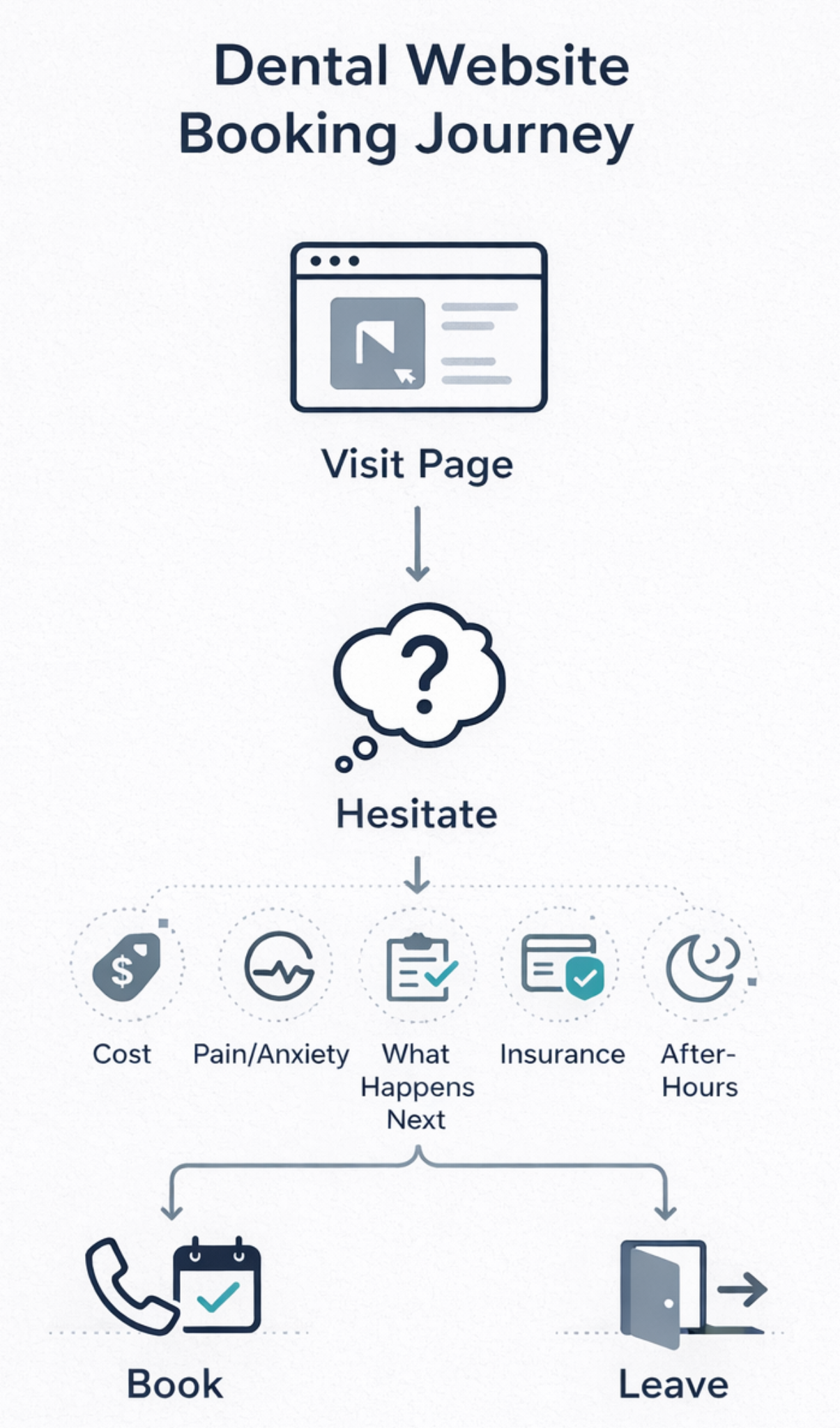
An anxious adult lands on a “sedation” page late at night. They scroll, see a promise of “comfortable care,” but never find what happens afterward, whether someone needs to drive them, or how quickly the office responds to online requests. They close the tab and keep searching—not because they don’t want care, but because the path feels uncertain.
A caregiver searching for an older parent may do the same thing for different reasons: they can’t find accessibility details, appointment timing, or how multi-visit treatment plans get coordinated. In both cases, missing specifics can become friction.
Different Patient Types, Different Booking Barriers
Not every patient is worried about the same thing. Content is strongest when it anticipates common hesitation patterns for different user types.
- Anxious adults – Fear of pain, loss of control, sensory discomfort, gag reflex triggers, or being rushed.
- Cost-sensitive patients – Concern about surprise charges, unclear insurance coverage, and lack of estimate expectations.
- Patients avoiding care – Embarrassment about dental neglect and fear of being judged.
- Parents – Worry about whether care is age-appropriate and emotionally safe for their child.
- Caregivers researching for seniors – Questions about mobility, medications, recovery support, and appointment coordination.
A simple pattern helps: normalize the concern, explain the process, and make the next step obvious.
How to Find Dental Content Gaps Using a 7-Step Audit
The fastest improvements typically come from auditing the pages closest to booking and treating drop-offs like unanswered questions.
- Identify your highest-intent pages (New Patient, top Services, Booking/Contact, Insurance/Financing).
- Map each page to intent: research, compare, or book.
- Review search queries and page copy for mismatch (what people search vs. what the page answers).
- Analyze behavior signals such as scroll depth, exits, click-to-call taps, and form start vs. submit rate.
- Collect real questions from calls, emails, chats, and front-desk conversations.
- Group those questions by scenario (first visit, cost, anxiety, emergencies, kids, seniors).
- Prioritize fixes based on impact: highest-intent pages with the most traffic and highest drop-off first.
A practical “audit deliverable” is a short list: the page, the missing question, the answer block to add, and the spot it should appear (near the form, near pricing language, near after-hours instructions, and so on).
7-Step Audit Recap
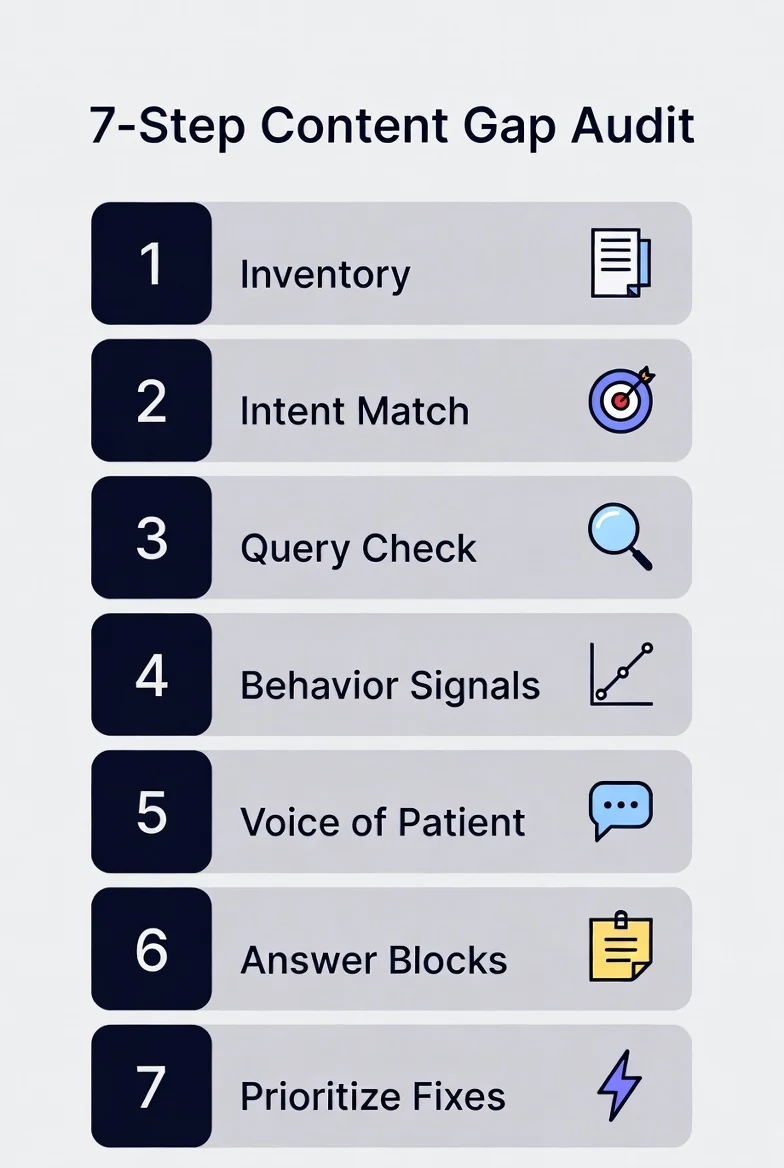
- Inventory – List highest-intent pages.
- Intent match – Confirm each page serves research, comparison, or booking intent.
- Query check – Compare search language to what you actually answer.
- Behavior check – Find exits, scroll stops, and form abandonment points.
- Voice-of-patient – Pull repeated questions from staff and messages.
- Answer blocks – Write short, specific answers using plain language.
- Prioritize – Fix biggest leaks first.
Where These Answers Belong by Page Type
Even great answers create friction if they’re in the wrong place. Patients look for reassurance where decisions happen.
| • |
Home page
- Care approach, comfort philosophy, trust cues, and clear pathways to New Patient, Services, Reviews, and Booking.
|
| • |
New Patient page - First-visit checklist, documentation needed, scheduling expectations, and what happens after submitting a request.
|
| • |
Service pages - What it involves, what it feels like, recovery timeline, risks, alternatives, and “what if” scenarios.
|
| • |
Insurance and financing - How estimates work, common cost factors, and how coverage questions are handled.
|
| • |
About and team - Credentials, training, and how multi-provider care is coordinated without overwhelming detail.
|
| • |
Booking and contact - Clear steps, response timing, accessible options, and after-hours guidance. |
Pro tip: If your site uses accordions, avoid hiding essential booking steps behind collapsible panels. Use expanders for details, not for the core path to scheduling.
Operational Questions That Commonly Block Scheduling
Operational uncertainty can stop booking momentum even when a patient is ready.
| • |
First-visit requirements - What ID, insurance details, and forms are needed and what can be completed online.
|
| • |
New-patient timing - General scheduling expectations so visitors can plan without guessing.
|
| • |
Rescheduling - Clear, humane guidance for changes, especially for caregivers and shift workers.
|
| • |
Virtual consult options - When teledentistry is appropriate and what still requires an in-person exam.
|
| • |
After submit - What happens next and when patients can expect a response. |
Cost, Insurance, and Financial Uncertainty
Patients usually want predictability more than price. The most helpful content explains the estimate process, what drives cost, and how financial conversations work before treatment begins.
| • |
Estimate process - Explain when costs are discussed and that final recommendations follow an exam.
|
| • |
Common cost factors - Complexity, imaging needs, materials, lab work, and number of visits.
|
| • |
Insurance clarity - What to bring, how benefits are verified, and how out-of-pocket portions are communicated.
|
| • |
If coverage changes - A neutral explanation of how plans can be adjusted mid-treatment if insurance changes.
|
| • |
Affordability - Options like phased care or payment plans explained without pressure or shame. |
Safety, Sterilization, and Emergency Boundaries
Some visitors need a clear sense of safety standards before they’ll schedule—especially caregivers or patients returning after a long gap. A brief, plain-language summary of infection control and sterilization practices can reduce uncertainty.
Emergency guidance should also be easy to find. The goal is not diagnosis, but clear next steps.
| • |
Infection control - Plain-language explanation of sterilization, hygiene, and safety protocols consistent with widely accepted standards.
|
| • |
After-hours care - Clear steps for urgent dental problems when the office is closed.
|
| • |
Medical boundary - For severe symptoms such as difficulty breathing, spreading facial swelling, or high fever, seek emergency medical care. |
Microcopy Templates You Can Paste Into Pages
These short answer blocks are designed to reduce friction without sounding salesy.
| • |
What happens after you submit an online request - “After you submit this form, our team will contact you with next steps and scheduling options. If you prefer, you can also call during business hours to schedule immediately.”
|
| • |
Response-time expectation - “If you send a request outside business hours, you’ll be contacted on the next business day. For urgent concerns, use the after-hours instructions on our emergency page.”
|
| • |
Estimate and cost clarity - “Costs depend on your exam findings and the options you choose. Before treatment begins, you’ll receive an explanation of recommended care and expected costs so you can decide how to proceed.”
|
| • |
Rescheduling reassurance - “If you need to reschedule, contact us as soon as you can. We’ll help you find a new time that works, especially for time-sensitive concerns.”
|
| • |
Comfort and autonomy - “If you feel anxious, let us know. Visits can be paced, questions are welcome, and you can request breaks. Comfort options are discussed before treatment begins.”
|
| • |
After-hours boundary - “If the office is closed and you have urgent dental pain or swelling, follow our after-hours steps. If symptoms are severe or rapidly worsening, seek emergency medical care.” |
By-Procedure FLUQs for High-Intent Service Pages
Procedure pages often perform best when they address what patients worry about for that specific service, using general, process-based language.
| • |
Implants - How many visits are typical?; What does recovery usually feel like?; What risks are commonly discussed?; What are alternatives and tradeoffs?; What happens if something needs revision?
|
| • |
Sedation and comfort options - Who may be a candidate?; How do you prepare?; What should you expect afterward?; Will you need a driver?; How is anxiety handled during care?
|
| • |
Emergency dentistry - What counts as urgent?; How quickly can you be seen?; What should you do after hours?; What happens after stabilization?; When should you seek emergency medical care?
|
| • |
Pediatric dentistry - What does a first visit look like?; How is care paced by age?; Can a parent stay present?; How are anxious kids supported?; What happens if a child is distressed? |
Top FLUQ Library: Questions Patients Need Answered Before They’ll Book
These question groups work well as expandable sections on New Patient, Services, and Booking pages. Keep essential booking steps visible outside expanders.
Placement tip: Put 3–5 of the most relevant questions directly above the primary booking CTA; keep the rest below as expandable sections.
First Visit and Scheduling
| • |
What do I need to bring to my first appointment?; How soon can new patients typically get scheduled?
|
| • |
What happens after I submit an online request?; Can I reschedule if something comes up?
|
| • |
What if I need to reschedule more than once?; Do you offer virtual consults for first steps? |
Cost, Insurance, and Payment
| • |
Will I know costs before treatment starts?; What factors usually affect cost?
|
| • |
What should I bring for insurance verification?; What if I don’t have insurance?
|
| • |
Are payment plans available?; What if I lose insurance mid-treatment? |
Pain, Anxiety, and Embarrassment
| • |
Will it hurt?; What comfort options are available?
|
| • |
Can I take breaks?; I’m embarrassed it’s been years—what should I expect?
|
| • |
What if I gag easily or have sensory sensitivities?; Can someone come with me? |
Outcomes, Risks, and “What If”
| • |
How long does it take?; What does recovery usually feel like?
|
| • |
What are the risks or side effects?; What are alternatives and tradeoffs?
|
| • |
What happens if a procedure needs revision?; What if I postpone treatment—what changes? |
Emergency and After-Hours
| • |
What counts as a dental emergency?; What should I do after hours?
|
| • |
How quickly can you be seen?; What symptoms require urgent medical care?
|
| • |
What should I do if a temporary breaks?; What should I do if pain worsens after treatment? |
Before-and-After Copy Examples
| • |
New Patient page - Before: “We welcome new patients.” After: “New patients can request an appointment online. Bring a photo ID and insurance card if applicable. You’ll receive confirmation and next steps after submitting.”
|
| • |
Insurance and financing - Before: “We accept most insurance.” After: “Insurance benefits are reviewed before treatment planning whenever possible, and estimates are discussed in advance so you can choose an option that fits your situation.”
|
| • |
Emergency page - Before: “Call us for emergency care.” After: “For severe pain, swelling, bleeding, or a broken tooth, follow the steps on this page to request urgent care. If symptoms are severe or rapidly worsening, seek emergency medical care.” |
Self-Assessment: How Much Conversion Friction Exists?
Use this checklist on your New Patient page, your top 3 Service pages, and your Booking page.
| • |
Scheduling clarity - Next steps and response timing are clear.
|
| • |
First-visit checklist - Documentation and arrival expectations are stated.
|
| • |
Cost transparency - Estimate process and insurance handling are explained plainly.
|
| • |
Rescheduling reassurance - Policies reduce fear of “being in trouble” for life circumstances.
|
| • |
Comfort and autonomy - Anxiety support and patient control are explained specifically.
|
| • |
Emergency steps - After-hours guidance is easy to find and not vague. |
Scoring:
| • |
0-2 missing: minor friction |
| • |
3-4 missing: moderate friction |
| • |
5+ missing: major friction likely affecting conversions. |
If you scored 5+, start with the 7-step audit and fix the New Patient page first.
How to Measure Whether Content Fixes Are Working
Measurement works best when you compare the same pages and the same traffic sources across stable time windows.
| • |
Click-to-call rate - Mobile taps on phone numbers and call buttons.
|
| • |
Form start vs submit - A practical indicator of friction inside the booking flow.
|
| • |
High-intent exits - Exits from New Patient, Booking/Contact, and top Service pages.
|
| • |
Scroll depth - Whether users reach cost, comfort, and “what if” sections. |
Directional outcomes are often the first signs of improvement: fewer exits from high-intent pages and higher form completion.
An Anonymized Case Pattern
A general dentistry site received steady traffic to its New Patient and emergency pages but saw fewer completed requests than expected. The primary gaps were operational questions (what to bring, what happens after submitting, after-hours steps) and comfort questions (how anxiety is handled). After publishing a first-visit checklist near the form, clarifying after-hours steps, and replacing vague reassurance with process-specific language, form submits increased and high-intent exits decreased in later reporting periods. Results vary: outcomes depend on traffic mix, competition, and the booking workflow itself.
Accessibility and Privacy Considerations
Accessible, ethical content reduces friction for everyone.
| • |
Accessibility essentials
- Short sentences, readable contrast, clear headings, labeled forms, and mobile-friendly tap targets; Test with mobile and keyboard-only navigation when possible.
|
| • |
Privacy essentials
- Use consent for testimonials, avoid identifiable health details, and share analytics in aggregated form rather than patient-level details. |
A simple internal rule helps: assign one person to approve testimonials and analytics visuals before anything is published.
Next Steps for Reducing Missed Conversions
Most teams get the fastest wins by starting with three pages: New Patient, top Services, and Booking/Contact. Add the answers that remove uncertainty closest to the action, then track whether exits fall and completion rates rise.
If you want a second set of eyes or practical guidance, WEO Media – Dental Marketing helps practices identify friction points and missed opportunities across dental websites through structured audits, real user behavior analysis, and no-pressure conversations about what to fix first.
FAQs
What are dental website content gaps?
Dental website content gaps are missing details, unclear explanations, or absent reassurances that prevent visitors from feeling confident enough to schedule. These gaps often involve cost predictability, comfort expectations, safety standards, timelines, and what happens next.
Why do patients hesitate to book a dentist online?
Hesitation is commonly driven by uncertainty about pain, cost, judgment, safety, timing, outcomes, or the booking process. Clear, specific answers placed near decision points often reduce that uncertainty.
What pages should be prioritized to reduce missed conversions?
Start with the New Patient page, the top 3 Service pages, and the Booking/Contact page. These pages usually carry the most booking intent and show the biggest impact when friction is removed.
What should a dental office publish about response time and next steps?
Patients benefit from a clear statement of what happens after submitting a request and when they can expect a response. This reduces form abandonment and prevents uncertainty from turning into postponement. |
|