FTC Advertising Rules for Dentists: A Practical Compliance Guide for Dental Marketing
Posted on 1/13/2026 by WEO Media |
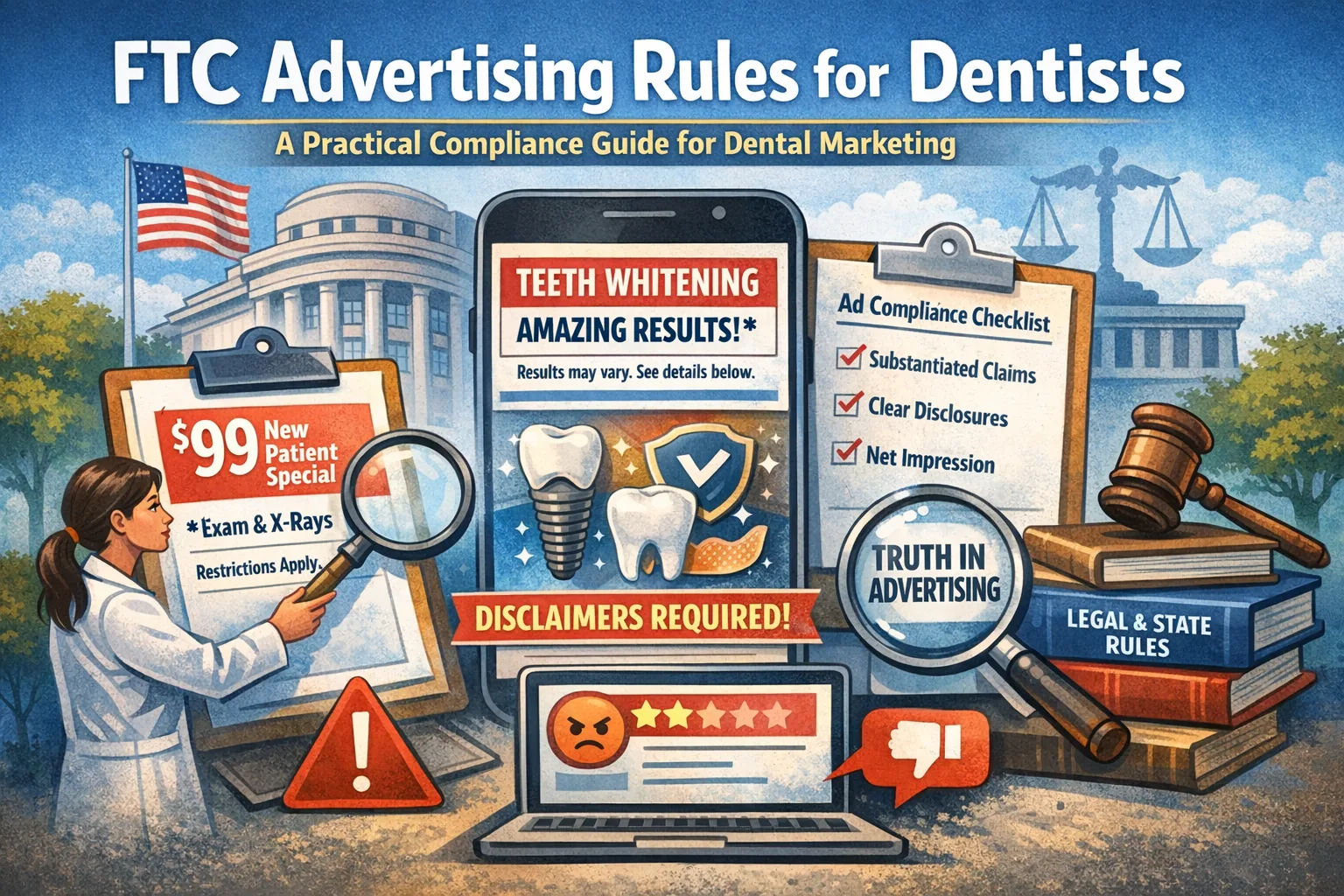 FTC advertising rules for dentists are easiest to follow when you manage three things consistently: the net impression (what a reasonable patient thinks you mean), substantiation (support for measurable claims before they run), and clear and conspicuous disclosures (visible at the decision point, especially on mobile). This guide is designed to reduce the “you changed the deal” moments that trigger distrust, angry calls, negative reviews, and refund requests—without making your marketing sound timid or confusing. FTC advertising rules for dentists are easiest to follow when you manage three things consistently: the net impression (what a reasonable patient thinks you mean), substantiation (support for measurable claims before they run), and clear and conspicuous disclosures (visible at the decision point, especially on mobile). This guide is designed to reduce the “you changed the deal” moments that trigger distrust, angry calls, negative reviews, and refund requests—without making your marketing sound timid or confusing.
This page is educational only, not legal advice. FTC standards are a baseline, and additional rules may apply based on your state dental board, consumer protection laws, financing requirements, platform policies, and privacy/communications regulations. When in doubt, escalate.
Use this guide before any promotion goes live—and bookmark it so you can run the self-audit weekly during active promos.
Does the FTC apply to dentists?
In general, FTC truth-in-advertising principles apply broadly to advertising and marketing—including healthcare marketing—when practices promote services, offers, or outcomes. For a plain-English overview, see the FTC’s topic hub on Truth in Advertising.
Who This Is For
| • |
This is for practice owners, office managers, treatment coordinators, front desk teams, and dental marketing teams who publish ads, landing pages, promos, and social content
|
| • |
This is not a substitute for state board guidance, qualified legal counsel, or lender-provided compliance requirements for financing promos |
| • |
Escalate quickly if you run financing “specials,” health-related benefit claims (sleep/TMJ/pain), influencer/creator content, before-and-after imagery, or subscription-style membership billing. |
Operational rule: If a patient could screenshot your claim and treat it like a promise, build your copy and disclosures as if that will happen.
Table of Contents
FTC Dental Advertising Compliance in 60 Seconds
One-glance answer: FTC compliance generally means your message can’t mislead in its overall impression, objective claims should have support before publishing, and disclosures must be clear and conspicuous where patients decide (especially on mobile). See the FTC’s Truth in Advertising topic hub and the FTC’s .com Disclosures guidance for digital placements.
| 1. |
Net impression - the entire message shouldn’t mislead, including what’s implied or omitted |
| 2. |
Substantiation - measurable claims should be supportable before you run them |
| 3. |
Clear and conspicuous disclosures - essential terms must be easy to notice and understand in the same experience as the claim. |
Important guardrail: Disclosures can’t “fix” a fundamentally misleading headline. If the main message is deceptive, fine print that contradicts it often won’t cure the overall net impression. For context, see the FTC’s discussion of deceptive advertising myths and net-impression analysis: Myths and Half-Truths About Deceptive Advertising.
Launch-ready checklist (use this before anything goes live)
| 1. |
Identify the objective claim (price, time, outcome, comparison, proof words) |
| 2. |
Confirm support exists for the exact wording before publishing |
| 3. |
Write the essential disclosure in one plain sentence |
| 4. |
Place the disclosure where the patient decides (ad when possible, above the fold on mobile, and on booking steps) |
| 5. |
Align chat and front desk scripts to the same message |
| 6. |
Archive “what was live” (ad screenshots + mobile page view) |
| 7. |
Run a weekly drift check during active promos. |
Bottom line: Patients don’t experience “the ad” and “the fine print” separately—they experience the combined impression.
> Back to Table of Contents
Key Definitions Every Team Member Should Share
The FTC often uses “reasonable consumer” in guidance. In dental marketing, it helps to think “reasonable patient”: someone moving fast, possibly anxious, and making decisions based on what they can see in one glance.
| • |
Net impression - what a reasonable patient thinks you mean after seeing the whole message |
| • |
Objective claim - a measurable/verifiable statement a patient can treat as factual (price, timeline, outcomes, comparisons, proof language) |
| • |
Substantiation - support that should exist before making an objective claim |
| • |
Clear and conspicuous - disclosures that are easy to notice and understand in the same experience as the claim (mobile-first) |
| • |
.com Disclosures - the FTC’s framework for making digital disclosures effective (prominence, proximity, and avoiding burying key terms) |
| • |
Material connection - a relationship that could affect how people interpret an endorsement (payment, free services, discounts, employment) |
| • |
Typicality - whether a testimonial implies results most patients can generally expect. |
Operational rule: Shared definitions keep your team from sounding evasive because everyone is explaining the same reality in the same way.
> Back to Table of Contents
Claim Clarity Matrix and Copy/Paste Disclosures
Use this scan-first tool: claim type → what patients need to know → where it must appear → the control point that keeps reality aligned.
Claim clarity matrix (scan-first)
| • |
$99 new patient special - Disclose: what’s included (exam, X-rays, cleaning) and eligibility; Where: next to the price and on booking steps; Control point: written estimate before add-ons |
| • |
Free X-rays / free add-ons - Disclose: scope and when imaging is recommended; Where: wherever “free” appears; Control point: confirm scope before charges |
| • |
From / as low as - Disclose: who qualifies and what changes the price; Where: adjacent to the number; Control point: Offer Card + script |
| • |
Insurance accepted - Disclose: accepted vs in-network vs “we file claims”; Where: next to the claim and on booking steps; Control point: benefits verification script |
| • |
Same-day - Disclose: capacity and clinical constraints; Where: next to the claim, above the fold on mobile; Control point: confirmation script |
| • |
Walk-ins / after-hours - Disclose: “answered” vs “treated,” response expectations; Where: next to the claim; Control point: call-handling script |
| • |
$X/month and 0% promos - Disclose: approval dependence, term length, promo details; Where: adjacent to the payment/rate claim and repeated at booking; Control point: written estimate |
| • |
Implant pricing ads - Disclose: what’s included and common exclusions; Where: next to the price everywhere it appears; Control point: itemized estimate |
| • |
Aligner timelines - Disclose: complexity and compliance drivers; Where: next to timeline wording; Control point: exam-based estimate |
| • |
Whitening outcomes - Disclose: variability (shade change, sensitivity, speed); Where: next to numbers and “instant” language; Control point: expectations script |
| • |
Comparisons - Disclose: what outcome is being compared and the basis; Where: next to “better than” language; Control point: substantiation file + script |
| • |
5-star / top-rated - Disclose: source and timeframe; Where: immediately next to the claim; Control point: periodic revalidation |
| • |
Awards / “as seen on” - Disclose: source, date, and permission; Where: next to the badge/claim; Control point: archive proof |
| • |
Discounts and limited-time offers - Disclose: eligibility, end date, real limits; Where: wherever urgency appears; Control point: Offer Card + drift check |
| • |
Price match - Disclose: what qualifies, documentation, exclusions; Where: next to “match” language and in booking path; Control point: policy + script |
| • |
Guarantees and warranties - Disclose: conditions, exclusions, time limits; Where: next to the guarantee; Control point: written policy + script |
| • |
Membership plans - Disclose: auto-renew cadence, cancellation steps, fees, inclusions/exclusions; Where: enrollment step and confirmation; Control point: written plan terms + script. |
Copy/paste disclosures (plain language)
| • |
$99 special - “Includes [list inclusions]. Any additional needs are discussed before charges.” |
| • |
Insurance - “Coverage varies by plan. We can verify benefits and review estimated costs before treatment.” |
| • |
Same-day - “Same-day may be available. Timing depends on schedule and clinical needs.” |
| • |
$X/month - “Monthly payment depends on approval and term length. Terms apply.” |
| • |
0% promo - “Promotional terms may be available for qualified applicants. Promotional period and terms apply.” |
| • |
From/as low as - “Starting pricing reflects qualifying cases. Total cost depends on evaluation and treatment needs.” |
| • |
Top-rated - “Highly rated on [platform] based on reviews from the past [time window].” |
| • |
Membership plan - “Plan renews [monthly/annually] unless canceled. See cancellation steps and included services before enrolling.” |
Operational rule: Don’t rely on footers or tiny text to “fix” a headline claim. Make the main message accurate first, then use disclosures to add essential details.
> Back to Table of Contents
Health-Related Benefit Claims and What “Evidence” Usually Means
Dental marketing can drift into “treats,” “relieves,” “prevents,” “reduces,” “cures,” or “safe for everyone” language—especially around sleep, TMJ, pain, infection, and anxiety. When you make health-related benefit or safety claims, the FTC often expects a level of substantiation commonly described as competent and reliable scientific evidence, with the needed strength depending on the claim. See the FTC’s Health Products Compliance Guidance for a practical overview.
What evidence usually means operationally: keep a claim-support file that matches the exact wording you use, not a general folder of marketing materials. If you change the claim (“reduces pain” → “eliminates pain”), your support burden changes too.
Avoid cure language: “Cures,” “guaranteed relief,” “permanent fix,” and “works for everyone” wording is high-risk in any condition-related ad.
A safer pattern is evaluation-forward language: “may help,” “options available,” “we’ll evaluate and discuss what’s appropriate.”
Bottom line: Health-benefit language should be supportable, case-dependent, and framed around evaluation.
> Back to Table of Contents
$99 New Patient Specials: What’s Included, What’s Not
One-glance answer: “$99 exam” offers are safest when inclusions are stated in plain language next to the price, and anything that changes cost is explained before the patient commits.
Common searches this section answers
| • |
“Does the $99 include X-rays?” |
| • |
“Does it include a cleaning?” |
| • |
“Is it only for uninsured patients?” |
| • |
“Can insurance still be billed?” |
Why it’s risky
Patients interpret a price as a bundle. If “exam,” “consultation,” “cleaning,” and “X-rays” blur together, the visit can feel like a bait-and-switch—even when staff acted in good faith.
Safer wording examples
| • |
Risky - “$99 new patient special” |
| • |
Safer - “$99 new patient exam includes [A, B]. Imaging and additional needs are discussed before any charges.” |
| • |
Risky - “$99 exam and cleaning” (when cleaning isn’t always appropriate) |
| • |
Safer - “Exam included. Cleaning recommendations depend on evaluation.” |
| • |
Risky - “$99 with insurance” (if the price is actually a cash offer) |
| • |
Safer - “$99 offer applies to [cash/qualifying new patients]. Insurance coverage varies by plan; we can help verify benefits.” |
Where the disclosure must appear
In the ad when possible, and always on the first mobile screen where the $99 is stated—plus anywhere the price is repeated (popups, sticky bars, scheduling widgets, and PDFs).
Front desk micro-script
“The $99 covers the exam and [inclusions]. If imaging or additional services are recommended, we’ll explain why and review costs before anything is done.”
Mini checklist
| • |
List inclusions next to the price (no guessing) |
| • |
If cleaning is conditional, say so plainly |
| • |
If insurance is mentioned, clarify “we verify benefits” vs “in-network pricing” |
| • |
Use a written estimate before add-ons. |
Bottom line: The clearest $99 specials are the ones a patient can understand in one glance.
> Back to Table of Contents
Free X-Rays and Free Add-Ons
One-glance answer: “Free” works best when it’s specific about scope and visible where patients decide, not buried later. The FTC maintains dedicated guidance on “free” representations: Guide Concerning Use of the Word “Free” and Similar Representations.
Why it’s risky
Patients may assume “free X-rays” means all imaging is included and necessary. If the first clarification happens after arrival, it can feel like there was a catch.
Safer wording examples
| • |
Risky - “Free X-rays” |
| • |
Safer - “X-rays included when clinically appropriate; recommendations and costs are discussed before proceeding.” |
| • |
Risky - “Free whitening with aligners” (no scope or eligibility) |
| • |
Safer - “Whitening add-on may be included with qualifying treatment; eligibility and scope are confirmed before scheduling.” |
Where the disclosure must appear
Wherever “free” appears: ad, landing hero, popup, sticky bar, scheduling widget, and any PDF that restates the offer.
Front desk micro-script
“The free portion covers [scope]. If other imaging or services are recommended, we’ll explain options and costs before proceeding.”
Bottom line: “Free” is safest when patients can understand the scope before they book.
> Back to Table of Contents
From Pricing and “As Low As” Claims
One-glance answer: “From” and “as low as” should tell patients what qualifies and what changes the price—right next to the number.
Why it’s risky
Patients often interpret the low number as typical. If only a narrow subset qualifies, people can feel misled even when the words were technically true.
Safer wording examples
| • |
Risky - “Implants from $X” |
| • |
Safer - “Implant treatment starting at $X for qualifying cases; total cost depends on imaging and treatment needs discussed after evaluation.” |
| • |
Risky - “As low as $X/month” (without who qualifies) |
| • |
Safer - “Payments vary by approval and term; examples are reviewed before scheduling.” |
Where the disclosure must appear
Adjacent to the number on mobile and repeated anywhere the price is restated in the booking path.
Front desk micro-script
“The starting price reflects certain cases. After an exam, we’ll explain what’s included and what affects total cost before you decide.”
Operational rule: If you use “from,” name the variable that moves the number.
> Back to Table of Contents
Insurance Accepted, In-Network, and “We File Claims”
One-glance answer: Insurance language is safest when it clearly separates “we can submit claims” from “we’re in-network” and from “your plan covers this.”
Common searches this section answers
| • |
“Do you take my insurance?” |
| • |
“Are you in-network with Delta Dental?” |
| • |
“What does ‘insurance accepted’ actually mean?” |
Why it’s risky
Patients often hear “insurance accepted” as “this will be covered” or “you’ll get in-network pricing.” If reality differs, it can feel deceptive—even when staff intended to be helpful.
Safer wording examples
| • |
Risky - “We accept all insurance” |
| • |
Safer - “We file claims for many plans. Coverage and out-of-pocket costs vary by plan; we can verify benefits before treatment.” |
| • |
Risky - “In-network pricing available” (if only true for some plans) |
| • |
Safer - “Network status varies by plan; we’ll confirm benefits and explain estimated costs before you proceed.” |
Where the disclosure must appear
Next to the insurance claim and anywhere it’s repeated (landing pages, forms, chat macros). If you mention a specific carrier, be especially careful that the statement matches reality for that location and provider.
Front desk micro-script (de-escalation)
“I hear you. ‘Accept’ can mean a few different things. We can submit claims, but coverage and in-network pricing depend on your plan. If you’d like, we can verify benefits and give you an estimate before you arrive.”
Bottom line: Insurance messaging should reduce uncertainty, not create false certainty.
> Back to Table of Contents
Same-Day Claims
One-glance answer: “Same-day” is safest when you say “may be available” and define the real constraints: schedule capacity and clinical needs.
Why it’s risky
A timing promise is an objective claim patients interpret literally—especially in pain-driven searches.
Where the disclosure must appear
Next to the claim (when possible) and above the fold on mobile, plus anywhere “same-day” is restated in the booking path.
Front desk micro-script (when same-day isn’t available today)
“I understand you were hoping for same-day. Today’s availability depends on the schedule and clinical needs. We can offer the next fastest option and confirm timing before you arrive.”
Mini checklist
| • |
Use “may be available” unless you can consistently guarantee capacity |
| • |
Avoid “24/7” unless it’s truly care availability, not just an answering service |
| • |
Align the scheduler and phone script to the same promise. |
Operational rule: Availability claims must be true at the moment they’re read, not just when the ad was written.
> Back to Table of Contents
Walk-Ins and After-Hours Claims
One-glance answer: “Walk-ins welcome” and “after-hours” claims should clarify what is actually available: answered phones, scheduled care, or urgent evaluation.
Safer wording examples
| • |
Risky - “24/7 emergency dentist” |
| • |
Safer - “Phones answered 24/7; clinical availability varies. We’ll schedule the next available urgent visit.” |
| • |
Risky - “Walk-ins always accepted” |
| • |
Safer - “Walk-ins may be accommodated based on schedule; calling ahead helps us confirm timing.” |
Bottom line: “Answered 24/7” and “treated 24/7” are not the same claim—patients deserve clarity.
> Back to Table of Contents
$X/Month and 0% Promos
One-glance answer: Payment and promotional rate claims are safest when approval dependence, term length, and promo details are visible adjacent to the claim—before the patient books.
What patients assume (and what to disclose)
| • |
Is 0% promotional, and for how long? |
| • |
What happens after the promo period? |
| • |
Is approval required, and does credit affect terms? |
| • |
Is there a minimum purchase, down payment, or fees? |
| • |
Are there deferred-interest terms or other conditions the patient should see before committing? |
Credit advertising overlay
If you advertise payment amount, APR/0%, term length, or similar credit terms, additional advertising rules may apply beyond FTC standards, such as Truth in Lending / Regulation Z. You don’t need to memorize the regulation to do the right thing—escalate to the financing provider and confirm required disclosures before publishing.
Bottom line: Financing promos should be lender-reviewed and disclosure-complete.
> Back to Table of Contents
Implant Cost Ads and What’s Included
One-glance answer: Implant pricing is safest when you state what the price includes and name common exclusions that often change total cost—right next to the number.
Why it’s risky
Patients commonly read “implant $X” as “everything included.” The mismatch often shows up as: “I thought the crown was included,” or “I didn’t realize imaging or grafting could be separate.”
What to clarify (common inclusions and exclusions)
Even if you don’t list everything, naming a few typical variables prevents the “all-in” assumption.
| • |
Common components patients may assume are included: implant post, abutment, crown, imaging/CBCT, extractions, bone grafting, sedation, follow-ups |
| • |
The right approach is not to overwhelm—just to be honest that total cost depends on evaluation and what’s clinically needed. |
Safer wording examples
| • |
Risky - “Implants $X” |
| • |
Safer - “Implant treatment starting at $X for qualifying cases. Total cost depends on imaging and treatment needs discussed after evaluation.” |
| • |
Risky - “All-inclusive implant special” (if common services are excluded) |
| • |
Safer - “Price includes [list]. Additional services, if recommended, are reviewed with a written estimate before treatment.” |
Where the disclosure must appear
Next to the price on mobile, and anywhere the number is repeated: ads, landing hero, popups, widgets, and any PDFs.
Front desk micro-script
“Implant pricing depends on your evaluation. We can share what the starting price typically includes and review an itemized estimate before you decide.”
Bottom line: Implant ads build trust when they explain cost drivers instead of hiding them.
> Back to Table of Contents
Aligner Timeline Claims
One-glance answer: Timeline claims should be framed as estimates that vary by case complexity and wear time, confirmed after evaluation.
Why it’s risky
A timeline is measurable, so patients interpret it as a promise. If the ad suggests “fast for everyone,” a qualifier later can feel like backtracking.
Safer wording examples
| • |
Risky - “Straight teeth in 6 months” |
| • |
Safer - “Many cases finish in a range; your timeline depends on complexity and wear time, confirmed after an exam.” |
| • |
Risky - “Faster than braces” (without basis) |
| • |
Safer - “Some cases may finish faster than other options; we’ll evaluate and discuss what’s realistic for you.” |
Where the disclosure must appear
Next to any number-based timeline (“6 months,” “10 weeks”) and above the fold on mobile, plus in booking flows that repeat the promise.
Front desk micro-script
“Timelines vary by case. After an exam, we’ll give you a realistic estimate and review what can change it.”
Bottom line: The safest timeline language is “range + evaluation.”
> Back to Table of Contents
Whitening Outcome Claims
One-glance answer: Whitening claims are safest when shade change, sensitivity, and speed are framed as variable—not instant or guaranteed.
Common searches this section answers
| • |
“How many shades whiter will I get?” |
| • |
“Is whitening instant?” |
| • |
“Will it make my teeth sensitive?” |
Safer wording examples
| • |
Risky - “Instant whitening results” |
| • |
Safer - “Results vary; we’ll recommend the right option and discuss expected shade change and sensitivity risks.” |
| • |
Risky - “Guaranteed 8 shades whiter” |
| • |
Safer - “Shade change varies; your provider will review expected results after evaluation.” |
Bottom line: Whitening ads reduce anxiety when they set realistic expectations upfront.
> Back to Table of Contents
Can Dentists Say “Pain-Free”?
One-glance answer: “Pain-free” often reads like a guarantee. It’s usually safer to describe comfort options and acknowledge variability.
Safer wording examples
| • |
Risky - “Pain-free dentistry” |
| • |
Safer - “Comfort-focused care options available. Sensations vary, and we’ll discuss what to expect.” |
Bottom line: Patients trust confidence paired with honesty more than absolute promises.
> Back to Table of Contents
Sedation “Sleep Through It” Claims
One-glance answer: Sedation messaging should be evaluation-forward and screening-forward. Avoid implying everyone can “sleep through” treatment without qualification.
Operational rule: Frame sedation as an option with appropriateness and screening, not a universal guarantee.
> Back to Table of Contents
Veneers and Smile Makeover Pricing
One-glance answer: Veneers pricing should clarify what’s bundled, what’s per-tooth, and what changes total cost before the patient books.
Operational rule: If it’s “per tooth,” say “per tooth.” If it’s a package, list what’s inside the package.
> Back to Table of Contents
Comparison and Superiority Claims (“Better Than Braces”)
One-glance answer: Comparisons are objective claims. Name what outcome is being compared (comfort, speed, longevity, cost), avoid implied universality, and be ready to support the exact wording.
Operational rule: “Better” without a basis is a trust problem, even when competitors are aggressive.
> Back to Table of Contents
5-Star Claims, “Top-Rated,” and Reviews Compliance
One-glance answer: Reputation claims are safest when you state the source and timeframe next to the claim and avoid practices that create a misleading ratings picture.
The FTC maintains a dedicated hub on endorsements, influencers, and reviews: Endorsements, Influencers, and Reviews, plus a practical Q&A: FTC’s Endorsement Guides: What People Are Asking.
Important 2024 update: The FTC adopted a rule commonly referred to as the Rule on the Use of Consumer Reviews and Testimonials. The FTC’s Q&A and the Federal Register publication are helpful starting points, including the stated effective date of October 21, 2024: Consumer Reviews and Testimonials Rule: Questions and Answers and Federal Register notice.
What not to do (plain-English list):
| • |
Buy or fabricate reviews |
| • |
Post “insider” reviews without disclosure (staff, family, vendors) |
| • |
Use tools or processes that suppress negative reviews or selectively gate who gets asked to review |
| • |
Use “top-rated” without stating the platform and timeframe. |
Bottom line: “Top-rated” is only trust-building when it’s specific, current, and not selectively curated.
> Back to Table of Contents
Awards, Badges, and “As Seen On”
One-glance answer: Awards and “as seen on” claims should identify the source and date and avoid implying an endorsement that doesn’t exist.
Operational rule: If you can’t document the badge, don’t run the badge.
> Back to Table of Contents
Discounts, Coupons, and Limited-Time Offers
One-glance answer: Discounts are safest when eligibility, end dates, and real limits are shown next to the offer wherever urgency appears.
Operational rule: If a countdown timer resets or an offer keeps returning, it stops being “limited” in the way patients interpret it.
> Back to Table of Contents
Price Match Claims
One-glance answer: “Price match” is a policy claim. Define what qualifies and make the conditions visible next to the claim.
Operational rule: “Match” should specify what’s being matched (same procedure, same materials, same inclusions) and what documentation is required.
> Back to Table of Contents
Guarantees, Warranties, and “Permanent” Language
One-glance answer: Guarantees and warranties should be treated as objective promises with written conditions, visible disclosures, and aligned scripts.
Operational rule: If a promise has conditions, the conditions must be easy to see where the promise is made.
> Back to Table of Contents
Membership Plans and Auto-Renew Billing
One-glance answer: Membership plans should clearly explain renewal cadence, cancellation steps, fees, what’s included, and what’s excluded before a patient enrolls.
Where the disclosure must appear
At the enrollment decision point (checkout or sign-up step) and again in the confirmation email or receipt.
Front desk micro-script
“The plan renews [monthly/annually] unless you cancel. Before you enroll, we’ll review what’s included, what isn’t, and how to cancel.”
Bottom line: Subscriptions are trust-forward when cancellation and renewal terms are easy to understand, not hidden.
> Back to Table of Contents
“Clinically Proven” and FDA Wording
One-glance answer: Proof language should be precise, verified in original documentation, and never used as a substitute for explaining variability and candidacy.
Plain-language guardrail: Don’t say “FDA approved” unless the exact product, device, or context you’re describing is actually FDA-approved in that context. Many products are “cleared” rather than “approved,” and FDA status applies to a specific product and use—not the practice overall.
Operational rule: Proof wording is an objective claim. Treat it like one.
> Back to Table of Contents
Testimonials, Reviews, and Material Connections
One-glance answer: If an endorsement would be interpreted differently because of a relationship or incentive, disclose it. If it implies results, add context so the net impression isn’t “everyone gets this outcome.” See the FTC’s endorsements guidance: Endorsement Guides Q&A.
Operational rule: “Results may vary” alone can be inadequate if the testimonial implies typical outcomes.
> Back to Table of Contents
Before-and-After Images
One-glance answer: Before-and-after content should avoid edits that change outcomes, include honest captions that prevent implied guarantees, and be supported by documented consent and a removal process.
Privacy and authorization note: Separate from FTC advertising concepts, practices should obtain written patient authorization/consent before publishing identifiable patient images or videos. If a patient revokes consent, having a documented removal process helps you respond quickly across channels.
Bottom line: Before-and-after builds trust only when it’s authentic, permissioned, and contextual.
> Back to Table of Contents
Automation and A/B Testing Guardrails
One-glance answer: Automation should be constrained so it can’t remove essential disclosures or generate stronger promises than approved.
Operational rule: If a tool can generate new promises (auto headlines, dynamic insertion, AI chat), it needs guardrails and periodic transcript/asset review.
> Back to Table of Contents
State Dental Board Overlays: Titles, Credentials, and Fee Advertising
One-glance answer: State dental board rules may be stricter than FTC baselines—especially for specialty titles, credential language, and fee advertising.
Common pitfalls to check
| • |
“Specialist” and “board-certified” wording (what your state allows and what credentials you hold) |
| • |
“Cosmetic dentist” language (how your state defines specialty claims vs marketing phrases) |
| • |
Fee advertising restrictions (what must be included or clarified for advertised prices) |
| • |
Location-specific realities (hours, Medicaid acceptance, staffing) for multi-location campaigns. |
Operational rule: Treat titles and fee language like objective claims—verify what your state allows and keep it consistent.
> Back to Table of Contents
Offer Cards, Drift Control, and Documentation
Offer Cards are your single source of truth. They keep ad copy, landing pages, widgets, chat macros, and front desk scripts aligned so patients aren’t surprised later.
Weekly drift check (10 minutes during active promos)
| 1. |
Check live ads (including platform-generated assets) for missing disclosures |
| 2. |
Check extensions and pinned assets for outdated offers |
| 3. |
Open landing pages on mobile; confirm disclosures are visible above the fold |
| 4. |
Trigger popups, widgets, forms, and chat; confirm they match the Offer Card |
| 5. |
Scan for shadow offers (old PDFs, old email footers, pinned posts) |
| 6. |
Capture quick archives with date-stamped filenames (example: YYYY-MM-DD_offer-card_new-patient-special.pdf). |
Bottom line: Drift is how “truthful copy” becomes misleading over time.
> Back to Table of Contents
Self-Audit Scoring Rubric
Score each area from 0 to 2:
0 = missing or inconsistent, 1 = partially present, 2 = clear and consistent.
| • |
0–6 - urgent fixes before running offers |
| • |
7–14 - tighten disclosures, scripts, and drift controls |
| • |
15–20 - maintain cadence and revalidate “top-rated,” financing, and offer terms. |
Operational rule: During active promos, treat this like a weekly safety check, not a one-time project.
> Back to Table of Contents
Implementation Roadmap (Four Weeks)
| 1. |
Week 1 - Inventory every objective claim (prices, timelines, outcomes, comparisons, proof language) and collect support where needed |
| 2. |
Week 2 - Create Offer Cards for each active promo and define approvers and pause authority |
| 3. |
Week 3 - Align disclosures and scripts across ads, landing pages, widgets, chat, and phone |
| 4. |
Week 4 - Launch the weekly drift check, archive process, and self-audit cadence. |
Bottom line: Consistency is what makes compliance sustainable.
> Back to Table of Contents
Related Compliance to Consider
FTC standards are one piece of a practice’s risk landscape.
| • |
Patient consent and privacy
- marketing photos, testimonials, and tracking tools can trigger privacy and authorization obligations beyond advertising concepts |
| • |
Texting and calling rules - appointment marketing via phone/text can trigger communications requirements depending on how consent is obtained and used |
| • |
Financing and credit advertising - lender-provided terms and additional rules may apply beyond FTC standards |
| • |
Native advertising and advertorial-style content - if you run “sponsored article” pages, quiz funnels, or creator content that looks editorial, disclosures should make it clear what is advertising. |
Operational rule: When a claim is financial, medical-adjacent, or tied to personal data, escalation is often the safest move.
> Back to Table of Contents
FAQs
What are the FTC advertising rules for dentists in plain English?
In plain English, your ads shouldn’t mislead in their overall impression, measurable claims should have support before you publish them, and important disclosures should be clear and conspicuous where patients decide—especially on mobile.
Can disclosures fix a misleading headline?
Disclosures are important, but they typically can’t cure a fundamentally misleading main message. A safer approach is to make the headline accurate first, then use disclosures to add essential details without contradicting the core claim.
What does “clear and conspicuous” mean on mobile?
A disclosure is clear and conspicuous when a reasonable mobile user can notice and understand it in the same experience as the claim. Essential terms shouldn’t be buried in footers, tiny text, hover-only elements, or sections that are easy to miss on a phone.
Do health-related benefit claims require stronger evidence?
Often, yes. The needed level of substantiation depends on the claim, and health-related benefit or safety language can require stronger scientific support. If you’re unsure, use evaluation-forward wording and escalate for review before publishing.
Do financing ads have extra requirements beyond FTC standards?
They can. If you advertise payment amount, APR/0%, term length, or similar credit terms, additional advertising rules may apply beyond FTC standards. It’s usually best to use lender-provided compliant copy and confirm required disclosures before running the campaign.
How should we describe “insurance accepted” without misleading patients?
A safer approach is to distinguish “we can submit claims” from “we’re in-network” and from “your plan covers this.” Coverage varies by plan, so benefits verification and an estimate before treatment can prevent expectation gaps.
> Back to Table of Contents
About This Resource
This educational guide is published by WEO Media - Dental Marketing. The practical systems in this article—Offer Cards, drift checks, and cross-channel scripts—reflect how dental marketing teams can reduce expectation gaps across ads, landing pages, booking tools, and calls. We do not provide legal advice, and readers should confirm state dental board rules and any jurisdiction-specific requirements that apply to their practice.
> Back to Table of Contents
References
|
|