How to Promote Your Dental Membership Plan at Every Patient Touchpoint
Posted on 2/6/2026 by WEO Media |
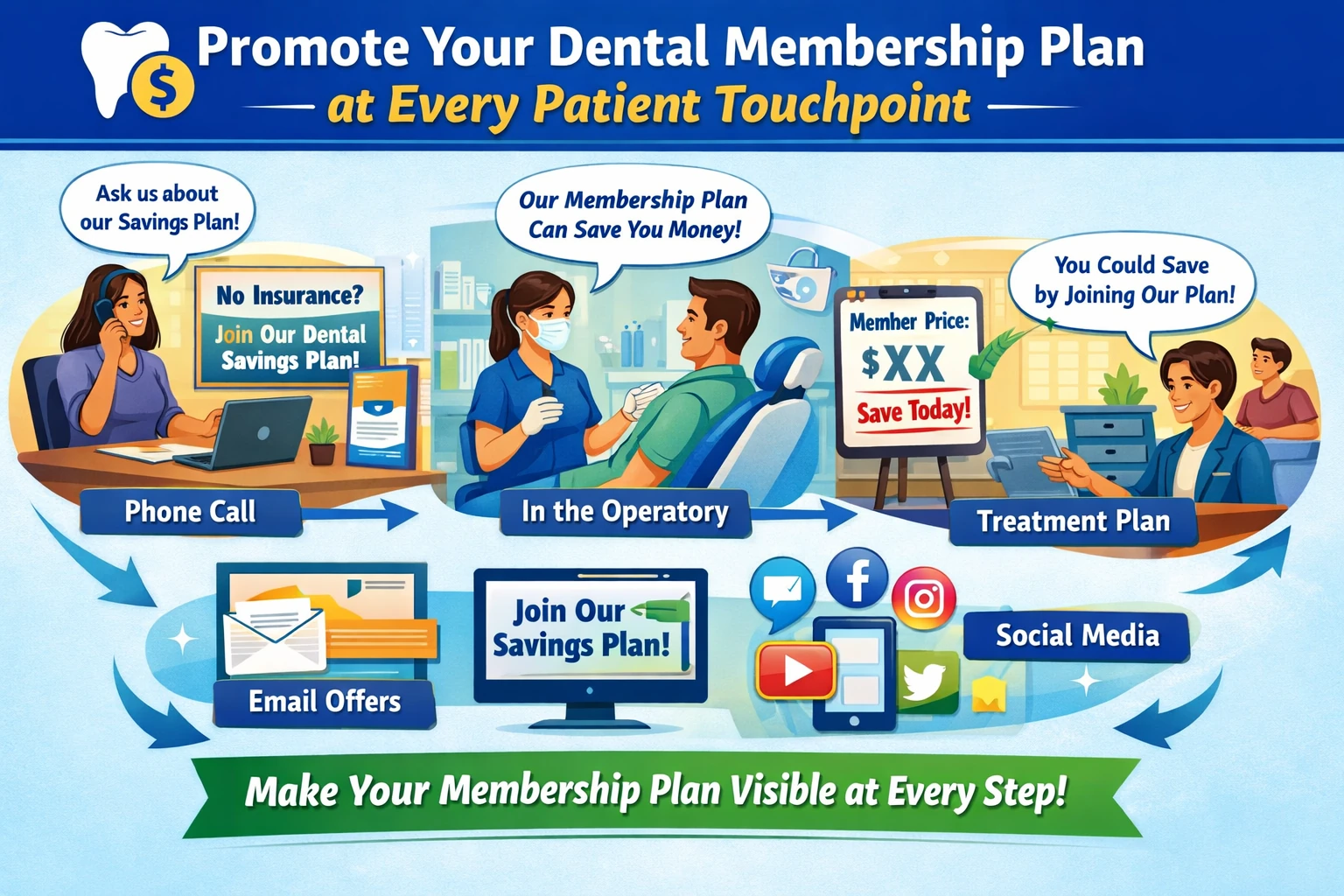 Make your membership plan visible at every stage of the patient journey—not just when insurance comes up. Most practices create a membership plan, mention it occasionally, and wonder why enrollment stays flat. The problem isn’t the plan itself. It’s that patients never hear about it at the moments when it matters most: when they’re booking, waiting, sitting in the chair, reviewing treatment, or paying at checkout. Make your membership plan visible at every stage of the patient journey—not just when insurance comes up. Most practices create a membership plan, mention it occasionally, and wonder why enrollment stays flat. The problem isn’t the plan itself. It’s that patients never hear about it at the moments when it matters most: when they’re booking, waiting, sitting in the chair, reviewing treatment, or paying at checkout.
The pattern we commonly see: a practice launches a membership plan, the front desk mentions it sometimes, a small sign sits in the waiting room, and enrollment trickles in. Meanwhile, uninsured patients decline treatment, delay hygiene visits, or leave for practices that seem more affordable. The plan exists—but it’s invisible at the touchpoints where decisions happen.
Touchpoint marketing solves this by building your membership message into every interaction, so patients encounter it naturally and repeatedly. This isn’t about being pushy. It’s about making sure the patients who would benefit actually know the option exists before they say no or walk away.
Already have strong enrollment? This guide will help you systematize what’s working. If you’re still exploring how membership plans drive practice growth, start with insights on growing enrollment through membership plans first.
Below, you’ll learn how to identify your highest-impact touchpoints, create consistent messaging across each one, equip your team with scripts that feel natural, and track which touchpoints actually drive signups—so you can stop guessing and start growing enrollment predictably.
Written for: dental practice owners, office managers, and marketing coordinators who want to increase membership plan enrollment by making the plan visible at every patient interaction point.
TL;DR
If you only do seven things, do these:
| • |
Add membership to your phone script – mention it when uninsured patients call to book, before they ask about cost
|
| • |
Make it visible in the waiting room – signage, digital displays, and intake forms that prompt the conversation
|
| • |
Train hygienists to mention it chairside – the operatory is where trust is highest and treatment decisions happen
|
| • |
Include it in every treatment presentation – show the member price alongside the standard fee
|
| • |
Prompt it at checkout – when patients see their bill is the natural moment to offer savings
|
| • |
Feature it prominently on your website – dedicated page, homepage banner, and clear calls to action
|
| • |
Track signups by touchpoint – ask “how did you hear about our plan?” to know what’s working |
Table of Contents
Why touchpoint marketing works for membership plans
Dental membership plans solve a real problem—affordability for uninsured patients—but they only work if patients know about them at decision points. A single mention during a phone call or a lone sign in the waiting room isn’t enough. Patients are distracted, overwhelmed with information, and often don’t retain details from one interaction to the next.
Touchpoint marketing works because it creates repetition without repetition feeling forced. When a patient hears about the membership plan on the phone, sees signage in the waiting room, discusses it with the hygienist, sees member pricing on their treatment plan, and gets reminded at checkout, the message lands. By the time they’re ready to decide, they already understand what the plan offers.
In our work with practices, we find that enrollment typically increases when the membership plan is mentioned at a minimum of three touchpoints per patient visit. Fewer than three, and patients often forget or assume the plan isn’t relevant to them. Three or more, and the plan becomes a natural part of how the practice operates—not a sales pitch.
The goal isn’t to pressure patients. It’s to ensure that every uninsured patient (and even insured patients with limited benefits) understands they have an option. Many patients assume dental care is simply expensive and don’t realize an alternative exists unless you tell them—multiple times, in multiple ways. Understanding the dental patient journey helps you identify exactly where these mentions should occur.
> Back to Table of Contents
Phone and scheduling touchpoints
The first call is often the first opportunity to introduce your membership plan. When an uninsured patient calls to schedule, they’re already thinking about cost. Mentioning the plan proactively—before they ask—positions your practice as affordable and welcoming. A strong patient intake process includes membership plan messaging from the very first contact.
What to include in your phone script:
| • |
Identify insurance status early – “Do you have dental insurance, or will you be paying out of pocket?”
|
| • |
Introduce the plan naturally – “We have a membership plan for patients without insurance that includes your cleanings and exams and gives you a discount on other treatment.”
|
| • |
Offer to send information – “I can email you the details, or we can go over it when you come in.”
|
| • |
Note it in the chart – flag that the patient is uninsured and was informed about the plan |
Online scheduling platforms offer another touchpoint. If your scheduling software allows custom fields or confirmations, add a line about your membership plan. Even a simple note like “Ask us about our in-house savings plan for patients without insurance” plants the seed before the patient arrives.
For patients who schedule via your website, the confirmation email is prime real estate. Include a brief paragraph about the membership plan with a link to learn more. This ensures that even patients who book online without speaking to anyone still encounter the message.
> Back to Table of Contents
Waiting room and intake touchpoints
The waiting room is underutilized for membership marketing in most practices. Patients sit for 5–15 minutes with little to do but look around. This is time you can use to reinforce your message.
Effective waiting room touchpoints:
| • |
Dedicated signage – a clear, professional sign explaining the membership plan basics (what’s included, approximate monthly cost, who it’s for)
|
| • |
Digital displays – if you have a waiting room TV or monitor, rotate membership plan information into the content
|
| • |
Brochures or takeaway cards – simple one-pagers patients can take home and review
|
| • |
Intake form prompt – add a question like “Would you like to learn about our membership plan for patients without insurance? ☐ Yes ☐ No” |
The intake form prompt is particularly effective. It requires the patient to actively consider the question, and a “yes” response gives your front desk a natural opening to discuss it. Even a “no” means the patient has now seen the plan mentioned twice (phone and form), building familiarity.
A common mistake: creating a single small sign and placing it where patients don’t naturally look. Signage works best when it’s positioned at eye level, near where patients sit, and uses clear language without dental jargon. “No insurance? Ask about our Savings Plan” outperforms “In-House Dental Membership Program Available.”
> Back to Table of Contents
Operatory and chairside touchpoints
The operatory is where trust is built. Patients have one-on-one time with their hygienist or assistant, often for 30–60 minutes. This is a high-value touchpoint because the patient is relaxed (relatively), engaged, and interacting with a clinical team member they trust.
Chairside opportunities to mention the membership plan:
| • |
During medical history review – if the patient mentions being uninsured, the hygienist can note that a savings option exists
|
| • |
When discussing treatment needs – “You’ll want to talk to the doctor about this area, and by the way, if cost is a concern, we do have a membership plan that helps.”
|
| • |
At the end of the cleaning – “Before you head to checkout, did anyone mention our membership plan to you?” |
Hygienists often hesitate to discuss financial topics because they feel it’s outside their role. Training your dental team should emphasize that mentioning the plan is about patient care, not sales. Patients who decline needed treatment due to cost aren’t getting optimal care. Offering an affordability option is part of helping them.
Operatory signage also helps. A small countertop sign or poster in the patient’s line of sight reinforces the message without requiring the clinical team to initiate every conversation. Some practices use chair-back cards or ceiling tiles with plan information for patients to read during procedures.
> Back to Table of Contents
Treatment presentation touchpoints
When the dentist or treatment coordinator presents a treatment plan, cost is always a factor. This is the moment where patients decide whether to accept, delay, or decline treatment. Your membership plan should be visible here.
Effective treatment presentation integration:
| • |
Show member pricing alongside standard fees – “The fee for this crown is $1,200, or $960 with our membership plan.”
|
| • |
Calculate total savings – for larger treatment plans, show what the patient would save as a member versus non-member
|
| • |
Include plan cost in the math – “The membership is $XX per year. With the discount on this treatment plus your included cleanings, you’d save $XX total.”
|
| • |
Offer to sign them up on the spot – if the math works, make enrollment easy: “Would you like me to add the membership today so you get the savings on this treatment?” |
This is where membership plans often pay for themselves in a single visit. A patient facing a $2,000 treatment plan who sees they could save $400 by becoming a member for $300/year has a clear reason to enroll. Presenting this math explicitly removes guesswork and addresses why patients decline treatment—often, it’s cost uncertainty rather than unwillingness.
Software integration matters here. If your practice management software can automatically display member pricing, the team doesn’t have to calculate manually. Some dental marketing technology platforms integrate membership plan features that streamline this process.
> Back to Table of Contents
Checkout and billing touchpoints
Checkout is a natural touchpoint because patients are actively thinking about money. They’re seeing their bill, handing over payment, and are primed to consider savings opportunities.
Checkout touchpoint strategies:
| • |
Train front desk to offer the plan when presenting the bill – “Your total today is $350. If you were on our membership plan, this would have been $280. Would you like me to tell you about it?”
|
| • |
Show the savings they missed – some practices print a line on receipts showing what the member price would have been
|
| • |
Make enrollment available at checkout – if a patient decides to sign up, the front desk should be able to complete it immediately
|
| • |
Collect payment for the plan the same way as treatment – same card, same transaction, minimal friction |
A pattern we see in high-enrollment practices: they treat checkout as a conversion point, not just a transaction. The front desk process is trained to mention the plan to every uninsured patient at checkout, every time. Consistency matters more than any single script.
For patients who decline at checkout, offer to send information home with them or follow up via email. Some patients need time to consider, and a follow-up touchpoint can convert them later.
> Back to Table of Contents
Digital and online touchpoints
Your website, email, and social media are touchpoints that work around the clock. Patients research your practice online before calling, and they receive your emails between visits. These channels should consistently feature your membership plan.
Website touchpoints
| • |
Dedicated membership plan page – a full page explaining what’s included, who it’s for, pricing, and how to sign up (with clear calls to action)
|
| • |
Homepage visibility – a banner, button, or featured section mentioning the plan so visitors encounter it immediately
|
| • |
Services pages – mention member pricing or link to the plan on pages for cleanings, exams, and common procedures
|
| • |
Online enrollment option – if possible, allow patients to sign up directly from the website |
Your dental website design should make the membership plan easy to find. Following homepage design best practices means featuring the plan prominently rather than burying it in a submenu. Strong calls to action like “Join Our Savings Plan” or “No Insurance? Learn About Our Membership” guide visitors toward enrollment.
Email touchpoints
| • |
New patient welcome emails – introduce the plan to every new patient who isn’t already a member
|
| • |
Recall and reactivation emails – mention the plan when reaching out to overdue patients, especially uninsured ones
|
| • |
Dedicated email campaigns – periodic emails (quarterly or seasonally) specifically promoting the membership plan
|
| • |
Email signature lines – a simple line in staff email signatures: “Ask about our Dental Savings Plan for patients without insurance” |
Dental email marketing works best when the membership plan is woven into multiple email types rather than relegated to occasional promotional blasts. Automated email sequences can trigger membership plan messaging based on patient status—for example, automatically sending plan information to new patients flagged as uninsured.
Social media touchpoints
| • |
Periodic posts about the plan – explain what it includes and who benefits
|
| • |
Patient testimonials – share stories (with permission) from members who saved on treatment
|
| • |
Seasonal promotions – if you run enrollment specials, promote them on social channels |
Your social media marketing should include the membership plan as a recurring theme. The key to digital touchpoints is consistency over time. A single social post won’t move the needle. Regular, repeated visibility across all digital channels builds awareness with patients who may not visit your office for months.
> Back to Table of Contents
Recall and reactivation touchpoints
Patients who haven’t visited in 12–24 months are at risk of leaving the practice entirely. When you reach out for reactivation, your membership plan can be the hook that brings them back.
Reactivation messaging that works:
| • |
Lead with the plan – “We haven’t seen you in a while, and we wanted to let you know about our new membership plan for patients without insurance.”
|
| • |
Emphasize affordability – many lapsed patients stopped coming because of cost; the plan addresses this directly
|
| • |
Include a specific offer – “Schedule your next cleaning this month and we’ll waive the enrollment fee.”
|
| • |
Use multiple channels – email, text, postcards, and phone calls all work for reactivation; use the plan message across all of them |
Recall messaging for active patients should also include the plan. When sending hygiene reminders to uninsured patients, mention that the membership plan includes their preventive visits. This reinforces value and reminds them why staying current makes financial sense.
For practices with a significant number of uninsured patients who have lapsed, a targeted reactivation campaign focused specifically on the membership plan can generate a measurable enrollment spike. Segment your patient list by insurance status and time since last visit, then craft messaging that speaks directly to affordability concerns. This approach fits into a broader dental marketing funnel strategy where reactivation is a distinct stage requiring its own messaging. If patient acquisition is also a priority, the membership plan can serve double duty—attracting new uninsured patients while reactivating lapsed ones.
> Back to Table of Contents
Staff training and scripts
Touchpoint marketing only works if your team executes consistently. This requires clear training, simple scripts, and an understanding of why the plan matters.
Training fundamentals:
| • |
Everyone should understand the plan – what’s included, what it costs, who it’s for, and how it helps patients
|
| • |
Role-specific scripts – different language for front desk, hygienists, treatment coordinators, and checkout
|
| • |
Objection handling – what to say when patients push back (“I’ll think about it,” “I don’t come often enough,” “I’m waiting to see if I get insurance”)
|
| • |
Practice and role-play – scripts only work if the team has rehearsed them |
Sample script for front desk (phone intake)
“I see you don’t have dental insurance. We have a membership plan that includes your cleanings, exams, and x-rays, plus a discount on any other treatment you need. It’s $XX per month or $XX per year. Would you like me to email you the details, or I can go over it with you when you come in.”
Sample script for hygienist (chairside)
“I noticed you’re not on our membership plan yet. Has anyone told you about it? It covers your preventive visits and gives you 15% off other treatment. Since you don’t have insurance, it might be a good fit. Just ask the front desk when you check out if you’re interested.”
Sample script for checkout
“Your total today is $XX. As a membership plan member, this would have been $XX—you would have saved $XX today plus your cleanings would be included. Would you like to sign up so you get the savings on your next visit?”
Consistency is the goal. It’s better for every team member to use a simple script every time than to have a perfect script that only gets used occasionally. This same principle applies to improving case acceptance—systematic team training outperforms relying on individual talent.
> Back to Table of Contents
Tracking what works
You can’t optimize what you don’t measure. Tracking which touchpoints drive enrollment tells you where to focus your effort.
Simple tracking methods:
| • |
Ask at enrollment – “How did you hear about our membership plan?” and record the answer
|
| • |
Track by role – note whether the enrolling touchpoint was phone, hygienist, treatment presentation, checkout, website, or email
|
| • |
Review monthly – tally enrollments by touchpoint to see patterns
|
| • |
Test and adjust – if checkout is driving signups but phone isn’t, focus training on the phone script |
Metrics to track:
| • |
Total enrollments per month – the baseline number
|
| • |
Enrollments by touchpoint – where signups are coming from
|
| • |
Conversion rate – if you track how many uninsured patients visited and how many enrolled, you can calculate the percentage
|
| • |
Renewal rate – what percentage of members renew after year one
|
| • |
Treatment acceptance by members vs. non-members – this shows the plan’s impact on case acceptance |
In practices we work with, the highest-converting touchpoints are usually treatment presentation and checkout—moments when the patient is actively considering cost. Phone and waiting room touchpoints build awareness, but the conversion typically happens later. Understanding this helps you design a system where early touchpoints set up later ones. Tracking marketing ROI by channel applies the same principle—knowing where results come from lets you invest accordingly.
> Back to Table of Contents
Start building your touchpoint system
Marketing your dental membership plan effectively means making it visible at every patient interaction, not just when insurance comes up. The practices that see strong enrollment treat it as a system: scripted touchpoints, consistent training, and regular tracking.
Start here: phone scripts, waiting room signage, checkout prompts—these three touchpoints alone can significantly increase enrollment when executed consistently.
If you want help building a membership plan marketing strategy that integrates with your website, email campaigns, and patient communications, schedule a consultation to discuss your practice’s needs. We help dental practices nationwide build patient conversion systems that turn more inquiries into loyal, paying patients.
> Back to Table of Contents
FAQs
What is the best way to market a dental membership plan?
The most effective approach is touchpoint marketing, which means promoting the plan at multiple points throughout the patient journey: phone calls, waiting room signage, chairside conversations, treatment presentations, checkout, website, and email. Repetition across touchpoints increases awareness and conversion without feeling pushy.
How many times should we mention the membership plan to each patient?
Aim for at least three touchpoints per patient visit for uninsured patients. This typically includes phone or intake, a chairside mention, and checkout. Fewer than three touchpoints often means patients forget or don’t realize the plan is relevant to them.
Should hygienists talk about the membership plan?
Yes. Hygienists spend significant one-on-one time with patients and build trust. A brief mention of the membership plan, especially when discussing treatment needs or when the patient mentions cost concerns, is appropriate and often effective. Training should emphasize that this is about patient care and affordability, not sales.
What should our website say about the membership plan?
Your website should have a dedicated membership plan page explaining what’s included, pricing, who it’s for, and how to enroll. The plan should also be visible on your homepage and mentioned on relevant services pages. If possible, offer online enrollment so patients can sign up without calling.
How do we track which touchpoints are working?
Ask every new member how they heard about the plan and record the answer. Review enrollments monthly by touchpoint to identify patterns. If one touchpoint is underperforming, focus training there. Tracking also reveals which touchpoints build awareness versus which drive the actual conversion.
Can we mention the membership plan to patients who have insurance?
In some cases, yes. Patients with limited insurance benefits or high deductibles may find value in a membership plan, especially if their insurance doesn’t cover certain procedures. However, check the terms of your plan and any legal considerations before marketing to insured patients.
What do we say when patients say they’ll think about it?
Acknowledge their response and offer to send information home or via email. Ask if there’s a specific concern you can address. For patients who need treatment soon, calculate the savings so they can see the immediate benefit. Make it easy to enroll later by noting their interest in the chart and following up at the next visit.
How do we use the membership plan for patient reactivation?
For patients who haven’t visited in over a year, the membership plan can be a compelling reason to return. Lead your reactivation outreach with the plan, emphasizing affordability and included preventive care. Consider offering an incentive like a waived enrollment fee for patients who schedule within a certain timeframe. |
|