Dental Link Building: How to Earn Ethical Backlinks That Rank
Posted on 4/13/2026 by WEO Media |
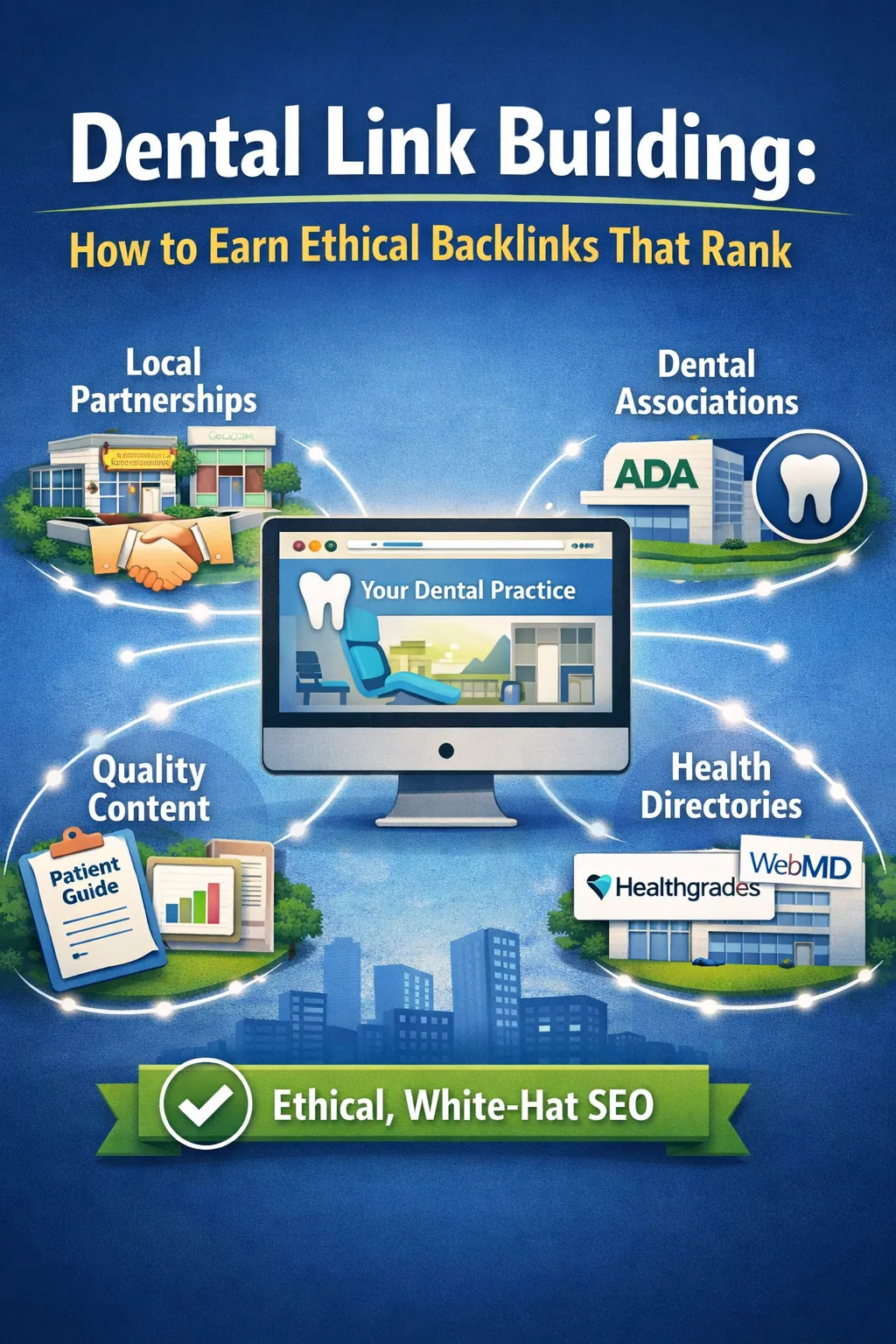 This guide shows dental practices how to approach dental link building ethically—earning high-quality backlinks through white-hat strategies that rank in Google, strengthen domain authority, improve local search visibility, and avoid penalties. This guide shows dental practices how to approach dental link building ethically—earning high-quality backlinks through white-hat strategies that rank in Google, strengthen domain authority, improve local search visibility, and avoid penalties.
Link building is still one of the strongest signals Google uses to decide which dental websites deserve to rank, but the rules have changed. Buying links, swapping them in bulk, or chasing low-quality directories now does more harm than good.
The good news: dental practices have natural advantages most industries don’t. You’re embedded in a local community, you serve real patients with real stories, and you’re part of a respected healthcare profession with established associations and publications. Ethical link building leans into those advantages instead of trying to game algorithms.
Already have a few backlinks but unsure if they’re helping? This guide will help you audit what you have and identify the gaps worth filling.
Below, you’ll learn what counts as an ethical backlink, the highest-value link sources for dental websites, how to earn links through local partnerships and content, the outreach approach that actually works, and the black-hat tactics that put your rankings at risk.
Written for: dental practice owners, marketing managers, and in-house SEO leads who want to grow organic traffic without risking a Google penalty.
TL;DR
If you only do five things, do these:
| 1. |
Earn links, don’t buy them - paid link schemes and link farms violate Google’s policies and can trigger manual actions
|
| 2. |
Prioritize local and dental-relevant sources - chamber of commerce, local sponsorships, dental associations, and healthcare directories outperform generic backlinks
|
| 3. |
Create assets worth linking to - patient guides, original data, and community resources earn natural links over time
|
| 4. |
Build relationships, not link lists - personalized outreach to journalists, bloggers, and partners works; mass email blasts don’t
|
| 5. |
Measure what matters - referring domains, link relevance, and organic traffic growth—not just total link count |
Table of Contents
Why ethical link building matters for dental practices
Backlinks are still one of Google’s strongest ranking signals, and they play a particularly important role in dental SEO. When another reputable site links to yours, Google reads that as a vote of confidence—an external signal that your dental practice is credible, relevant, and worth showing in search results.
For dental practices specifically, links influence two outcomes that drive new patients: organic visibility (showing up for searches like “dentist near me” or “cosmetic dentist [city]”) and local pack rankings (the map results that dominate mobile search). A practice with 40 high-quality, locally relevant links almost always outranks a competitor with 200 low-quality directory links—because Google measures quality, not just quantity.
The risk side matters too. Google’s spam policies have grown more sophisticated, and the 2024 Google core updates were especially aggressive against sites with manipulative link profiles. Practices that bought links from cheap services, joined private blog networks, or participated in reciprocal link schemes have seen rankings collapse—sometimes overnight. Recovering from a manual action or algorithmic suppression takes months and often requires hiring outside help to disavow toxic links.
Ethical link building takes longer, but the gains compound. Every legitimate link strengthens your foundation rather than putting it at risk.
> Back to Table of Contents
What counts as an ethical (white-hat) backlink
Google’s definition of an ethical backlink hasn’t changed much over the years: a link that exists because someone genuinely chose to point their readers to your content. Everything else falls somewhere on the spectrum between gray-hat (risky) and black-hat (penalty territory).
An ethical backlink generally meets these criteria:
| • |
Editorially placed - the linking site chose to include the link based on relevance, not payment or trade
|
| • |
Topically relevant - the linking page’s subject relates to dentistry, healthcare, your local community, or your services
|
| • |
From a real, active site - the domain has its own audience, regular content, and isn’t a network built for link-selling
|
| • |
Natural anchor text - the clickable text reads naturally rather than stuffing exact-match keywords
|
| • |
Useful to the reader - clicking the link delivers value, not a sales page or thin content |
The simplest test: would you be comfortable showing this link to a Google search quality rater? If the answer is yes, it’s probably ethical. If you’d need to explain or justify it, it’s probably not. This standard aligns closely with Google’s E-E-A-T framework for dental practices, which rewards experience, expertise, authoritativeness, and trustworthiness.
> Back to Table of Contents
The highest-value link sources for dental websites
Not all backlinks carry equal weight. For dental practices, certain source categories consistently deliver stronger ranking impact than others because they combine relevance, authority, and trust.
Dental and healthcare associations
Memberships in organizations like the American Dental Association, Academy of General Dentistry, American Academy of Cosmetic Dentistry, and state dental associations often include a member directory listing that links back to your practice. These links carry significant weight because the linking domains are authoritative, well-established, and topically perfect.
Healthcare and medical directories
Reputable directories like Healthgrades, Vitals, Zocdoc, and WebMD’s provider listings give you both backlinks and patient discovery. Stick to directories with editorial standards and real user traffic—skip the generic “business listing” sites that exist only to sell links. Our complete guide to dental citation SEO covers which directories are worth your time.
Local citations and chambers of commerce
Your local chamber of commerce, BBB, downtown business association, and city tourism site are nearly always linkable and carry strong local relevance signals. These also reinforce your NAP consistency, which supports local pack rankings.
Dental schools and continuing education
If you’ve completed advanced training, hold a faculty position, or contribute to a dental school program, those institutions often link back to participating practitioners.
News and local media
Local newspapers, neighborhood blogs, and regional magazines linking to your practice deliver some of the strongest signals available—both because of their authority and because they reinforce that you’re a recognized part of the community.
> Back to Table of Contents
Local link building tactics for dental practices
Local link building is where dental practices have a structural advantage over national brands. You’re physically embedded in a community, which opens doors that purely online businesses can’t access.
Sponsor local events and youth sports
Sponsoring a local 5K, youth soccer team, school fundraiser, or community festival almost always earns a backlink from the event website or organization. The cost is typically modest, the link is relevant, and you build real community goodwill in the process.
Partner with non-competing local businesses
Orthodontists, pediatricians, physical therapists, fitness studios, and wellness practitioners often maintain “trusted partners” or “community resources” pages. A genuine referral relationship can lead to a natural cross-link that benefits both sides.
Host or support free community events
Free dental screenings, school visits for National Children’s Dental Health Month, veterans’ appreciation days, and senior care outreach all generate coverage opportunities—from local news, community calendars, and the partnering organizations themselves.
Get listed on city and neighborhood resource pages
Many cities, neighborhoods, and HOAs maintain “local services” or “new resident” pages. A short email asking to be considered is often all it takes.
Charitable partnerships and pro bono work
Practices that donate care to nonprofits, shelters, or programs like Donated Dental Services frequently earn backlinks from those organizations’ websites—and the associations are genuinely meaningful for your reputation.
> Back to Table of Contents
Content assets that earn dental backlinks naturally
The most sustainable link-building strategy is creating content other people genuinely want to reference. In dental marketing, certain content types consistently attract links over time without active outreach.
In-depth patient guides
Comprehensive guides on procedures like dental implants, Invisalign, sedation dentistry, or full-mouth restoration become reference points that bloggers, journalists, and partner sites link to when they need a credible explanation.
Original data and surveys
Surveying your patient base about dental anxiety, cost concerns, or treatment decisions produces original data that journalists love to cite. Even small-sample surveys can generate meaningful coverage if the findings are interesting.
Local oral health resources
A guide to “dental emergency care in [your city]” or “low-cost dental options in [region]” positions your practice as a community resource and naturally attracts links from local sites.
Visual assets and infographics
Original infographics explaining tooth anatomy, the implant process, or oral health statistics are highly linkable—especially when you allow free use with attribution.
Expert commentary and Q&A
Detailed answers to common patient questions, written by your dentists with their credentials cited, can be quoted and linked by health publications looking for expert sources.
The key principle: create content that helps someone else write their own content better. That’s when links happen naturally. For more on this approach, see our guide to building dental content clusters that compound authority over time.
> Back to Table of Contents
Digital PR and outreach without the spam
Outreach is where ethical link building most often goes off the rails. Mass emails with templates, fake personalization, and aggressive follow-ups don’t just fail—they damage your reputation with the journalists and bloggers you most want to work with.
What works instead:
| • |
Pitch real stories - a new technology you’ve adopted, a free clinic day, a milestone, or a community partnership gives reporters something to write about
|
| • |
Use journalist source platforms - Qwoted, Featured.com, and ProfNet connect dentists with journalists actively looking for expert sources
|
| • |
Build relationships before you need them - follow local journalists on social media, share their work, and become a known name before pitching
|
| • |
Personalize every pitch - reference specific articles they’ve written and explain why your story fits their beat
|
| • |
Make their job easy - include quotable statements, high-resolution images, and clear contact information in every pitch |
Guest posting—done right
Guest posting still works when it’s done for the right reasons. Writing a genuinely useful article for a respected dental, healthcare, or local publication earns you a relevant backlink and exposes your expertise to a new audience. The wrong way: paying for guest post placements on irrelevant sites, using spun content, or stuffing keyword-rich anchor text into the bio link.
> Back to Table of Contents
Black-hat tactics to avoid (and why)
Some link-building tactics carry real penalty risk under Google’s spam policies. Avoid them entirely—the short-term gains aren’t worth the long-term damage.
Tactics to stay away from:
| • |
Paid links that pass PageRank - any link you pay for must use the rel=“sponsored” or rel=“nofollow” attribute, or it violates Google’s policies
|
| • |
Private blog networks (PBNs) - networks of fake sites built solely to sell links are a leading cause of manual actions
|
| • |
Reciprocal link schemes - excessive “link to me and I’ll link to you” arrangements are a known spam signal
|
| • |
Comment spam and forum signatures - dropping links in unrelated comment sections or forum profiles is ineffective and reputation-damaging
|
| • |
Low-quality directories - generic “business listing” sites with no editorial standards add nothing and may hurt your profile
|
| • |
Exact-match anchor text overuse - if every backlink uses the same keyword phrase, Google notices and discounts the entire profile
|
| • |
Hacked site links - links from compromised or hijacked websites can trigger algorithmic suppression |
A pattern we commonly see: a practice hires a cheap SEO vendor, sees a brief ranking lift, then loses everything during the next core update. Recovering takes longer than the original gains lasted. This is one of many reasons we recommend asking the right questions before signing with any dental marketing agency.
> Back to Table of Contents
How to measure dental link building success
Tracking link building requires looking past total link count. The metrics that actually correlate with ranking gains are more specific.
The metrics that matter:
| • |
Referring domains - the number of unique websites linking to you, which matters more than total links
|
| • |
Link relevance - the percentage of links from dental, healthcare, or locally relevant sources
|
| • |
Link authority - domain authority or domain rating of linking sites (using Ahrefs, Moz, or Semrush)
|
| • |
Anchor text distribution - a healthy profile has mostly branded and natural-language anchors, not exact-match keywords
|
| • |
Organic traffic growth - the ultimate measure; quality links should translate into more search visitors over 3–6 months
|
| • |
Local pack visibility - rankings in the Google map results for your core service keywords |
Set a baseline before starting any link campaign, then re-measure quarterly. Link building is a slow signal—expect 3 to 6 months before meaningful ranking changes appear, and longer for competitive markets. If you want a structured starting point, our step-by-step dental SEO audit guide walks through how to baseline your current profile.
Tools to track your backlink profile
Free tools include Google Search Console’s Links report, which shows the backlinks Google has discovered for your site. Paid tools like Ahrefs, Semrush, and Moz Pro give more detail on competitor profiles, link velocity, and toxic link identification.
> Back to Table of Contents
Get help building your dental backlink profile
Ethical link building takes time, relationships, and consistent effort—and it’s one of the hardest parts of dental SEO to do well in-house. WEO Media has spent more than two decades helping dental practices grow through search, and our team builds backlink profiles the right way: through real relationships, real content, and real local partnerships.
If you’d like a review of your current backlink profile or a conversation about an ethical link-building strategy for your practice, call us at 888-246-6906 or schedule a consultation with our team.
> Back to Table of Contents
FAQs
How many backlinks does a dental practice website need to rank?
There is no fixed number. What matters is the quality, relevance, and authority of the linking sites compared to competitors in your local market. Many dental practices rank well with 30 to 60 high-quality referring domains, while others in competitive metro areas need significantly more. Audit your top three local competitors’ backlink profiles to set a realistic target.
Is it okay to pay for dental backlinks?
Paying for links that pass PageRank violates Google’s spam policies and can result in a manual action against your site. The exception is sponsored content, which is allowed as long as the link uses the rel=“sponsored” or rel=“nofollow” attribute. Sponsorships of legitimate organizations and events are also acceptable because the link reflects a real community relationship, not a transaction for ranking purposes.
How long does dental link building take to show results?
Most practices begin seeing ranking improvements 3 to 6 months after starting an ethical link-building campaign. Competitive markets and highly searched keywords often take 6 to 12 months. Link building is a slow, compounding signal—the gains build over time as your profile grows.
What is the best free way to build dental backlinks?
Local sponsorships, chamber of commerce membership, dental association directory listings, and partnerships with non-competing local healthcare providers consistently produce high-quality links at little or no cost. Creating genuinely useful patient guides on your blog also earns natural links over time without direct outreach.
Can bad backlinks hurt my dental website’s rankings?
Yes. Links from spammy, irrelevant, or hacked sites can trigger algorithmic suppression or manual actions, particularly after Google core updates. If you discover toxic links pointing to your site, you can use Google’s disavow tool to ask Google to ignore them. A backlink audit using tools like Ahrefs or Semrush helps identify problem links before they cause damage.
Do nofollow links help dental SEO?
Yes, though differently than dofollow links. Google treats nofollow as a hint rather than a strict directive, meaning some nofollow links still influence rankings. They also drive referral traffic, build brand visibility, and create a natural-looking backlink profile. A healthy dental site has a mix of dofollow and nofollow links from a variety of sources.
Should dental practices do guest posting in 2026?
Guest posting still works when it’s done with editorial integrity. Writing a substantive article for a respected dental, healthcare, or local publication remains a legitimate way to earn relevant backlinks and reach new audiences. Avoid paid guest post networks, irrelevant sites, and any service offering bulk guest post placements—these violate Google’s policies and can hurt your rankings.
|
|