Lower Dental Google Ads Cost Per Acquisition (CPA) Without Losing Lead Quality
Posted on 1/16/2026 by WEO Media |
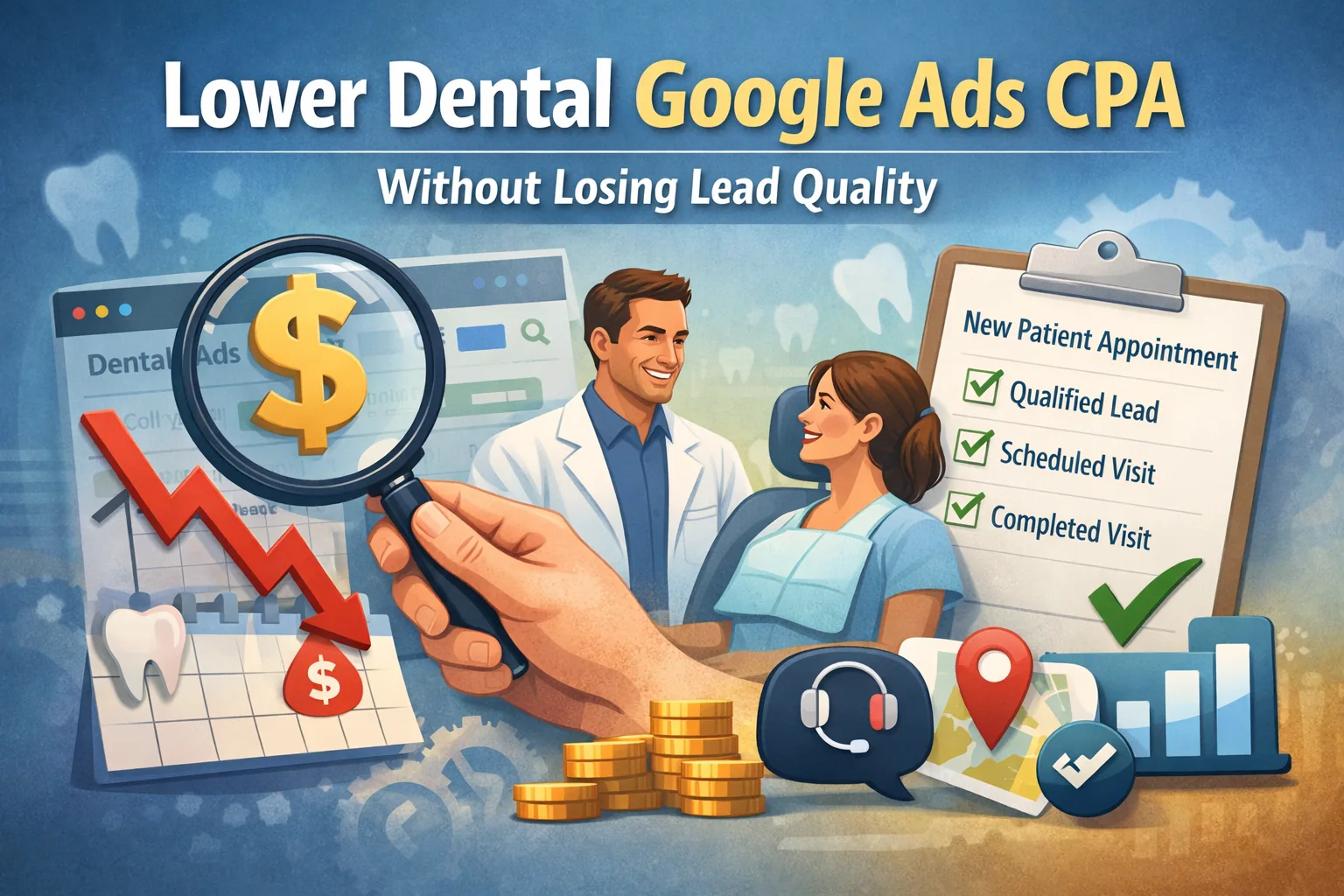 If your practice is paying for Google Ads and acquisition costs keep rising, the goal usually isn’t “spend less.” It’s lowering patient acquisition cost while keeping lead volume steady, protecting lead quality, and avoiding compliance or reputation problems. If your practice is paying for Google Ads and acquisition costs keep rising, the goal usually isn’t “spend less.” It’s lowering patient acquisition cost while keeping lead volume steady, protecting lead quality, and avoiding compliance or reputation problems.
In dental PPC, true CPA is what you spend to generate real appointments from paid ads: qualified leads that become scheduled visits and, ideally, a completed first visit. Getting there requires clean tracking, deduplication across contact paths, and accounting for cancellations and no-shows.
This guide applies to both single-location practices and multi-location groups. Multi-location considerations like call routing, location assets, and location-level reporting are included where they change how you measure and optimize.
How to use this guide - Implement in order: measurement integrity first, then intent and geo controls, then landing pages and intake.
What success looks like - Lower cost per real appointment while maintaining patient fit and schedule stability.
Table of Contents
Definitions at a Glance
| • |
Cost per lead - Spend ÷ calls, forms, chats, and booking requests. |
| • |
Cost per qualified lead - Spend ÷ leads that meet your minimum fit criteria. |
| • |
Cost per scheduled patient - Spend ÷ appointments booked on the schedule. |
| • |
Cost per completed first visit - Spend ÷ first visits that actually happen, which helps reduce no-show noise. |
| • |
Booking rate - Scheduled ÷ qualified (how often qualified leads become appointments). |
| • |
Show rate - Showed (arrived) ÷ scheduled (how often booked patients arrive). |
| • |
Completed first visit rate - Completed first visits ÷ showed (how often arrivals convert to a completed first visit when those are tracked separately). |
| • |
True CPA - Spend ÷ deduplicated real outcomes (scheduled, arrived, or completed first visits), adjusted for cancellations and no-shows. |
If growth is the priority, cost per scheduled patient can be a useful interim KPI. If capacity is tight, cost per completed first visit is often the most reliable anchor.
Key takeaway: Pick the CPA definition that matches the reality of your schedule, not the default inside the ad platform.
> Back to Table of Contents
The Quick Answer: Top 5 Fastest CPA Fixes
| 1. |
Deduplicate conversions - Stop counting the same patient multiple times across call, form, chat, and online booking. |
| 2. |
Fix conversion definitions - Track qualified and scheduled outcomes, not every call and form submission. |
| 3. |
Do weekly search-term cleanup - Add negative keywords for wrong intent and tighten match where drift persists. |
| 4. |
Tighten geo leakage - Prefer presence-based targeting and exclude areas that repeatedly produce unqualified or no-show outcomes. |
| 5. |
Raise booking rate - Align ad scheduling to staffed coverage and implement intake SLAs so more paid leads become real appointments. |
Key takeaway: Most “CPA problems” are measurement or intent problems before they’re bid problems.
Additional Resource: Dental PPC Audit Checklist: 10 Fixes to Stop Wasted Spend Fast
> Back to Table of Contents
The CPA Equation That Connects the Whole System
CPA is a chain of rates. One weak link makes CPA rise even if click volume stays steady.
Completed first visit CPA ≈ CPC ÷ (click-to-lead rate × qualified rate × booking rate × show rate × completed first visit rate)
If you do not track completed first visits separately from arrivals yet, you can start by using show rate as a proxy and then add completed first visit rate once your tracking can support it.
What each rate means
| • |
CPC - Cost per click. |
| • |
Click-to-lead rate - Leads ÷ clicks (how often visits become leads). |
| • |
Qualified rate - Qualified ÷ total leads (how often leads fit your criteria). |
| • |
Booking rate - Scheduled ÷ qualified (how often qualified leads book). |
| • |
Show rate - Showed (arrived) ÷ scheduled (how often booked patients arrive). |
| • |
Completed first visit rate - Completed first visits ÷ showed (how often arrivals become a completed first visit when tracked). |
This is why intake can lower CPA without changing ad spend: if booking rate, show rate, or completed first visit rate rises, the denominator improves and CPA drops.
Key takeaway: If you only optimize ads, you only optimize part of the CPA equation.
> Back to Table of Contents
What Counts as “Qualified” in Dental PPC
“Qualified” should be defined so your team can tag outcomes consistently and your reporting can trust the data. A minimum criteria definition is usually enough.
| • |
Service fit - The patient is requesting a service you actually provide and want to promote. |
| • |
Geo fit - The patient is realistically within your service area and travel behavior aligns with your location. |
| • |
New-patient fit - The intent is new-patient acquisition, not existing-patient scheduling or general questions. |
| • |
Reachable - You can contact them and they can respond through your chosen path (call, text, email). |
| • |
Clinically appropriate next step - The inquiry matches a reasonable first visit pathway (exam, emergency evaluation, consult). |
Key takeaway: A clear qualified definition prevents “cheap leads” from looking like success when they don’t fit the practice.
> Back to Table of Contents
Break-even CPA: A Simple Calculation With Clear Math
Break-even CPA varies by service line and market. The safest method is to choose the value basis you’re starting from and apply the correct rates without double-counting.
Method A: Start from value per completed first visit
If you start with contribution per completed first visit, do not multiply by show rate again because the value is already conditional on the visit happening.
| • |
Break-even CPA (completed-visit basis) - Contribution per completed first visit × case acceptance factor (if relevant for that service line). |
| • |
Use when - You can track completed first visits reliably and want a conservative guardrail tied to delivered chair time. |
Method B: Start from value per scheduled appointment
If you start with value per scheduled appointment, apply show rate (arrived ÷ scheduled) and, if you track it, completed first visit rate (completed first visits ÷ showed) to estimate expected value.
| • |
Break-even CPA (scheduled basis) - Contribution per scheduled appointment × show rate × completed first visit rate (if tracked) × case acceptance factor (if applicable). |
| • |
Use when - You have reliable scheduled data but completed-first-visit tracking is delayed or not yet integrated. |
One worked example (hypothetical) that matches the math
Assume a consult-driven service line where the contribution value is $600 only when a case proceeds beyond the consult (case acceptance value). If show rate is 70% and case acceptance is 50%, expected contribution per scheduled consult is $600 × 0.70 × 0.50 = $210. In this simplified example, break-even CPA for that service line would be about $210 under current conditions.
Key takeaway: Break-even CPA is a service line number, and it moves when show rate and case acceptance move.
> Back to Table of Contents
What’s a Good Dental CPA
There isn’t one universal “good CPA” because acquisition cost depends on market competition, service mix, capacity, and whether scheduled visits become completed care. The safest benchmarking is outcome-based and relative.
| • |
Benchmark by service line - Emergency, hygiene, implants, ortho, and cosmetic have different lead paths and show-risk patterns. |
| • |
Benchmark by location - Commute patterns and local competition can shift outcomes across nearby areas. |
| • |
Benchmark by outcome depth - Lead CPA can look “better” while completed-first-visit CPA worsens if arrivals and completions fall. |
Key takeaway: A “good CPA” stays below break-even for that service line while maintaining patient fit and schedule stability.
> Back to Table of Contents
Step One: Fix Tracking and Deduplication So You Can Trust CPA
If spend can’t be tied to scheduled care, optimization becomes guesswork. The goal isn’t more conversions; it’s cleaner conversions that reflect real appointments.
Where deduplication should happen
Pick one system of record for patient identity and appointment outcomes, then enforce deduplication there. For most practices, the PMS or CRM is the best source of truth for scheduled and completed outcomes, while ad platforms and analytics should receive deduped events.
Text-only “system of record” map
| • |
Google Ads and GA4
- Capture identifiers and top-of-funnel events (clicks, lead events) and pass attribution signals forward. |
| • |
Call tracking, forms, chat, online booking - Capture channel events and route leads into one identity record when possible. |
| • |
PMS or CRM - Source of truth for scheduled, arrived, and completed outcomes by patient identity. |
| • |
Offline outcomes back to ads - Send deduped scheduled or completed outcomes back so reporting and optimization reflect reality. |
Key takeaway: One source of truth plus consistent deduplication prevents fake “improvements” that come from double-counting.
Tracking quick checklist
| • |
Calls are attributed correctly - Ad calls, location-asset calls, and mobile tap-to-call are tracked as intended. |
| • |
Short calls aren’t treated as wins - Set a threshold based on call recordings and actual booking patterns, not an arbitrary duration. |
| • |
Forms don’t double-fire - Prevent repeat submissions and thank-you triggers from counting multiple times. |
| • |
Chat and online booking don’t duplicate - One patient journey should not create multiple conversions across tools. |
| • |
Brand vs acquisition is separated - Existing-patient demand doesn’t distort new-patient CPA. |
| • |
Outcome tagging is consistent - Qualified, scheduled, and not-a-fit outcomes are recorded consistently by service line. |
Enhanced conversions and consent alignment
Modern measurement often relies on privacy-safe first-party data signals to improve lead attribution when browsers and devices limit traditional tracking. Because these approaches can involve hashed customer data, coordinate implementation with your privacy and consent requirements and avoid collecting unnecessary sensitive details in the first place.
Key takeaway: Good bidding starts with good signals, and good signals start with clean, consent-aligned measurement.
> Back to Table of Contents
Offline Conversion Imports: Identifiers, Timing, Processing Lag, and Dedupe
Offline conversion imports are most useful when you want deeper outcomes like scheduled appointments or completed first visits reflected in reporting or bidding. The practical success factors are a consistent identifier, a correct conversion timestamp, and a dedupe key so one appointment outcome isn’t uploaded twice.
| • |
Identifier examples - GCLID and, in some cases, GBRAID or WBRAID depending on device and measurement context, plus conversion time and conversion name. |
| • |
Dedupe mechanism - Use a stable transaction ID or order ID concept so repeated uploads don’t double-count the same appointment outcome. |
| • |
Timing expectations - New conversion actions can require a several-hour waiting period before uploads behave predictably, and imported data commonly lags reporting by a day or two. |
| • |
Common failure modes - Timestamp mismatches, duplicate uploads, inconsistent conversion naming, and uploading “scheduled” outcomes when you intended “completed.” |
Key takeaway: Expect reporting lag on deeper outcomes and avoid judging major changes on the same day.
> Back to Table of Contents
Conversion Lag: How to Evaluate Changes Without Guessing
Even when everything is configured correctly, deeper outcomes take time to materialize. Scheduled outcomes typically appear faster than completed outcomes, and imported outcomes can take time to process and reconcile across tools.
A practical approach is to judge changes using a layered view: lead quality and booking signals first, then scheduled outcomes, then completed outcomes once enough data accumulates to reflect true performance.
Key takeaway: If you judge changes only on immediate lead volume, you can accidentally optimize away real appointments that arrive later in the journey.
> Back to Table of Contents
Smart Bidding Readiness: When to Use tCPA vs When to Wait
Smart bidding (often referenced as tCPA) tends to be more reliable when conversions are consistent, deduped, and tied to scheduled care rather than raw lead volume. If the account is learning from duplicates, unqualified calls, or mixed intent, automation can get “efficient” at generating the wrong outcomes.
| • |
Use tCPA when - Your primary conversions reflect qualified and scheduled outcomes, deduplication is working, and volume is consistent enough to learn. |
| • |
Wait or use tighter controls when - Tracking is messy, conversions are inflated, service lines are mixed, or the practice cannot reliably answer and book during peak demand. |
Key takeaway: Smart bidding does not fix weak signals; it amplifies whatever signals you feed it.
> Back to Table of Contents
Reduce Waste at the Keyword and Search Term Level
Most acquisition cost inflation starts with intent mismatch. PPC works best when keywords map to a realistic next step: call for emergency availability, request a consult, or schedule an exam.
Match behavior and close variants
Match behavior can expand beyond the exact phrase you think you are buying. That’s why search-term reviews are a weekly control mechanism: you govern drift with negative keywords and tighter matching where needed.
Weekly search-term review: a simple decision template
| • |
Input - Search terms that triggered ads plus outcome tags (qualified, scheduled, not a fit). |
| • |
Decision - Add negative keywords for wrong intent; tighten match where drift persists; keep borderline terms in a review bucket until outcomes prove they are waste. |
| • |
Action - Update negatives, refine match controls, and adjust ad or landing messaging when misunderstandings repeat. |
Negative keyword examples by service line
| • |
General dentistry - jobs, salary, school, classes, training, supplies, wholesale, DIY, definition, meaning. |
| • |
Emergency - home remedy, DIY, pictures, what is, symptoms (when these dominate and do not schedule), plus non-service-fit terms your practice cannot handle. |
| • |
Implants - course, training, wholesale, parts, kit, DIY, lab, supplies. |
| • |
Ortho - school, salary, course, training, wholesale, DIY aligners, repair parts. |
| • |
Cosmetic - kits, wholesale, training, courses, DIY whitening, at-home. |
Beyond jobs, training, and DIY patterns, many practices also see high-frequency wrong-intent modifiers that are worth checking and adding as negatives only when your practice cannot serve that intent responsibly or consistently.
| • |
Price-shopping modifiers - free, cheap, coupon, low cost (use selectively; don’t block legitimate “cost” intent if it books). |
| • |
Coverage mismatch terms - insurance terms you do not accept or cannot verify reliably during intake (add only if your policy is clear and consistent). |
| • |
After-hours mismatch terms - open now, 24/7 (if you cannot answer, book, or route these calls consistently). |
Review buckets: terms you should not auto-block
| • |
Cost - Often high intent; block bargain-only modifiers first and set expectations about evaluation. |
| • |
Price - Can be comparison shopping or serious intent; keep if it produces consult bookings and arrives reliably. |
| • |
Financing - Often purchase intent; keep if you can handle the conversation ethically and consistently. |
Key takeaway: Search-term discipline lowers CPA by removing spend that cannot become scheduled care, without shrinking high-intent volume.
> Back to Table of Contents
Geo Targeting That Improves Local Fit Without Killing Reach
Geo leakage increases CPA by generating out-of-area calls, low booking rates, and higher no-show risk. It also becomes more complex for multi-location practices, where routing and location assets can create misroutes.
Presence vs interest: use the setting names you will see
Google’s advanced location options commonly distinguish broader targeting like “Presence or interest” from more restrictive “Presence.” The exact UI labels can change, so verify in-account settings and evaluate by qualified and scheduled outcomes.
Radius vs ZIP targeting: when each makes sense
Radius targeting can be useful when distance predicts behavior and travel patterns are consistent. ZIP targeting is often better when outcomes vary sharply by neighborhood, commute routes, or local competition. “Near me” behavior can be influenced by commuters and travelers, so expansions should be evaluated by outcomes, not click volume.
A simple geo measurement micro-template
| • |
Area - ZIP, radius zone, or city segment you are evaluating. |
| • |
Qualified rate - Qualified leads ÷ total leads from that area. |
| • |
Booking rate - Scheduled ÷ qualified leads from that area. |
| • |
Decision - Keep, exclude, or segment into its own campaign with tailored messaging. |
Multi-location routing verification checklist
| • |
Phone numbers map correctly - Each location’s tracking numbers route to the correct office. |
| • |
Location assets match locations - Ads display the right address and call destination for each office. |
| • |
DNI is scoped - Dynamic number insertion swaps numbers on the website to attribute calls; ensure pools do not leak across locations or pages. |
| • |
After-hours handling is consistent - Each location has a clear process so missed calls do not become lost bookings. |
Key takeaway: Tight geo plus correct routing reduces wrong-fit calls and protects both CPA and patient experience.
> Back to Table of Contents
Ad Relevance, Assets, and Networks That Affect CPA
Ad relevance influences conversion quality, while network and placement choices can dilute intent if they expand beyond high-intent local search behavior.
Assets that commonly improve lead quality
| • |
Call assets - Help call-first patients reach you during staffed hours. |
| • |
Location assets - Reinforce proximity and reduce out-of-area calls. |
| • |
Sitelinks - Route intent to the correct path (emergency, consult, exam). |
| • |
Structured snippets - Clarify services offered and reduce mismatch. |
Lead form assets: what can distort CPA if you miss it
Lead form assets can increase lead volume, but they can also increase duplication if the same patient also calls or books online. Another common gotcha is lead access: in the Google Ads interface, lead downloads are typically limited to the most recent 30 days, which creates “missing lead” confusion if exports are not captured consistently. Judge lead form assets by qualified and scheduled outcomes and ensure deduplication rules treat the journey as one patient, not multiple conversions.
Network settings checklist
Network choices widen reach, which often widens intent. Evaluate these settings using scheduled care and completed outcomes, not cost per lead.
| • |
Search Partners - Evaluate by scheduled and completed outcomes, not just cost per lead. |
| • |
Display expansion - Avoid accidental expansion that changes intent quality and lead behavior. |
| • |
After-hours exposure - If calls cannot be handled, verify whether leads actually schedule and arrive. |
| • |
Change discipline - Log network changes so CPA shifts are explainable. |
Key takeaway: Assets and networks should be judged by real appointment outcomes, not surface-level conversion counts.
> Back to Table of Contents
Landing Pages and Contact Paths That Lower CPA Without Pressure
Landing pages should reduce uncertainty, not create urgency. Calm clarity usually converts better than pushy offers because it aligns expectations and reduces skepticism.
Contact paths and what each requires
| • |
Call-first - Best for emergency; requires strong answer coverage and call outcome tagging. |
| • |
Form-first - Best for consult-driven services; requires fast response and dedupe rules. |
| • |
Text-first - Useful for missed calls and text-first patients; requires consent-aware handling and clear monitoring ownership. |
| • |
Online booking
- Reduces friction when capacity exists; requires attribution capture and no-show monitoring. |
Two copy lines that filter with clarity
| • |
Ad or landing page clarification - “Consult required to determine candidacy and options.” |
| • |
Expectation-setting line - “Your first visit is an evaluation so we can recommend the right options for you.” |
Premium feel without exclusion
A premium feel should mean clarity, calm communication, and reliable care processes, not excluding patients based on affordability. Clear expectations help everyone, including patients who need accessibility-friendly contact paths or who prefer text-based communication.
Key takeaway: The best landing pages match intent, protect privacy, and support the contact path your team can consistently handle.
> Back to Table of Contents
Intake and Follow-Up: Where CPA Often Improves the Most
If more qualified leads become scheduled and completed visits, CPA drops even if click costs do not. Intake is a core PPC lever because it turns paid demand into real appointments.
Intake SLA template by channel
These SLAs should match what your staffing can maintain, then improve step by step. Track contact rate and booking rate by channel weekly.
| • |
Calls - Define staffed answer windows and a backup plan for overflow; measure missed-call rate and booking rate from calls. |
| • |
Forms - Assign an owner and a response window; measure contact rate and scheduled rate from forms. |
| • |
Chat - Define monitoring ownership; minimize sensitive data capture; measure qualified and scheduled rates. |
| • |
Missed-call text-back - Use consent-aware messaging; assign ownership; measure whether text-back leads schedule and arrive. |
Three ready-to-use front desk lines
| • |
Cost question without losing serious buyers - “Costs depend on what we find in the evaluation, but we can explain the process and discuss options when you come in.” |
| • |
Ad skepticism response - “I’m glad you found us—tell me what you’re dealing with and we’ll help you choose the right next step.” |
| • |
Availability clarity without pressure - “We’ll do our best to find the right time; let’s start with what you need and what works for your schedule.” |
Reducing no-shows attributed to ad-driven patients
Track show rate by source, contact path, and time of day. No-shows often rise when booking happens after-hours without confirmation, or when the first visit type does not match intent. Improve show rate by clarifying what the first visit includes, confirming next steps, and keeping reminders consistent with your workflow.
Preventing front desk burnout while improving booking
| • |
Reduce wrong-intent upstream - Tighten search terms and geo before scaling spend. |
| • |
Protect peak call windows - Schedule ads when you can answer and book effectively. |
| • |
Coach patterns, not people - Review a small sample for trends without creating a surveillance culture. |
| • |
Make quality visible - Outcome tagging helps staff see which fixes reduce frustration. |
Key takeaway: Booking rate and show rate are CPA multipliers, and improving them often lowers CPA more reliably than bidding tweaks.
> Back to Table of Contents
Diagnostic Metrics That Explain CPA Changes
When CPA rises, it is usually because one link in the chain changed. Diagnose in order:
| • |
CPC and impression share - Competition and coverage shifts can raise costs without changing lead quality. |
| • |
CTR and search term mix - Intent dilution often appears as weaker engagement and more irrelevant queries. |
| • |
Landing conversion rate - Page speed, message match, and contact-path friction can reduce lead rate. |
| • |
Qualified rate - Reveals targeting drift and mismatched intent. |
| • |
Booking rate - Intake performance and response SLAs can move CPA dramatically. |
| • |
Show rate - Reveals whether scheduled volume translates into arrivals and completed care pathways. |
| • |
Capacity and coverage - Staffing and hours influence booking and show outcomes even with stable ads. |
Key takeaway: The fastest “why did CPA rise?” answer comes from separating ad delivery, conversion, qualification, booking, and arrival behavior.
> Back to Table of Contents
Compliance, Privacy, and Remarketing Limits in Healthcare
Appointment requests linked to identity should be treated as sensitive by default, especially when paired with service or care context. Keep marketing intake minimal and avoid inviting clinical details into unstructured channels.
This section is operational guidance, not legal advice. Verify HIPAA obligations, state dental board marketing rules, and state recording and texting consent laws with appropriate professionals. For a plain-English overview, see our HIPAA Compliance for Dental Marketing guide
.
Practical privacy implementation note for marketing tools
Evaluate the vendors and tools involved in forms, chat, call tracking, recordings, transcripts, analytics, and session recording. Know what data is collected, where it is stored, who can access it, how long it is retained, and how exports are handled.
Which fields to avoid on forms and chats
| • |
Avoid collecting - Symptoms and diagnoses in free text, medication lists, full insurance member IDs, images of conditions, and detailed medical narratives. |
| • |
Prefer collecting - Name, preferred contact method, service category (emergency, consult, hygiene), and preferred time window, then gather clinical detail through controlled workflows. |
Remarketing and personalized advertising: the practical constraint
Health is commonly treated as a sensitive interest category in advertising policy, and that affects what audience strategies are allowed or advisable. This is why many healthcare advertisers avoid remarketing and Customer Match use cases and instead rely on intent-first search targeting, local relevance, and clear landing pages that convert high-intent visits without retargeting.
| • |
Risk to avoid - Creating audience strategies that could imply health status or target people based on sensitive inferences. |
| • |
Safer alternatives - Intent-based keywords, tighter geo targeting, and expectation-setting landing pages and scripts. |
Key takeaway: In healthcare, reducing privacy risk is part of “lower CPA safely” because trust and compliance failures create costly downstream damage.
> Back to Table of Contents
LSA vs Google Ads: Using Both Without Inflating Combined CPA
Local Services Ads can be simpler for broad local demand where available, while Google Ads provides more control for procedure-specific intent and service line segmentation. If you run both, dedupe across channels so one patient journey is not counted twice.
| • |
Setup prerequisites - LSAs generally require a public, verified Google Business Profile and screening or verification requirements that can vary by market. |
| • |
Healthcare booking limitation - Booking leads are not available for healthcare verticals in LSAs, which changes how you plan contact paths and measure outcomes. |
Key takeaway: Multi-channel only works when measurement is unified, deduped, and aligned to scheduled care.
> Back to Table of Contents
Governance: How to Improve CPA Without Volatility
Stable improvement comes from fewer, better-documented changes and outcome-based reviews.
Safest sequence to implement changes
Tracking cleanup first; deduplication and conversion definitions next; campaign segmentation by service line and geo; landing pages aligned to intent and contact paths; bidding adjustments after signals are clean; intake SLAs and coaching continuously.
Change discipline that keeps results interpretable
| • |
One major change at a time - Avoid stacking tracking, bidding, and geo changes simultaneously. |
| • |
Document the hypothesis - What should improve and why, based on scheduled and completed outcomes. |
| • |
Reconcile monthly - Use your PMS or CRM as the truth for scheduled, arrived, and completed outcomes. |
| • |
Include context - Seasonality, staffing changes, and holidays should be noted so results remain interpretable. |
Key takeaway: Governance turns PPC from constant tweaks into a repeatable process that protects performance.
> Back to Table of Contents
Glossary: Dental PPC CPA Terms in Plain Language
| • |
GA4 - Google Analytics 4. |
| • |
PMS - Practice Management System. |
| • |
CPA - Cost per acquisition, defined by the outcome you choose (lead, qualified, scheduled, completed first visit). |
| • |
CPC - Cost per click. |
| • |
CTR - Click-through rate, the percentage of impressions that become clicks. |
| • |
Impression share - How often your ads showed compared to eligible opportunities. |
| • |
Match types - Keyword matching settings that influence which searches can trigger ads. |
| • |
Close variants - Matching that can show ads on searches similar to your keyword, not always identical. |
| • |
SLA - Service-level agreement, meaning response and follow-up standards your team commits to. |
| • |
tCPA - Target cost per acquisition, a smart bidding approach focused on conversion cost goals. |
| • |
Search Partners - A Google network option that can expand search reach beyond Google’s own results. |
| • |
DNI - Dynamic number insertion, swapping phone numbers on a website to attribute calls to marketing sources. |
| • |
Enhanced conversions for leads - A measurement approach using privacy-safe first-party data signals to improve lead attribution when traditional tracking is limited. |
| • |
Offline conversion imports - Uploading deeper outcomes like scheduled visits or completed first visits to reflect real results. |
| • |
Deduplication - Preventing the same patient journey from being counted twice, such as a call and a form from the same person. |
| • |
Qualified lead - A lead that meets your minimum fit criteria (service, geo, new-patient intent, reachable). |
| • |
Booking rate - Scheduled ÷ qualified. |
| • |
Show rate - Showed (arrived) ÷ scheduled. |
| • |
Completed first visit rate - Completed first visits ÷ showed (when tracked separately). |
| • |
True CPA - CPA calculated from scheduled, arrived, or completed outcomes rather than raw leads. |
> Back to Table of Contents
FAQs
How do we lower CPA without making patients feel sold to or pressured?
Use expectation clarity instead of hype. Align ads, landing pages, and scripts around the care process (evaluation first, options discussed, candidacy determined clinically). Patients feel pressured when ads promise certainty but the experience feels like a funnel; they feel respected when the next step is explained calmly and consistently.
What is the simplest way to separate new-patient acquisition from existing-patient and brand demand?
Separate brand campaigns from non-brand acquisition and tag outcomes accordingly. Brand demand often includes existing patients looking for hours or directions and can distort CPA. Keep new-patient campaigns focused on service line intent and measure scheduled and completed outcomes separately.
What if deduplication reduces reported conversions and performance looks worse?
Reported conversions can drop because you stopped double-counting, not because demand disappeared. Keep the cleaner definition, document the change, and judge performance by qualified and scheduled outcomes. Avoid stacking major changes while the account re-learns from cleaner signals.
Which data elements on forms and chats are most likely to create privacy risk?
Appointment request data linked to identity should be treated as sensitive by default, especially when paired with care context. Higher-risk elements include symptoms, diagnoses, medications, detailed treatment history, images, full insurance member IDs, and free-text medical narratives. A safer approach is minimal category-based intake with clinical details handled through controlled workflows.
What if call-first optimization increases calls but scheduled outcomes decrease?
That pattern usually indicates answering capacity and intake process are the bottlenecks. Align ad scheduling to staffed coverage, reduce exposure during low-answer windows, implement a consent-aware missed-call text-back workflow, and measure booking rate from calls rather than call volume alone.
How do we prevent bait-and-switch perceptions if availability, offers, or insurance language changes?
Keep messaging consistent across ads, landing pages, and intake scripts. Update ads promptly when offers or availability change, avoid blanket insurance promises, and explain what is confirmed during evaluation. Most bait-and-switch perceptions come from inconsistent expectations rather than from pricing itself. |
|