How to Market Dental Implants Without Attracting Price-Shoppers
Posted on 1/31/2026 by WEO Media |
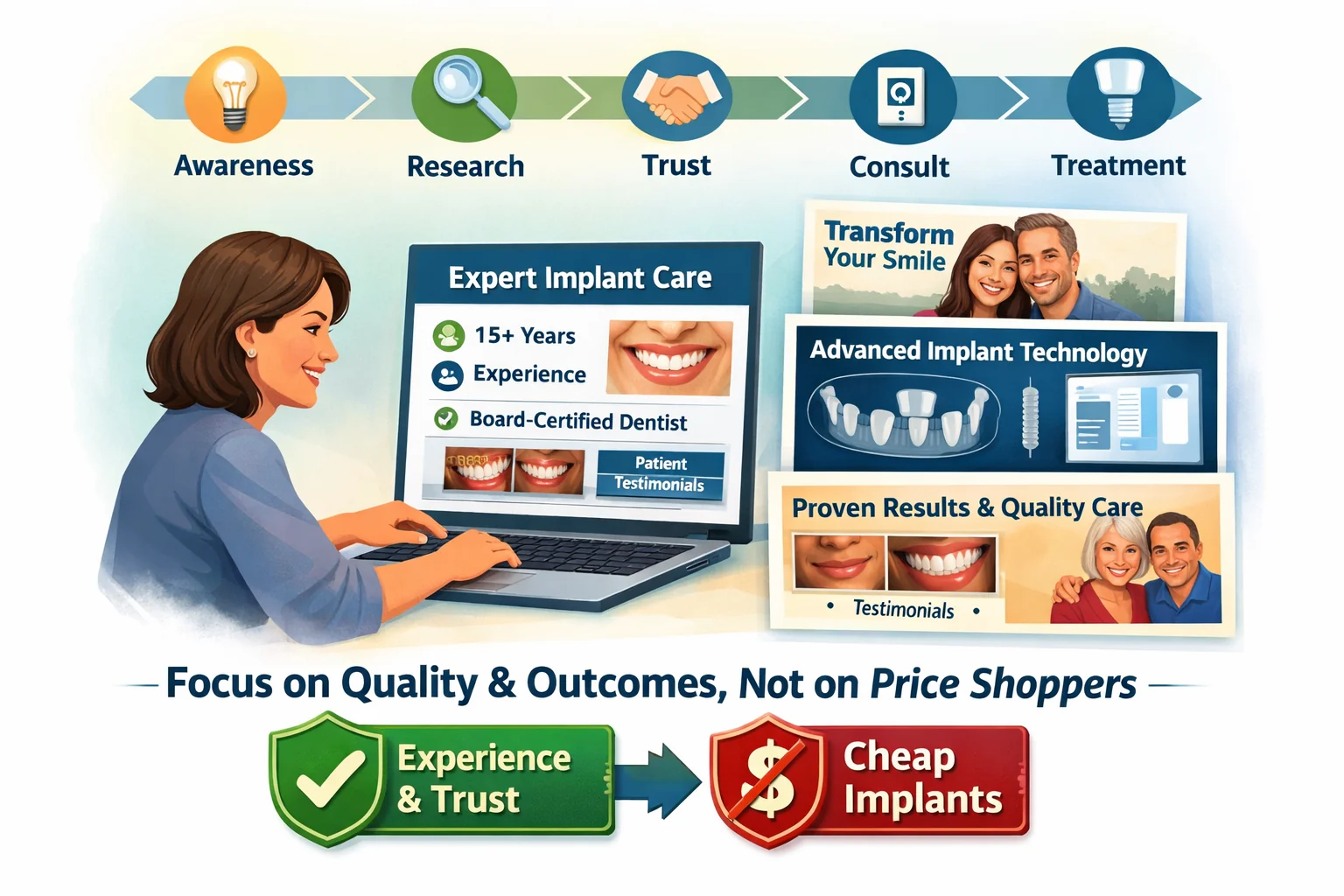 You attract what your marketing emphasizes. If your implant ads and landing pages lead with “affordable” or “low-cost,” you’ll fill your pipeline with callers whose first question is “how much?” and whose last action is ghosting after they hear the answer. The fix isn’t spending more on ads—it’s changing what those ads communicate, who they target, and how leads are handled once they inquire. You attract what your marketing emphasizes. If your implant ads and landing pages lead with “affordable” or “low-cost,” you’ll fill your pipeline with callers whose first question is “how much?” and whose last action is ghosting after they hear the answer. The fix isn’t spending more on ads—it’s changing what those ads communicate, who they target, and how leads are handled once they inquire.
The pattern is predictable: practices invest in dental implant marketing, generate a healthy volume of leads, and then watch conversion rates collapse because 70–80% of inquiries are pure price comparison. The treatment coordinator spends hours on consults that go nowhere. The cost-per-acquired-patient climbs. The assumption becomes “implant leads are just bad.” But the leads aren’t bad—the messaging attracted the wrong intent.
Already have lead flow but poor conversion? Keep reading. If you’re not generating implant leads yet, start with dental SEO or paid search strategy first.
This guide walks through the messaging shifts, targeting refinements, content strategies, and intake adjustments that filter for value-focused patients before they ever call—so your consult time goes to people ready to move forward, not shoppers collecting quotes.
Written for: dental practice owners, treatment coordinators, and marketing teams who want higher-converting implant leads without racing to the bottom on price.
TL;DR
If you only do five things, do these:
| • |
Lead with outcomes, not price - emphasize longevity, function, confidence, and life improvement; remove “affordable” and “low-cost” from your messaging
|
| • |
Show credentials and experience - implant training, case volume, years of experience, and advanced technology signal quality and justify investment
|
| • |
Pre-qualify with content - educational pages about implant process, candidacy, and what to expect filter out shoppers who just want a number
|
| • |
Target by behavior, not just keywords - use audience signals for financial stability and research-stage behavior rather than “cheap implants” queries
|
| • |
Handle price questions strategically - redirect to value and outcomes before discussing investment; never quote over the phone without context |
Table of Contents
Why implant marketing attracts price-shoppers
Dental implants are a high-consideration purchase. Patients researching implants often start with cost because it’s the easiest variable to compare when they don’t yet understand the clinical differences between providers. Your marketing either reinforces that price-first mindset or redirects it toward value.
Common patterns that attract price-shoppers:
| • |
Price-forward headlines - “Affordable Dental Implants” or “Implants Starting at $X” trains searchers to compare your number against competitors
|
| • |
Discount and promotion emphasis - “Free consultation” and “Special financing” as primary hooks attract deal-seekers rather than outcome-seekers
|
| • |
Thin landing pages - pages with minimal educational content and prominent “Get a Quote” forms signal that price is the main decision factor
|
| • |
Broad keyword targeting - bidding on “cheap dental implants” or “low cost implants near me” guarantees price-focused traffic
|
| • |
Missing credibility signals - without visible credentials, case results, and experience markers, patients default to comparing the one thing they can see: price |
In our work with practices running implant campaigns, we commonly find that 60–75% of leads from price-forward messaging ask “how much?” within the first 30 seconds of the call. When messaging shifts to outcomes and credentials, that pattern reverses—and the leads who do call are already prepared to discuss their situation rather than just collect a number.
> Back to Table of Contents
What value-focused implant patients look for
Value-focused patients aren’t ignoring cost—they’re weighing cost against outcomes, longevity, experience, and trust. They’re willing to pay more for the right provider. Your job is to give them the information they need to identify you as that provider.
What matters to value-focused implant patients:
| • |
Provider credentials and training - fellowship programs, continuing education, implant-specific certifications, surgical experience
|
| • |
Technology and techniques - guided surgery, 3D imaging, immediate-load options, bone grafting capabilities
|
| • |
Case experience - how many implants placed, years of implant experience, full-arch case volume
|
| • |
Patient outcomes - before/after photos, testimonials focused on life improvement, long-term success rates
|
| • |
Process transparency - clear explanation of what to expect, realistic timelines, honest candidacy assessment
|
| • |
Comfort and care - sedation options, anxiety management, post-op support, accessibility |
A pattern we see repeatedly: when practices add detailed “About Our Implant Team” content with training credentials and case photos, lead quality improves within 4–6 weeks—even without changing ad spend. The same traffic converts differently when the landing experience builds trust. Strong reputation management and consistent five-star reviews reinforce these credibility signals. This principle applies to other high-value services as well—our veneers marketing strategy guide covers similar approaches for attracting premium cosmetic patients.
> Back to Table of Contents
Messaging shifts that filter by intent
The words you use in ads, landing pages, and website content act as filters. Price language attracts price-shoppers. Outcome language attracts outcome-seekers. This isn’t about hiding your prices—it’s about leading with what actually differentiates your care.
Headlines that attract value-focused patients
Replace price-forward headlines with outcome-forward alternatives:
| • |
Instead of “Affordable Dental Implants” try “Dental Implants That Last a Lifetime”
|
| • |
Instead of “Low-Cost Implant Solutions” try “Restore Your Smile with Confidence”
|
| • |
Instead of “Implants Starting at $X” try “Expert Implant Care from [Fellowship-Trained/Board-Certified] Dentists”
|
| • |
Instead of “Free Implant Consultation” try “Personalized Implant Treatment Planning” |
Body copy that builds trust
Your ad descriptions and landing page content should emphasize:
| • |
Experience and volume - “Over 2,000 implants placed” or “15+ years of implant experience”
|
| • |
Advanced capabilities - “Guided implant surgery for precision placement” or “Same-day teeth options available”
|
| • |
Patient outcomes - “Patients report improved confidence and quality of life”
|
| • |
Process clarity - “Comprehensive evaluation to determine if implants are right for you” |
How you frame your website messaging directly impacts whether patients see you as a commodity or a trusted provider worth the investment.
Phrases to remove from your marketing
Audit your current ads and pages for these price-shopper magnets:
| • |
“Affordable” - implies price is the primary consideration
|
| • |
“Low-cost” or “budget” - attracts comparison shoppers
|
| • |
“Cheapest” or “best price” - positions you in a race to the bottom
|
| • |
“Discount” or “special offer” as headline - makes price the hook
|
| • |
“Starting at $X” in prominent positions - invites quote comparison |
This doesn’t mean never mentioning financing or value. It means leading with outcomes and credentials, then addressing investment as part of a complete conversation.
> Back to Table of Contents
Content strategies that pre-qualify
Educational content serves as a filter. Patients who read detailed information about the implant process, candidacy factors, and what to expect are further along in their decision-making. They’re researching providers, not just prices.
Essential implant content pages
Core pages that pre-qualify leads:
| • |
Implant process overview - detailed explanation of evaluation, planning, surgery, healing, and restoration phases
|
| • |
Candidacy factors - bone density, health conditions, lifestyle factors, realistic expectations
|
| • |
Implant types and options - single tooth, multiple teeth, full-arch, implant-supported dentures
|
| • |
Technology and techniques - guided surgery, 3D imaging, sedation options, immediate-load protocols
|
| • |
Recovery and aftercare - realistic timelines, post-op instructions, long-term maintenance
|
| • |
Provider credentials page - training, certifications, implant-specific experience, case volume |
Your dental website design should make this educational content easy to find and navigate. If patients have to hunt for information, they’ll default to the one metric they can easily compare: price.
Content that filters out price-shoppers
Specific content elements that discourage pure price comparison:
| • |
“Why implant costs vary” section - explain how experience, technology, and materials affect outcomes (and justify investment)
|
| • |
“What to look for in an implant provider” - criteria that favor your credentials and capabilities
|
| • |
Case studies with context - not just before/after photos, but the patient’s situation, concerns, and life improvement
|
| • |
“Is an implant right for you?” quiz or assessment - engages serious candidates, filters casual browsers
|
| • |
Long-form educational content - 1,500+ word guides that only motivated researchers will read completely |
A high-converting smile gallery with patient stories and outcomes builds trust far more effectively than stock photos or generic before/after images. Your landing pages should be designed to convert researchers into consultations—not to collect price inquiries.
When someone reads 2,000 words about implant candidacy, reviews your credentials page, and then submits a form, they’re a fundamentally different lead than someone who clicked an ad and immediately asked “how much?” Understanding the dental marketing funnel and patient journey stages helps you see how content moves patients from awareness to consultation-ready.
> Back to Table of Contents
Ad targeting refinements
Beyond messaging, your targeting determines who sees your ads in the first place. Strategic adjustments filter out price-shoppers before they ever click.
Keyword strategy adjustments
Keywords to target:
| • |
Provider-focused terms - “best implant dentist,” “experienced implant surgeon,” “implant specialist near me”
|
| • |
Quality signals - “dental implant reviews,” “implant success rate,” “top rated implant dentist”
|
| • |
Specific procedures - “All-on-4 dental implants,” “full mouth dental implants,” “implant-supported dentures”
|
| • |
Condition-based terms - “missing teeth solutions,” “failing teeth replacement,” “denture alternative” |
Our guide to high-value dental PPC keywords covers keyword selection in more depth, including how to identify terms that signal treatment-ready intent.
Keywords to exclude (negative keywords):
| • |
Price terms - “cheap,” “cheapest,” “low cost,” “affordable,” “budget,” “discount”
|
| • |
Comparison shopping terms - “price list,” “cost comparison,” “how much do implants cost”
|
| • |
DIY/alternative terms - “implants at home,” “implant alternatives,” “avoid implants”
|
| • |
Insurance-only terms - “free implants,” “insurance-covered implants,” “Medicaid implants” |
Many of these targeting mistakes overlap with the Google Ads errors that waste the most money—bidding on the wrong terms is one of the fastest ways to burn through budget on leads who will never convert.
Audience targeting refinements
Behavioral and demographic signals that correlate with value-focused patients:
| • |
Homeowners - indicates financial stability and long-term thinking
|
| • |
Higher household income brackets - ability to invest in quality care
|
| • |
Research behavior - audiences who engage with health content, read reviews, compare providers
|
| • |
Age-appropriate targeting - 45+ for single implants, 55+ for full-arch cases
|
| • |
Retargeting engaged visitors - people who viewed multiple pages or spent significant time on your site |
These targeting refinements may reduce total lead volume while improving lead quality. In our experience, practices often see a 30–40% reduction in lead volume paired with a 50–70% improvement in consultation-to-treatment conversion—resulting in more actual cases at lower cost-per-acquisition. For a deeper look at optimizing paid campaigns, see our guide on lowering dental Google Ads CPA without sacrificing lead quality.
> Back to Table of Contents
Intake and consultation adjustments
Even with improved messaging and targeting, some price-focused callers will still reach your practice. How you handle these calls determines whether you waste time or redirect the conversation toward value.
Phone handling for implant inquiries
When a caller immediately asks “how much are implants?”:
| • |
Acknowledge the question - “That’s an important consideration, and I want to make sure you get accurate information for your specific situation.”
|
| • |
Redirect to discovery - “Implant treatment varies quite a bit depending on factors like bone health and how many teeth are involved. Can I ask you a few questions to better understand your situation?”
|
| • |
Build value before numbers - “Our implant team has placed over 2,000 implants and uses guided surgery for precision. The consultation includes a 3D scan and detailed treatment plan.”
|
| • |
Offer the consultation path - “The best way to get an accurate picture is a consultation where we can evaluate your specific needs and create a customized plan.” |
Your patient intake process is just as important as your marketing. If leads convert to calls but not to consultations, the leak is often in phone handling—not lead quality.
Qualifying questions for implant leads
Questions that help identify value-focused patients:
| • |
“What’s prompting you to explore implants now?” - identifies motivation level and urgency
|
| • |
“Have you had a consultation elsewhere?” - reveals comparison shopping behavior
|
| • |
“What’s most important to you in choosing an implant provider?” - surfaces whether price or quality is the priority
|
| • |
“Are you familiar with the implant process and timeline?” - gauges research stage and seriousness |
For more on converting leads through better team communication, see how to train dental teams to improve case acceptance. How you present the treatment plan during consultation is equally critical—value-focused patients respond to clear explanations and honest recommendations, not pressure tactics.
When to release a price-focused lead
Not every lead is worth pursuing. If a caller:
| • |
Refuses to answer qualifying questions - they just want a number to compare
|
| • |
States they’re calling five practices for prices - they’ve already decided to shop on cost
|
| • |
Pushes back on consultation - “I just want a ballpark over the phone”
|
| • |
Mentions they’re looking for the cheapest option - your practice isn’t the right fit |
Politely provide general information and move on. Your treatment coordinator’s time is better spent on candidates who are ready to have a real conversation about their care.
> Back to Table of Contents
Measuring what matters
When you shift from price-forward to value-forward marketing, total lead volume often decreases while quality improves. Track the metrics that actually matter for practice growth.
Key performance indicators for implant marketing
Metrics to track weekly:
| • |
Lead-to-consultation rate - what percentage of inquiries convert to scheduled consultations?
|
| • |
Consultation-to-treatment rate - what percentage of consultations result in treatment acceptance?
|
| • |
Average case value - are you attracting single-tooth cases or full-arch opportunities?
|
| • |
Cost-per-acquired-patient - total marketing spend ÷ patients who started treatment
|
| • |
Time-to-decision - how long from consultation to treatment acceptance? |
Understanding how to track dental marketing ROI by channel helps you see which campaigns are driving value-focused patients versus price-shoppers.
Benchmarks and realistic expectations
What we typically see when practices shift to value-focused implant marketing:
| • |
Lead volume - may decrease 20–40% initially as price-shoppers are filtered out
|
| • |
Lead-to-consultation rate - often improves from 30–40% to 50–65%
|
| • |
Consultation-to-treatment rate - commonly increases from 25–35% to 45–60%
|
| • |
Cost-per-acquired-patient - typically decreases 25–45% despite lower lead volume
|
| • |
Average case value - often increases as value-focused patients pursue more comprehensive treatment |
The math works because you’re spending less time and resources on leads who were never going to convert. A practice that converts 50% of 30 consultations acquires more patients than one that converts 25% of 50 consultations—and does it with less overhead.
> Back to Table of Contents
Next steps
If your implant marketing is generating volume but not conversions, the issue is usually intent mismatch—not lead quality. Audit your current ads, landing pages, and intake process for the price-forward signals that attract shoppers instead of patients.
Start here: Messaging shifts, ad targeting refinements, intake adjustments.
For practices ready to take their implant marketing to the next level, WEO Media provides dental implant marketing, PPC advertising, and SEO services designed to attract value-focused patients. Schedule a consultation to discuss your current results and where improvements can be made, or contact us at 888-246-6906.
> Back to Table of Contents
FAQs
Should I remove all pricing information from my implant marketing?
Not necessarily. The goal is to avoid leading with price as your primary differentiator. You can address investment during consultations and on deeper pages of your site. What matters is that your headlines, ads, and landing page hooks emphasize outcomes, experience, and quality rather than cost.
Will I lose leads if I stop using “affordable” in my ads?
You may see a reduction in total lead volume, but the leads you do receive are more likely to convert. Practices typically find that removing price-forward language reduces inquiries by 20–40% while improving consultation-to-treatment conversion by 50% or more—resulting in more actual patients at lower acquisition cost.
How do I handle callers who immediately ask about price?
Acknowledge the question, then redirect to understanding their specific situation. Ask qualifying questions about their dental needs, explain that treatment varies based on individual factors, and build value by mentioning your experience and technology before discussing investment. Guide them toward a consultation where you can provide accurate, personalized information.
What keywords should I exclude from implant ad campaigns?
Add negative keywords for terms like “cheap,” “cheapest,” “low cost,” “affordable,” “budget,” “discount,” “free,” “price list,” and “cost comparison.” These searches indicate price-shopping intent and typically result in leads who are unlikely to convert at standard case fees.
How long does it take to see results from value-focused implant marketing?
Most practices begin seeing changes in lead quality within 2–4 weeks of implementing messaging and targeting changes. Full impact on consultation-to-treatment conversion typically becomes measurable within 6–8 weeks as the new lead pool moves through your consultation process.
What content helps pre-qualify implant leads?
Educational content about the implant process, candidacy factors, technology used, and what to expect during treatment helps filter out casual browsers. A detailed provider credentials page, case studies with patient stories, and content explaining why implant costs vary also attract patients who are researching quality rather than just comparing prices.
Is it okay to offer financing for dental implants?
Absolutely. Financing options help value-focused patients afford comprehensive treatment. The key is positioning financing as an accessibility tool rather than a price hook. Mention financing as part of your treatment planning conversation, not as a headline in your advertising. This attracts patients who want quality care and need payment flexibility, rather than bargain hunters.
What metrics should I track for implant marketing success?
Focus on lead-to-consultation rate, consultation-to-treatment rate, average case value, and cost-per-acquired-patient. These metrics reveal whether your marketing is attracting patients who actually convert to treatment. Raw lead volume matters less than the quality of those leads and their likelihood of becoming patients. |
|