Dental PPC Keywords That Waste Budget vs Drive High ROI for Dentists
Posted on 2/1/2026 by WEO Media |
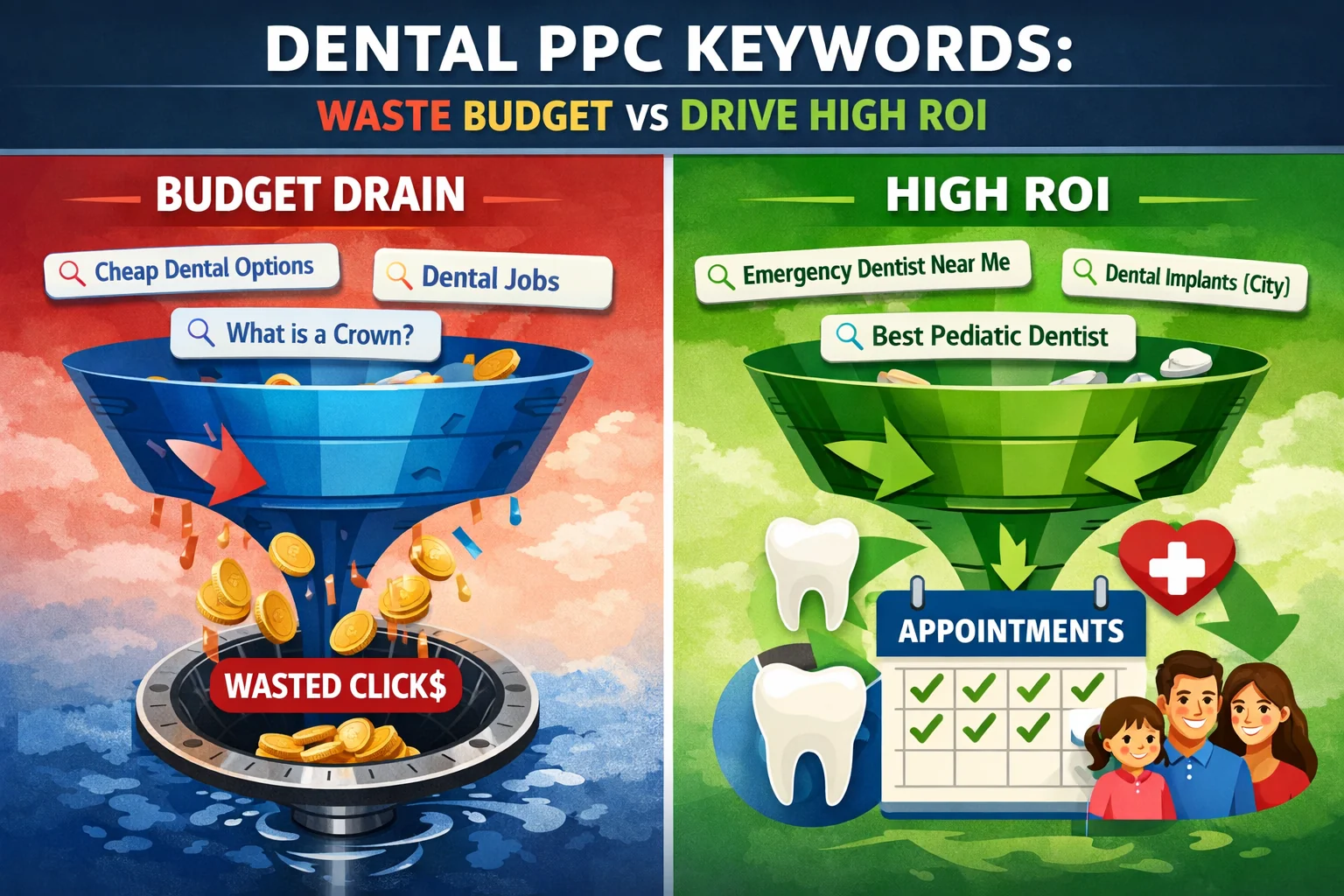 Some dental PPC keywords cost you money. Others make you money. The difference often comes down to intent, not volume. In our work managing paid advertising for dental practices, we consistently find that 20–40% of ad spend goes to keywords that will never convert to booked patients—not because the clicks are fake, but because the searcher’s intent doesn’t match what your practice offers. Some dental PPC keywords cost you money. Others make you money. The difference often comes down to intent, not volume. In our work managing paid advertising for dental practices, we consistently find that 20–40% of ad spend goes to keywords that will never convert to booked patients—not because the clicks are fake, but because the searcher’s intent doesn’t match what your practice offers.
The pattern is predictable: broad keywords with high search volume attract clicks from people researching, comparing, or looking for something you don’t provide. Meanwhile, specific keywords with clear patient intent often get overlooked because their volume looks small. The result is a campaign that generates traffic reports but not appointment growth—a breakdown in your marketing funnel before patients even reach the front desk.
Running ads but not seeing new patients? This guide will help you identify the leak. If you’re not yet running PPC, start with understanding how PPC compares to SEO to build the foundation first.
Below, you’ll learn the specific keyword categories that typically waste dental PPC budgets, the keyword patterns that consistently drive high-value patients, and a practical framework for auditing your own account—including negative keyword lists, match type strategy, and budget reallocation approaches we use with practices every month.
Written for: dental practice owners, marketing managers, and teams evaluating or managing Google Ads campaigns who want to stop funding clicks that never convert. For a broader view of where PPC fits, see our complete dental marketing strategy guide.
TL;DR
If you only remember five things about dental PPC keywords:
| • |
High volume does not equal high ROI - “dentist” and “dental” alone attract researchers, job seekers, and students—not patients ready to book
|
| • |
Intent beats volume every time - “emergency dentist open now” converts at 3–5x the rate of “dentist near me” despite lower search volume
|
| • |
Negative keywords are profit protection - blocking “free,” “cheap,” “jobs,” “schools,” and “DIY” can cut wasted spend by 15–25%
|
| • |
Match types control who sees your ads - broad match without negatives is a budget leak; phrase and exact match give you precision
|
| • |
Audit quarterly at minimum - search term reports reveal the actual queries triggering your ads, not just the keywords you bid on |
Table of Contents
Keywords that typically waste dental PPC budget
Not all clicks are created equal. These keyword categories consistently underperform in dental PPC campaigns because the searcher’s intent doesn’t align with booking an appointment. Understanding these patterns is the first step toward reducing your cost per lead.
Generic single-word terms
Keywords like “dentist,” “dental,” “teeth,” or “orthodontist” cast too wide a net. The person searching might be looking for a dentist, but they might also be researching career paths, looking up definitions, or comparing dental insurance plans. In our experience, single-word dental terms typically convert at less than 2% while costing premium CPCs because of competition.
Informational and research queries
Searches like “what does a root canal feel like,” “how much do veneers cost,” or “is teeth whitening safe” indicate someone in research mode, not booking mode. These searchers may become patients eventually, but paying for their click today usually means paying twice—once for the research visit and again when they’re actually ready.
| • |
“How to” queries - how to whiten teeth, how to fix a chipped tooth, how to stop tooth pain
|
| • |
“What is” queries - what is a crown, what is Invisalign, what is periodontal disease
|
| • |
“Cost” queries without location - dental implant cost, Invisalign price, how much for veneers
|
| • |
“vs” comparison queries - Invisalign vs braces, implants vs dentures, crowns vs veneers |
These queries are better served by SEO content that captures them organically rather than paid clicks.
Job seeker and student traffic
Searches containing “jobs,” “career,” “salary,” “school,” “program,” or “degree” will never convert to patient appointments. Yet without proper negative keywords, a campaign targeting “dental assistant” services might show ads to people searching “dental assistant jobs near me.” This category alone can consume 5–10% of poorly managed dental PPC budgets.
Price-sensitive and discount seekers
Keywords containing “free,” “cheap,” “discount,” “low cost,” or “affordable” attract searchers whose primary decision factor is price. While some practices compete on price, most find these patients have higher no-show rates, lower treatment acceptance, and lower lifetime value. If your practice doesn’t position itself as the low-cost option, these keywords drain budget without delivering your ideal patient.
DIY and home remedy searches
“How to whiten teeth at home,” “DIY tooth repair,” “home remedies for toothache”—these searchers are explicitly trying to avoid visiting a dentist. Paying to reach them is paying to reach people who’ve already decided they don’t want what you offer.
Insurance and coverage queries
Searches like “does insurance cover Invisalign,” “dental insurance plans,” or “best dental coverage” indicate someone shopping for insurance, not a dentist. Unless you’re marketing dental insurance products, these clicks represent pure waste. This is one of the most common Google Ads mistakes we see in dental accounts.
> Back to Table of Contents
Keywords that consistently drive high-value patients
High-ROI dental PPC keywords share common traits: clear patient intent, specific service focus, and urgency or location signals. These are the keyword categories worth protecting and expanding in your campaigns. For a deeper dive into high-value keyword selection by specialty, see our comprehensive keyword guide.
Emergency and urgent care keywords
Emergency dental searches represent patients who need care now and will book with whoever can see them fastest. These keywords consistently deliver the highest conversion rates in dental PPC.
| • |
“Emergency dentist” + location - emergency dentist [city], 24 hour dentist near me, same day dental appointment
|
| • |
Urgent symptom searches - severe tooth pain dentist, broken tooth repair today, knocked out tooth emergency
|
| • |
After-hours searches - dentist open Saturday, Sunday emergency dentist, dentist open late today |
A pattern we commonly see: emergency keywords cost more per click but deliver 3–5x higher conversion rates and often lead to comprehensive treatment plans once the immediate issue is resolved. Learn more about capturing high-intent emergency searches effectively.
High-value service keywords with location
Patients searching for specific procedures with location modifiers have moved past research into active provider selection.
| • |
Implant-focused - dental implants [city], implant dentist near me, All-on-4 [city]
|
| • |
Cosmetic-focused - veneers dentist [city], cosmetic dentist near me, smile makeover [city]
|
| • |
Orthodontic-focused - Invisalign provider [city], adult braces [city], clear aligners dentist near me
|
| • |
Restorative-focused - dental crowns [city], full mouth reconstruction near me |
These patients typically represent higher case values and have often already decided they want the procedure—they’re choosing the provider. Practices focused on implants should review our dental implant marketing strategies, while those promoting clear aligners can benefit from dedicated Invisalign marketing approaches. For cosmetic cases, our veneers marketing strategy covers how to attract premium patients.
“Best” and “top” qualifier keywords
Searches containing “best dentist,” “top rated dental,” or “highest reviewed orthodontist” indicate quality-focused patients willing to pay for excellent care. These searchers prioritize reputation over price and tend to have higher treatment acceptance rates. Strong reputation management supports these keywords by ensuring your reviews back up your ad claims.
New patient specific searches
Keywords explicitly mentioning “new patient,” “accepting new patients,” or “first visit” signal someone actively looking to establish care. These searches convert well because the intent is unambiguous—they want to become your patient.
Insurance-specific provider searches
When searchers include their insurance in the query (“Delta Dental dentist near me,” “dentist that takes Cigna”), they’ve moved past general research into practical logistics. They’ve decided to see a dentist and are now filtering by coverage. If your practice accepts their insurance, these clicks have strong conversion potential.
Pediatric and family-focused keywords
“Pediatric dentist,” “kids dentist,” “family dental practice”—these keywords attract parents making healthcare decisions for their families. Family patients represent long-term value through multiple household members and years of continued care. Practices specializing in children should explore dedicated pediatric dentist marketing strategies, while orthodontist marketing covers how to reach teens and adults seeking alignment treatment.
> Back to Table of Contents
How to audit your own account
You don’t need to guess which keywords are wasting budget. Google Ads provides the data—you just need to know where to look. This process aligns with our PPC audit checklist for identifying wasted spend.
Step 1: Pull your search terms report
The search terms report shows the actual queries that triggered your ads, not just the keywords you’re bidding on. This distinction matters because match types allow your ads to show for searches you never explicitly targeted.
| • |
Navigate to - Keywords → Search terms in your Google Ads account
|
| • |
Set date range - minimum 30 days, ideally 90 days for meaningful patterns
|
| • |
Export to spreadsheet - easier to filter, sort, and analyze offline |
Step 2: Categorize by intent
Sort your search terms into three buckets:
| 1. |
Clear patient intent - searches where someone is obviously looking to book (emergency dentist, Invisalign consultation, dentist accepting patients)
|
| 2. |
Ambiguous intent - could be a patient or could be research (dentist near me, dental implants, cosmetic dentistry)
|
| 3. |
Non-patient intent - clearly not looking to book (dental jobs, dentistry school, how to whiten teeth at home) |
Step 3: Calculate performance by category
For each category, calculate the metrics that matter. Understanding how to track marketing ROI by channel helps you make data-driven decisions:
| • |
Cost per conversion - total spend ÷ conversions (calls, form fills, appointments)
|
| • |
Conversion rate - conversions ÷ clicks
|
| • |
Spend percentage - category spend ÷ total spend |
What we typically find: the “non-patient intent” bucket consumes 15–30% of budget with near-zero conversions. That’s your immediate opportunity.
Step 4: Identify your top performers and worst offenders
Sort by cost per conversion and look at both extremes. Your top 10 search terms by conversion volume often share patterns (location modifiers, urgency words, specific services). Your bottom 10 by cost with zero conversions reveal what to block immediately.
> Back to Table of Contents
Building your negative keyword strategy
Negative keywords tell Google which searches should not trigger your ads. A strong negative keyword list is the single fastest way to reduce wasted spend in dental PPC.
Core negative keyword categories for dental practices
These categories should be blocked in virtually every dental PPC campaign:
| • |
Employment terms - jobs, careers, hiring, salary, employment, resume, job openings, work, positions
|
| • |
Education terms - school, college, university, degree, program, training, certification, student, course
|
| • |
DIY and home terms - at home, DIY, home remedy, homemade, self, yourself, without dentist
|
| • |
Price-sensitive terms - free, cheap, cheapest, discount, low cost, budget, bargain (unless you compete on price)
|
| • |
Insurance shopping terms - insurance plans, coverage options, dental insurance cost, buy dental insurance
|
| • |
Unrelated medical terms - veterinary, dog, cat, pet, animal (yes, “dog dental cleaning” triggers human dental ads)
|
| • |
Geographic exclusions - cities and states you don’t serve |
Service-specific negatives
If you don’t offer certain services, block them explicitly:
| • |
If you don’t do orthodontics - braces, Invisalign, orthodontist, aligners, retainer
|
| • |
If you don’t do oral surgery - wisdom teeth removal, extraction, oral surgeon
|
| • |
If you don’t do pediatric - kids, children, pediatric, baby teeth (if you’re adult-only)
|
| • |
If you don’t do sedation - sedation dentistry, sleep dentistry, IV sedation, dental anesthesia |
Implementing negative keywords
Add negatives at three levels for proper coverage:
| 1. |
Account level - blocks that apply everywhere (jobs, schools, free)
|
| 2. |
Campaign level - blocks specific to campaign focus (if running separate implant and general campaigns)
|
| 3. |
Ad group level - fine-tuned blocks for specific keyword groups |
Review and update your negative keyword list monthly. New wasteful queries appear constantly as search behavior evolves.
> Back to Table of Contents
Match type strategy for dental practices
Match types determine how closely a search must relate to your keyword to trigger your ad. Choosing the wrong match type is one of the most common sources of dental PPC waste.
Understanding the three match types
| • |
Broad match - shows ads for searches related to your keyword, including synonyms and related concepts (keyword: “dental implants” might show for “tooth replacement options”)
|
| • |
Phrase match - shows ads for searches containing your keyword’s meaning (keyword: “dental implants” shows for “dental implants near me” but not “implant surgery recovery”)
|
| • |
Exact match - shows ads for searches with the same meaning as your keyword (keyword: “dental implants” shows for “dental implants” and close variants like “dental implant”) |
Match type recommendations by keyword category
Emergency keywords: Use phrase or exact match. You want control over when these high-cost keywords trigger. “Emergency dentist” in broad match might show for “emergency vet dentist”—not helpful.
High-value service keywords: Start with phrase match, monitor search terms closely, and add exact match for proven performers. “Dental implants [city]” in phrase match captures “best dental implants [city]” and “dental implants [city] cost”—both valuable.
General awareness keywords: If you use broad match at all, pair it with extensive negative keyword lists and Smart Bidding. Broad match without guardrails is a budget leak. Most practices get better ROI by avoiding broad match entirely for core keywords.
The case against broad match for most dental practices
Google encourages broad match because it increases their inventory—more searches trigger more ads. But for local service businesses like dental practices, broad match typically delivers lower-intent traffic at higher cost. A pattern we see repeatedly: practices switch from broad to phrase and exact match, reduce total clicks by 40%, but increase conversions because remaining traffic has stronger intent.
> Back to Table of Contents
Budget reallocation framework
Once you’ve identified wasteful keywords and high performers, reallocate budget to compound your results. This directly impacts your cost per acquisition across all campaigns.
The 80/20 analysis
In most dental PPC accounts, 20% of keywords drive 80% of conversions. Your job is to find that 20% and feed it more budget while starving the underperformers.
| 1. |
Export keyword performance data - include conversions, cost, and conversion rate
|
| 2. |
Sort by conversions - identify which keywords actually produce appointments
|
| 3. |
Calculate cumulative spend - determine what percentage of budget goes to your top converters
|
| 4. |
Set reallocation targets - aim to shift at least 20% of current waste toward proven performers |
Practical reallocation steps
| • |
Pause zero-conversion keywords - if a keyword has 50+ clicks and zero conversions, pause it and add as negative
|
| • |
Reduce bids on low converters - keywords converting but at high cost get bid reductions, not elimination
|
| • |
Increase bids on top performers - keywords converting efficiently often have room to capture more volume at higher positions
|
| • |
Test new variations of winners - if “emergency dentist [city]” converts well, test “same day dentist [city]” and “urgent dental care [city]” |
Budget allocation by campaign type
A framework we use with practices allocates budget based on conversion potential and case value:
| • |
Emergency campaigns - 25–35% of budget (highest conversion rate, immediate appointments)
|
| • |
High-value service campaigns - 30–40% of budget (implants, cosmetic, ortho—lower volume but higher case value)
|
| • |
General/new patient campaigns - 25–35% of budget (steady flow of comprehensive care patients)
|
| • |
Brand campaigns - 5–10% of budget (protect your practice name from competitor bidding) |
These percentages shift based on practice capacity, service mix, and competitive landscape. The point is intentional allocation rather than spreading budget evenly across all keywords. For practices with multiple locations, DSO marketing strategies require additional coordination across accounts.
> Back to Table of Contents
Get help with your dental PPC
Managing dental PPC effectively requires ongoing attention—search behavior changes, competitors adjust bids, and new keyword opportunities emerge. Strong ad copy and landing pages that convert work together with keyword strategy to maximize your results.
If you’d rather focus on patient care while experts handle your paid advertising, WEO Media specializes in dental marketing with dedicated PPC management for practices. We also integrate PPC with SEO, patient pipeline optimization, and website design for a complete lead generation approach.
Schedule a consultation to discuss your current campaign performance and identify opportunities for improvement.
> Back to Table of Contents
FAQs
How much should a dental practice spend on PPC?
PPC budgets vary based on market competition, practice size, and growth goals. Most dental practices see meaningful results starting at $1,500–$3,000 per month in competitive markets. The more important metric is cost per new patient acquired, which should be compared against patient lifetime value. A well-managed campaign typically acquires new patients at $150–$400 each, though this varies significantly by location and service focus.
What is a good conversion rate for dental PPC?
Dental PPC conversion rates typically range from 5–15% depending on keyword type and landing page quality. Emergency keywords often convert at 15–25% because intent is urgent. General keywords like “dentist near me” typically convert at 5–10%. If your conversion rate is below 5%, focus on landing page relevance, call tracking setup, and keyword intent alignment before increasing budget.
Should dental practices bid on competitor names?
Bidding on competitor practice names is allowed by Google but comes with tradeoffs. Clicks tend to be expensive with lower conversion rates because searchers were looking for a specific competitor. The strategy works best when you have a clear differentiator to highlight. Be aware that competitors may retaliate by bidding on your name, increasing your brand defense costs.
How often should I review my dental PPC keywords?
Review search terms weekly for the first 90 days of a campaign or after major changes. Once stable, monthly reviews catch new wasteful queries and emerging opportunities. Conduct a comprehensive keyword audit quarterly, including match type evaluation, negative keyword expansion, and budget reallocation. Seasonal patterns in dental searches also warrant attention—emergency searches spike around holidays, for example.
What is the difference between keywords and search terms in Google Ads?
Keywords are what you bid on—the terms you add to your campaigns. Search terms are what users actually type into Google that trigger your ads. Because of match types, a keyword like “dental implants” might trigger ads for search terms like “dental implant surgery recovery time” or “dental implants cost.” Reviewing search terms reveals the gap between what you intended to target and what you’re actually paying for.
Should I use Google’s automated bidding for dental PPC?
Automated bidding strategies like Target CPA or Maximize Conversions can work well for dental PPC once you have sufficient conversion data—typically 30 or more conversions per month. With less data, automated bidding makes unreliable decisions. Start with manual CPC bidding to maintain control, then test automated strategies once you have historical conversion patterns for the algorithm to learn from.
Why are my dental PPC costs so high?
High dental PPC costs typically stem from three issues: poor keyword targeting (broad match without negatives), low Quality Scores (ad relevance and landing page experience), or intense local competition. Start by auditing search terms for wasted spend on irrelevant queries. Then check Quality Scores—keywords below 5 pay a premium per click. Finally, consider whether your market supports profitable PPC or whether SEO might deliver better long-term ROI.
What landing pages work best for dental PPC?
The best dental PPC landing pages match the search intent exactly. Emergency keywords should land on pages with prominent phone numbers, same-day availability messaging, and minimal friction to call. Service-specific keywords like “dental implants [city]” should land on dedicated implant pages, not the homepage. Key elements include clear calls to action, mobile-friendly design, fast load times, and trust signals like reviews and credentials. |
|