The Dental New Patient Experience: How to Convert Clicks Into Kept Appointments
Posted on 3/15/2026 by WEO Media |
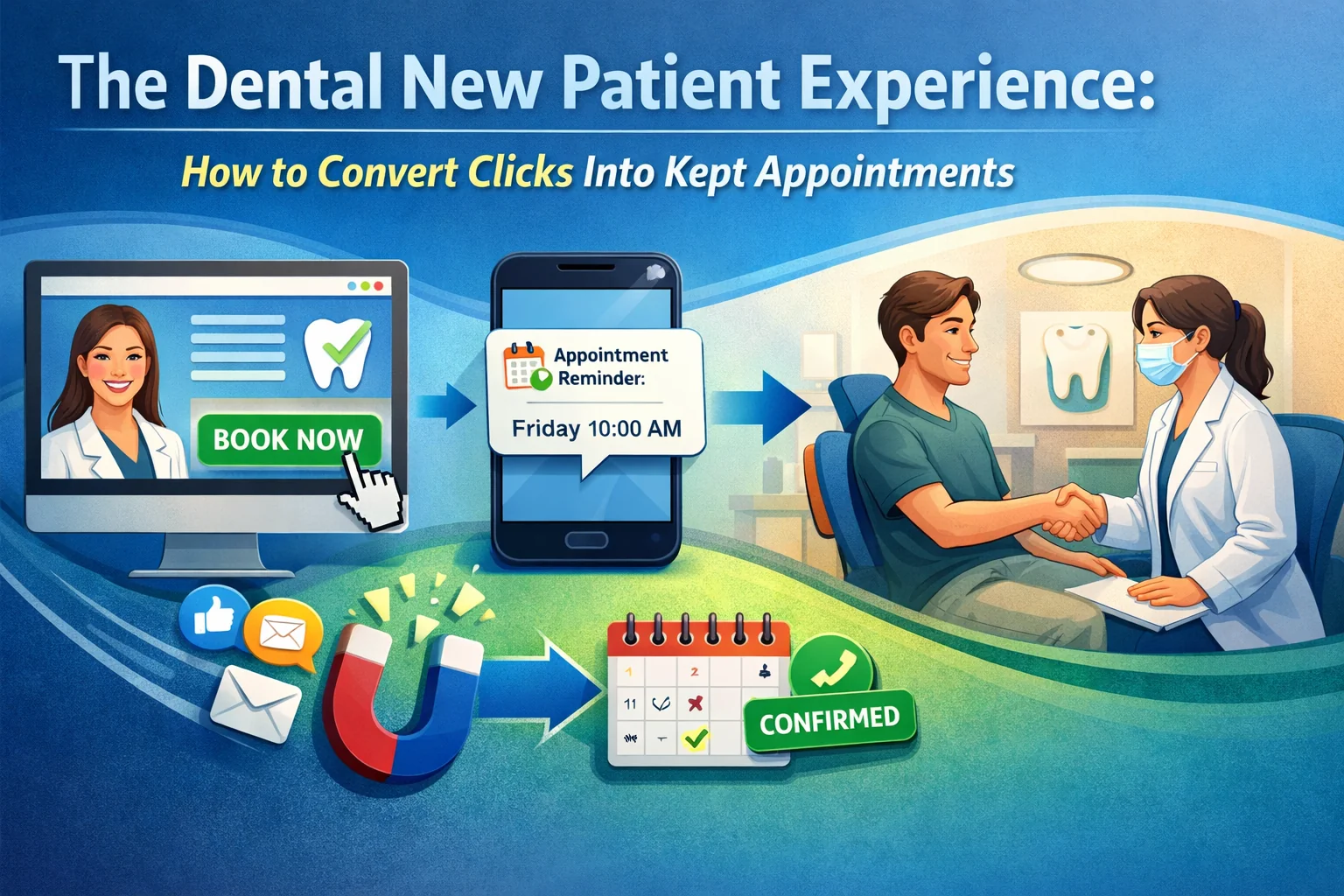 For dental practices looking to convert more online clicks into kept first appointments, optimizing the dental new patient experience is the single highest-leverage improvement available—and it starts with understanding the complete journey a prospective patient takes from their first search interaction through scheduling, pre-visit communication, and the in-office visit itself. Every stage of that journey either builds momentum toward a kept appointment or introduces friction that causes the patient to disappear. Practices that design this experience intentionally convert more of the marketing investment they’re already making. Practices that leave it to chance lose patients at every handoff—and usually blame marketing for the gap. For dental practices looking to convert more online clicks into kept first appointments, optimizing the dental new patient experience is the single highest-leverage improvement available—and it starts with understanding the complete journey a prospective patient takes from their first search interaction through scheduling, pre-visit communication, and the in-office visit itself. Every stage of that journey either builds momentum toward a kept appointment or introduces friction that causes the patient to disappear. Practices that design this experience intentionally convert more of the marketing investment they’re already making. Practices that leave it to chance lose patients at every handoff—and usually blame marketing for the gap.
The challenge is that most practices optimize in silos. The website design team focuses on aesthetics. The front desk focuses on phones. The clinical team focuses on treatment. But the patient experiences all of it as one continuous interaction, and a breakdown at any point colors everything that follows. A beautifully designed website means nothing if the first phone call goes to voicemail. A friendly receptionist can’t recover from a confusing online scheduling tool. The new patient experience is a chain, and chains break at their weakest link.
This guide covers the full journey from digital touchpoint to in-office visit. If your practice needs help generating more clicks in the first place, start with a broader patient acquisition strategy first.
Below, you’ll learn how to audit and improve each stage of the new patient experience: digital first impressions (website, listings, reviews), inquiry response (speed, quality, follow-through), scheduling friction (online booking, phone handling, after-hours capture), pre-visit communication (confirmations, paperwork, expectations), and in-office delivery (matching the promise your marketing made). Each section includes specific benchmarks, diagnostic questions, and fixes you can implement without a full system overhaul.
Written for: dental practice owners, office managers, and marketing coordinators who want to convert more of the leads they’re already generating into kept first appointments.
TL;DR
If you focus on seven things, focus on these:
| • |
Audit your website as a first-time visitor — load your site on a phone, try to find the new patient phone number and online scheduling in under 10 seconds, and note every point of confusion
|
| • |
Respond to every inquiry within 5 minutes during business hours — speed-to-lead is the single highest-leverage fix for most practices; after 5 minutes, contact rates drop dramatically
|
| • |
Make online scheduling genuinely functional — if your scheduler only offers limited visit types, requires a callback, or shows no availability, it’s creating friction, not reducing it
|
| • |
Eliminate the phone gap — missed calls, long holds, and after-hours dead ends are where the most new patient demand disappears
|
| • |
Send pre-visit communication that reduces anxiety — confirmation with office photos, parking details, paperwork links, and what to expect on arrival
|
| • |
Deliver an in-office experience that matches your online promise — if your website says “spa-like” and your lobby says “1997,” trust breaks immediately
|
| • |
Measure the full funnel, not just leads — track clicks → inquiries → contacted → scheduled → confirmed → kept to find exactly where patients drop off |
Table of Contents
What the new patient experience really is (and why it determines growth)
The new patient experience is not a single event. It’s a sequence of micro-decisions a prospective patient makes—each one either advancing them toward a kept appointment or giving them a reason to stop. The sequence typically follows this path: see (find your practice online) → evaluate (check your website, reviews, and profiles) → reach out (call, submit a form, or book online) → schedule (confirm a date and time) → prepare (receive pre-visit communication) → arrive (walk through the door for the first time). This is the dental patient journey in its most practical form.
A pattern we commonly see is practices investing heavily in the “see” stage—SEO, paid ads, social media—while underinvesting in every stage after it. The result is a high volume of clicks and calls with a low volume of kept appointments, which creates the impression that “marketing isn’t working” when the real issue is experience friction downstream.
Why this matters for growth: acquiring a new patient is significantly more expensive than retaining an existing one. When a prospective patient clicks on your ad, visits your website, and calls your office, you’ve already paid for that interaction. Every patient who drops off between click and visit is revenue you’ve paid for but never collected. Improving conversion at each stage of the dental marketing funnel compounds: a 10% improvement at three stages doesn’t add 30%—it multiplies. That’s why the new patient experience is the highest-leverage growth system most practices aren’t managing.
The ownership question: in most practices, nobody owns the full experience. Marketing handles the website. The front desk handles calls. The office manager handles scheduling logistics. The clinical team handles the visit. Without someone tracking the patient across all of these handoffs, gaps appear at every transition—and no single department sees the full picture. The first step in improving the new patient experience is assigning one person to own the patient pipeline end-to-end and report on where patients are dropping off.
> Back to Table of Contents
Your digital first impression: website, listings, and reviews
Before a prospective patient ever speaks to your team, they’ve already formed an opinion about your practice. That opinion is built from three digital assets: your dental website, your business listings, and your online reviews. All three need to work together, and all three need to be optimized for a first-time visitor who has never heard of your practice.
Website: the 10-second test
Load your practice website on a mobile phone—not your phone where you know where everything is, but as if you’ve never seen it before. Can a first-time visitor do the following within 10 seconds?
| • |
Find the phone number — it should be tappable and visible without scrolling on mobile; if it’s buried in a hamburger menu, you’re losing calls
|
| • |
Find online scheduling — a prominent button above the fold, not a text link in the footer
|
| • |
Understand what kind of practice this is — general, cosmetic, pediatric, orthodontic; the homepage design should make this immediately clear
|
| • |
See social proof — a review rating, a patient count, or testimonials visible without scrolling |
What we typically find when auditing dental website structure is that the homepage looks polished but fails the functional test. Beautiful hero images don’t matter if the call-to-action is unclear. A well-written “About” page doesn’t matter if the new patient can’t figure out how to schedule. Design serves conversion—not the other way around.
Page speed matters more than most practices realize. If your site takes longer than 3 seconds to load on mobile, a significant percentage of visitors will leave before it finishes rendering. Google’s Core Web Vitals now factor directly into search rankings, so a slow dental website hurts both user experience and visibility simultaneously.
Business listings: consistency and completeness
Your Google Business Profile, Yelp listing, Healthgrades profile, and other directory pages are often the first thing a prospective patient sees—before they ever reach your website. Inconsistent information across these listings (different phone numbers, outdated hours, missing services) creates doubt before the relationship even starts.
| • |
Verify NAP consistency — name, address, and phone number should be identical across every listing; even small variations (“Suite 100” vs. “Ste 100”) can affect citation SEO
|
| • |
Claim and complete every profile — unclaimed listings often show outdated or incorrect information that you can’t control
|
| • |
Add photos and service descriptions — listings with photos receive significantly more engagement than those without; show your office, team, and technology
|
| • |
Keep hours current — nothing erodes trust faster than a patient arriving at a “closed” office during what a listing said were open hours |
Reviews: the trust accelerator
Online reviews are the single most influential trust signal for prospective dental patients. A pattern we see across practices is that review volume and recency matter as much as star rating. A practice with 400 reviews and a 4.7 rating will typically outperform a practice with 20 reviews and a 5.0 rating—both in local SEO rankings and in patient trust. If your practice needs to build review volume, a structured approach to generating more five-star Google reviews is one of the fastest ways to improve both visibility and trust simultaneously.
The review response habit: responding to every review—positive and negative—signals that your practice pays attention and cares about patient feedback. For negative reviews, a professional, empathetic review response that avoids disclosing protected health information demonstrates maturity. For positive reviews, a brief thank-you reinforces the behavior and shows appreciation. Building a consistent reputation management habit is what separates practices that grow review volume from those that stall. What matters most is consistency: responding to reviews should be a weekly task with a named owner, not something that happens when someone remembers.
> Back to Table of Contents
From first inquiry to first response: speed and quality of contact
The moment a prospective patient reaches out—whether by phone, web form, live chat, or text message—a clock starts. The speed and quality of your response at this stage has a disproportionate impact on whether they become a patient or disappear.
Speed-to-lead: the 5-minute window
Research across multiple industries consistently shows that the probability of making meaningful contact with a lead drops dramatically after the first 5 minutes. In dental, this is even more compressed because patients are often reaching out to multiple practices simultaneously. The first practice to respond with a helpful, human interaction wins the appointment in the majority of cases.
What this means operationally: web form submissions, live chat requests, and text messages during business hours need to receive a response within 5 minutes—not 5 hours, not “by end of day.” This requires a named owner for each inquiry channel, a notification system that actually alerts them in real time, and a backup plan for when the primary owner is unavailable.
After-hours inquiries are a particularly common leak. A patient who submits a form at 8 PM expects something—an automated acknowledgment, a text confirmation, a clear statement of when they’ll hear back. Silence until 9 AM the next morning communicates that their inquiry doesn’t matter. An immediate auto-response that says “We received your message and will contact you by 9:30 AM tomorrow” buys time while maintaining trust.
Phone handling: the highest-stakes channel
Despite the growth of digital communication, phone calls remain the highest-intent inquiry channel for dental practices. A patient who picks up the phone and calls is further along in their decision-making than someone who submits a form. That makes front desk phone handling the highest-stakes interaction in the new patient experience.
| • |
Answer rate target — aim for 85% or higher during business hours; track this weekly with call tracking data, not assumptions
|
| • |
Peak-time coverage — lunch hours (11:30–1:00) and end-of-day (3:30–4:30) are when call volume spikes and staffing thins; these windows need dedicated phone coverage
|
| • |
First 60 seconds — the first minute of the call determines whether the patient books; the team member should identify the caller’s need, express empathy, and offer a next step within that window
|
| • |
Hold time — anything beyond 60 seconds significantly increases abandonment; if a hold is necessary, offer a callback instead |
Multi-channel consistency
Prospective patients now reach out through multiple channels—sometimes simultaneously. Someone might submit a web form, then call 10 minutes later because they didn’t receive an immediate response. Without a system that connects these interactions, the phone team treats it as a new inquiry, the form response goes out anyway, and the patient gets duplicate or conflicting communication.
The fix is a unified intake process where every inquiry—regardless of channel—flows into one system with one owner and one follow-up sequence. This doesn’t require expensive software. It requires a decision about where inquiries live, who manages them, and how handoffs work.
> Back to Table of Contents
The scheduling experience: removing friction from booking
Getting a prospective patient to reach out is only half the challenge. Converting that inquiry into a scheduled appointment is where many practices introduce unnecessary friction—often without realizing it.
Online scheduling: functional vs. decorative
Many dental practices have added online scheduling to their websites, but not all online scheduling tools are created equal. A common issue we see is scheduling widgets that technically exist but functionally fail the patient.
| • |
Limited visit types — if the scheduler only allows booking for cleanings but your marketing promotes implant consultations, the patient can’t book what brought them to your site
|
| • |
No real-time availability — schedulers that say “request an appointment” instead of showing actual open times create uncertainty; the patient doesn’t know if they’ve booked or just submitted a request
|
| • |
Too many steps — every additional form field or page in the booking process is a drop-off point; collect only what’s required to hold the slot and gather the rest later
|
| • |
Callback-required scheduling — if every online booking attempt results in “we’ll call you to confirm,” you’ve just added a step that defeats the purpose of self-scheduling |
The test is simple: can a new patient visiting your dental website at 10 PM on a Saturday book a real appointment for next Tuesday without waiting for a phone call? If the answer is no, your online scheduling is decorative, not functional.
Phone scheduling: permissions and pathways
When a prospective patient calls to schedule, the person answering the phone needs two things: permission to book the appointment (without escalating to a manager or checking with the doctor) and a clear pathway for common scenarios.
Permission issues are more common than most practice owners realize. If the team member answering the phone can’t book an emergency exam, a cosmetic consultation, or a new patient comprehensive exam without getting approval, the patient hears hesitation—and hesitation sounds like incompetence. Write down the top 5 visit types your marketing promotes and confirm that every person who answers the phone can book all of them without escalation.
Booked-out pathways are the other critical piece. When the schedule is full for the requested time, the team member needs a scripted response that doesn’t end the conversation. Building these scripts into your dental marketing SOPs ensures consistency across your team. Something like: “Our next available new patient appointment is [date]. I can also add you to our priority list so if something opens sooner, we’ll call you first. Would you like me to hold that [date] slot while we check?” This keeps the patient engaged instead of sending them to the next Google result.
> Back to Table of Contents
Pre-visit communication: confirmation, paperwork, and expectations
Once the appointment is scheduled, the new patient experience enters a critical gap—the days between booking and arrival. This is where no-shows are born. Practices that communicate proactively during this window see significantly higher kept-appointment rates than those that go silent after scheduling.
Confirmation sequences that reduce no-shows
A single confirmation message is not enough. A well-designed new patient communication sequence typically includes three touchpoints:
| 1. |
Immediate booking confirmation — sent within minutes of scheduling via email or text; includes date, time, office address, and a link to complete paperwork online
|
| 2. |
Reminder at 48–72 hours before the appointment — a brief text or email that confirms the date and time, includes a “confirm” or “reschedule” option, and restates what to bring
|
| 3. |
Day-of reminder — sent the morning of the appointment with parking instructions, office entry details, and a note about arriving 10–15 minutes early if paperwork wasn’t completed online |
The medium matters: text message reminders consistently outperform email for appointment reminders in dental. Open rates for SMS reminders are dramatically higher than email, and two-way texting allows patients to confirm, reschedule, or ask questions without making a phone call. Following dental SMS best practices ensures your messages are both effective and consent-compliant.
Pre-visit paperwork: remove the lobby bottleneck
Asking a new patient to arrive 15–20 minutes early to fill out paper forms on a clipboard is one of the most common experience failures in dental. It signals that the practice hasn’t invested in modernizing, it creates stress for patients who are already anxious, and it wastes clinical time while the team waits for forms to be completed.
The modern approach: send digital paperwork as part of the booking confirmation. Give patients a secure link to complete medical history, insurance information, and consent forms from their phone or computer before they arrive. When they walk in, their information is already in the system, and the visit starts on time. Practices that implement digital intake consistently report shorter check-in times, fewer data-entry errors, and higher patient satisfaction scores.
Setting expectations: what will actually happen
New dental patients are often anxious—particularly if they haven’t visited a dentist in a while. Pre-visit communication is an opportunity to reduce that anxiety by explaining exactly what to expect.
| • |
What the first visit includes — a brief, plain-language description: “Your first visit will include X-rays, a comprehensive exam with the doctor, and a conversation about your goals and any concerns”
|
| • |
How long it will take — give a realistic time estimate so patients can plan accordingly; “Plan for about 60–90 minutes for your first visit”
|
| • |
What to bring — insurance card, photo ID, and any referral paperwork; state this clearly even if it seems obvious
|
| • |
Office photos and team introductions — showing the patient what the office looks like and who they’ll meet reduces the “unknown” factor that drives anxiety and no-shows; professional dental photography makes a measurable difference here |
> Back to Table of Contents
The in-office first visit: delivering on the digital promise
Everything up to this point—the website, the phone call, the scheduling, the pre-visit communication—has set an expectation. The in-office experience either confirms that expectation or breaks it. When a new patient walks through the door, they’re subconsciously comparing what they see, hear, and feel to what your website messaging promised.
The first 90 seconds
The first 90 seconds of the in-office experience set the tone for the entire relationship. This is not about clinical excellence—it’s about how the patient feels when they walk in.
| • |
Greeting by name — when a new patient arrives, the front desk should know who they are and greet them by name; “Welcome, you must be [patient name]” immediately communicates that they were expected and valued
|
| • |
Acknowledgment of their time — “Thank you for choosing us for your care” or “We’re glad you’re here” takes two seconds and makes a measurable difference in first impressions
|
| • |
Clear next steps — “Your paperwork is all set, so we’ll take you back in just a few minutes” reduces the uncertainty that makes waiting rooms uncomfortable
|
| • |
Physical environment — the lobby should be clean, current, and consistent with the dental brand your website presents; outdated magazines, worn furniture, or a television blaring cable news undermines trust built online |
Clinical experience consistency
The clinical team’s interaction with a new patient should reflect the same values communicated in marketing. If your website emphasizes gentle, patient-centered care, the hygienist and doctor need to embody that during the first visit. Training your dental team on how to communicate with empathy and clarity during clinical interactions directly impacts whether new patients accept treatment and return.
Key moments that matter: introductions by name and role (“I’m Sarah, I’ll be your hygienist today”), narrating procedures before performing them (“I’m going to take a few X-rays now—you’ll hear a small click”), asking about comfort periodically, and avoiding clinical jargon without explanation. Patient education videos can supplement verbal explanations and help patients understand what’s happening during each step. These are small behaviors, but they’re the difference between a patient who schedules their next appointment and one who doesn’t return.
The checkout experience and next-step commitment
The final touchpoint of the first visit is checkout, and it’s where many practices lose momentum. The patient has had a positive clinical experience, but if checkout is rushed, confusing, or doesn’t include a clear next step, the relationship stalls.
Before the patient leaves, three things should happen: they should understand their treatment plan in plain language (not clinical codes), they should have their next appointment scheduled (not “we’ll call you”), and they should know what their financial responsibility will be. For higher-value cases, offering patient financing options at checkout removes a common barrier to acceptance. Practices that schedule the next visit before checkout see dramatically higher retention rates than those that rely on follow-up calls to rebook. If your recall system depends on chasing patients after they leave, you’re already at a disadvantage.
> Back to Table of Contents
How to measure and improve your new patient experience
You can’t improve what you don’t measure, and most practices measure the wrong things. Tracking total new patient calls or total website visits gives you volume information but tells you nothing about where the experience breaks down. The goal is to track marketing ROI by channel and source so you can see exactly where patients disappear.
The new patient experience funnel
The most useful framework is a stage-by-stage funnel that tracks conversion at each handoff:
| 1. |
Impressions → Clicks — how many people who saw your listing or ad actually visited your website; this is your marketing visibility metric
|
| 2. |
Clicks → Inquiries — how many website visitors took action (called, submitted a form, booked online); this is your website conversion metric
|
| 3. |
Inquiries → Contacted — how many inquiries received a response from your team; this is your responsiveness metric
|
| 4. |
Contacted → Scheduled — how many contacted prospects booked an appointment; this is your scheduling conversion metric
|
| 5. |
Scheduled → Kept — how many scheduled appointments were actually kept; this is your confirmation and experience metric |
By tracking conversion percentages at each stage, you can identify exactly where the biggest drop-off occurs and focus improvement efforts there. A practice losing 40% of inquiries between “contacted” and “scheduled” has a different problem than a practice losing 30% between “scheduled” and “kept.” Building this data into a dental marketing dashboard makes the patterns visible at a glance.
Tools for measurement
You don’t need enterprise software to measure the new patient experience, but you do need a few specific tools working together.
| • |
Call tracking — assigns unique phone numbers to each marketing channel so you know which source generated each call; also records calls for quality review
|
| • |
Form and chat tracking — connects web form submissions and live chat conversations to specific marketing campaigns and website pages
|
| • |
CRM or intake log — a central place where every inquiry is logged with a status (contacted, scheduled, kept, lost) and an outcome note; this can be as simple as a shared spreadsheet if your volume is manageable
|
| • |
Patient satisfaction survey — a brief post-visit survey (3–5 questions maximum) sent within 24 hours of the first appointment; focus on experience questions, not just clinical satisfaction |
The weekly review habit
Data only matters if someone reviews it regularly. The most effective pattern we see is a weekly 15-minute review where the person responsible for new patient experience looks at three numbers: inquiry volume by channel, conversion rate at each funnel stage, and any open inquiries that haven’t been resolved.
The goal of the weekly review is pattern recognition, not blame. If answer rates dropped on Tuesday, the question is “what happened with staffing on Tuesday?” not “who missed calls on Tuesday?” When teams feel safe reporting problems, problems get fixed. When teams feel watched, problems get hidden.
Results vary by market, practice size, and patient mix. These benchmarks are a starting point for measuring your own performance, not absolute standards.
> Back to Table of Contents
Talk to WEO Media about your new patient experience
If your dental practice is generating clicks and calls but not enough kept appointments, WEO Media can help you find and fix the gaps. From dental website design and SEO to call tracking, reputation management, and patient communication systems, we build the marketing infrastructure that supports the full new patient experience—from the first search result to the first visit and beyond. Call 888-246-6906 or schedule a consultation with WEO Media — Dental Marketing to start the conversation.
> Back to Table of Contents
FAQs
What is the dental new patient experience?
The dental new patient experience is the complete journey a prospective patient takes from their first online interaction with a dental practice through scheduling, pre-visit communication, and their first in-office appointment. It includes every touchpoint—website visits, phone calls, online booking, confirmation messages, and the in-office visit itself—that influences whether a prospect becomes a long-term patient.
How fast should a dental office respond to a new patient inquiry?
Dental practices should aim to respond to new patient inquiries within 5 minutes during business hours. Research consistently shows that contact rates decline sharply after the first few minutes. For after-hours inquiries, an immediate automated acknowledgment that sets a specific callback time (such as “by 9:30 AM tomorrow”) helps maintain trust until a team member can follow up personally.
How do I reduce no-shows for new dental patients?
Reducing new patient no-shows requires a multi-touch confirmation sequence: an immediate booking confirmation, a reminder 48–72 hours before the appointment with a confirm or reschedule option, and a day-of reminder with arrival instructions. Sending digital paperwork in advance, providing office photos, and setting clear expectations about what the first visit involves also reduce the anxiety and uncertainty that drive no-shows.
What should a dental website include to convert new patients?
A dental website optimized for new patient conversion should include a tappable phone number visible without scrolling on mobile, a prominent online scheduling button above the fold, a clear description of what kind of practice it is, social proof such as review ratings or patient counts, and fast page load times. A first-time visitor should be able to identify the practice type and find a way to schedule within 10 seconds.
Does online scheduling help dental practices get more new patients?
Online scheduling can significantly increase new patient bookings, but only if it is genuinely functional. Schedulers that show real-time availability, allow patients to book the visit types being marketed, and confirm appointments without requiring a callback are effective. Schedulers that only offer limited visit types, require staff follow-up, or show no availability add friction rather than removing it.
How do I measure my dental new patient conversion rate?
Measure conversion at each stage of the new patient funnel: impressions to clicks (visibility), clicks to inquiries (website conversion), inquiries to contacted (responsiveness), contacted to scheduled (scheduling conversion), and scheduled to kept (confirmation and experience). Tracking the conversion percentage at each stage reveals exactly where prospective patients drop off so you can focus improvement on the weakest link.
What is the most common reason dental practices lose new patients before the first visit?
The most common reason is slow or missed response to the initial inquiry. Missed phone calls, delayed responses to web form submissions, and after-hours inquiries that receive no acknowledgment account for the largest share of lost new patients. Speed-to-lead—responding within the first 5 minutes during business hours—is the single highest-leverage improvement most practices can make.
How should a dental office greet a new patient on their first visit?
The front desk should greet a new patient by name within the first few seconds of their arrival. A welcome such as “Welcome, you must be [name]” signals that they were expected and valued. Following the greeting with a brief acknowledgment of their time, a thank-you for choosing the practice, and a clear explanation of what happens next (“We’ll take you back in just a few minutes”) sets a positive tone for the entire visit. |
|