How to Rebrand Your Dental Practice Without Losing Patients or Rankings
Posted on 4/4/2026 by WEO Media |
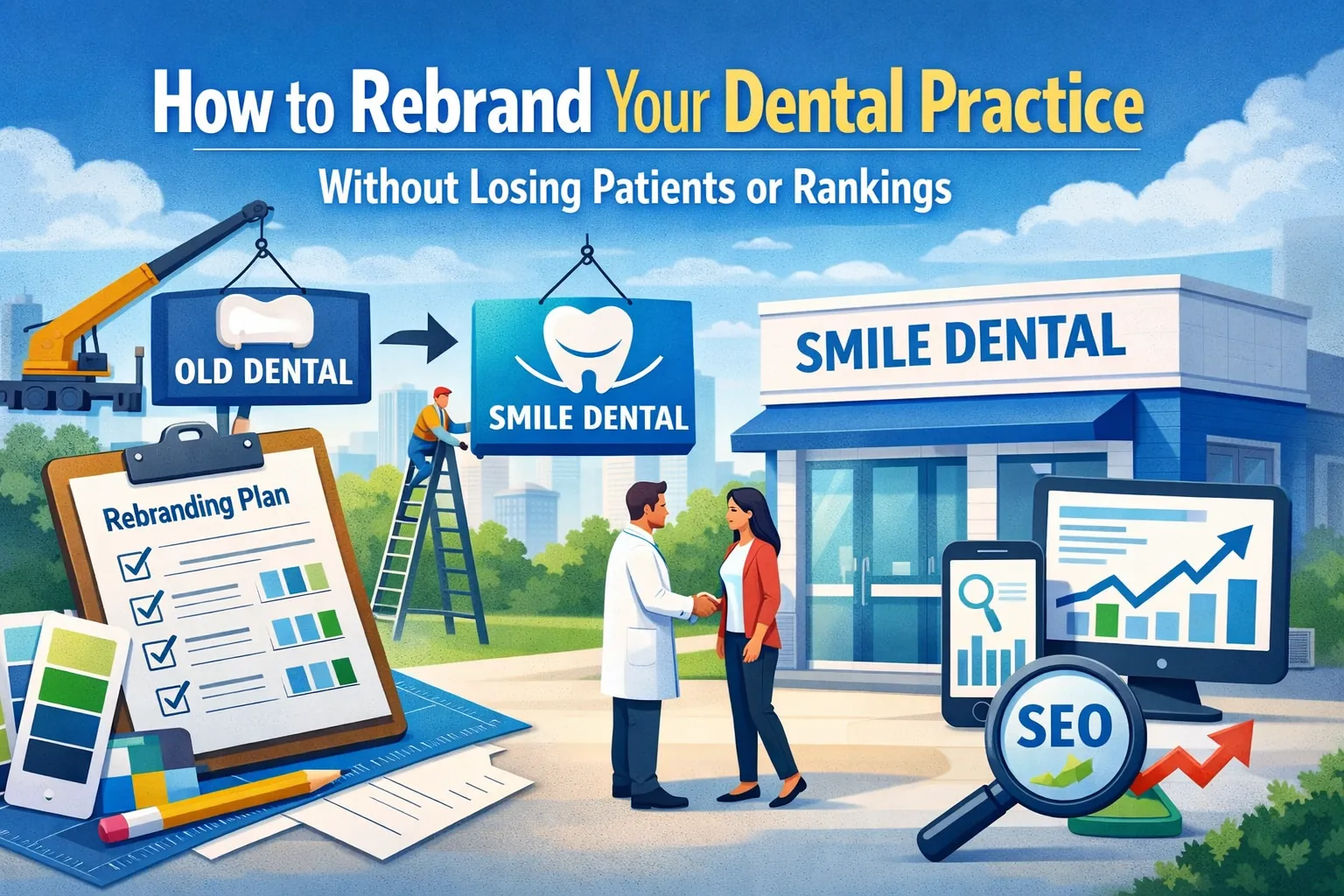 Rebranding a dental practice the right way means aligning your visual identity, messaging, website, and digital presence around a clear strategy—without losing the patients, search rankings, or reputation you’ve already built. Rebranding a dental practice the right way means aligning your visual identity, messaging, website, and digital presence around a clear strategy—without losing the patients, search rankings, or reputation you’ve already built.
Whether you’re updating a dated logo, changing your practice name after an acquisition, or repositioning to attract a different patient base, a rebrand touches every part of how people find and perceive your practice. Done well, it strengthens trust and drives growth. Done carelessly, it erases years of dental marketing progress overnight.
The risk is real: even a well-executed rebrand can cause a temporary 20–40% dip in organic traffic during the recovery window, and a poorly planned migration—missing redirects, expired domains, inconsistent NAP—can cost you 50% or more of your search visibility permanently. Add confused patients and a Google Business Profile suspension to the mix, and the cost of getting it wrong far exceeds the investment of getting it right.
This guide covers the full rebranding process from initial strategy through post-launch monitoring. If you’re building a brand from scratch for a new practice, many of the same principles apply—but you won’t need the migration and SEO preservation steps. (See our pre-opening marketing timeline for startups.)
Below, you’ll learn when a rebrand is truly warranted, how to build the brand strategy foundation before touching any visuals, how to protect your search rankings through 301 redirects and NAP consistency, and how to communicate the change to patients so they stay engaged rather than confused.
Written for: dental practice owners, office managers, and marketing teams planning a rebrand—whether it’s a visual refresh, a name change after an acquisition, or a full repositioning.
TL;DR
If you only remember seven things, remember these:
| 1. |
Start with strategy, not design - define your target patient, unique value proposition, and brand personality before choosing colors or fonts
|
| 2. |
Know when a rebrand is actually necessary - outdated visuals, a practice acquisition, a mismatch between your brand and the patients you serve, or competitive pressure in your market
|
| 3. |
Protect your SEO at every step - map every URL, implement 301 redirects, update your NPI record before touching your Google Business Profile, and keep your old domain active
|
| 4. |
Keep NAP consistent everywhere - your practice name, address, and phone number must match exactly across your website, Google Business Profile, directories, and citations
|
| 5. |
Communicate proactively with patients - use email, in-office signage, social media, and appointment reminders to explain the change so patients don’t think they’ve lost their dentist
|
| 6. |
Coordinate your launch - update every touchpoint (website, signage, social profiles, printed materials, email signatures) before going public so patients encounter one consistent brand
|
| 7. |
Monitor and adjust post-launch - track organic traffic, new patient calls, and directory accuracy for 6–12 months after the rebrand to catch any issues early |
Table of Contents
When does a dental practice actually need a rebrand?
Not every practice that feels “stale” needs a full rebrand. A rebrand is a significant investment of time, money, and operational energy—so before committing, it helps to distinguish between situations that call for a refresh (updated colors, modernized logo, new photography) and situations that require a full rebrand (new name, repositioned messaging, redesigned patient experience).
A full rebrand is typically warranted when:
| • |
You’ve acquired or merged with another practice - combining two identities under one roof requires a unified brand that communicates stability to both patient bases
|
| • |
Your brand no longer matches your services or patient base - if you’ve added cosmetic dentistry, dental implant services, or sedation but your brand still signals “basic family cleanings,” there’s a mismatch between perception and reality
|
| • |
You’re struggling to differentiate from competitors - when your logo, messaging, and website look like every other practice in your market, patients have no reason to choose you over the office next door
|
| • |
Your online presence is working against you - an outdated dental website, inconsistent branding across directories, or a visual identity that signals “we haven’t updated anything since 2008” can undermine even strong clinical care
|
| • |
There’s significant negative association with the current brand - whether from a previous owner’s reputation, a PR issue, or persistent negative reviews tied to the old identity |
A visual refresh may be enough when: the underlying brand positioning is sound, but the logo, photography, or color palette simply looks dated. In these cases, updating surface elements while keeping your name, domain, and core messaging intact avoids the SEO risks and patient confusion that come with a full rebrand.
The key question: does the problem live in how people perceive you (a brand problem), or just in how things look (a design problem)? If it’s perception, you likely need a rebrand. If it’s just aesthetics, a refresh will do.
> Back to Table of Contents
Build the brand strategy before you touch any visuals
A pattern we commonly see: a practice owner gets excited about rebranding, jumps straight to logo design, picks colors they personally like, and ends up with a brand that doesn’t resonate with the patients they’re actually trying to attract. The visual identity is the output of brand strategy—not the starting point.
Define your target patient
Before choosing fonts or colors, get specific about who you want to attract. A cosmetic-focused practice targeting image-conscious professionals needs a completely different brand than a family dental practice in a suburban neighborhood. Consider demographics (age, income, family status), psychographics (what motivates their dental decisions), and the specific services they’re most likely to seek.
Articulate your unique value proposition
What makes your practice meaningfully different from the three closest competitors? This isn’t about being “friendly” or “caring”—every dentist says that. It might be advanced technology like same-day crowns, a spa-like patient experience, extended evening hours for working professionals, or deep expertise in a specialty like implant dentistry or full-mouth rehabilitation. Your UVP becomes the foundation that every brand decision builds on.
Establish your brand personality and voice
Think of your brand as a person. Is it warm and approachable, or sleek and clinical? Is it playful (pediatric practices often benefit from this) or authoritative (implant and cosmetic practices tend to lean here)? Document this personality in a brief brand guide so that everyone—your marketing team, front desk staff, and any agencies you work with—communicates consistently. Your website messaging should reflect this same voice.
What we typically find: practices that invest 2–4 weeks in strategy before starting design end up with a stronger brand and a faster design process, because the designer has clear direction instead of guessing what the practice wants.
> Back to Table of Contents
Create a visual identity that works across every touchpoint
Once the strategy is locked in, the visual identity brings it to life. This is where your logo, color palette, typography, and imagery come together to create a cohesive look that patients recognize whether they’re visiting your dental website, scrolling past your social media posts, or walking into your office.
Logo design considerations
Your logo needs to work at every size—on a billboard, a business card, a browser tab favicon, and a social media avatar. Avoid overly complex designs that lose clarity at small sizes. While dental imagery like teeth or smiles can work, the most distinctive practice logos often move beyond the obvious to reflect the practice’s personality rather than its industry. Work with a professional designer rather than using generic templates—a logo that looks like every other dental practice defeats the purpose of rebranding.
Color palette and typography
Branding colors carry meaning: blues and greens convey calm and trust, warm whites and golds signal premium quality, and bright primaries can work well for pediatric practices. Choose a primary and secondary palette (typically 2–4 colors) that aligns with your brand personality and test them across digital and print applications. Typography should be legible at all sizes and complement your brand tone—a modern sans-serif for a tech-forward practice, a classic serif for a more traditional feel.
Photography and imagery standards
Stock photos of models posing as patients rarely build trust. Custom practice photography of your actual team, office, and technology gives prospective patients an honest preview of what to expect. If custom photography isn’t immediately feasible, select stock images that match your practice’s real environment in terms of diversity, age range, and setting. Document your photography standards so all future images stay consistent.
Compile everything into a brand guide: a reference document that includes your logo usage rules, color codes (hex, RGB, and CMYK), typography selections, photography guidelines, and brand voice notes. This guide ensures consistency as you roll out the rebrand across every channel.
> Back to Table of Contents
Protect your SEO during a dental practice rebrand
This is where most practices either succeed or suffer significant setbacks. A rebrand that involves a domain change, URL restructuring, or practice name change directly impacts your search engine optimization—and without careful planning, you can lose rankings that took years to build.
Map every URL before migration
Create a comprehensive spreadsheet that maps every page on your current site to its corresponding page on the new site. This includes service pages, blog posts, location pages, team bios—everything. No page should be left unmapped. This URL map becomes the foundation for your redirect strategy. If you’re also restructuring your website architecture, map the old structure to the new one simultaneously.
Implement 301 redirects for every page
A 301 redirect is a permanent redirect that tells search engines a page has moved to a new location. Google has confirmed that properly implemented 301 redirects pass nearly all link equity (the SEO value accumulated from backlinks and ranking signals) to the new URL. For dental practice rebrands, 301 redirects are critical because they preserve your search rankings, ensure patients using old bookmarks still find you, and prevent broken links from hurting your SEO.
Key redirect rules:
| • |
Redirect page-to-page, not everything to the homepage - sending every old URL to your new homepage wastes the ranking value of individual service pages and frustrates users who were looking for specific content
|
| • |
Keep your old domain active and redirecting - renew the old domain for at least 1–2 years (ideally indefinitely) so backlinks continue to pass value and patients with old bookmarks still reach you
|
| • |
Test every redirect before going live - use a staging environment to verify that each old URL correctly reaches its new destination
|
| • |
Avoid redirect chains - if Page A already redirects to Page B, don’t redirect Page B to Page C; update the chain so Page A goes directly to Page C |
Use Google Search Console’s Change of Address tool
If your rebrand involves a new domain, add and verify the new domain in Google Search Console, then use the Change of Address feature in your old domain’s property. This signals Google to prioritize crawling your new site and speeds up the re-indexing process.
Update your NPI record first
For dental practices, the National Provider Identifier (NPI) record in the NPPES database functions as a “source of truth” that many healthcare directories (Healthgrades, Vitals, WebMD) and even Google cross-reference. Update your NPI with your new practice name and website before updating your Google Business Profile. This creates a verification trail that reduces the risk of profile suspension.
Expect a temporary traffic dip
Even with perfect execution, most practices see a temporary 20–40% dip in organic traffic during the 3–6 month recovery window, with full stabilization sometimes taking 6–12 months. Plan for this in your marketing budget by maintaining or increasing paid search advertising during the transition period so patient flow doesn’t drop. Tracking your marketing KPIs closely during this window helps you distinguish a normal dip from a redirect or indexing problem.
> Back to Table of Contents
Update your Google Business Profile without getting suspended
Your Google Business Profile is one of the most important assets for local search visibility. It’s also one of the most fragile during a rebrand. Google cross-references your GBP information against your NPI record, data aggregators, and directory listings—and if those sources still show your old information when you update your profile, Google may flag the change as suspicious and suspend your listing.
Follow this sequence to minimize risk:
| 1. |
Update your NPI/NPPES record with the new practice name and website (allow 1–2 weeks for propagation)
|
| 2. |
Update your website with the new name, branding, and NAP information on every page
|
| 3. |
Update major directories (Healthgrades, Yelp, Facebook, Vitals, Zocdoc) with consistent citation data
|
| 4. |
Update your Google Business Profile —change the business name, update the website URL, upload your new logo and photos, and publish a Google Post announcing the rebrand
|
| 5. |
Respond to any re-verification requests promptly —name changes may trigger re-verification that takes 5–14 days |
NAP consistency is non-negotiable: your practice name, address, and phone number must appear identically across your website, GBP, and every directory listing. Even small differences—like “St.” vs. “Street” or a missing suite number—can confuse search engines and lower your local search rankings. Use a citation management service or a local SEO audit to verify exact consistency across 50+ directories.
If your rebrand includes both a name change and a domain change, consider waiting 1–2 weeks after updating your website and NPI before making changes to your GBP. This gives Google time to detect the new information through other sources first.
> Back to Table of Contents
Communicate the rebrand to patients
A common mistake is treating the rebrand as an internal event and forgetting that your patients need to understand what’s happening. Without proactive communication, patients who see an unfamiliar name on their appointment reminder or an unrecognized logo on social media may think their dentist has closed or that they’ve been transferred to a different practice.
Build a communication plan that covers three phases:
Before the launch (2–4 weeks out)
| • |
Send a personalized email or letter - explain what’s changing (and what isn’t), reassure patients that the same team and same quality of care will continue, and express genuine excitement about the next chapter; an email marketing sequence works well for this
|
| • |
Train your front desk and clinical team - every staff member should be able to explain the rebrand confidently and answer common questions like “Did the practice get sold?” or “Is my dentist leaving?”
|
| • |
Place in-office signage - “Exciting news: we’re becoming [New Name]!” with a brief explanation visible in the reception area |
During the launch
| • |
Announce on social media - share the story behind the rebrand, introduce the new look, and emphasize continuity of care; use your social media content framework to plan a series of launch posts rather than a single announcement
|
| • |
Update your voicemail and phone greeting - “Thank you for calling [New Name], formerly [Old Name]” for at least 3–6 months
|
| • |
Add a “Formerly [Old Name]” note - include this on your website’s About page, in your GBP description, and on any printed materials for 6–12 months to help patients and search engines connect the old and new identities |
After the launch (ongoing)
| • |
Include a brief mention in appointment reminders - for the first 3–6 months, add a line like “Reminder: [Old Name] is now [New Name]—same team, same great care”
|
| • |
Monitor reviews and questions - watch for confused reviews or questions on Google and social media, and respond to reviews promptly with clarification
|
| • |
Celebrate the milestone - consider a small open house, a social media campaign, or a patient appreciation event that reintroduces the practice under its new identity |
> Back to Table of Contents
Coordinate the launch across every channel
A phased rollout where some channels show the old brand and others show the new brand creates confusion for both patients and search engines. The goal is a coordinated launch where every touchpoint reflects the new identity simultaneously.
Rebrand launch checklist:
| • |
Website - new website design live with 301 redirects in place, updated schema markup, and “Formerly [Old Name]” on the About page
|
| • |
Google Business Profile - name, URL, logo, photos, and description updated (after NPI and directories are aligned)
|
| • |
Social media profiles - updated profile photos, cover images, bios, and website links across all active social media platforms
|
| • |
Directory listings - NAP updated across Healthgrades, Yelp, Vitals, Zocdoc, the local chamber of commerce, and any dental association listings
|
| • |
Physical signage - exterior signs, window graphics, and interior branding updated or scheduled for installation on launch day
|
| • |
Printed materials - new business cards, appointment cards, letterhead, and patient welcome packets ready
|
| • |
Email and communication systems - updated email signatures, appointment reminder templates, and recall message templates
|
| • |
Advertising - any active paid search or video marketing campaigns updated with new branding, URLs, and messaging |
> Back to Table of Contents
Common dental rebranding mistakes to avoid
In our work with dental practices, we see the same mistakes repeated. Avoiding these can save months of recovery time and thousands of dollars in lost patient volume.
| 1. |
Skipping brand strategy and jumping to logo design - a logo designed without a clear target patient, UVP, or brand personality may look attractive but fail to attract the right patients or differentiate from competitors
|
| 2. |
Changing your practice name without a compelling reason - a name change is the most disruptive form of rebranding; it resets name recognition, complicates SEO, and confuses patients; only pursue it when the current name is genuinely a liability
|
| 3. |
Ignoring SEO during the transition - failing to implement 301 redirects, leaving the old domain to expire, or not updating Google Search Console can erase years of organic search visibility in weeks
|
| 4. |
Updating Google Business Profile before directories and NPI - this is the most common trigger for GBP suspension during a rebrand; always create the “digital paper trail” in supporting sources first
|
| 5. |
Inconsistent NAP across platforms - even minor discrepancies between your website, GBP, and directory listings can hurt your local Map Pack rankings and confuse patients
|
| 6. |
Forgetting to communicate with existing patients - patients who don’t understand the change may assume the practice closed, skip their next appointment, or leave confused reviews
|
| 7. |
Trying to DIY everything - rebranding involves design, web development, SEO migration, directory management, and patient communication; underestimating the scope leads to gaps that cost more to fix later |
> Back to Table of Contents
Talk to a dental marketing team that manages rebrands
Rebranding your dental practice is a high-stakes project that affects everything from how patients find you online to how they feel when they walk through your door. WEO Media has guided dental practices through rebrands of every scale—from visual refreshes to full name changes with domain migrations. If you’re planning a rebrand and want to protect your search rankings, retain your patients, and launch with confidence, 888-246-6906 to talk with our team or schedule a consultation to start building a plan that fits your practice.
> Back to Table of Contents
FAQs
How much does it cost to rebrand a dental practice?
Costs vary widely depending on scope. A visual refresh (updated logo, color palette, and photography) may range from a few thousand dollars, while a full rebrand with a new name, website redesign, SEO migration, signage, and printed materials can be a significantly larger investment. The biggest hidden cost is often lost revenue from a poorly executed transition, which makes professional guidance a worthwhile part of the budget.
How long does a dental practice rebrand take?
Plan for 3 to 6 months from initial strategy through launch. The strategy and design phases typically take 4 to 8 weeks, website development and SEO migration take another 4 to 8 weeks, and directory updates, patient communication, and signage production fill the remaining time. Rushing the process increases the risk of mistakes that are expensive to correct.
Will I lose my Google reviews if I rebrand?
No, as long as you update your existing Google Business Profile rather than creating a new one. Reviews are tied to your GBP listing, not your practice name. When you change the business name within your existing profile, your reviews carry over. Creating a new profile from scratch would mean starting with zero reviews.
How long does it take to recover SEO after a dental practice rebrand?
With proper 301 redirects, updated directory listings, and Google Search Console configuration, most practices see initial recovery within 3 to 6 months, with full stabilization by 6 to 12 months. Practices that skip redirect implementation or allow old domains to expire often experience steeper and longer traffic losses.
Should I keep my old domain after rebranding?
Yes. Keep the old domain active with 301 redirects pointing to your new site for at least 1 to 2 years, and ideally indefinitely. This preserves backlink equity, prevents competitors from acquiring the domain, and ensures patients using old bookmarks still reach your practice. The annual renewal cost is minimal compared to the SEO value retained.
What is the difference between a brand refresh and a full rebrand?
A brand refresh updates surface-level elements like your logo, color palette, photography, and website design while keeping your practice name, domain, and core positioning intact. A full rebrand involves changing your practice name, repositioning your messaging, redesigning your entire identity, and often migrating to a new domain. A refresh carries lower risk and cost, while a full rebrand is appropriate when the underlying brand no longer fits your practice.
How do I tell my patients about the rebrand?
Use multiple channels starting 2 to 4 weeks before launch. Send a personalized email or letter explaining what is changing and what is staying the same, place in-office signage, train your team to answer questions confidently, and announce on social media. After launch, add a note to appointment reminders and keep a “Formerly [Old Name]” reference on your website and phone greeting for at least 6 months.
Can rebranding help attract new patients?
Yes, when the rebrand solves a real positioning problem. If your current brand doesn’t reflect the services you offer, fails to appeal to your target demographic, or looks outdated compared to competitors, a well-executed rebrand can strengthen your first impression and attract patients who previously overlooked your practice. The key is that the new brand accurately represents the experience patients will actually have.
|
|