Free Dental Implant Consultations: How to Offer Them Without Devaluing Your Practice
Posted on 5/17/2026 by WEO Media |
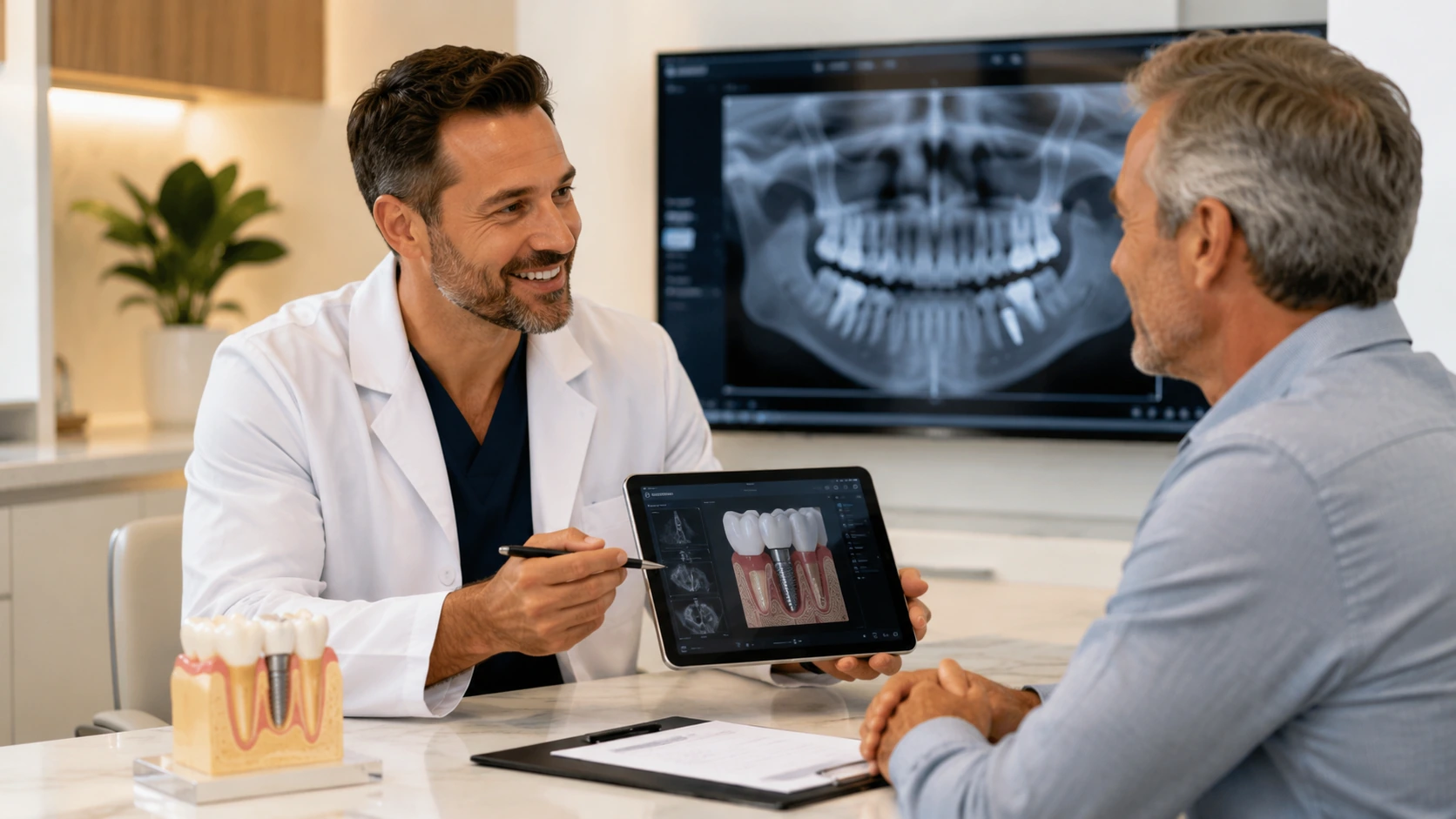 Free dental implant consultations can be offered without devaluing your practice when you structure them around clinical evaluation, mutual qualification, and a clear paid next step—not discount marketing. The practices that win with free consults don’t compete on price. They use the offer as a qualification gate that filters in serious patients, filters out tire-kickers, and earns the right to a paid diagnostic visit where the real conversion happens. Free dental implant consultations can be offered without devaluing your practice when you structure them around clinical evaluation, mutual qualification, and a clear paid next step—not discount marketing. The practices that win with free consults don’t compete on price. They use the offer as a qualification gate that filters in serious patients, filters out tire-kickers, and earns the right to a paid diagnostic visit where the real conversion happens.
The fear is reasonable: “free” can attract price shoppers, signal a hungry practice, or train patients to expect discounts on treatment. All of those outcomes are preventable. They’re a function of how the offer is designed, messaged, and operated—not of the word “free” itself. The practices producing strong accepted-case rates from free consults treat the appointment as a clinical relationship-builder, not a sales close. They pair it with a paid diagnostic step that requires real commitment before treatment is presented.
If you already offer paid consultations and convert well, this article will help you decide whether to test a free-consult funnel alongside it. If you’ve never offered free consults because you assumed they’d cheapen your brand, this will show you how to structure one that doesn’t.
Below, you’ll learn how to design a free implant consultation offer that protects your fee structure, attracts patients who can afford treatment, and converts qualified consults into accepted cases—without discount language, fake urgency, or the bait-and-switch tactics that erode trust over time.
Written for: general dentists, prosthodontists, periodontists, and oral surgeons who place or restore implants and want to grow case volume without competing on price.
TL;DR
If you only do five things, do these:
| • |
Position the consult as a clinical evaluation - not a sales pitch or a discount; the language and pre-appointment touchpoints should signal professional expertise
|
| • |
Set clear scope upfront - what’s included in the free visit, what isn’t, and what the paid next step looks like
|
| • |
Charge for diagnostic imaging separately - a CBCT or panoramic fee signals the consult has real clinical value and self-qualifies budget readiness
|
| • |
Screen leads before the appointment - five short questions about timeline, decision authority, and budget awareness reduce no-shows and protect chair time
|
| • |
Track consult-to-treatment conversion as a separate metric - if you can’t see show rate, diagnostic conversion, and case acceptance by source, you can’t fix what’s leaking |
Table of Contents
Why free implant consultations work when structured correctly
The strategic argument for offering free implant consults isn’t that they generate more leads—although they do. It’s that they reduce friction at the top of a marketing funnel where the average patient is doing weeks of quiet research, reading reviews, comparing practices, and evaluating cost long before they pick up the phone. A no-cost evaluation removes one of the last barriers to that first conversation.
What separates practices that benefit from free consults vs. practices that get burned isn’t whether they charge for the consult. It’s what happens after someone responds to the offer.
Three patterns we see in practices that win with free consults:
| • |
They treat the consult as the start of a multi-step pathway - the free visit’s job is to earn the paid diagnostic appointment, not to close the case in 30 minutes
|
| • |
They use scope, time investment, and a separate imaging fee to self-qualify - patients who refuse to travel, fill out paperwork, or pay for a CBCT are signaling budget concerns that will continue throughout treatment
|
| • |
They track conversion separately by lead source - the consult that came from a Google search converts very differently from one that came from a social ad with a discount headline |
The practices that get burned usually share the opposite pattern: they market “free” without context, let anyone book without screening, treat the visit as a sales pitch, and lose the majority of consults to no-shows or one-and-done visits where the patient never returns.
A note on specialists: periodontists, oral surgeons, and prosthodontists sometimes resist offering free consults because they worry it undermines specialist positioning. The opposite is more often true—a structured free evaluation paired with a paid diagnostic phase actually reinforces specialist authority by separating the introductory conversation from the clinical workup. Patients perceive the paid imaging visit as the “real” appointment, which signals expertise rather than diluting it.
> Back to Table of Contents
What to include (and exclude) in a free implant consultation
The scope of a free implant consult is the most important design decision you’ll make. Get it right and the visit feels valuable to the patient while protecting your clinical time. Get it wrong and you’re either doing a full diagnostic workup for free or leaving the patient feeling like the appointment was a sales call dressed up as an exam.
What a well-designed free implant consult includes:
| • |
A 20–30 minute clinical conversation with the doctor or a clinically trained treatment coordinator, not just front-desk staff
|
| • |
A visual oral exam focused on implant candidacy - bone visibility, soft tissue health, occlusion, and obvious contraindications
|
| • |
A review of relevant medical history including medications, smoking status, and conditions that affect implant outcomes
|
| • |
A discussion of restoration options appropriate to the patient’s situation: single implant, implant-supported bridge, full-arch fixed, or overdenture
|
| • |
A tier-based pricing range—not an itemized quote—so the patient leaves understanding the order of magnitude
|
| • |
A clearly explained next step: the paid diagnostic visit, what it includes, what it costs, and why it’s necessary |
What should not be included (or should require a separate fee):
| • |
3D CBCT imaging - present this as a separate diagnostic fee at the paid visit, not as part of the free consult
|
| • |
Detailed itemized treatment plans - these belong in the diagnostic phase after imaging
|
| • |
Impressions or surgical guide planning - clinical workup steps require paid visits
|
| • |
Sedation consultations - these involve medical history review and time that warrants a separate appointment
|
| • |
Second opinions on existing treatment plans - these aren’t free-consult candidates; charge for the review or refer back to the treating doctor |
Why the separate imaging fee matters: charging a diagnostic imaging fee for a CBCT (or whatever your local market supports) is the single most powerful self-qualification signal in implant marketing. Patients who refuse to pay for imaging are almost always communicating budget concerns that will resurface when the full treatment fee is presented. The imaging fee filters the funnel before you’ve invested chair time on a detailed treatment plan.
> Back to Table of Contents
How to message free consults without attracting price shoppers
The words you use in the offer determine the kind of patient who responds. Two practices can run identical free-consult offers and get completely different patient mixes based entirely on the language in the headline, ad copy, and landing page.
Messaging patterns to avoid:
| • |
“Save on your implant consultation” - frames the offer as a discount and primes patients to negotiate on treatment
|
| • |
“Free consultation—call now!” - urgency-plus-free language reads as desperate and attracts the wrong audience
|
| • |
“No-cost evaluation, limited time” - fake scarcity erodes trust and signals discount marketing
|
| • |
“Don’t miss this offer” - any sales-pressure language undermines clinical positioning |
Messaging patterns that work:
| • |
“Find out if dental implants are right for you—complimentary candidacy evaluation” - leads with the outcome the patient actually wants (an answer), not the price
|
| • |
“Meet our implant team and review your options at no cost” - emphasizes the relationship and clinical expertise, not savings
|
| • |
“Schedule a complimentary implant evaluation with our doctors” - the word “complimentary” signals professional service more than “free”
|
| • |
“Not sure if you’re a candidate? Start with a no-obligation consultation” - positions the offer around the patient’s real question |
Supporting elements that reinforce value on the landing page:
| • |
Show credentials prominently - implant training, fellowship status, years of experience, case volume
|
| • |
Show before/after results - case photography is the most persuasive content on an implant landing page
|
| • |
Show technology - CBCT, guided surgery, and in-house lab capabilities all communicate clinical seriousness
|
| • |
Show outcomes - patient testimonials about the experience and the result, not the price |
A pattern we commonly see: practices that lead with credentials and outcomes get consult requests from patients who are budget-aware but value-driven. Practices that lead with “Free!” in their headline get consults from patients shopping the lowest price across multiple offices—and those patients rarely accept treatment at any practice.
> Back to Table of Contents
Qualifying patients before they book the appointment
Pre-appointment screening is where most practices lose the most leverage. The patient calls, the front desk books them, and no one asks the questions that would identify whether this person is 30 days from treatment or 18 months out and just gathering information.
Five screening questions to integrate into scheduling:
| 1. |
“When are you thinking about moving forward with treatment?” - identifies decision timeline; under 90 days is strong, 3–6 months is workable, over 12 months is research mode
|
| 2. |
“Are you currently evaluating other practices for this?” - tells you where you are in the consideration set without putting the patient on the defensive
|
| 3. |
“Do you have dental insurance, an HSA or FSA, or a financing plan in mind for this?” - normalizes the budget conversation without asking “can you afford it”
|
| 4. |
“What’s prompted you to look into implants now?” - reveals motivation; pain, recent extraction, or denture failure are stronger signals than “just curious”
|
| 5. |
“Will anyone else be part of this decision—a spouse, adult child, primary dentist?” - identifies decision authority and surfaces who should attend the consult |
How to use the answers:
| • |
Don’t disqualify based on the answers - use them to inform appointment prep, education materials sent ahead, and how the doctor approaches the conversation
|
| • |
High-intent leads get scheduled within 7–10 days - urgency matters when motivation is high and the patient is comparing practices
|
| • |
Research-mode leads get scheduled with extra time and pre-visit education - sending video content or a printed implant primer in advance reduces the “I need to think about it” close
|
| • |
Patients refusing all screening questions are a soft red flag - flag for the doctor’s awareness and adjust the appointment approach |
Pre-appointment touchpoints that reduce no-shows:
| • |
Confirmation message within an hour of booking - sets a professional tone and confirms the appointment is real
|
| • |
Pre-visit questionnaire 48 hours out - medical history, goals, prior dental work; the act of filling it out increases psychological commitment
|
| • |
Reminder with parking and prep instructions 24 hours out - reduces the practical friction of attending
|
| • |
Day-of text confirming the appointment - last-mile reduction in no-shows |
> Back to Table of Contents
The conversion pathway from free consult to accepted case
The single biggest mistake practices make with free implant consults is trying to close the case during the free visit. The math doesn’t work. There’s no imaging yet, no detailed plan, and no committed financial step. Patients in a 20-minute conversation about a significant clinical and financial decision shouldn’t be asked to commit.
The four-stage conversion pathway that does work:
| 1. |
Free consult - relationship, candidacy, restoration options, tier-based pricing range, clear next-step explanation
|
| 2. |
Paid diagnostic appointment - CBCT or panoramic imaging, full clinical workup, written treatment plan with itemized fees
|
| 3. |
Treatment plan presentation - either at the diagnostic visit or scheduled separately; fees, financing options, timeline, surgical and restorative phases
|
| 4. |
Treatment acceptance - deposit collected, surgery scheduled, sequence of restorative appointments mapped |
Why each stage qualifies further:
| • |
The free consult earns the right to the paid diagnostic - patients who don’t book the next step are signaling weak intent or budget concerns
|
| • |
The paid diagnostic earns the right to present treatment - patients who pay for imaging are typically several times more likely to accept treatment than patients who only received a free consult
|
| • |
The treatment presentation earns the deposit - by the time you’re presenting an itemized plan, you’ve had two prior visits to build clinical authority
|
| • |
The deposit secures the schedule - financial commitment combined with a calendar date is what converts “I’ll think about it” into a kept case |
Realistic conversion benchmarks at each stage:
| • |
Free consult to paid diagnostic - 50–70% when leads are well-screened; below 40% suggests scope, messaging, or qualification problems
|
| • |
Diagnostic to treatment plan presentation - 90%+ at well-run practices; this stage shouldn’t leak much because patients have already committed to paid imaging
|
| • |
Treatment plan to acceptance - 40–60% depending on case complexity and financing options offered
|
| • |
Overall free consult to accepted case - 20–35% across the full funnel for well-designed offers; results vary by market, case mix, and operational maturity |
Practices benchmarking below these numbers should look first at qualification (are the wrong patients booking?) and second at the consult experience (is the doctor building authority or rushing the visit?). Adjusting upstream screening usually moves the needle faster than reworking the consult script itself.
> Back to Table of Contents
Common mistakes that devalue your implant practice
Most of the damage from free consult offers comes from a handful of operational mistakes that compound over time. The offer itself isn’t usually the problem—the way it’s executed is.
Ten mistakes to audit your practice against:
| 1. |
Treating the free consult like a sales close - high-pressure language, “today only” pricing, or asking for deposits in the first visit
|
| 2. |
Using discount language in marketing - any version of “save” or “sale” primes patients to negotiate
|
| 3. |
Failing to charge for imaging - giving away the CBCT removes the most important qualification gate in the funnel
|
| 4. |
Letting unqualified leads consume clinical time - no pre-appointment screening means every booking is a coin flip
|
| 5. |
Discounting treatment to “save” the case after the consult - this trains future patients to expect price negotiation and damages referral quality over time
|
| 6. |
Not tracking consult source - if you can’t see which marketing channel produces qualified consults, you’re flying blind on budget allocation
|
| 7. |
Letting admin staff conduct the clinical consult - patients in implant decisions need clinical authority in the room, not just front-desk rapport
|
| 8. |
Skipping the written treatment plan summary - patients leave without a clear record of what was discussed, which weakens follow-up and family discussions
|
| 9. |
Offering “free second opinions” without parameters - unscoped second opinions attract patients trying to negotiate elsewhere; charge for or scope these tightly
|
| 10. |
Having no documented next-step protocol - if every doctor and coordinator handles the close differently, conversion will swing wildly |
A pattern we typically find: practices addressing three or four of these mistakes in the first 90 days see consult-to-case conversion improve meaningfully without changing the offer itself or the marketing spend. The funnel was leaking from operational holes, not from the word “free.”
> Back to Table of Contents
How to measure ROI on free implant consultations
A free consult program that isn’t measured will quietly drift in the wrong direction. The metrics aren’t complicated, but most practices either skip them entirely or measure the wrong ones—tracking total leads instead of accepted cases by source, or vanity metrics like impressions instead of cost per accepted case.
Core metrics to track monthly:
| • |
Consults booked - total scheduled by source (organic search, paid search, social, referral, repeat)
|
| • |
Show rate - attended ÷ booked; healthy practices typically run 75–90%
|
| • |
Free consult to paid diagnostic conversion - the most important top-of-funnel metric
|
| • |
Diagnostic to treatment acceptance conversion - measures how well the clinical and financial conversation lands
|
| • |
Average case value - segmented by case type (single, multi-unit, full arch)
|
| • |
Cost per consult - marketing spend ÷ total consults
|
| • |
Cost per accepted case - marketing spend ÷ accepted cases
|
| • |
Return on marketing spend - average case value × accepted cases ÷ marketing spend |
Decision thresholds worth acting on:
| • |
Cost per accepted case above 15–20% of average case value - the offer, the targeting, or the conversion process needs adjustment
|
| • |
Show rate below 70% - qualification and pre-appointment touchpoints need strengthening
|
| • |
Free consult to diagnostic conversion below 40% - the consult experience itself needs work; usually a scope or authority issue
|
| • |
Diagnostic to treatment conversion below 30% - financial presentation, financing options, or treatment plan clarity need review |
How often to review the data:
| • |
Weekly - consults booked, show rate, qualification flags from screening calls
|
| • |
Monthly - full funnel metrics by source, average case value, cost per accepted case
|
| • |
Quarterly - offer design, messaging, landing page conversion, and competitive positioning |
The practices that benefit most from free consults aren’t the ones with the best ads—they’re the ones who treat the entire funnel as a measurable, fixable system and review the numbers before they make changes.
> Back to Table of Contents
Talk to WEO Media about your implant marketing
If you’re considering a free implant consultation offer or trying to fix one that isn’t producing the case acceptance you expected, our dental implant marketing team can audit your current funnel, identify the leaks, and build a measurement framework that ties marketing spend to accepted cases. Call WEO Media - Dental Marketing at 888-246-6906 or schedule a consultation to start the conversation.
> Back to Table of Contents
FAQs
Should specialists offer free implant consultations?
Yes, when paired with a paid diagnostic phase. Periodontists, oral surgeons, and prosthodontists sometimes worry that free consults undermine specialist positioning, but a structured free evaluation followed by a paid imaging and treatment-planning visit actually reinforces expertise by separating the introductory conversation from clinical workup. The patient perceives the paid diagnostic as the “real” appointment, which signals clinical seriousness rather than diluting specialist authority.
How long should a free implant consultation last?
Twenty to thirty minutes is the typical range. Shorter than 20 minutes feels rushed and doesn’t build clinical authority; longer than 30 minutes turns the free visit into the diagnostic appointment and devalues the paid next step. The goal is enough time to establish candidacy, discuss restoration options, and earn the paid diagnostic visit—not to complete a full workup.
Should I include 3D imaging in a free implant consultation?
No. Charging a separate diagnostic fee for CBCT or panoramic imaging is the most important self-qualification step in an implant funnel. Patients who refuse to pay for imaging are almost always signaling budget concerns that will resurface when the full treatment fee is presented. The imaging fee filters the funnel before chair time is invested in a detailed treatment plan.
What if a patient asks for treatment fees during the free consult?
Give a tier-based range, not an itemized quote. Patients deserve to leave the consult understanding the order of magnitude of treatment—a single implant range, a multi-unit range, and a full-arch range are typical tiers. Itemized fees require imaging and a written treatment plan, which is what the paid diagnostic visit is for. Be transparent that the precise fee depends on findings at the diagnostic appointment.
Can a free implant consultation be conducted virtually?
A virtual screening conversation can work as a pre-qualification step, but the clinical consult itself should be in-person. A brief 10–15 minute video call to review the patient’s situation, set expectations, and confirm fit before booking the in-office visit can reduce no-shows and help the patient feel prepared. Virtual-only consults skip the in-person rapport and physical exam that drive conversion to the paid diagnostic step.
How do I handle a patient consulting multiple implant practices at once?
Acknowledge it directly during the screening conversation and at the consult. Patients researching multiple practices are usually decision-stage, which is a strong signal—not a threat. The practice that wins typically isn’t the cheapest; it’s the one that demonstrated the clearest clinical reasoning, the strongest credentials, and the most professional next-step pathway. Don’t discount to compete; differentiate on expertise, technology, and patient experience.
How quickly should I follow up after a free implant consult?
Within 24 hours for the first touchpoint, with a written summary of what was discussed, the proposed next step, and the details of the diagnostic visit. A second follow-up at day 7 and a third at day 21 captures patients who needed time to think or talk with a spouse. After day 30, leads should move to a longer-term nurture sequence rather than active follow-up calls.
Is it better to offer free consults or paid consults for implants?
It depends on the market and how the offer is structured. Practices in competitive metros where multiple offices market implants often benefit from a free-consult funnel paired with a paid diagnostic step. Practices in less competitive markets or with strong referral networks may find paid consults convert better because they self-select for committed patients. Testing both with proper source tracking is the only way to know what works for a specific practice.
How do I prevent free consult patients from negotiating treatment fees?
Three things prevent fee negotiation: avoid discount language in all marketing, charge separately for diagnostic imaging so the free portion is clearly scoped, and present treatment fees with confident financing options rather than open-ended negotiation. When a patient asks for a discount, the response should focus on financing or staged treatment, not price reduction. Discounting after the consult trains patients and referrals to expect it on every future case. |
|