How to Structure Dental PPC Campaigns to Attract High-Value Cases
Posted on 2/15/2026 by WEO Media |
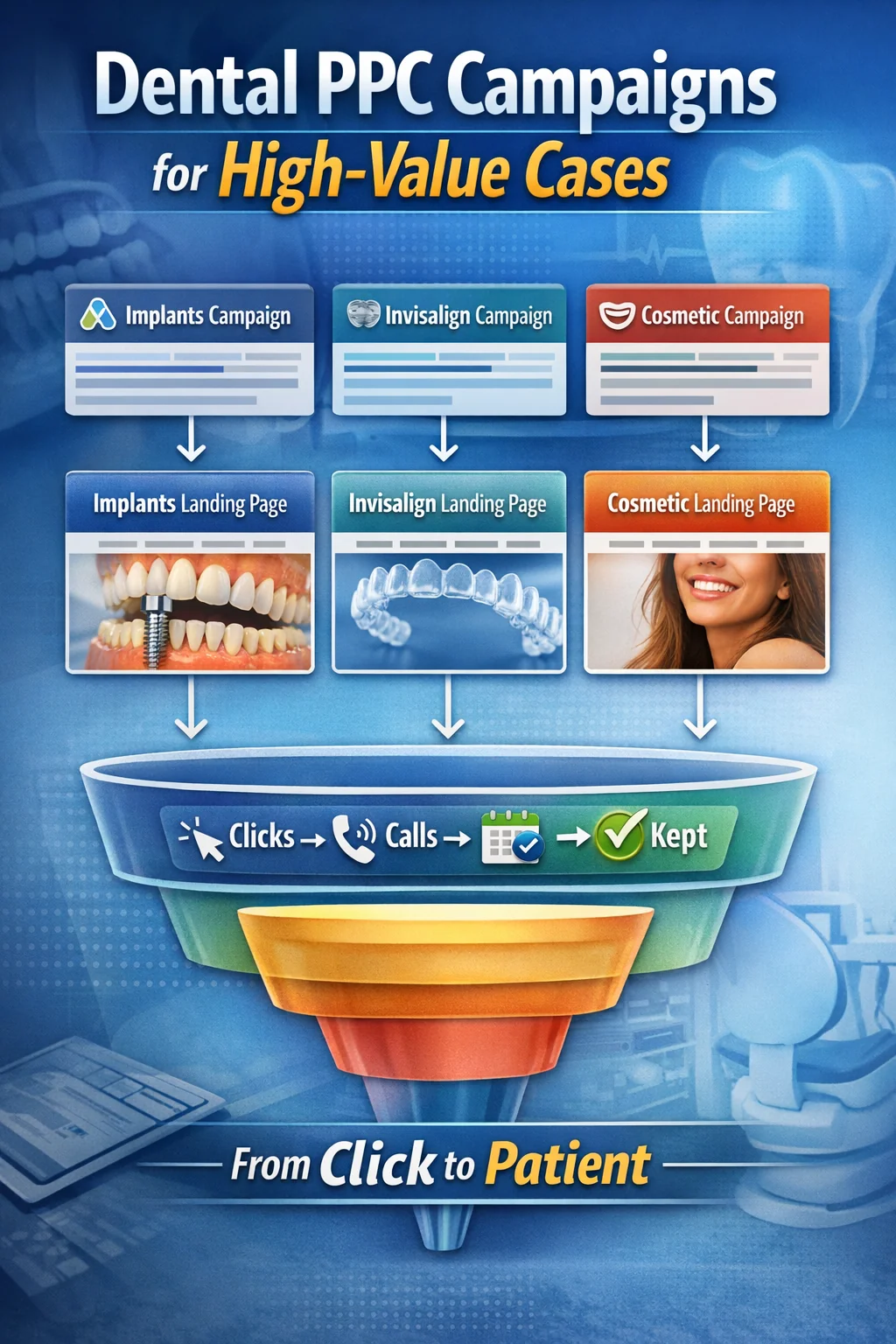 The best way to structure dental PPC campaigns for high-value cases is to separate campaigns by service, target high-intent keywords, and send each click to a dedicated landing page—not your homepage. Most dental practices running pay-per-click ads make the same structural mistake: one campaign, a handful of broad keywords, and every click landing on a general services page. The result is wasted budget on low-value clicks and no clear picture of which services actually drive revenue. Structuring your PPC campaigns around your highest-value procedures changes both what you attract and what you can measure. The best way to structure dental PPC campaigns for high-value cases is to separate campaigns by service, target high-intent keywords, and send each click to a dedicated landing page—not your homepage. Most dental practices running pay-per-click ads make the same structural mistake: one campaign, a handful of broad keywords, and every click landing on a general services page. The result is wasted budget on low-value clicks and no clear picture of which services actually drive revenue. Structuring your PPC campaigns around your highest-value procedures changes both what you attract and what you can measure.
The math is straightforward: a single dental implant case can generate several thousand dollars in revenue. If your cost to acquire that patient through Google Ads is a few hundred dollars, the return is significant—but only if your campaign structure makes that acquisition possible. When implant keywords, Invisalign keywords, and general dentistry keywords all share the same campaign, you can’t control budget, can’t tailor ad copy, and can’t optimize landing pages for each service. That’s where most practices lose money.
Already running PPC but unsure which keywords deserve their own campaigns? Keep reading. If you’re not yet running paid ads, start with our PPC overview for foundational setup guidance.
Below, you’ll learn how to build a campaign architecture that prioritizes high-value procedures, choose keywords based on intent rather than volume, build landing pages that convert, set budgets that reflect case value, and track ROI by channel and source—cost per booked appointment, not just cost per click.
Written for: dental practice owners, marketing coordinators, and agency partners who want to shift PPC spend toward higher-value cases like implants, Invisalign, cosmetic dentistry, and full-arch restorations.
TL;DR
If you only do five things, do these:
| • |
Separate campaigns by service category - one campaign for implants, one for Invisalign, one for cosmetic, one for general/emergency so you control budget and messaging independently
|
| • |
Target intent, not volume - “dental implant specialist near me” converts at a far higher rate than “what are dental implants” even though it has lower search volume
|
| • |
Build dedicated landing pages per service - sending implant clicks to your homepage is one of the most expensive mistakes in dental PPC; each high-value service needs its own conversion-focused page
|
| • |
Align budget to case value - allocate 50–70% of budget to high-value services where a single conversion can return thousands in revenue rather than spreading spend evenly across all services
|
| • |
Measure cost per booked appointment - clicks and impressions are vanity metrics; track the full path from click → call → booked → kept to know your true acquisition cost |
Table of Contents
Campaign architecture: why structure determines ROI
A pattern we commonly see when auditing dental PPC accounts is a single campaign labeled something like “Dental Services” with ad groups for every procedure the practice offers. This flat structure creates a fundamental problem: you can’t allocate budget strategically. Google distributes spend across ad groups based on its own signals, which means your implant keywords might be starved of budget while general cleaning keywords consume the majority of your spend.
The solution is campaign-level separation by service category. Each major service type gets its own campaign, which gives you independent budget control, tailored ad copy, service-specific landing pages, and clean performance data per service line.
A well-structured dental PPC account for high-value case acquisition typically looks like this:
| • |
Campaign 1: Dental Implants - includes ad groups for single implants, implant-supported bridges, full-arch/All-on-4, and implant-related modifiers like “cost,” “specialist,” and “near me”; for a deeper look at implant-specific paid strategy, see our guide to targeted dental implant advertising
|
| • |
Campaign 2: Invisalign / Clear Aligners - ad groups for branded Invisalign terms, clear aligner alternatives, and adult orthodontics keywords; practices focused on aligner volume should also review Invisalign marketing strategies
|
| • |
Campaign 3: Cosmetic Dentistry - ad groups for veneers, smile makeovers, teeth whitening, and cosmetic-specific modifiers
|
| • |
Campaign 4: General / New Patient - ad groups for “dentist near me,” new patient specials, and general dental care
|
| • |
Campaign 5: Emergency Dental - ad groups for toothache, broken tooth, same-day emergency, and urgent care keywords
|
This structure lets you invest more heavily in the campaigns that drive the most revenue per patient. If implant cases average several thousand dollars in production and general cleanings average a few hundred, your budget allocation should reflect that difference.
Ad group organization within each campaign matters too. Group keywords by theme so your ad copy can match the searcher’s specific intent. An ad group for “All-on-4 dental implants” should have ad copy that speaks directly to full-arch replacement—not generic implant language. The tighter the match between keyword, ad copy, and landing page, the higher your Quality Score and the lower your cost per click.
> Back to Table of Contents
Keyword strategy for high-value dental cases
The most common keyword mistake in dental PPC is chasing volume over intent. A keyword like “dental implants” gets thousands of monthly searches, but many of those searchers are researching, comparing, or looking for academic information—not booking an appointment. Meanwhile, a keyword like “dental implant specialist accepting new patients” has a fraction of the volume but dramatically higher conversion potential. For a full breakdown of which keywords drive real case value, see best dental PPC keywords for high-value patient acquisition.
Intent categories for dental PPC keywords:
| • |
High intent (bottom of funnel) - “dental implant consultation [city],” “Invisalign provider near me,” “cosmetic dentist accepting new patients”—these searchers are ready to act and should get the majority of your budget
|
| • |
Medium intent (mid-funnel) - “dental implant cost,” “Invisalign vs braces,” “best cosmetic dentist [city]”—these searchers are comparing options and can convert with the right landing page
|
| • |
Low intent (top of funnel) - “what are dental implants,” “how does Invisalign work,” “types of veneers”—these are informational queries best served by SEO content, not paid clicks |
For high-value case acquisition, weight your keyword mix toward high- and medium-intent terms. Use phrase match and exact match to maintain control over which searches trigger your ads. Broad match can work with smart bidding strategies once you have sufficient conversion data, but starting with tighter match types gives you cleaner data to learn from.
Negative keywords: protecting your budget
Negative keywords are just as important as your target keywords—especially for high-value services where clicks can cost several dollars each. Without a robust negative keyword list, your implant campaign might show ads for searches like “dental implant schools,” “free dental implants,” or “dental implant complications.” For a detailed look at which terms silently drain budgets, see dental PPC keywords that waste budget vs. drive high ROI.
Build your negative keyword list from day one. Common negatives for dental PPC include:
| • |
Cost-avoidance terms - “free,” “cheap,” “discount,” “low cost,” “affordable” (unless your practice specifically targets value-conscious patients)
|
| • |
Career and education terms - “schools,” “programs,” “courses,” “salary,” “jobs,” “how to become”
|
| • |
DIY and home terms - “at home,” “DIY,” “without dentist,” “home remedies”
|
| • |
Complication and fear terms - “failed,” “horror stories,” “lawsuit,” “malpractice” (these searchers are unlikely to book) |
Review your search term report weekly—especially during the first 60 days of a campaign. This report shows the actual queries that triggered your ads, and it’s where you’ll find the unexpected terms eating your budget. We typically find that practices recover 15–25% of wasted spend in the first month just by building out their negative keyword list from search term data. Our dental PPC audit checklist walks through this process step by step.
> Back to Table of Contents
Landing pages that convert high-value clicks
Sending paid traffic to your homepage is one of the most expensive mistakes in dental PPC. Your homepage has navigation links, multiple service descriptions, team bios, and dozens of other elements competing for attention. A patient who clicked on an ad for “dental implants near me” lands on a page that talks about cleanings, orthodontics, pediatric care, and implants—buried somewhere in the middle. That patient bounces, and you’ve just paid several dollars for nothing.
Every high-value service campaign needs a dedicated landing page. That page should do one thing well: convert the visitor into a consultation request or phone call.
What we typically find on high-converting dental landing pages:
| • |
Headline that matches the ad - if your ad says “Dental Implants in [City],” your landing page headline should echo that exact phrase; this continuity reassures the visitor they’re in the right place
|
| • |
Clear, prominent call to action - a clickable phone number and a short contact form above the fold; don’t make patients scroll to find out how to reach you; see best calls to action for dental websites for proven formats
|
| • |
Social proof near the top - patient testimonials, star ratings, or online reviews build trust within the first few seconds; smile transformation galleries are particularly effective for cosmetic and implant pages
|
| • |
Service-specific content - address the questions and concerns specific to that procedure; an implant page should cover the process, what to expect, and candidacy—not a generic overview of all your services
|
| • |
Minimal navigation - remove or reduce your main site navigation on landing pages to keep the visitor focused on converting rather than wandering to other pages |
Mobile optimization is non-negotiable
The majority of dental PPC clicks come from mobile devices. If your landing page loads slowly, has tiny text, or requires pinching and zooming to fill out a form, you’re losing conversions on the platform where most of your budget is spent. Test your landing pages on multiple mobile devices. The phone number should be tap-to-call. The form should require minimal fields—name, phone number, and preferred appointment time are enough to start a conversation. Your dental website design should support fast, mobile-first landing page experiences from the start.
> Back to Table of Contents
Budget allocation and bidding for case value
Not every dental service generates the same revenue, and your PPC budget shouldn’t treat them as equal. A common pattern we see is practices splitting budget evenly across campaigns—giving implants the same monthly allocation as general dentistry. This ignores the fundamental economics of case value. If you’re still working out how much to invest overall, our guide to setting a profitable dental marketing budget covers the broader framework.
Align your budget to lifetime patient value. If a single implant case generates several thousand dollars in revenue and your cost per acquisition for that case is a few hundred dollars, the return on that spend is substantial. If a general cleaning patient generates a few hundred dollars on the first visit, the math is different—though still positive when you factor in lifetime value and referrals.
A practical budget allocation framework for high-value case acquisition:
| • |
50–70% to high-value services - implants, cosmetic procedures, Invisalign, full-arch restorations; these campaigns have higher cost per click but dramatically higher revenue per conversion
|
| • |
20–30% to general new patient acquisition - “dentist near me” and new patient campaigns that build your patient base and generate lifetime value
|
| • |
10–20% to testing and expansion - new keyword experiments, new service campaigns, geographic expansion, and seasonal promotions |
Bidding strategy selection
For practices with limited conversion data (fewer than 30 conversions per month across the account), start with manual CPC bidding or maximize clicks with a bid cap. This gives you control while you collect data. Once a campaign has accumulated sufficient conversion history—typically 30 or more conversions over 30 days—you can shift to maximize conversions—optionally with a target CPA (cost per acquisition) to guide bidding toward a specific acquisition cost. For a deeper look at lowering CPA without sacrificing lead quality, we’ve covered that process separately.
Smart bidding works best when it has enough data to learn from. Switching to target CPA on a brand-new campaign with three conversions teaches the algorithm very little. Be patient with data collection, and segment your conversion actions so the algorithm optimizes for the outcomes you actually value—phone calls and form submissions, not page views or button clicks.
Dayparting and geographic targeting
Two often-overlooked budget levers for dental PPC are ad scheduling (dayparting) and geographic targeting. If your front desk process doesn’t cover phones after 5 PM and your campaign runs ads until midnight, you’re paying for clicks that can’t convert into live conversations. Schedule ads during hours when your team can respond to inquiries—and if you use an after-hours answering service, adjust accordingly.
Geographic targeting should reflect your actual patient draw area. Most dental practices draw patients from a defined radius. Tightening your geographic targeting prevents budget from being spent on clicks from patients who are unlikely to drive to your office. For high-value services like implants, patients may travel further—so consider a wider radius for those campaigns while keeping general dentistry campaigns tighter. If you want to reach patients in surrounding communities beyond your immediate radius, service area SEO pages can supplement your paid reach organically.
> Back to Table of Contents
Tracking and measuring what matters
The most important metric in dental PPC isn’t cost per click, click-through rate, or impression share. It’s cost per booked appointment—how much you actually spend to get a patient into the chair for a specific service.
To measure this accurately, you need tracking at every stage of the conversion funnel: click → landing page visit → call or form submission → reached → booked → kept.
Essential tracking setup for dental PPC:
| • |
Call tracking with dynamic number insertion - assigns unique phone numbers to each campaign so you know which service campaign generated each call; this is foundational for dental PPC because most conversions happen by phone, not by form
|
| • |
Form submission tracking - every contact form submission should fire a conversion event in Google Ads so the algorithm can optimize toward form leads as well as calls
|
| • |
Call recording and scoring - recording calls lets you verify whether a “conversion” was actually a qualified new patient inquiry or a wrong number, existing patient, or vendor call; scoring separates real leads from noise
|
| • |
CRM or outcome logging - track what happens after the call: was the patient reached, was an appointment booked, did they show up, and what was the case value? This closes the loop between ad spend and actual revenue; see how to track dental marketing ROI by channel for the full setup |
Without call tracking, you’re guessing at which campaigns drive real patients. Without outcome logging, you can’t calculate true cost per acquisition or return on ad spend. These aren’t optional tools—they’re the infrastructure that makes smart optimization possible.
Key metrics to review weekly:
| 1. |
Cost per lead (CPL) - total spend ÷ total leads (calls + forms) per campaign; this tells you how efficiently each campaign generates inquiries; for strategies to bring this number down, see how to reduce cost per lead in dental PPC
|
| 2. |
Cost per booked appointment (CPA) - total spend ÷ booked appointments per campaign; this is your true acquisition cost and the number that matters most
|
| 3. |
Lead-to-booked rate - booked appointments ÷ total leads; low rates here often point to front desk intake issues rather than campaign problems
|
| 4. |
Return on ad spend (ROAS) - revenue from booked cases ÷ total ad spend; for high-value services, a well-structured campaign should deliver substantial returns on every dollar invested |
> Back to Table of Contents
Common structural mistakes that waste budget
In our work managing dental PPC campaigns, these are the structural errors we see most frequently—and each one directly undermines your ability to attract high-value cases. For an even more granular walkthrough, our guide to the most expensive Google Ads mistakes dentists make covers additional pitfalls:
| 1. |
One campaign for everything - lumping all services into a single campaign means Google controls your budget allocation, not you; implant clicks compete with cleaning clicks, and you can’t see which service drives ROI
|
| 2. |
Sending all traffic to the homepage - your homepage is designed for browsing, not converting; high-value PPC traffic needs focused landing pages with a single clear next step
|
| 3. |
Ignoring negative keywords - without ongoing negative keyword management, you’re paying for clicks from people searching for dental schools, free services, and DIY solutions; review your search term report weekly
|
| 4. |
Using broad match without guardrails - broad match keywords on a new campaign with no conversion history gives Google too much freedom to match your ads to irrelevant searches; start with phrase and exact match, then expand carefully
|
| 5. |
Tracking clicks instead of patients - if your reporting stops at clicks and calls, you can’t distinguish a qualified implant inquiry from a wrong number; implement call scoring and outcome logging to measure what matters
|
| 6. |
Running ads when nobody answers the phone - if your front desk closes at 5 PM and your ads run until 10 PM, every after-hours click is a wasted opportunity unless you have an answering service or after-hours form strategy in place
|
| 7. |
Equal budget across unequal services - spending the same amount on general dentistry and implant campaigns ignores the dramatically different revenue potential of each conversion |
Each of these mistakes is fixable. Most practices can restructure their PPC account—using the PPC audit checklist as a starting point—and see measurable improvement within the first 30 days.
> Back to Table of Contents
Ongoing optimization: the weekly review cycle
Launching a well-structured campaign is the starting point, not the finish line. Dental PPC requires ongoing attention to maintain performance and continue improving. The practices that get the best results treat their campaigns as a living system that gets refined every week.
A practical weekly review takes 30–45 minutes and covers:
| • |
Search term review - identify new negative keywords from actual search queries that triggered your ads; look for irrelevant or low-intent terms consuming budget
|
| • |
Cost per lead by campaign - compare each campaign’s CPL to the previous week; sudden spikes often signal new competitor activity, keyword drift, or landing page issues
|
| • |
Call quality review - listen to a sample of recorded calls to verify lead quality and identify front desk conversion opportunities; a campaign generating great leads means nothing if calls aren’t handled well
|
| • |
Ad copy performance - compare click-through rates across ad copy variations; pause underperformers and test new copy that addresses specific patient concerns or highlights differentiators
|
| • |
Budget pacing - verify each campaign is spending its full budget without going over; campaigns that consistently underspend may need keyword expansion or bid adjustments |
Beyond the weekly review, run a deeper monthly analysis that examines trends in cost per booked appointment, compares performance across service campaigns, and identifies opportunities to shift budget from lower-performing to higher-performing campaigns. This rhythm of weekly maintenance and monthly strategic review keeps your campaigns competitive and cost-effective.
Seasonal adjustments matter too. Cosmetic dentistry inquiries often spike before wedding season and around the new year. Invisalign campaigns may see increased interest at the start of the school year or in January. Emergency dental campaigns tend to stay consistent year-round. Anticipating these patterns lets you increase budget proactively rather than scrambling to respond after the surge begins. Practices that combine PPC with strong SEO and retargeting create a multi-channel system where paid and organic efforts reinforce each other.
> Back to Table of Contents
Next steps
If you’re ready to restructure your dental PPC campaigns for high-value case acquisition, WEO Media’s PPC team can help. We build campaign architectures designed specifically for dental practices—with service-level segmentation, high-intent keyword targeting, dedicated landing pages, call tracking, and the reporting infrastructure to measure real ROI. Contact us at 888-246-6906 or schedule a consultation to discuss your practice’s goals.
FAQs
How much should a dental practice spend on PPC for high-value cases?
Budget depends on your market, competition, and growth goals, but most practices investing in high-value case acquisition allocate between $2,000 and $10,000 per month to PPC. The key is aligning budget to case value—spending more on implant and cosmetic campaigns where a single conversion can generate thousands in revenue, and less on services with lower per-patient returns. Start with what you can sustain consistently, track cost per booked appointment, and scale based on measurable ROI.
What is a good cost per lead for dental PPC?
For general dental services, cost per lead typically falls between $50 and $150. For high-value services like implants, cosmetic dentistry, and Invisalign, expect higher costs per lead—potentially $150 to $350—because of greater keyword competition. The important number to watch is cost per booked appointment rather than cost per lead, because not every lead converts to a scheduled patient. A $300 cost per acquisition on an implant case that generates thousands in revenue is a strong return.
Should I use Google’s Performance Max campaigns for dental PPC?
Performance Max campaigns can work well as a supplement to traditional search campaigns once you have established conversion tracking and sufficient data. However, they give you less control over keyword targeting and placement compared to standard search campaigns. For high-value case acquisition, we recommend starting with well-structured search campaigns to build clean conversion data, then testing Performance Max as an additional channel once your account has a strong performance baseline.
How long does it take for dental PPC campaigns to show results?
Most dental PPC campaigns begin generating leads within the first one to two weeks of launch. However, meaningful optimization requires 60 to 90 days of data collection. During this initial period, you are building search term data for negative keywords, testing ad copy variations, and collecting enough conversion data to make informed bidding decisions. Expect the first 30 days to be a learning phase and months two through three to show the trajectory of campaign performance.
Why is my dental PPC campaign getting clicks but not phone calls?
The most common reasons for clicks without conversions are landing page misalignment, slow page load speed, poor mobile experience, or targeting keywords with informational rather than transactional intent. If your ad promises dental implants but the landing page discusses general dentistry, visitors leave. Check that your landing page matches your ad copy, loads quickly on mobile devices, has a prominent phone number and short contact form, and targets keywords from patients ready to book—not just research.
What is the difference between cost per click and cost per acquisition in dental PPC?
Cost per click (CPC) is what you pay each time someone clicks your ad. Cost per acquisition (CPA) is what you pay to actually acquire a new patient lead—a phone call, form submission, or booked appointment. CPC tells you about keyword competition and ad efficiency. CPA tells you about campaign effectiveness. A campaign with a low CPC but poor landing page conversion will have a high CPA, which means you are paying little per click but spending a lot per actual patient inquiry. Focus optimization efforts on lowering CPA, not just CPC.
How do I know if my dental PPC campaign is targeting the right keywords?
Review your search term report in Google Ads weekly. This report shows the actual queries people typed before clicking your ad. If you see searches like “dental assistant jobs” or “free dental care” triggering your ads, your keywords are too broad and you need more negatives. If the search terms closely match the services you offer and include location or intent signals like “near me,” “consultation,” or “cost,” your targeting is on track. The search term report is the single best diagnostic tool for keyword accuracy.
Should dental PPC ads run on weekends and after hours?
It depends on your call-handling capacity. If your office is closed on weekends and has no answering service, running ads during those hours generates clicks that cannot convert into live conversations. Some practices run weekend and after-hours ads with form-only landing pages or after-hours answering services, which can capture leads effectively. Review your conversion data by day and hour to identify when your campaigns generate the most booked appointments and focus budget on those windows. |
|