Year-End Dental Benefits Marketing Strategy: How to Fill Your Q4 Schedule
Posted on 4/10/2026 by WEO Media |
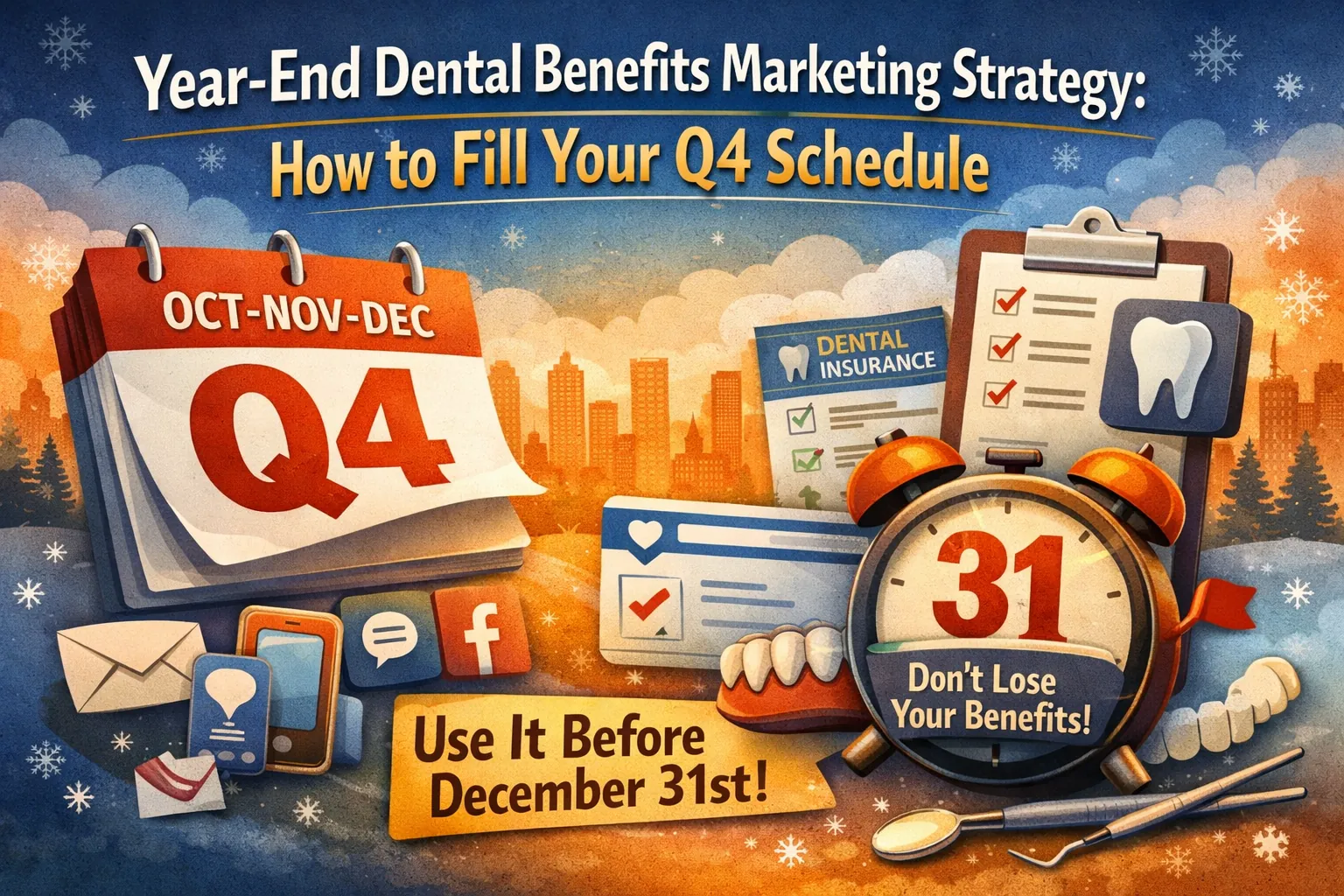 This guide shows dental practices how to build a year-end benefits marketing strategy that fills the schedule in Q4 by reaching patients before their insurance coverage resets on December 31st. Billions of dollars in dental benefits go unused every year—not because patients don’t need care, but because no one reminded them in time. The practices that capture this demand don’t wait until December. They build a structured campaign that starts in early October, layers the right channels, and aligns front-desk operations with the messaging patients are seeing. This guide shows dental practices how to build a year-end benefits marketing strategy that fills the schedule in Q4 by reaching patients before their insurance coverage resets on December 31st. Billions of dollars in dental benefits go unused every year—not because patients don’t need care, but because no one reminded them in time. The practices that capture this demand don’t wait until December. They build a structured campaign that starts in early October, layers the right channels, and aligns front-desk operations with the messaging patients are seeing.
The opportunity is straightforward: most dental insurance plans operate on a calendar-year cycle. Annual maximums (typically $1,000–$2,000), deductibles, and covered preventive visits all reset on January 1st. Patients who haven’t used their benefits lose them permanently—no rollovers, no exceptions. A well-timed marketing push turns that deadline into booked appointments and completed treatment plans, benefiting both the practice and the patient.
Below, you’ll learn how to structure your Q4 benefits campaign from timeline to channel mix, segment your patient outreach for maximum impact, align your website and front desk with the campaign, and measure what actually worked—so you can repeat it (and improve it) every year.
Written for: dental practice owners, office managers, and marketing teams who want to convert expiring patient benefits into scheduled appointments and higher Q4 production.
TL;DR
If you only do seven things for your year-end benefits push, do these:
| • |
Start outreach by early October — waiting until December leaves too few appointment slots and too little patient response time
|
| • |
Segment your patient list — patients with unscheduled hygiene visits, outstanding treatment plans, and lapsed patients each need different messages
|
| • |
Layer your channels — email, SMS, social media, Google Business Profile posts, and website banners working together outperform any single channel
|
| • |
Lead with patient value, not pressure — frame messaging around helping patients keep benefits they’ve already paid for, not sales urgency
|
| • |
Update your website — add a benefits-reminder banner or landing page so organic and paid traffic reinforces the campaign
|
| • |
Align your front desk — staff need scripts, scheduling flexibility, and the ability to verify remaining benefits quickly
|
| • |
Track results — compare Q4 production, kept appointments, and reactivated patients year over year to justify and improve the campaign |
Table of Contents
Why year-end benefits season is your biggest Q4 opportunity
Most dental insurance plans reset on a calendar-year basis. That means every patient with employer-sponsored or individual dental coverage faces the same reality each December: benefits they haven’t used disappear. Annual maximums vanish. Deductibles they’ve already met reset to zero. Preventive visits they skipped are gone for good.
What this means for your practice: there is a large, identifiable group of patients who have a genuine financial incentive to schedule care before December 31st. This isn’t manufactured urgency—it’s a real deadline that directly affects what patients pay out of pocket.
The practices that benefit most from this season share a few traits. They start planning early. They treat the benefits push as a structured campaign rather than a few last-minute reminder calls. And they recognize that this isn’t just about filling December’s schedule—it’s about reactivating lapsed patients, completing outstanding treatment plans, and building momentum that carries into January.
A pattern we commonly see: practices that run a coordinated year-end campaign typically see a measurable lift in Q4 hygiene visits, treatment acceptance, and reactivated patients. Practices that rely on ad-hoc reminders or skip the push entirely leave that production on the table—and their patients lose benefits they’ve already paid for through premiums.
> Back to Table of Contents
Campaign timeline: when to launch each phase
Timing is the single biggest factor that separates high-performing year-end campaigns from ones that fizzle. A December-only push competes with holiday schedules, reduced office hours, and patient fatigue. Starting earlier gives patients time to respond and gives your schedule room to absorb the demand.
Phase 1: Foundation (September)
Use September to prepare the campaign infrastructure before any patient-facing outreach begins.
| • |
Pull your patient data — identify patients with remaining benefits, unscheduled second hygiene visits, outstanding treatment plans, and anyone who hasn’t visited in 12+ months
|
| • |
Verify insurance details — confirm which patients are on calendar-year plans vs. fiscal-year plans so you’re targeting the right group
|
| • |
Prepare your content — draft email sequences, SMS templates, social posts, and website banner copy before launch day
|
| • |
Brief your front desk — share the campaign timeline, scripts, and scheduling goals so everyone is aligned before outreach starts |
Phase 2: Early outreach (October)
October is when patient-facing communication begins. The goal is awareness—planting the seed before the holiday rush crowds patients’ attention.
| • |
Send the first email or newsletter — a friendly, educational message explaining how dental benefits work and why acting before year-end matters
|
| • |
Post on social media — 1–2 posts per week educating patients about expiring benefits, with a clear link to schedule
|
| • |
Update your Google Business Profile — publish a post about year-end benefits availability and appointment openings
|
| • |
Add a website banner — a persistent, non-intrusive banner reminding visitors that benefits expire December 31st |
Phase 3: Acceleration (November)
November shifts the tone from educational to action-oriented. Patients who didn’t respond in October get a second touch, and new urgency messaging enters the mix.
| • |
Send a direct reminder email or SMS — more specific than October’s message, referencing remaining benefits or unscheduled appointments where possible
|
| • |
Increase social posting frequency — 2–3 posts per week with countdown-style messaging and patient-friendly explanations
|
| • |
Activate paid channels if budget allows — targeted social ads or Google Ads using benefits-related keywords to reach patients searching for year-end dental care
|
| • |
Have the front desk make personal calls — prioritize patients with known outstanding treatment plans or remaining annual maximum balances |
Phase 4: Final push (December 1–20)
December is about conversion and urgency. By now, patients who are going to act need a final nudge and an easy path to book.
| • |
Send a final-call email and SMS — clear, concise messaging: “Your dental benefits expire December 31st. We still have openings this month.”
|
| • |
Post last-chance social content — countdown posts, deadline reminders, and simple calls to action
|
| • |
Extend hours if feasible — even one or two additional evening or Saturday slots can capture patients who can’t book during standard hours
|
| • |
Prioritize treatment starts over completions — for larger cases, patients can begin treatment in December using current-year benefits and complete it in January using next year’s allocation |
> Back to Table of Contents
Patient segmentation for year-end outreach
A single “use your benefits” blast to your entire patient list is better than nothing, but segmenting your outreach dramatically improves response rates. Different patients have different motivations, and matching your message to their situation makes it more likely they’ll act.
Segment 1: Patients with unscheduled hygiene visits
These are patients who completed their first cleaning earlier in the year but haven’t booked the second. Most insurance plans cover two preventive visits per year at 100%. This is the easiest win in your year-end campaign because the patient’s cost is typically zero and the visit is already overdue.
Message angle: “You still have a fully covered cleaning available this year. If you don’t use it before December 31st, you’ll lose it.”
Segment 2: Patients with outstanding treatment plans
These patients had treatment recommended—a crown, a filling, periodontal therapy—but haven’t scheduled it yet. The year-end deadline adds a financial incentive to act: they’ve already met their deductible, and their remaining annual maximum can offset the cost.
Message angle: “You’ve already met your deductible this year. Completing your recommended treatment now means lower out-of-pocket costs than waiting until January, when your deductible resets.”
Segment 3: Lapsed patients (12+ months since last visit)
Lapsed patients are harder to reactivate, but the benefits deadline gives you a concrete, patient-friendly reason to reach out. These patients may not realize they’re about to lose coverage they’ve been paying premiums for all year.
Message angle: “It’s been a while since your last visit, and your dental benefits are about to reset. You’ve been paying premiums all year—let’s make sure you get the care those premiums are designed to cover.”
Segment 4: New patients from Q4 search traffic
Not all year-end demand comes from your existing base. Patients searching for a new dentist in Q4 are often motivated by expiring benefits. Your paid and organic search strategy should capture this intent.
Message angle: “Looking for a dentist before your benefits expire? We’re accepting new patients and can help you maximize your remaining coverage before December 31st.”
> Back to Table of Contents
Channel strategy: email, SMS, social, PPC, and more
No single channel carries a year-end benefits campaign alone. The most effective campaigns layer multiple touchpoints so patients encounter the message in different contexts—their inbox, their phone, their social feed, and your website.
Email
Email remains the backbone of most year-end campaigns because it allows for longer, more detailed messaging and easy segmentation. Plan a sequence of 3–4 emails spaced across October through mid-December.
| • |
Email 1 (early October) — educational: explain how dental benefits work, the use-it-or-lose-it reality, and what patients should check on their plan
|
| • |
Email 2 (early November) — reminder: more direct, referencing the approaching deadline and encouraging patients to check their remaining benefits
|
| • |
Email 3 (late November) — action: specific call to schedule, with a link to online booking or a phone number to call
|
| • |
Email 4 (early December) — final call: short, urgent, focused on limited remaining appointment availability |
Subject line examples: “Your dental benefits expire in [X] weeks” … “Have you used both cleanings this year?” … “December openings are filling fast”
SMS and text messaging
SMS works best as a short, direct nudge—especially for patients who don’t engage with email. Keep texts under 160 characters when possible, and always include a link to schedule or a phone number.
What works in our experience: practices that pair email with SMS typically see higher response rates than either channel alone. SMS is especially effective in the final two weeks of the campaign when urgency is highest.
Social media (organic and paid)
Social media builds ambient awareness—patients may not act on the first post they see, but repeated exposure keeps the benefits deadline on their radar.
| • |
Organic posts — 1–2 per week in October, increasing to 2–3 per week in November and December; mix educational content (“how dental benefits work”) with direct reminders (“don’t lose your benefits”)
|
| • |
Paid social ads — targeted Facebook and Instagram ads reaching your existing patient list (custom audience upload) and lookalike audiences in your service area; budget as little as $5–$15/day for meaningful reach
|
| • |
Google Business Profile posts — free, visible directly in search results when patients look up your practice; post a benefits reminder every 1–2 weeks through Q4 |
PPC (Google Ads)
Paid search captures active intent—patients who are already searching for terms like “dentist near me,” “use dental insurance before year end,” or “dental benefits expiring.” If your practice runs Google Ads, consider adding seasonal ad copy and a dedicated landing page for Q4.
What we typically recommend: create a small, focused campaign or ad group around year-end benefits keywords. Use ad copy that references the December 31st deadline and links to a landing page that explains the benefits situation and makes scheduling easy. Even a modest budget increase in November and December can capture high-intent searches that your standard campaigns miss.
Direct mail and in-office signage
For practices with strong direct-mail systems, a year-end recall card or postcard to patients overdue for hygiene visits adds a physical touchpoint. In-office signage—a simple counter card or poster in the waiting area—reminds patients who are already in the chair about additional treatment they could complete before year-end.
> Back to Table of Contents
Website and landing page alignment
Your campaign drives patients back to your website. If the website doesn’t reinforce the benefits message, you lose momentum between the outreach and the booking.
Add a seasonal banner or alert bar
A persistent banner across the top of your homepage (or site-wide) is the simplest high-impact change. Keep the copy short and direct: “Dental benefits expire December 31st — schedule now before your coverage resets.” Link the banner to your scheduling page or a dedicated year-end landing page.
Create a year-end benefits landing page
A dedicated landing page gives you a focused destination for paid ads, email links, and social posts. Include the key information patients need to act:
| • |
A clear explanation of how dental benefits reset and what patients lose if they don’t act
|
| • |
Common services patients can schedule before year-end (cleanings, exams, crowns, fillings)
|
| • |
A scheduling widget or prominent phone number so patients can book immediately
|
| • |
Insurance information — which plans you accept and how to check remaining benefits |
Keep the page simple. This is not the place for lengthy service descriptions. Patients arriving at this page already have intent—they need reassurance and a fast path to schedule.
Optimize for mobile
Most patients will see your emails, texts, and social posts on their phones. If your scheduling page or landing page isn’t mobile-friendly—fast load times, tap-friendly buttons, click-to-call phone numbers—you’ll lose conversions at the last step. Google’s standard for a good mobile experience targets page loads under 2.5 seconds and tap targets of at least 48 × 48 pixels.
> Back to Table of Contents
Front-desk operations and scripts
Marketing gets patients to call or click. Your front desk determines whether that interest becomes a kept appointment. Aligning operations with your campaign is just as important as the outreach itself.
Equip staff with benefits verification tools
When patients call in response to a benefits reminder, they’ll often ask how much coverage they have left. Your team needs a fast, reliable way to verify remaining annual maximums, deductible status, and covered services. If verification takes too long or requires a callback, you risk losing the patient’s motivation.
Provide phone and in-person scripts
Front-desk scripts for year-end benefits conversations don’t need to be complex. The key elements are:
| • |
Acknowledge the deadline — “You’re right that your benefits will reset on January 1st, so scheduling before December 31st makes sense.”
|
| • |
Reference remaining coverage — “It looks like you still have $[amount] in annual maximum. Let’s find a time to use that before it resets.”
|
| • |
Offer scheduling flexibility — “We have openings on [date] and [date]. Which works better for you?”
|
| • |
Mention treatment staging for larger cases — “We can start the first phase this year and complete it in January, which lets you use benefits from both plan years.” |
Manage scheduling capacity proactively
A successful year-end campaign creates a surge in demand—which is the goal. But if your schedule is already full and patients hear “we’re booked out,” the campaign backfires. Plan for increased capacity in November and December: consider adding hygiene days, extending hours, or reserving specific appointment blocks for benefits-driven patients. If the schedule does fill, offer a waitlist and a January callback rather than a dead end.
> Back to Table of Contents
How to measure your year-end campaign results
Measurement turns a one-time push into a repeatable system. Without data, you can’t tell what worked, what didn’t, or how to improve next year. Track these metrics across the campaign:
Production metrics
| • |
Q4 production vs. prior year — the most direct measure of campaign impact; compare total production for October through December year over year
|
| • |
Hygiene visits completed in Q4 — specifically second-visit completions, since that’s the primary target of benefits outreach
|
| • |
Treatment acceptance rate in Q4 — did the benefits deadline motivate patients to accept recommended treatment at higher rates than other quarters? |
Campaign-specific metrics
| • |
Email open and click rates — compare across your October, November, and December sends to see which timing and messaging performed best
|
| • |
SMS response rate — how many patients replied or clicked through from text reminders
|
| • |
Appointments booked from campaign touchpoints — use UTM parameters, tracked phone numbers, or scheduling source fields to attribute bookings to specific channels
|
| • |
Landing page conversion rate — if you created a dedicated year-end page, measure visits vs. completed bookings or calls |
Patient reactivation metrics
| • |
Lapsed patients reactivated — how many patients who hadn’t visited in 12+ months came back during the campaign period
|
| • |
Outstanding treatment plans completed — how many patients who had pending treatment finally scheduled and completed it in Q4
|
| • |
New patients acquired through Q4 search — track new patients who found you through benefits-related search terms or paid ads |
After the campaign ends, compile these numbers into a simple year-over-year comparison. This gives you a clear case for repeating (and budgeting for) the campaign next year, and it shows exactly which channels and segments drove the most value.
> Back to Table of Contents
Common year-end campaign mistakes to avoid
Even well-intentioned year-end pushes can underperform if they fall into common traps. Here are the mistakes we see most often—and what to do instead.
Starting too late: a December-only campaign limits your scheduling capacity and competes with holiday distractions. Start outreach in October and build urgency gradually. Patients need time to see the message, check their benefits, and find a slot that works.
Sending one generic blast to everyone: a single “use your benefits” email to your entire list treats a patient with an outstanding crown recommendation the same as someone who just needs a cleaning. Segmentation takes more effort but produces significantly better results.
Focusing only on existing patients: your current patient base is the primary audience, but new patients also search for dentists in Q4 specifically because their benefits are expiring. Ignoring paid search and organic content for this audience leaves new-patient opportunities uncaptured.
Neglecting the front desk: if your team isn’t prepared for the increase in calls and scheduling requests, the campaign generates demand that doesn’t convert. Brief your staff, provide scripts, and make sure they can verify benefits quickly.
Overselling or fear-based messaging: patients respond better to helpful, factual reminders than to aggressive “you’re losing money!” tactics. Frame the message around helping patients get care they’ve already paid for—not around pressure or scarcity.
Forgetting to measure: if you don’t track what happened, you can’t improve. Even basic metrics—Q4 production vs. last year, number of lapsed patients reactivated, email open rates—give you a foundation for next year’s planning.
> Back to Table of Contents
Start planning your year-end benefits campaign
A well-executed year-end benefits strategy does more than fill December’s schedule. It reactivates patients who’ve drifted, completes treatment plans that have been sitting idle, and builds habits—both for your patients and your team—that strengthen the practice year-round.
If you want help building a year-end campaign that integrates with your broader marketing strategy—from email and SMS sequencing to paid search and landing page development—WEO Media can help. We work with dental practices across the country to create structured, measurable campaigns that turn seasonal opportunities into lasting growth.
Call 888-246-6906 or reach out online to start planning.
FAQs
When should a dental practice start its year-end benefits marketing campaign?
Most practices benefit from starting campaign preparation in September and launching patient-facing outreach in early October. This gives patients time to receive the message, check their remaining benefits, and schedule before the holiday rush makes both their calendars and your schedule more crowded. A December-only push limits your results because too few appointment slots remain.
What channels work best for year-end dental benefits reminders?
A layered approach works best. Email provides the detailed messaging and segmentation. SMS delivers short, direct nudges that reach patients who don’t open emails. Social media builds ambient awareness over weeks. Google Business Profile posts are free and visible in search results. Paid search captures patients actively looking for a dentist before year-end. No single channel outperforms a coordinated multi-channel campaign.
How do I segment patients for a year-end benefits campaign?
The most effective segments are patients with unscheduled second hygiene visits (easiest win since the visit is usually 100% covered), patients with outstanding treatment plans (financial incentive since their deductible is already met), lapsed patients who haven’t visited in over 12 months (benefits deadline gives a concrete reason to return), and new patients from Q4 search traffic (people actively searching for a dentist because their benefits are expiring).
What should year-end dental benefits emails say?
Effective year-end benefits emails are clear, specific, and helpful rather than pushy. Explain that most dental insurance benefits reset on January 1st and any unused coverage is lost permanently. Reference the patient’s specific situation if possible (unscheduled cleaning, remaining annual maximum). Include a direct link to schedule or a phone number, and keep the message concise—patients are more likely to act on a short, clear email than a lengthy one.
Should I run Google Ads for year-end dental benefits?
Google Ads can be effective for capturing new patients who are actively searching for a dentist before their benefits expire. Create a focused ad group with benefits-related keywords and link to a dedicated landing page. Even a modest budget increase in November and December can capture high-intent searches your standard campaigns miss. This channel is most valuable for practices in competitive markets where organic rankings alone may not be enough.
Can patients split treatment across two benefit years?
Yes, and this is a strategy worth communicating to patients who need larger treatments. If a patient needs work that exceeds their remaining annual maximum, they can begin treatment in December using current-year benefits and complete it in January using next year’s allocation. This effectively doubles the available insurance coverage for the overall treatment plan and reduces the patient’s out-of-pocket cost.
How do I prepare my front desk for year-end benefits calls?
Brief your front-desk team on the campaign timeline and messaging before outreach begins. Provide simple scripts that acknowledge the benefits deadline, reference remaining coverage, and offer specific appointment options. Make sure staff have fast access to benefits verification tools so they can confirm coverage during the call rather than requiring a callback. If scheduling fills up, train the team to offer a waitlist and a January appointment rather than a dead-end response.
What metrics should I track for a year-end dental marketing campaign?
Track Q4 production compared to prior years, second hygiene visit completions, treatment acceptance rates, lapsed patients reactivated, email open and click rates, SMS response rates, appointments attributed to specific campaign channels, and landing page conversion rates. Compiling these into a year-over-year comparison gives you a clear picture of campaign impact and a foundation for improving next year’s approach. |
|