Dental About Us Page Design: How to Build One That Books New Patients
Posted on 5/15/2026 by WEO Media |
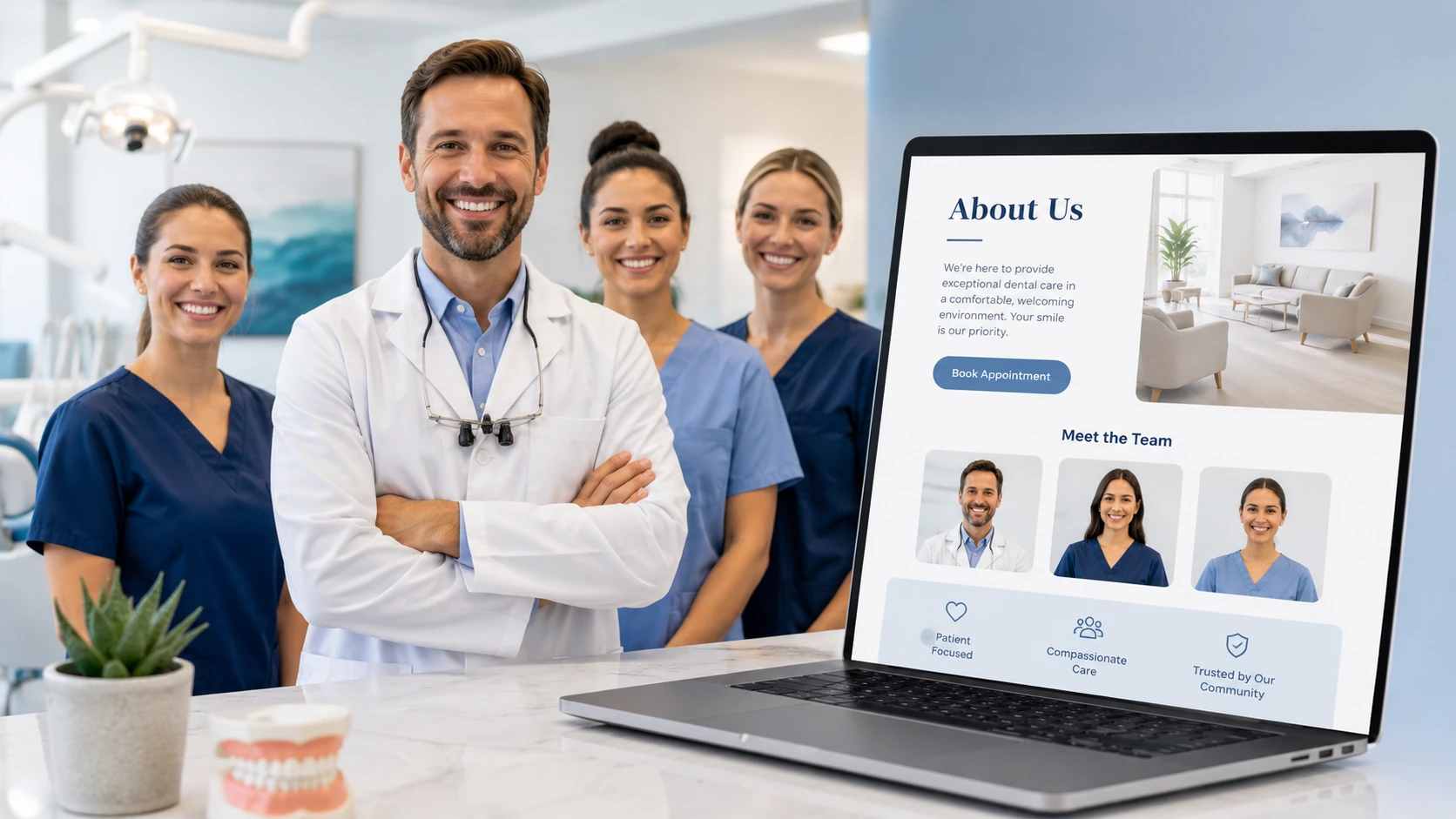 To build a dental About Us page that books new patients, design for the patient’s trust, not the dentist’s résumé—real team photos, plain-spoken trust signals, mobile-first layout, and one clear next step on the first scroll convert more visitors into patients than any mission statement. For dental practice owners, office managers, and marketing coordinators, the About Us page is consistently the second- or third-most-visited page on a dental website—and the moment a prospective patient decides whether your practice feels like the right fit. A well-designed About Us page answers the unspoken question every new patient brings to a dental website: Can I trust these people with my mouth? To build a dental About Us page that books new patients, design for the patient’s trust, not the dentist’s résumé—real team photos, plain-spoken trust signals, mobile-first layout, and one clear next step on the first scroll convert more visitors into patients than any mission statement. For dental practice owners, office managers, and marketing coordinators, the About Us page is consistently the second- or third-most-visited page on a dental website—and the moment a prospective patient decides whether your practice feels like the right fit. A well-designed About Us page answers the unspoken question every new patient brings to a dental website: Can I trust these people with my mouth?
Most dental About Us pages quietly leak patients. They open with a generic mission statement, push credentials before connection, lean on stock imagery, and bury the phone number three scrolls down. The result is a page that reassures the dentist’s ego but does little for the anxious patient comparing three offices on a Tuesday night. This guide walks through what high-converting dental About Us pages do differently—from copy and photography to layout, trust signals, and the small conversion details that move site visitors from “reading” to “booking.”
If you’re still working on the foundations, start with your homepage and core service pages first. The About Us page amplifies trust; it doesn’t create it from nothing.
Written for: dental practice owners, office managers, and marketing coordinators who want their About Us page to actually contribute to new-patient growth—not just sit there as a digital biography.
TL;DR
If you only do six things on your dental About Us page, do these:
| • |
Lead with connection, not credentials - open with a one-sentence promise about the patient experience before listing degrees and dental school graduation years
|
| • |
Use real photos of your real team - professional, high-resolution photos of the actual dentists, hygienists, and front-desk team beat any stock image
|
| • |
Write in plain language, not dental jargon - patients shouldn’t need a glossary to understand who you are and what makes you different
|
| • |
Show proof, not promises - integrate short patient quotes, association logos, years-in-practice numbers, and community involvement
|
| • |
Design for mobile first - the majority of dental searches happen on phones; thumb-friendly layouts and a sticky call button matter more than desktop hero animations
|
| • |
End every section with a clear next step - book online, call now, or meet the team on video—don’t leave readers wondering what to do next |
Table of Contents
Why your dental About Us page is a conversion lever
In our work with dental practices across the country, the traffic that lands on an About Us page is heavily weighted toward high-intent visitors—people who have already considered your services, looked at your homepage, and are now deciding whether you are the right office. A pattern we commonly see is that practices invest heavily in service pages while letting the About Us page stagnate with a paragraph the dentist wrote five years ago. That’s a missed conversion opportunity, and one of the cheapest to fix.
The About Us page sits at the trust threshold of the patient journey. Service pages answer what you do. The About Us page answers who you are—and for healthcare decisions, “who” matters as much as “what.” Patients comparing three nearby offices will rarely choose based on a longer list of services. They’ll choose based on which team they want to sit in a chair with for an hour.
What a dental About Us page needs to accomplish in 30 seconds
| • |
Establish the people - make the dentists and team feel real, approachable, and competent
|
| • |
Signal trust - credentials, years in practice, community ties, and association memberships
|
| • |
Set the patient experience - communicate the vibe of the office (calm, family-friendly, modern, anxiety-aware)
|
| • |
Differentiate clearly - what makes this practice different from the office two blocks away
|
| • |
Point to the next step - schedule, call, take a virtual tour, or meet the team on video |
A practice that nails these five jobs will outperform a competitor with better SEO and a weaker About Us page—because by the time someone lands on your About Us page, the search is largely done. The decision is what’s left.
> Back to Table of Contents
Common dental About Us page mistakes that kill conversion
Before listing what works, it helps to be specific about what doesn’t. The most common dental About Us page mistakes share a theme: they are written for the dentist, not the patient.
| • |
Opening with credentials instead of connection - “Dr. Smith graduated from XYZ Dental School in 2003” tells a prospective patient nothing about the experience they’ll have
|
| • |
Stock photos of unrelated smiling people - patients can spot a stock image instantly, and it signals that the real team wasn’t worth photographing
|
| • |
Dental jargon and clinical language - phrases like “comprehensive prosthodontic rehabilitation” mean nothing to someone Googling “dentist near me”
|
| • |
A wall of text with no visual breaks - a single 600-word paragraph about the dentist’s philosophy will not be read on a phone
|
| • |
No team photos or team bios beyond the dentist - the hygienist often spends more chair time with the patient than the dentist; ignoring the team is a missed trust moment
|
| • |
Generic mission statements - “We are committed to providing exceptional dental care in a comfortable environment” could appear on any practice site in the country
|
| • |
No clear call to action - the page ends and the visitor has to figure out where to click next
|
| • |
Outdated content - team members who left two years ago, broken testimonial widgets, or a “new in 2019” banner still on the page |
The cumulative effect is a page that reads like a digital version of a 2008 practice brochure. It doesn’t actively hurt the practice, but it doesn’t earn appointments either—and that’s the standard a good About Us page should meet.
> Back to Table of Contents
Essential elements of a high-converting dental About Us page
A high-converting dental About Us page is less a single block of content and more a curated sequence of trust moments. Each element does a specific job. You don’t need every element on every page, but most converting pages include the following ten:
1. A hero section that frames the patient experience
Open with a one-sentence promise about what it’s like to be a patient at your office, paired with a real photo of the dentist or team. Skip the dental school. The headline should feel human: “A calm, modern dental home for families in [neighborhood]” outperforms “Welcome to [Practice Name].”
2. A short practice story
Two to four paragraphs covering why the practice exists, what kind of care it’s built around, and who it’s for. Avoid the “founded in 1998” chronology unless the longevity itself is a selling point. Lead with the patient, not the timeline.
3. Doctor bios that lead with personality
Each dentist should have a dedicated section with a real photo, a short bio that starts with something human (where they grew up, why dentistry, a quick fact about life outside the operatory), and then credentials. Memberships in the American Dental Association, the Academy of General Dentistry, or specialty colleges belong here—but after the human introduction, not before.
4. Team profiles for hygienists and front-desk staff
Hygienists, dental assistants, and front-desk team members deserve photos and short bios. Patients see these team members the most. Listing them by first name with one-line bios (“Sarah, lead hygienist—works gently with anxious patients”) builds the same kind of trust as the doctor bios at a fraction of the word count.
5. A mission, values, or patient promise
A short statement of what the practice stands for, written as if you were explaining it to a patient in the chair. “We don’t recommend treatment we wouldn’t do on our own families” lands harder than a paragraph of generic mission language.
6. Trust signals
Logos of association memberships, certifications, community partnerships, “Best of” awards, years in practice, number of patients served (when accurate and current), and any continuing education or specialty training the team holds. These should be visible without scrolling deep into the page.
7. Patient testimonials or short reviews
Embed two to four short quotes from real patients (with first name and last initial), pulled from Google reviews or collected internally with written permission. Avoid a long video testimonial that requires a click to play—a short text quote is read by everyone.
8. Office photos or a virtual tour
Real photos of the waiting room, operatories, and team in action remove the “what will it look like” uncertainty. A scrollable photo strip works on mobile better than a single static hero image.
9. Community and local proof
School sponsorships, charity work, local press mentions, or partnerships with nearby businesses tell prospective patients that the practice is invested in the area—a powerful signal for local search and for trust.
10. A clear next-step CTA
A closing call to action that points to one or two next steps: book online, call, or read about a specific service. Avoid stacking five CTAs at the bottom; visitors will pick none of them.
> Back to Table of Contents
Photography and visuals that build patient trust
Photography may be the single highest-leverage element of an About Us page redesign. The right photos can compensate for average copy. The wrong photos can undercut excellent copy. We’ve seen practices meaningfully lift About Us page engagement by replacing stock imagery and dated headshots with professional dental practice photography.
What to capture in a dental About Us photo shoot
The shot list should cover the team, the space, and the work itself:
| • |
Individual portraits of every team member - matching lighting, neutral backgrounds, and warm expressions; smiling but not stiff
|
| • |
A group photo of the full team - in scrubs or branded apparel, taken in the actual office
|
| • |
The dentist in the operatory - with a consenting patient or alone, showing the real work environment rather than a posed studio shot
|
| • |
Front-desk interaction shots - the team greeting a consenting patient or working the phones
|
| • |
Operatory and waiting room photos - clean, well-lit, and recent; outdated decor signals an outdated practice
|
| • |
Detail shots - sterilization equipment, modern technology like digital scanners, or the kids’ play area if applicable |
Quality standards that matter
Whatever the shot list, the production basics matter as much as the choices:
| • |
Use a professional photographer - smartphone shots almost always read as amateur, no matter how good the phone’s camera; the cost of a half-day shoot pays back quickly
|
| • |
Match lighting and color across team portraits - inconsistent backgrounds and lighting make a team page feel pieced together
|
| • |
Optimize for the web - export WebP or compressed JPG at appropriate sizes; oversized image files slow the page and hurt the mobile experience
|
| • |
Refresh at least every two to three years - or sooner if team members change; outdated photos erode trust |
A small note: avoid using the same photo of the dentist that appears on every other dental marketing site in your town. Patients comparing three offices in the same suburb will notice when two of them use the same stock dentist headshot from the same vendor.
> Back to Table of Contents
Writing copy that connects without sounding arrogant
The hardest part of a dental About Us page is the copy. Dentists are often uncomfortable writing about themselves, and the default coping mechanism is to retreat into credentials and clinical language. The pages that convert do the opposite: they sound like a dentist talking to a new patient in the chair—not a CV submitted for tenure review.
Lead with the patient, not the practice
Every section should answer “what does this mean for me as a patient?” before it answers “what do we want to tell you about us?” A dentist with 30 years of experience can write “After 30 years in practice, I’ve learned that the best appointments are the boring ones—no surprises, no rushed decisions, no pressure” rather than “Dr. Smith has been practicing for over three decades.”
Use plain, conversational language
Write at roughly a sixth- to eighth-grade reading level. Replace clinical phrases with their everyday equivalents: “gum disease” instead of “periodontitis,” “crown” instead of “indirect restoration,” “cleaning” instead of “prophylaxis.” Save the technical vocabulary for the service pages where searchers are using those terms.
Make the dentist sound human
A short personal detail—where the dentist grew up, why they chose dentistry, what they do on weekends—does more for trust than a list of continuing education courses. The goal isn’t to overshare; it’s to make the page feel written by a person, not a marketing committee.
Show your work, don’t claim it
Instead of “we provide gentle, compassionate care,” describe the specific things you do: pre-visit phone calls for nervous patients, weighted blankets in the chair, headphones on request, a clear cost conversation before any treatment. Specifics earn trust; adjectives don’t.
Address the unspoken patient concerns
Most prospective patients are anxious about cost, pain, judgment about the condition of their teeth, and being upsold. A good About Us page acknowledges these directly: a sentence about how the practice handles cost conversations, a note about anxiety management, an explicit no-judgment statement. These are the lines that pull a hesitant searcher off the fence.
> Back to Table of Contents
Layout, hierarchy, and mobile UX for dental About pages
A well-written About Us page can still fail if the layout buries the most important elements. Visual hierarchy decides what gets seen, and on a phone screen, the visitor gets roughly three to five elements visible at a time. Those elements have to do real work.
Mobile-first design is non-negotiable
The majority of new-patient dental searches happen on mobile devices, and the About Us page is no exception. A page that’s designed desktop-first—with a wide hero image, multi-column team grids, and a fixed sidebar—will compress poorly on phones. Build for the phone first, then expand for desktop.
Visual hierarchy that matches the reading order
The order patients actually want to read: a photo and headline of the team or doctor, a one- or two-sentence promise, then proof (testimonials, credentials, awards), then the details. Reverse-engineering the page so this order is reflected in the visual layout—not just the HTML—makes the page work.
Thumb-friendly navigation and CTAs
Sticky call-to-action buttons (a phone icon and a “Book Online” button) that follow the patient down the page are standard on high-performing dental sites. Tappable phone numbers, large enough touch targets, and a contact section that doesn’t require pinch-zooming all matter more than scroll animations or fancy hover states.
Page speed and image optimization
About Us pages are often image-heavy. Without optimization, that means slow load times and failing Core Web Vitals, especially on cellular connections. Compress images, use modern formats like WebP, lazy-load below-the-fold images, and keep total page weight reasonable. A two-second improvement in load time meaningfully affects bounce rate on dental sites in our experience.
Accessibility considerations
Real alt text for every image, sufficient color contrast between text and background, proper heading hierarchy, and keyboard navigability matter for both ADA compliance and SEO. The same accessibility work that helps screen-reader users also tends to make pages easier to scan for everyone.
> Back to Table of Contents
Trust signals and E-E-A-T for YMYL dental content
Dental websites fall under what Google calls “Your Money or Your Life” (YMYL) content, which means search rankings depend heavily on demonstrated experience, expertise, authoritativeness, and trustworthiness—the E-E-A-T framework. The About Us page is the single best place on a dental site to build E-E-A-T signals, both for human visitors and for search engines.
E-E-A-T elements to prioritize on a dental About Us page
| • |
Experience - years in practice, number of patients served, specific procedures or specialties; first-person language about how the team approaches care
|
| • |
Expertise - dental school, continuing education, fellowships, board certifications, and specialty memberships (AAP for periodontists, AAE for endodontists, AAOMS for oral surgeons, AAO for orthodontists, AAPD for pediatric dentists, ACP for prosthodontists)
|
| • |
Authoritativeness - professional associations, faculty appointments, published work, speaking engagements, awards, press coverage, and leadership roles in local dental societies
|
| • |
Trustworthiness - real photos, real names, accurate contact information, transparent policies, current patient testimonials, accreditations, and clear ownership and leadership information |
Author and reviewer information for the page
For dental practice websites, consider adding an “authored by” or “reviewed by” line that ties the About Us content to a named dentist with their credentials. This is a strong YMYL signal and reinforces that the content represents the practice authentically.
Local proof and community ties
For a local service business, geographic trust matters. Mention specific neighborhoods served, community partnerships, school sponsorships, charity work, and local affiliations. These signal genuine local presence rather than a national-franchise feel.
Schema markup for the practice
Structured data such as Dentist, LocalBusiness, and Person schema for each dentist helps search engines understand the entities behind the page. Pair this with AboutPage schema on the page itself. Schema doesn’t replace good content, but it makes the trust signals on the page legible to AI Overviews and other search features.
> Back to Table of Contents
CTAs and conversion paths that don’t feel pushy
The About Us page should make it easy to take the next step without feeling like a sales funnel. Patients on this page are often comparing offices, not yet ready to commit, and aggressive CTAs can backfire—driving them back to the search results to look at the next practice instead.
Match the CTA intensity to the page intent
A “Book Now” button at the top of the About Us page is premature for many visitors. A softer first CTA (“Meet the Team,” “See Our Office,” “Read Patient Reviews”) feels more like an invitation. The harder CTA (book, call) belongs after the visitor has had a chance to absorb the trust content.
Offer multiple paths to the next step
Different visitors have different comfort levels. A confident patient may want to book online instantly; an anxious patient may want to call and talk to a human; another may want to read FAQs first. Offer all three options near the bottom of the page—phone, online booking, and a link to an FAQ or new-patient information page.
Reduce friction in the booking flow
If “Book Online” opens a third-party scheduling tool that asks for ten fields before showing availability, expect a high abandonment rate. The fewer clicks and the fewer required fields, the better. For practices without integrated online scheduling, a simple form that requests preferred days and times and a callback number often outperforms a complex scheduler.
Use language that matches patient mindset
“Schedule your visit” tends to outperform “Request appointment” in our experience. “Talk to our team” outperforms “Contact us.” Specific, action-oriented, low-friction language wins. The CTA should make the next step feel small.
> Back to Table of Contents
How to measure if your About Us page is converting
A dental About Us page that “feels good” isn’t the same as one that’s contributing to new-patient growth. Measurement turns design opinions into data. The good news is that the metrics that matter for an About Us page are straightforward to track with standard analytics.
Core metrics to track in GA4
| • |
Page views and unique visitors - baseline traffic to the page, ideally segmented by source (organic, direct, referral)
|
| • |
Average engagement time - how long visitors actually spend on the page; under 30 seconds typically signals a content or layout problem
|
| • |
Scroll depth - what percentage of visitors reach the bottom of the page; useful for diagnosing where the page loses people
|
| • |
Key events from the page - phone clicks, booking starts, contact form submissions, and clicks to scheduling tools (track these as key events, the term GA4 adopted in March 2024 in place of “conversions”)
|
| • |
Exit rate vs. continued navigation - whether visitors leave the site from this page or click through to a service page or scheduler |
Qualitative tools that complement analytics
| • |
Heatmaps and scroll maps - tools like Microsoft Clarity or Hotjar show where users click, hover, and stop scrolling
|
| • |
Session recordings - watch a handful of real sessions on the About Us page; you’ll see friction you’d never identify from numbers alone
|
| • |
A short new-patient question at intake - ask new patients one question: “What helped you decide to choose us?” The answers reveal whether the About Us page is doing real work |
Setting realistic benchmarks
There isn’t a universal “good” engagement time or scroll depth that applies to every dental practice. The most useful benchmark is your own page’s performance over time. Make one change, measure for 30 days, compare. Dentists are familiar with this kind of clinical iteration; the same patience and rigor pays off in marketing.
Iterating without overthinking
A practical cadence: review About Us page metrics monthly, ship one improvement per quarter, refresh photography every two to three years, and update team bios whenever someone joins or leaves. Pages that get touched regularly outperform pages that get redesigned every five years.
> Back to Table of Contents
Ready to redesign your dental About Us page?
A great dental About Us page is part design, part copy, part photography, and part patience. If you’re a dental practice owner or marketing coordinator looking to redesign your About Us page—or your full website—our team at WEO Media - Dental Marketing specializes in dental websites that put the practice’s real story to work for new-patient growth.
Call our team at 888-246-6906 to talk through what your About Us page could be, or send us a message and we’ll get back to you within one business day.
> Back to Table of Contents
FAQs
How long should a dental About Us page be?
Most high-converting dental About Us pages land between 800 and 1,500 words of body copy, spread across a hero section, practice story, team bios, trust signals, testimonials, and a clear next-step CTA. Length matters less than relevance and scannability; the page should answer the visitor’s implicit questions about who you are and what their visit will feel like, then point clearly to the next step.
Should the About Us page include every team member or just the dentists?
Include the dentists, hygienists, dental assistants, and front-desk team members at minimum. Hygienists and front-desk staff often spend more total chair and conversation time with patients than the dentist, and patients form trust with them quickly. First names, real photos, and one- to two-sentence bios are typically enough for non-doctor team members; reserve longer bios for the dentists and any specialists.
Are stock photos ever acceptable on a dental About Us page?
For team photos, doctor headshots, and office shots, no. Patients can identify stock imagery quickly, and it signals that the real team and space weren’t worth photographing. For supporting visuals such as illustrations of a dental procedure or background textures, licensed imagery can be acceptable. The rule of thumb: anything that represents a person, the team, or the office space should be a real photo of the actual people and place.
How often should a dental About Us page be updated?
Review the page at least once per year, and update it whenever a team member joins or leaves, the office is renovated, a new credential is earned, or testimonials feel dated. Photography should be refreshed every two to three years to keep the page feeling current. Pages that are reviewed and edited regularly tend to outperform pages that go untouched for years.
What schema markup should a dental About Us page use?
Implement Dentist and LocalBusiness schema at the practice level, and Person schema for each dentist, with credentials, professional affiliations, and a link to their bio. AboutPage schema can be applied to the page itself. Combined, these markup types help search engines understand the entities behind the practice and improve eligibility for AI Overviews and other rich features. Pair structured data with strong on-page E-E-A-T signals; schema reinforces good content, but it doesn’t replace it.
Should patient testimonials live on the About Us page or a separate reviews page?
Both. A separate reviews page deepens the proof for visitors who want to read more, and integrating two to four short quotes directly on the About Us page keeps trust signals close to where the decision is being made. Pull quotes from real reviews, attribute them with first name and last initial, and avoid generic five-star captions. Keep them current; a testimonial that references a team member who no longer works at the practice is worse than no testimonial at all.
What’s the difference between a dental homepage and an About Us page in terms of conversion?
The homepage works to capture and orient any visitor regardless of intent, balancing service navigation, trust signals, and immediate CTAs. The About Us page works for a narrower, higher-intent visitor: someone already considering the practice who is deciding whether to commit. The homepage answers “what does this practice offer?” while the About Us page answers “who are these people and is this where I want to be a patient?” Both pages need to convert, but they convert different audiences at different decision stages.
How do I write About Us copy if I’m a new practice with no story yet?
Lead with the dentist’s personal story, training, and reason for opening the practice in the chosen community. New practices can borrow trust from the dentist’s prior experience, training, and patient relationships, plus a clear statement of what kind of office is being built. Photography of the new space, the team being assembled, and any early patient feedback can substitute for a long company history. A new practice with a clear identity and a real dentist often outperforms an established practice that hides behind generic language. |
|