Periodontist Implant Marketing Strategies
Posted on 6/13/2026 by WEO Media |
How to Attract More Cases and Referrals
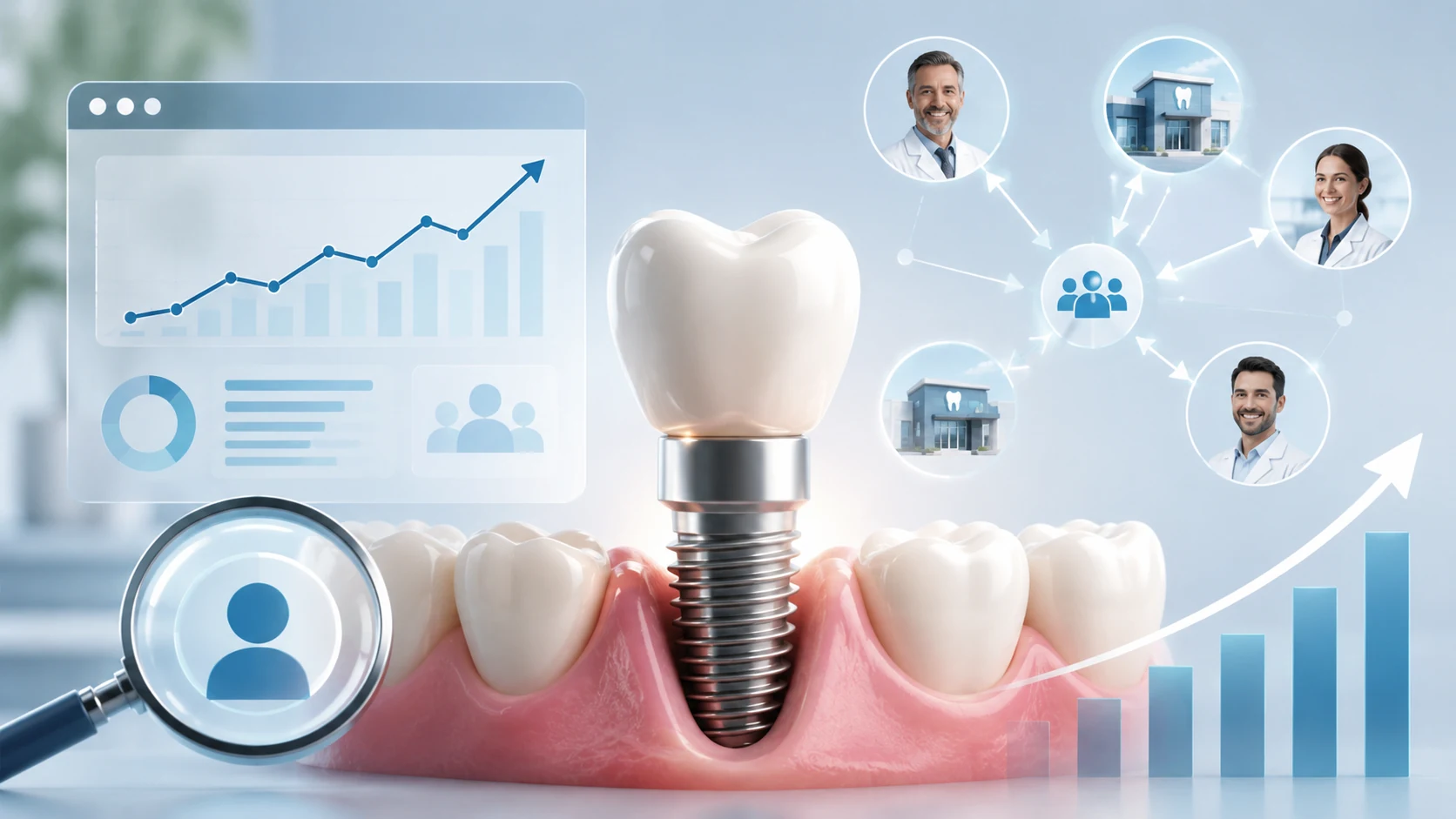 Periodontists attract more dental implant cases and referrals with marketing strategies built for specialty practice—referring-dentist relationships, implant-specific local SEO and Google Business Profile optimization, reputation management, and high-intent paid search—not generic dental advertising. Periodontists attract more dental implant cases and referrals with marketing strategies built for specialty practice—referring-dentist relationships, implant-specific local SEO and Google Business Profile optimization, reputation management, and high-intent paid search—not generic dental advertising.
If your practice places implants but your surgical schedule depends on a handful of referral sources, a focused strategy can protect that pipeline and add a second, patient-driven channel.
The challenge is specific to specialty practices. A periodontist competes for implant cases on two fronts at once: staying top-of-mind with the general dentists who refer, and becoming visible to patients who increasingly research implants directly before they ever ask for a referral. The tactics that work for a general dental office—broad “family dentist near me” visibility—don’t map cleanly to surgical implant demand, which is higher-consideration, higher-value, and often researched for weeks.
Already getting steady referrals? Keep reading to protect and diversify them. If referral volume is the immediate problem, start with the referral engine section first.
Below, you’ll find a practical approach for each channel that drives implant cases: a referral engine with general dentists, Google Business Profile and local search, conversion-focused implant pages, visibility across AI search surfaces, compliant review generation, paid search for high-intent demand, and the measurement that ties spend to booked surgical consults.
Written for: periodontists, practice owners, and specialty-practice managers who want a dependable, compliant system for attracting and converting more dental implant cases.
TL;DR
If you only prioritize five things, prioritize these:
| 1. |
Protect and grow referrals - treat referring general dentists as your most valuable channel with fast communication, easy referral pathways, and useful case follow-up
|
| 2. |
Own implant searches locally - optimize your Google Business Profile with the right categories, services, and photos so you appear when patients search implant terms nearby
|
| 3. |
Build implant pages that convert - dedicated, specific pages for single-tooth, full-arch, and supporting procedures with a clear next step to request a consult
|
| 4. |
Generate reviews the compliant way - ask every satisfied patient without gating or incentives, and respond carefully within privacy rules
|
| 5. |
Measure booked consults, not clicks - track calls, form requests, and referral sources so you know which channels actually produce surgical cases |
Table of Contents
Why periodontists need an implant-specific strategy
Implant cases don’t behave like routine dental visits, and the marketing that drives them shouldn’t either. Patients considering implants tend to research longer, compare providers, and weigh cost and trust heavily before booking a surgical consultation. At the same time, more general dentists are placing implants in-house, which means the referrals periodontists once received automatically can no longer be taken for granted. A dedicated periodontist marketing strategy addresses both realities at once.
The two channels you’re actually marketing to:
| • |
Referring dentists - general practitioners and other specialists who send complex implant, grafting, and full-arch cases your way
|
| • |
Direct patients - people who search for implant solutions themselves, often before they have a referral, and arrive ready to compare providers |
A practice that markets to only one of these channels leaves the other exposed. If referrals slow, there’s no patient-driven pipeline to absorb the gap; if you neglect referral relationships, you forfeit the highest-value, most predictable source of surgical cases. The sections below build both.
> Back to Table of Contents
Build a referral engine with general dentists
For most periodontists, referring general dentists are the single most valuable marketing channel—and often the most underinvested. Referrals aren’t a passive byproduct of good clinical work; they respond to communication, convenience, and trust, all of which can be strengthened through deliberate referral-network building.
Make referring effortless:
| • |
Simple referral pathways - offer several easy ways to refer (a short online form, a direct phone line, a printable slip) so a busy front desk can send a case in under a minute
|
| • |
Fast acknowledgment - confirm receipt of every referral quickly so the referring office knows their patient is in good hands
|
| • |
Clear scope - make it obvious which cases you welcome, from single-tooth implants and bone grafting to sinus lifts and full-arch restoration |
Close the loop after every case
The fastest way to lose a referral source is silence. Referring dentists want to know what happened to the patient they trusted you with. A consistent communication loop—an initial consult summary, a treatment update, and a note when the patient returns to their general dentist for restorative work—signals respect and keeps the relationship reciprocal. Periodontists who treat this follow-up as a system, not an afterthought, tend to see steadier referral volume.
Stay visible between referrals
Relationships fade without contact. Lightweight, genuinely useful touchpoints keep your practice top-of-mind without becoming a nuisance.
| • |
Education and case discussions - host or sponsor study clubs and lunch-and-learns on implant planning, complex grafting, or full-arch workflows
|
| • |
Co-marketing - collaborate on shared patient education so referring offices can explain when a specialist referral helps
|
| • |
Reliable communication - be the specialist who is easy to reach, quick to respond, and predictable to work with |
The goal isn’t to pressure anyone—it’s to be the obvious choice when a referable case appears.
> Back to Table of Contents
Optimize your Google Business Profile for implant searches
When patients search for implant providers themselves, your Google Business Profile often decides whether you appear in the local map results—the cluster of nearby practices shown above the standard listings. For local healthcare searches like “dental implants near me,” these map and local results remain the primary way patients discover and compare providers, so an optimized profile is foundational.
Get the fundamentals right:
| • |
Accurate categories - set “Periodontist” as your primary category and add relevant secondary categories such as “Dental implants provider” so Google understands your implant focus
|
| • |
Complete services and attributes - list your implant-related services specifically and keep hours, phone, and address consistent everywhere they appear online
|
| • |
Real photos - add current images of your office, team, and technology to build trust before a patient ever calls
|
| • |
Regular updates - use profile posts to share patient-education topics and keep the listing active |
Consistency matters as much as completeness. Your practice name, address, and phone number should match across your website, the profile, and any directories, because conflicting information undermines both rankings and patient confidence.
> Back to Table of Contents
Create implant pages that turn visitors into consultations
Traffic only matters if it converts, and a single generic “dental implants” page rarely does the job for a surgical practice. Patients researching implants have specific situations—a single missing tooth, a failing bridge, or a need for full-arch replacement—and they convert better on pages that speak directly to their situation.
Build dedicated pages for distinct needs:
| • |
Single-tooth implants - for patients replacing one missing or failing tooth
|
| • |
Full-arch and implant-supported solutions - for patients facing extensive tooth loss or failing dentition, including All-on-4 restorations
|
| • |
Supporting procedures - bone grafting, sinus lifts, and gum grafting that patients often research as separate concerns
|
| • |
What to expect - a clear, reassuring overview of the consultation and surgical process that reduces anxiety |
Make the next step obvious
Every implant page should make it easy to request a consultation without forcing a phone call as the only option. A short request form, a visible phone number, and clear language about what happens next remove friction for patients who are ready but hesitant. The aim is a single, obvious next step on every page—not a maze of competing calls to action.
Show evidence patients can trust
Implant patients are deciding whether they can trust you with surgery, so proof carries weight. Provider credentials, an explanation of your training and technology, and patient stories all help—but anything involving real patients requires explicit, written consent and careful handling of protected health information. Before-and-after photos and testimonials can be persuasive, yet they must never compromise patient privacy or imply guaranteed outcomes.
> Back to Table of Contents
Win local and AI-driven search visibility
Patient discovery is splitting across two layers. The first is traditional local search—the map results, organic listings, and review platforms patients still rely on to find and choose a nearby implant provider. The second is the growing set of AI assistants patients use earlier, while they’re still learning what implants involve and who provides them.
The local layer, where patients choose
This is where most implant patients still make their final choice, so it earns the bulk of your local SEO attention.
| • |
Local relevance - an optimized profile, consistent business information, and location-specific pages that connect your practice to the areas you serve
|
| • |
Authoritative content - clear, accurate answers to the questions implant patients ask, written to genuinely help rather than to chase keywords
|
| • |
Strong reviews - an active, recent review presence that signals trust to both patients and search engines |
The AI layer, where patients learn
A growing share of patients now ask AI assistants like ChatGPT, Perplexity, and Copilot about implants before they search a map or request a referral. These tools answer the informational question and then point patients toward sources and categories—the final step of choosing and contacting a specific provider still runs through search, maps, and review sites. Two things follow:
| • |
Publish content AI engines can use - clear, well-structured, genuinely useful answers about implants that these systems can draw from and cite
|
| • |
Keep your local presence strong - the profile and reviews patients check once an assistant has pointed them in your direction |
Because visibility in one AI tool doesn’t guarantee visibility in another, broad, accurate, well-organized information about your practice and procedures is the most durable approach.
> Back to Table of Contents
Generate and manage reviews the compliant way
Reviews influence both search visibility and the patient’s final decision, and for high-consideration implant cases they carry real weight. But healthcare reviews come with compliance obligations that make “just ask for reviews” insufficient—how you ask matters as much as that you ask.
Build a steady, compliant review habit:
| • |
Ask everyone, consistently - make a simple review request part of your standard patient wrap-up rather than a one-time push
|
| • |
Don’t gate or incentivize - asking only happy patients for reviews, or offering anything of value in exchange, runs afoul of platform policies and federal rules on reviews
|
| • |
Respond with care - reply professionally and never confirm someone was a patient or disclose any health details, since responses are public |
Federal consumer-protection rules now restrict practices like buying reviews, suppressing honest negative reviews, and using review-gating tactics. The safe, effective approach is the simplest one: ask every patient, make leaving feedback easy, and respond thoughtfully while protecting privacy.
> Back to Table of Contents
Use paid search to capture high-intent implant demand
Some patients are ready to act now, and paid search puts your practice in front of them at the moment they’re looking. For a high-value service like implants, well-managed campaigns can be worthwhile—but only with tight targeting and honest measurement, because broad, unmanaged spend wastes budget quickly.
Run paid search deliberately:
| • |
Tight geographic targeting - focus spend on the realistic service area patients will travel from for surgical care
|
| • |
Intent-matched keywords and pages - send implant searches to the specific implant page that matches their need, not a generic homepage
|
| • |
Ad assets that build trust - use call buttons, location details, and relevant links to make the next step easy
|
| • |
Call and form tracking - measure which clicks become real consultation requests, not just traffic |
Paid search complements—rather than replaces—referrals and organic visibility. Think of it as a way to capture ready-to-book demand while your longer-term channels compound, and revisit it regularly so spend stays tied to booked consults.
> Back to Table of Contents
Track the metrics that map to implant cases
The marketing question that matters for a periodontist isn’t “how much traffic did we get?”—it’s “how many qualified implant consultations did we book, and where did they come from?” Without that line of sight, it’s easy to fund channels that look busy but don’t produce surgical cases.
Measure what leads to cases:
| • |
Consultation requests - track calls and form submissions as key events so you can see real demand, not just visits
|
| • |
Source attribution - know whether a new patient came from a referral, search, your profile, or paid ads
|
| • |
Referral tracking - monitor which referring offices are active, growing, or going quiet so you can respond early
|
| • |
Consult-to-case view - watch how booked consultations move toward accepted treatment so marketing connects to outcomes, not just inquiries |
A multi-touch journey is normal—a patient may read an assistant’s answer, check your reviews, visit a page, then call. The point isn’t to credit a single touch perfectly; it’s to keep enough visibility to invest where cases actually originate and to catch a slowing referral source before it becomes a revenue problem.
> Back to Table of Contents
Get help building your implant marketing plan
Building a referral engine, optimizing for local and AI search, creating implant pages that convert, and measuring what actually produces cases is a lot to run alongside a full surgical schedule. WEO Media - Dental Marketing works with periodontists and specialty practices to build and manage strategies designed around how implant patients are referred and how they research. To talk through a plan for your practice, call 888-246-6906 or request a consultation with our team.
> Back to Table of Contents
FAQs
How do periodontists market implants without harming referral relationships?
Direct-to-patient marketing and referral relationships aren’t in conflict when handled transparently. Keep referring dentists informed, make referrals easy, and close the loop on every case, while building patient-facing visibility for searches that begin without a referral. The two channels reinforce each other: a strong reputation attracts patients and reassures referring offices that their patients are in capable hands.
What is the best Google Business Profile category for a periodontist who places implants?
Most periodontists set “Periodontist” as the primary category and add “Dental implants provider” as a secondary category to signal their implant focus. The guiding rule is accuracy—categories should reflect services you actually provide. Pair the right categories with complete services, consistent business information, and current photos so the profile performs in local results.
How long does implant marketing take to produce new cases?
Timelines vary by market, competition, and where you start. Paid search can generate consultation requests relatively quickly when targeting and pages are dialed in, while referral relationships, reviews, and organic visibility compound over a longer horizon. A realistic plan treats fast and slow channels as complementary rather than expecting any single tactic to fill the schedule overnight.
Should periodontists market to patients directly or only to referring dentists?
Both, in most cases. Referring dentists are typically the highest-value and most predictable source of complex implant cases, so protecting those relationships comes first. Adding patient-facing marketing diversifies the pipeline and captures patients who research implants on their own, so a slow referral month doesn’t leave the surgical schedule empty.
Do AI assistants like ChatGPT affect how patients find implant providers?
Increasingly, yes, but mostly in the research phase. Patients use assistants like ChatGPT, Perplexity, and Copilot to learn about implant options before they choose a provider, and these tools point them toward sources and categories. The final step of selecting and contacting a specific practice still runs through search, maps, and review platforms, so a strong local presence remains essential alongside clear, useful content.
How can a dental practice ask for reviews without breaking the rules?
Ask every patient consistently rather than only those you expect to be happy, and never offer anything of value in exchange for a review. Make leaving feedback simple, and respond to reviews professionally without confirming patient status or sharing any health details. Gating reviews and incentivizing them violate platform policies and federal consumer-protection rules, so the straightforward, ask-everyone approach is both safer and more effective.
Are paid search ads worth it for dental implant cases?
They can be, for a high-value service like implants, but only with disciplined management. Tight geographic targeting, keywords matched to specific implant pages, and call-and-form tracking keep spend tied to real consultation requests instead of raw clicks. Treat paid search as a way to capture ready-to-book demand while referrals and organic visibility build over time.
What marketing metrics should a periodontist actually track?
Focus on metrics that connect to cases: consultation requests (calls and form submissions tracked as key events), the source each new patient came from, the activity level of referring offices, and how booked consults progress toward accepted treatment. Traffic and rankings are useful context, but booked surgical consultations and their sources are what tell you where to invest. |
|