Dental Implant Patient Journey: How to Convert More Big Cases
Posted on 6/16/2026 by WEO Media |
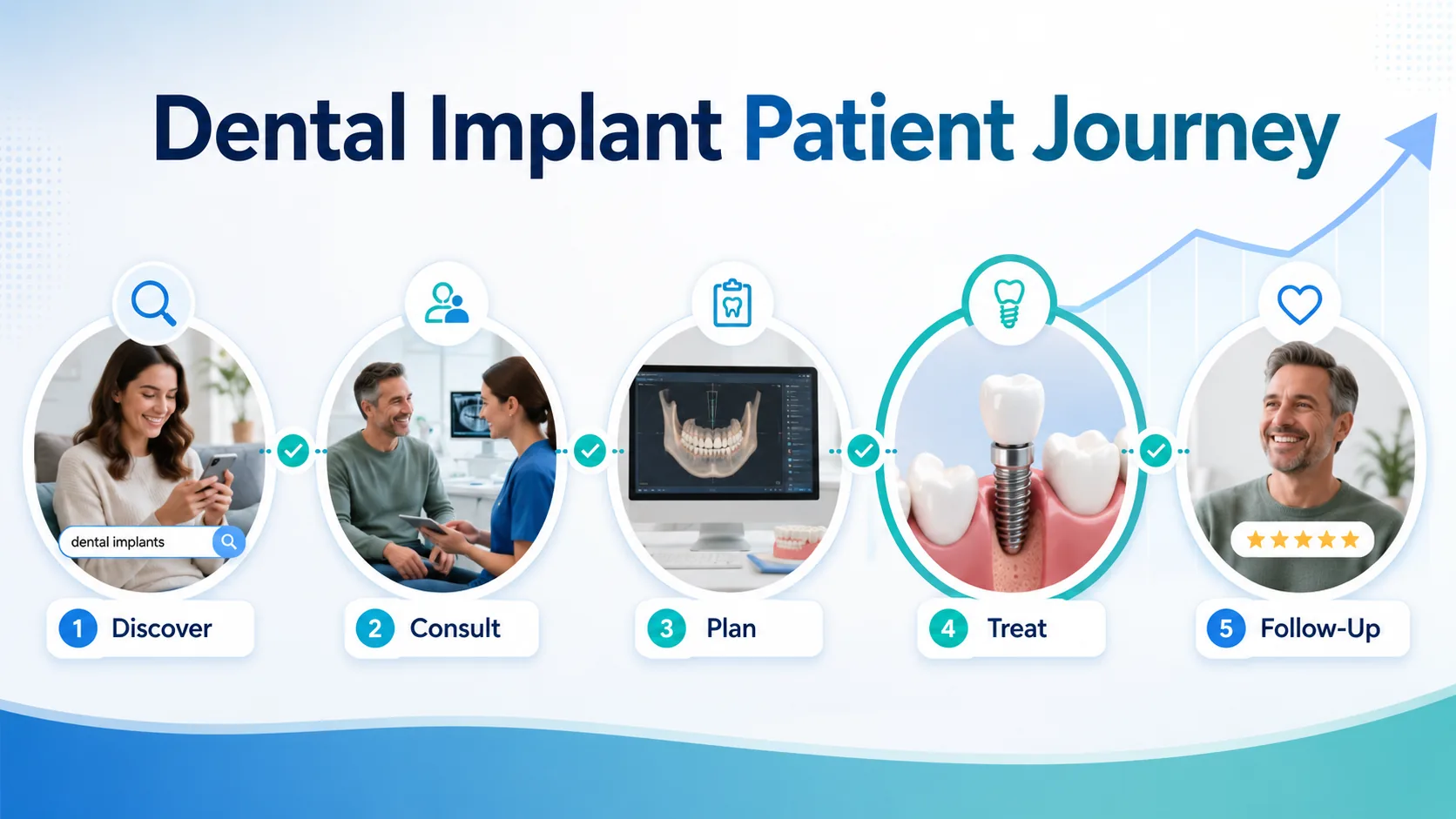 The dental implant patient journey is the full sequence of touchpoints a patient moves through — from first search to placed crown and every follow-up after — and mapping every touchpoint is how dental practices convert more implant cases. The dental implant patient journey is the full sequence of touchpoints a patient moves through — from first search to placed crown and every follow-up after — and mapping every touchpoint is how dental practices convert more implant cases.
Unlike a routine cleaning, an implant is a high-consideration, multi-visit decision that can unfold over several months. That long arc creates dozens of moments where a prospective patient can move forward or quietly drop off — and most of those moments are marketing and operations problems you can actually fix.
Most practices treat implant marketing as a single event — run an ad, rank a page, wait for the phone to ring. But implant patients rarely decide that way. They research for weeks, compare providers, weigh financing, and often go quiet between the consultation and a “yes.” When you map the journey as a connected series of touchpoints instead of one campaign, you can see exactly where interested patients stall and intervene with the right message at the right step.
New to mapping patient journeys? Start with the five-stage overview below, then use the touchpoint checklist in each section to audit your own funnel.
Below, we break the journey into five stages — awareness, consideration, conversion, treatment, and retention — and walk through the specific touchpoints inside each one: where patients find you, what builds (or breaks) trust, how a consult request becomes a booked visit, how to communicate across a months-long treatment, and how to measure the whole path so you know which touchpoint to improve first.
Written for: dental practice owners, treatment coordinators, office managers, and the marketing teams supporting general, implant, and specialty practices (oral surgery, periodontics, prosthodontics) who want to win more implant cases without leaning on pressure tactics.
TL;DR
If you only fix five touchpoints, fix these:
| 1. |
Win the awareness moment - implant discovery now splits between local search (map pack, Google Business Profile, reviews) and AI research surfaces, so you need both a strong local presence and clear, citable educational content
|
| 2. |
Make the website do the convincing - a dedicated implant page with honest expectations, real before-and-after proof, financing transparency, and authentic reviews answers the questions patients are actually weighing
|
| 3. |
Protect the consult request - fast, human response to calls, forms, and chat is where most implant interest is lost; slow follow-up quietly kills high-value cases
|
| 4. |
Nurture the undecided - implant patients often need weeks and a financing conversation before they say yes, so a planned follow-up sequence after the consultation matters more than any single ad
|
| 5. |
Measure the path, not just the lead - track consult-to-case-acceptance and which touchpoints drive booked cases (using GA4 key events and call tracking) so you improve the right step first |
Table of Contents
Map the implant journey: the five stages
Before optimizing any single touchpoint, it helps to see the whole patient journey. A useful model breaks the dental implant patient journey into five stages, each with its own touchpoints and its own reasons patients drop off.
| • |
Awareness - the patient realizes they need to replace a tooth (or teeth) and starts looking; touchpoints include local search, AI research tools, Google Business Profile, ads, social posts, and word-of-mouth referrals
|
| • |
Consideration - they compare providers and weigh the decision; touchpoints include your implant page, educational content, reviews, before-and-after galleries, and financing information
|
| • |
Conversion - they reach out; touchpoints include phone calls, web forms, click-to-call, chat, and the speed and tone of your response
|
| • |
Treatment - they accept and move through care; touchpoints include the consultation, the case presentation, the financing conversation, scheduling, and communication across a months-long clinical process
|
| • |
Retention and referral - after the final restoration; touchpoints include recall reminders, review requests, referral asks, and reactivation outreach |
The reason implants need this lens is simple: the decision is rarely linear. A prospective patient might read an AI answer about the procedure, check your map listing, read three reviews, leave to compare a competitor, return two weeks later to submit a form, then wait another month for a financing conversation before accepting. Map the stages, and those gaps stop being invisible.
> Back to Table of Contents
Awareness: how patients first find you
Implant awareness now happens across two very different surfaces, and you need a presence on both. Local discovery — someone searching for a provider in their area — still runs on traditional local results. As of 2026, Google does not show AI Overviews on local “near me” healthcare searches; those results are handled by the map pack, Google Business Profile, and organic listings. That means your local SEO, profile completeness, and review volume remain the deciding factors for “implant dentist near me” queries.
Research discovery works differently. For informational questions — how implants work, how long they take, what recovery looks like — AI surfaces are now front and center. Google’s AI Overviews appear on the large majority of treatment and procedure queries, and a growing share of patients use assistants like ChatGPT, Perplexity, and Copilot to research before they ever search locally. These tools shape which providers a patient even considers, often before a map listing enters the picture.
The practical takeaway is that your awareness touchpoints have two jobs:
| • |
Own the local surface - keep Google Business Profile complete and current, build a steady flow of authentic reviews, and make sure your name, address, and phone are consistent everywhere
|
| • |
Feed the research surface - publish clear, well-structured educational content that AI tools can cite, with plain answers to the questions patients ask about implants
|
| • |
Support paid and social - if you run ads, use current ad assets (formerly called ad extensions) like call and location assets, and treat social posts as awareness touchpoints that reinforce credibility rather than hard-sell |
Referrals belong here too. A referral from another patient, or a general dentist sending a case to a specialist, is often the highest-trust awareness touchpoint of all — and it deserves a deliberate process, not just hope.
> Back to Table of Contents
Consideration: website, content, and reviews
Once a patient is considering you, the touchpoints shift to trust. Implants are a major decision, and prospective patients arrive with specific worries: Will it hurt? How long does it take? Is this provider experienced? Can I afford it? Your consideration touchpoints exist to answer those questions honestly before the patient has to ask.
A dedicated implant page should do more than list the service. It should set realistic expectations about the staged, months-long process, explain who is a candidate, show your team’s experience, and address financing in plain language — without quoting prices that vary case by case. Vague pages lose patients to competitors who simply explain things more clearly.
Reviews and before-and-after proof are often the single most persuasive touchpoint — and the most regulated. The FTC’s rule on consumer reviews and testimonials, effective in 2024, prohibits fake or AI-generated reviews, undisclosed reviews from staff or insiders, and offering incentives in exchange for a positive review. Practices should collect reviews authentically, disclose any material connections, and never suppress or edit negative feedback to mislead. You can review the requirements directly in the FTC guidance on reviews and testimonials. Before-and-after photos carry the same duty of honesty — use real patients, obtain written consent, and avoid implying a typical result you cannot support.
Educational content rounds out consideration. Patient-friendly explainers about candidacy, the procedure timeline, bone grafting, and aftercare both reassure the patient and give AI research tools accurate material to cite. Content that answers real questions is what turns a curious visitor into a qualified consult request.
> Back to Table of Contents
Conversion: turning a request into a booked consult
This is where the most implant value leaks — and it is almost entirely an operations problem. A patient who has researched for weeks finally calls, fills out a form, or starts a chat. What happens in the next few minutes often decides whether a high-value case books or disappears.
The most common conversion leaks are predictable:
| • |
Missed calls during peak times - implant inquiries that hit voicemail at lunch or end-of-day rarely call back, so protect phone coverage and use overflow so demand does not vanish
|
| • |
Slow follow-up on forms and chats - a web lead answered hours later has usually moved on; same-day, ideally same-hour, response wins the case
|
| • |
Friction in booking - long hold times, too many transfers, or a coordinator who cannot actually schedule the consult add drop-off at the worst moment
|
| • |
Dead-end “we’ll call you back” - without a named owner and a due time, callbacks loop forever and the patient books elsewhere |
The fix is a simple, accountable intake process: a named owner for every inquiry, a target response time, the authority to book a consultation on the spot, and a short, warm script that acknowledges the patient is weighing a big decision. For a high-ticket case, response speed and tone are marketing — they are the difference between the awareness investment you already spent paying off or not.
> Back to Table of Contents
The consultation and case acceptance
Booking the consultation is a milestone, not the finish line. For implants, the consultation and the days that follow are where the case is actually won or lost — and where many practices simply stop following up.
Inside the consultation, the touchpoints are clinical and human at once: a clear explanation of the recommended treatment, a realistic timeline, what to expect at each visit, and an honest financing conversation. Treatment coordinators play a pivotal role here. Patients accept care they understand and trust; they hesitate when the plan feels rushed, confusing, or financially out of reach.
The undecided patient is the biggest missed opportunity. Many implant patients leave the consultation genuinely interested but not ready — they need to think, check financing, or talk to a partner. Without a deliberate follow-up sequence, that interest fades. A planned cadence of helpful, low-pressure touchpoints — a recap of the plan, answers to common financing questions, a check-in a few days later — recovers cases that a single conversation would have lost. The goal is not pressure; it is staying present and useful while the patient decides.
> Back to Table of Contents
Treatment and healing: months-long communication
Implant treatment is not a single appointment. Depending on the case, it commonly unfolds over several months and multiple visits — consultation and planning, any needed extraction or bone grafting, implant placement, a healing period while the implant integrates with the bone, and finally the abutment and crown. Timelines vary by patient, and grafting or extraction can extend them.
That long arc is itself a series of touchpoints, and communication during it shapes whether a patient feels cared for — and whether they refer others later:
| • |
Set expectations early - patients who understand up front that healing takes time are far less likely to feel anxious or abandoned during the quiet months
|
| • |
Keep a reminder and check-in cadence - appointment reminders and brief progress check-ins reduce no-shows and reassure patients that the long process is on track
|
| • |
Communicate through secure, compliant channels - any patient communication that includes health information should follow HIPAA-appropriate practices, so confirm your reminder and messaging tools handle protected information correctly |
Handled well, the treatment phase becomes a relationship-builder rather than a silent gap. Patients who feel guided through a months-long process are the ones who leave glowing reviews and send referrals — closing the loop back to your awareness touchpoints.
> Back to Table of Contents
Retention and referral after the crown
The journey does not end when the crown is placed. The post-treatment touchpoints determine lifetime value — and they are where a satisfied implant patient becomes a source of new patients:
| • |
Recall and maintenance - implants need ongoing care and monitoring, so a reliable recall system protects both patient health and the long-term relationship
|
| • |
Compliant review requests - the moment a patient is thrilled with their result is the right time to invite a review, as long as you ask authentically and never tie the request to an incentive for a positive rating
|
| • |
Referral generation - happy implant patients and referring general dentists are your most credible awareness channel, so make referring easy and acknowledge it
|
| • |
Reactivation - patients who completed one implant may need additional care later, so periodic, helpful outreach keeps your practice top of mind |
Treating retention as a set of intentional touchpoints — rather than an afterthought — is what turns one completed case into reviews, referrals, and future treatment. This is the stage that quietly feeds the top of your funnel.
> Back to Table of Contents
Measure the journey: touchpoint metrics
You cannot improve a journey you do not measure. The mistake most practices make is counting only leads — total calls or form fills — without seeing where in the path patients actually drop off. Mapping metrics to stages tells you which touchpoint to fix first:
| • |
Awareness - track local visibility, Google Business Profile actions, and which sources drive qualified traffic
|
| • |
Consideration - watch implant page engagement, review volume and rating, and content performance
|
| • |
Conversion - measure answer rate, response time, and the share of inquiries that book a consultation
|
| • |
Treatment - track consultation-to-case-acceptance rate, the single most revealing implant metric, plus no-show rate
|
| • |
Retention - monitor recall compliance, review generation, and referrals produced |
Set this up with the tools you already have. Use GA4 key events (the current GA4 term for what used to be called conversions) to mark meaningful actions like consult requests, and use call tracking to connect phone inquiries back to their source. Watch consult-to-acceptance closely — a strong flow of consultations with weak acceptance points to the consultation and follow-up touchpoints, while plenty of acceptance but few consultations points upstream to awareness or conversion. The metric that moves tells you where to work.
> Back to Table of Contents
Map your implant journey with WEO Media
Mapping the dental implant patient journey turns scattered marketing into a connected system — one where you can see exactly where prospective patients stall and fix the touchpoint that matters most. From local visibility and educational content to intake, follow-up, and measurement, every stage is an opportunity to convert more implant cases without pressure tactics.
WEO Media - Dental Marketing works with general, implant, and specialty practices to map and strengthen each of these touchpoints. If you want help turning your implant marketing into a journey that converts, call us at 888-246-6906 or schedule a consultation to talk through your funnel.
> Back to Table of Contents
FAQs
What is the dental implant patient journey?
It is the full path a patient takes around getting a dental implant, from first becoming aware they need tooth replacement through research, consultation, treatment, and long-term follow-up. Marketers map it as a series of touchpoints across five stages — awareness, consideration, conversion, treatment, and retention — so they can see where prospective patients drop off and improve those specific moments.
What are the main touchpoints in the implant journey?
Key touchpoints include local search and Google Business Profile, AI research tools, reviews and before-and-after galleries, the implant page on your website, phone calls and web forms, the consultation and case presentation, the financing conversation, appointment communication during healing, and post-treatment recall, review requests, and referrals. Each one is a chance to move a patient forward or lose them.
How long is the dental implant patient journey?
The marketing journey can begin weeks before a patient ever calls, and the clinical process itself commonly spans several months across multiple visits, since the implant needs time to integrate with the bone. Cases that require extraction or bone grafting can take longer, and timelines vary by patient. This long arc is why nurturing undecided patients matters so much.
Why do practices lose implant cases between the consultation and treatment?
Many patients leave a consultation interested but not ready — they need time to think, check financing, or talk with family. Without a deliberate, low-pressure follow-up sequence, that interest fades and the case is lost. A planned cadence of helpful check-ins after the consultation recovers cases that a single conversation would not close.
How do AI search tools affect dental implant patient discovery?
They mostly affect the research stage. As of 2026, Google does not show AI Overviews on local “near me” healthcare searches, so local provider discovery still runs on the map pack, Google Business Profile, and organic listings. For informational questions about implants, however, AI Overviews and assistants like ChatGPT and Perplexity are increasingly where patients learn, which makes clear, citable educational content important for being part of those answers.
Are patient reviews and testimonials allowed in implant marketing?
Yes, authentic reviews and testimonials are encouraged and powerful, but they are regulated. The FTC’s rule on consumer reviews and testimonials, effective in 2024, prohibits fake or AI-generated reviews, undisclosed reviews from insiders or staff, incentivizing reviews in exchange for a positive sentiment, and deceptively suppressing negative feedback. Collect reviews honestly, disclose material connections, and use real patients with written consent for before-and-after content.
How should we communicate with implant patients during the months-long healing process?
Set expectations early so patients know healing takes time, then keep a light cadence of appointment reminders and brief progress check-ins so they feel guided rather than forgotten. Any communication that includes health information should follow HIPAA-appropriate practices, so confirm your reminder and messaging tools handle protected information correctly. Good communication during this phase is what earns reviews and referrals later.
Which metrics matter most for the dental implant patient journey?
Map metrics to stages instead of counting only leads. The most revealing implant metric is consultation-to-case-acceptance rate, paired with response time and answer rate on inquiries, qualified traffic by source, review volume, and referrals generated. Use GA4 key events to mark meaningful actions and call tracking to tie phone inquiries to their source, so you know which touchpoint to improve first. |
|