Dental Referral Cards: How to Build a Legal, Effective Program
Posted on 7/3/2026 by WEO Media |
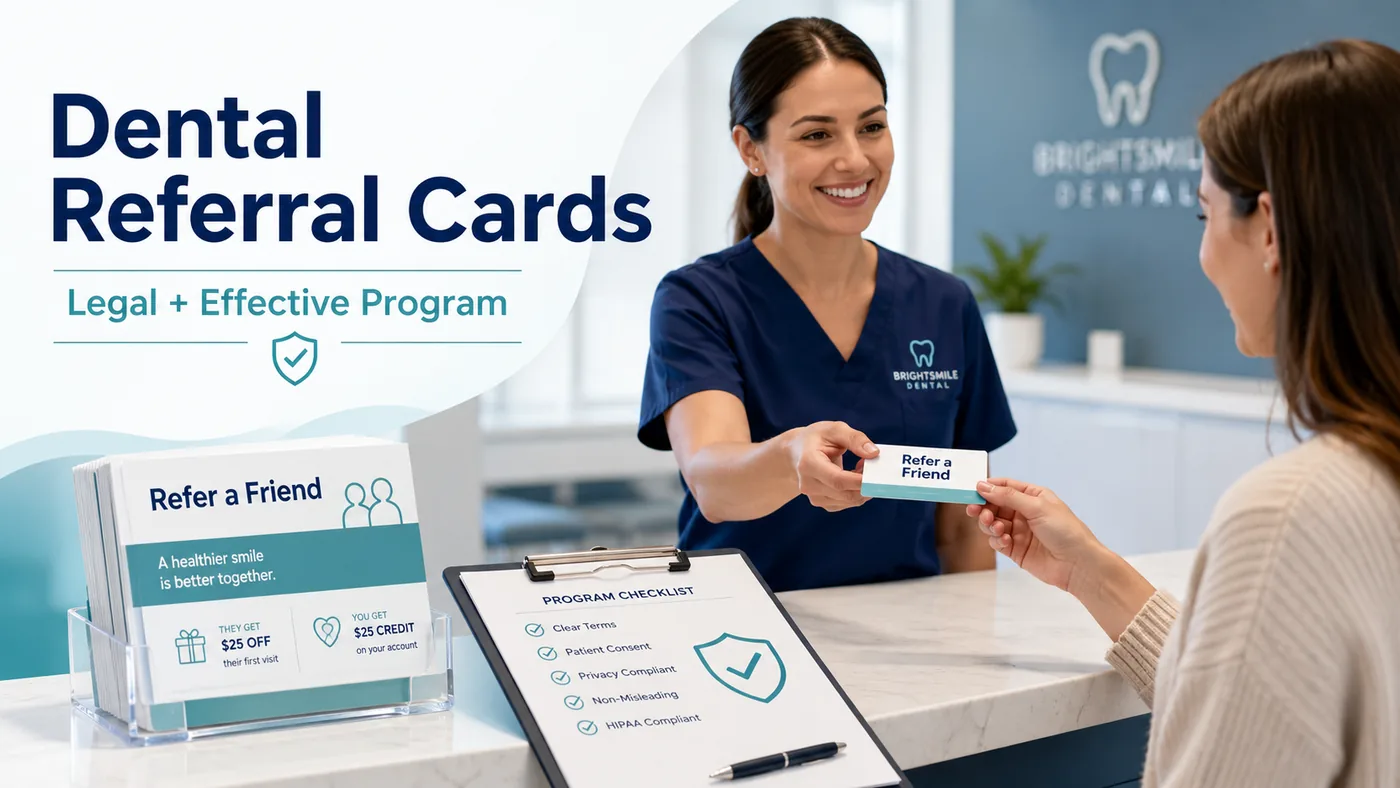 Dental referral cards are a legal, effective way for dental practices to grow through patient word-of-mouth, and building a compliant referral program around them comes down to keeping any reward within federal anti-kickback limits and your state’s rules on paying for patient referrals. Dental referral cards are a legal, effective way for dental practices to grow through patient word-of-mouth, and building a compliant referral program around them comes down to keeping any reward within federal anti-kickback limits and your state’s rules on paying for patient referrals.
The card itself—a simple, well-designed prompt a happy patient hands to a friend—carries very little legal risk. The risk lives in the incentive you attach to it: cash, gift cards, discounts, or any “thank you” that can be read as paying someone to send you patients. Get the reward wrong and a friendly growth tactic can collide with the federal Anti-Kickback Statute, the Medicare and Medicaid beneficiary-inducement rules, and your state’s fee-splitting laws. Get it right, and referral cards become one of the most cost-effective new-patient channels a practice has.
This guide covers both halves of the phrase “legal and effective.” First, the compliance guardrails: which laws apply, when they apply to your practice, and which rewards are safe, risky, or off-limits. Then the execution: how to design a card patients actually use, how to hand it out without feeling pushy, and how to track referrals so you can prove the return. One caveat up front, because it matters more here than in most marketing topics: WEO Media - Dental Marketing is a dental marketing agency, not a law firm, and nothing below is legal advice. Referral and anti-kickback rules vary by state and change over time, so treat this as a map of the terrain and confirm your specific program with a healthcare attorney licensed in your state before you launch.
Written for: dental practice owners, office managers, and marketing teams who want a patient referral program that grows the practice without creating legal exposure.
TL;DR
If you read nothing else, remember these seven points:
| 1. |
The card is low-risk; the reward is not - a plain “refer a friend” card is fine; the legal exposure comes from what you give people for referring
|
| 2. |
Federal programs are the trigger - if any patients are covered by Medicaid, Medicare, or TRICARE, the federal Anti-Kickback Statute and beneficiary-inducement rules can apply, and paying for those referrals can be a crime
|
| 3. |
Cash and gift cards are the danger zone - cash and general-purpose gift cards are treated as the highest-risk reward; a small, non-cash thank-you that is not tied to the number of referrals is far safer
|
| 4. |
State law can be stricter than federal law - some states, such as California, prohibit rewarding patient referrals regardless of who pays, so your dental board and state statutes matter as much as the federal rules
|
| 5. |
Reviews add a second rulebook - if your program asks for online reviews, the FTC’s 2024 reviews rule bars tying any incentive to a positive rating, and FTC guidance requires disclosing incentivized and insider reviews
|
| 6. |
Design for use, not just for looks - one clear ask, a QR code to a referral page, warm team scripts at high-satisfaction moments, and a “referred by” field turn cards into booked patients
|
| 7. |
When in doubt, keep it non-transactional and get sign-off - treat appreciation as practice-wide rather than a per-referral bounty, document your policy, and have an attorney review it first |
Table of Contents
What dental referral cards are (and why legal comes first)
A dental referral card is a small, branded card that an existing patient gives to a friend, family member, or coworker to introduce them to your practice—one of the oldest and most trusted tactics in dental referral marketing. It usually carries your practice name, contact details, a short prompt, and increasingly a QR code that links to a referral or new-patient page. Some practices add a reward—something the referring patient or the new patient receives—and that single design choice is where the legal questions begin.
Here is the distinction that governs everything that follows. Handing someone a card, and gaining new patients because your care is worth talking about, is ordinary word-of-mouth and is not a problem anywhere. Attaching remuneration—anything of value given in exchange for a referral—is what can trigger federal and state anti-kickback laws. So the practical question is never simply “are referral cards legal?” It is “what, if anything, am I giving people for referrals, who pays for the resulting care, and what does my state allow?”
That framing also clears up a myth you will see repeated in dental marketing circles: that patient-to-friend referrals are categorically exempt from these laws. They are not. As the U.S. Department of Health and Human Services Office of Inspector General puts it, the kickback prohibition applies to all sources of referrals, including patients. Whether it actually reaches your program depends on the facts below—but “a patient referred them” is not, by itself, a shield.
> Back to Table of Contents
The federal laws behind dental referral rewards
Three federal laws shape what a dental practice can offer for referrals. Only the first two usually matter for referral cards, but it helps to know where each one starts and stops. For a plain-language overview from the government itself, see the OIG’s summary of the federal fraud and abuse laws.
The Anti-Kickback Statute (AKS)
The federal Anti-Kickback Statute makes it a crime to knowingly and willfully offer, pay, solicit, or receive anything of value to induce or reward referrals of items or services paid for by a federal health care program—chiefly Medicaid, Medicare, and TRICARE. “Anything of value” is read broadly: cash, gift cards, discounts, free services, and more. The statute reaches every side of the arrangement, and as the OIG bluntly notes, in some industries rewarding referrals is normal, but in federal health care programs paying for referrals is a crime. Violations are felonies that can carry criminal fines, exclusion from federal programs, and up to ten years in prison.
The part that trips up dental practices is the trigger. Most routine dental care is not billed to Medicare, so many practices assume the statute cannot touch them. But Medicaid covers a great deal of dental care—especially pediatric dentistry—and a single Medicaid-covered referral can bring a rewarded referral within the law. If any meaningful share of your patients is covered by a federal program, assume the Anti-Kickback Statute is in play and design your rewards accordingly.
The beneficiary-inducement rules and the “nominal value” limit
A companion civil law, the beneficiary-inducement provision of the Civil Monetary Penalties Law, targets remuneration offered to a Medicare or Medicaid patient that you know or should know is likely to influence their choice of provider. This is the rule people reach for when they say “keep the gift small.” The OIG currently interprets a gift of “nominal value” as no more than 15 dollars per item or 75 dollars in total per patient per year, and—critically—it may never be cash or a cash equivalent.
Two cautions keep this from being a loophole. First, general-purpose gift cards, such as open-loop cards or cards for large online retailers, are treated as cash equivalents, so they fall outside the nominal-value allowance entirely. Second, and less well known, the nominal-value interpretation was written for gifts that might influence a patient’s own choice of provider; the OIG has indicated it was not meant to bless rewards to referral sources, which deserve close scrutiny. In other words, a small non-cash token of appreciation is defensible, but keeping a referral bonus “under 15 dollars” is not a clean green light for a cash-back referral program.
The Stark Law, usually a minor player here
The federal physician self-referral law, known as Stark, restricts referrals for certain “designated health services” when the referring provider has a financial relationship with the entity receiving the referral. Dentists are technically included in Stark’s definition of “physician,” but because Medicare covers so few dental services, Stark rarely reaches a typical dental referral card. It matters most in arrangements between dentists and physicians—for example, some dental-sleep and oral-surgery referral relationships—so it is worth a conversation with counsel if your practice sits at that intersection.
> Back to Table of Contents
State laws can be stricter—and often apply to everyone
Federal law is only half the picture, and for many practices it is the less restrictive half. Most states have their own anti-kickback, fee-splitting, or patient-brokering statutes, plus dental board rules on advertising and inducements. The important twist is that many state laws apply regardless of who pays for the care, so a cash-only cosmetic practice that never touches Medicaid can still be bound by them.
California is the clearest example. Its Business and Professions Code section 650 prohibits any licensed healing-arts provider from offering or accepting any rebate, refund, commission, discount, or “other consideration, whether in the form of money or otherwise,” as compensation or inducement for referring patients. Notice how broad that is: it covers non-cash rewards and discounts, and it applies to commercial and cash-pay patients, not just government ones. A violation is a criminal offense. Other states take similar positions—Illinois treats undisclosed fee-splitting for referrals as grounds for discipline under its Dental Practice Act, Texas restricts patient inducements even outside Medicaid, and states including Florida enforce patient-brokering statutes with real penalties.
The takeaway is not that referral rewards are illegal everywhere; it is that your state, not the federal government, may be the binding constraint. Before you print a single card that promises a reward, check your state dental practice act and anti-kickback or fee-splitting statute—or better, have a healthcare attorney do it—because a program that is fine in one state can be a licensing problem in the next.
> Back to Table of Contents
Designing the reward: low-risk vs. off-limits
Once you know which rules apply, the reward design almost writes itself: move away from cash and volume-based bounties, and toward genuine, non-transactional appreciation. The American Dental Association’s guidance on discounts and rebates is a useful reference point, and you can review it in the ADA’s anti-kickback and discount program FAQ. Here is how the common options sort out.
Rewards to avoid
| • |
Cash and checks - the clearest form of paying for referrals, and off-limits whenever a federal program is involved
|
| • |
General-purpose gift cards - open-loop or big-retailer cards are treated as cash equivalents, so they get none of the nominal-value protection
|
| • |
Per-referral bounties - any reward that scales with the number of patients someone sends looks exactly like a kickback and is hard to defend under either federal or state law
|
| • |
Discounts on the referrer’s own care in exchange for referrals - tying a price break to sending patients can count as “other consideration” under state fee-splitting laws even when no gift changes hands
|
| • |
Any reward offered to a Medicaid, Medicare, or TRICARE patient - the safest course is to exclude federally covered patients from reward-based referral offers entirely |
Lower-risk ways to say thank you
| • |
A genuine, personal thank-you - a handwritten note or a warm word from the dentist costs nothing and is the single most underused referral reward
|
| • |
A small, non-cash token within nominal limits - a modest branded item or practice-appropriate gift kept well under the nominal-value threshold, and not tied to how many people were referred
|
| • |
Practice-wide appreciation - a patient-appreciation event or seasonal gesture that every active patient can enjoy, rather than a bounty aimed only at referrers, is far easier to defend
|
| • |
Recognition and experience - making patients feel genuinely valued, and giving them an effortless way to share, often out-performs any material reward |
The pattern across all of these is the same: reward the relationship, not the transaction. A thank-you a patient would receive whether or not a referral converted is very different, legally and ethically, from a payment contingent on sending you business.
> Back to Table of Contents
Where referral cards and online reviews collide
Referral programs and review requests tend to travel together—the same happy patient who refers a friend is the one you would love to ask for a Google review. That overlap brings a second rulebook into play: the Federal Trade Commission’s Rule on the Use of Consumer Reviews and Testimonials, which took effect on October 21, 2024. You can read the agency’s own explanation in the FTC’s consumer reviews and testimonials rule FAQ.
The rule does not ban asking for reviews or even offering an incentive for feedback. What it prohibits is conditioning a reward on a particular sentiment. Offering something “for your honest feedback” is allowed; offering the same thing “for a five-star review,” or implying as much with language like “tell everyone how much you love us,” is not—and adding a disclosure does not cure a sentiment-based incentive. Under the FTC’s broader endorsement guidance, any incentive behind a review must also be disclosed, and the rule specifically requires reviews written by the practice’s own owners, staff, or immediate family to disclose that relationship.
For referral cards, the practical rules are simple. Keep the referral ask separate from any “leave us five stars and get a reward” structure. If you do incentivize feedback, make it sentiment-neutral and disclosed. And remember that your marketing partners are covered by the rule as well, so any vendor who manages reviews on your behalf needs to follow it too. This reviews rule is one piece of the broader FTC advertising rules for dentists, and civil penalties for knowing violations are steep—reason enough to keep this clean.
> Back to Table of Contents
How to design a referral card patients actually use
With the compliance guardrails set, the rest is craft. Most referral cards fail not because they break rules but because they never get handed out, or because the person who receives one does not know what to do next. A card that gets used is clear, effortless, and easy to act on the moment it is received.
What belongs on the card
| • |
One clear ask - a single, friendly call to action beats a cluttered card every time; the goal is to introduce a friend, not to explain your whole practice
|
| • |
The essentials - practice name, phone number, and website, so a new patient can reach you in one step
|
| • |
A QR code - link it to a dedicated referral or new-patient page rather than your homepage, so the visit has a clear next step
|
| • |
A place to identify the referrer - a name line or a unique code so you can track where referrals come from and thank the right person
|
| • |
Warm, permission-based wording - language that reflects care rather than a sales pitch, so patients feel comfortable passing it along |
Make the digital path effortless
Physical cards work best when they connect to a smooth digital experience. The QR code should open a mobile-friendly page that welcomes the referred person, explains what to expect from a first visit, and lets them request an appointment online without friction. Offer a text-a-friend or shareable link for patients who would rather send something from their phone than carry a card. The easier you make sharing, the more it happens—most missed referrals are simply the ones that were too much effort to complete.
When your new-patient page and referral page are part of a broader, well-optimized website, referrals compound with the rest of your marketing rather than living in a silo. A referred visitor who lands on a fast, reassuring page that converts is far more likely to book than one dropped onto a generic homepage.
> Back to Table of Contents
Handing them out: timing, scripts, and follow-through
The best-designed card does nothing sitting in a drawer. Referrals rise when the card is backed by a structured patient referral program, with the ask built into the visit at the right moment and the team feeling natural making it. Two things drive that: timing and a short, comfortable script.
Timing means asking for referrals at peak satisfaction—right after a positive outcome, a compliment about their smile, or an easy visit that beat their expectations. A patient who just had a great experience is far more receptive than one being handed a card on the way in the door. Build the moment into checkout and into new-patient welcome kits, so it happens consistently instead of only when someone remembers.
The script should be brief and pressure-free. Something as simple as “If you know anyone looking for a dentist, we’d love to take great care of them—here is a card” gives the team a repeatable line that never feels like a hard sell. Train the whole front office on it, and pair the physical hand-off with a digital follow-through: a friendly message after a milestone visit, or a shareable link included in appointment confirmations. The combination of a well-timed in-person ask and an easy digital path is what turns a card program into a steady new-patient stream.
> Back to Table of Contents
Tracking referrals and proving ROI
A referral program you cannot measure is one you cannot improve or defend. Tracking does double duty: it shows you which sources and moments produce patients, and it creates the documentation a compliance review will want to see. Fortunately, the same simple habits accomplish both.
Start with a way to attribute each new patient to a source. A “How did you hear about us?” field, a “referred by” line on your intake form, or a unique code on each card lets you connect a new patient back to the person who referred them. Record that in your practice management or CRM system so it is not lost. Then watch a few numbers over time: your referral rate, meaning how many active patients send someone; the conversion rate of referred leads into booked and kept appointments; and the share of total new patients that referrals represent.
Two practices make the program both stronger and safer. First, close the loop—thank the referrer within the legal limits above, and tell the team what is working so the good habits stick. Second, keep records: a written referral policy, the rewards you offer, and confirmation that federally covered patients are handled correctly. In our experience, referred patients tend to convert at higher rates and stay longer than cold leads, which is exactly why a well-run, well-documented program is worth the effort. Treat referrals as one measurable channel inside your overall new-patient marketing funnel, not a favor you can never quantify.
> Back to Table of Contents
Building a program that is both compliant and effective
Dental referral cards reward practices that get the sequence right: confirm what the law allows in your state, choose rewards that celebrate the relationship instead of paying for the transaction, design a card patients can act on, and measure what comes back. Do that, and word-of-mouth becomes a channel you grow on purpose rather than hope for.
If you would like help building a referral program that fits your practice—compliant, on-brand, and connected to the rest of your new-patient marketing—the team at WEO Media - Dental Marketing can help you design the cards, the referral pages, and the tracking behind them. Call 888-246-6906 or schedule a consultation to talk through a plan built around your goals. For questions about what your specific program may legally offer, confirm the details with a healthcare attorney licensed in your state.
> Back to Table of Contents
FAQs
Are dental referral cards legal?
Yes. The card itself is ordinary word-of-mouth and is legal everywhere. What can create legal risk is attaching a reward to referrals, which may implicate the federal Anti-Kickback Statute when federal-program patients are involved, as well as state fee-splitting laws. Keep the card simple and be careful about the incentive you attach.
Can I give patients a gift card for referrals?
This is one of the riskiest choices. Cash and general-purpose gift cards are treated as cash equivalents and fall outside the nominal-value allowance, and rewarding referrals of federal-program patients can violate the Anti-Kickback Statute. Many practices avoid gift cards for referrals entirely; if you are considering one, get legal advice first.
Do these rules apply if my practice does not take Medicaid or Medicare?
The federal Anti-Kickback Statute is triggered by federal-program business, so a truly all-private-pay practice may fall outside it. But state law is a separate constraint, and several states, with California a leading example, prohibit rewarding patient referrals regardless of who pays. Check your state dental practice act before assuming you are in the clear.
What is the safest reward for a dental referral program?
The lowest-risk approach is genuine, non-cash appreciation that is not tied to the number of referrals: a personal thank-you, a modest branded item within nominal limits, or a practice-wide appreciation gesture every active patient can enjoy. Reward the relationship, not the transaction, and exclude federally covered patients from reward-based offers.
Can I offer the new patient a discount on their first visit?
Sometimes, but with care. A new-patient offer must itself comply: it generally should not be extended to Medicaid or Medicare patients, and in strict states a discount tied to a referral can count as unlawful consideration for referring. Keep any new-patient offer separate from a referral reward and confirm it against your state rules.
Can I reward patients for leaving a review and referring a friend?
Be cautious about combining the two. Under the FTC’s 2024 reviews rule, you cannot condition any incentive on a positive or five-star review, and a disclosure does not cure that. FTC endorsement guidance separately requires disclosing any incentive behind a review. Keep referral rewards and review requests separate, and make any feedback incentive sentiment-neutral and clearly disclosed.
How much can I spend on a patient thank-you gift?
For patients covered by a federal program, the OIG treats a gift as “nominal” only up to 15 dollars per item and 75 dollars per patient per year, and never as cash or a cash equivalent. That interpretation was written for gifts influencing a patient’s own choice of provider, not for paying for referrals, so do not treat it as a ceiling that blesses referral bonuses. When in doubt, stay well below it and keep rewards non-cash.
Do I need a lawyer to start a referral program?
You do not need one to hand out simple, reward-free cards. Once you attach any incentive, a short review by a healthcare attorney licensed in your state is well worth it, because the rules vary by state and the penalties for getting anti-kickback compliance wrong are serious. Think of it as inexpensive insurance for a program meant to run for years. |
|