Content Marketing for Periodontists: How to Attract Patients and Referrals
Posted on 7/13/2026 by WEO Media |
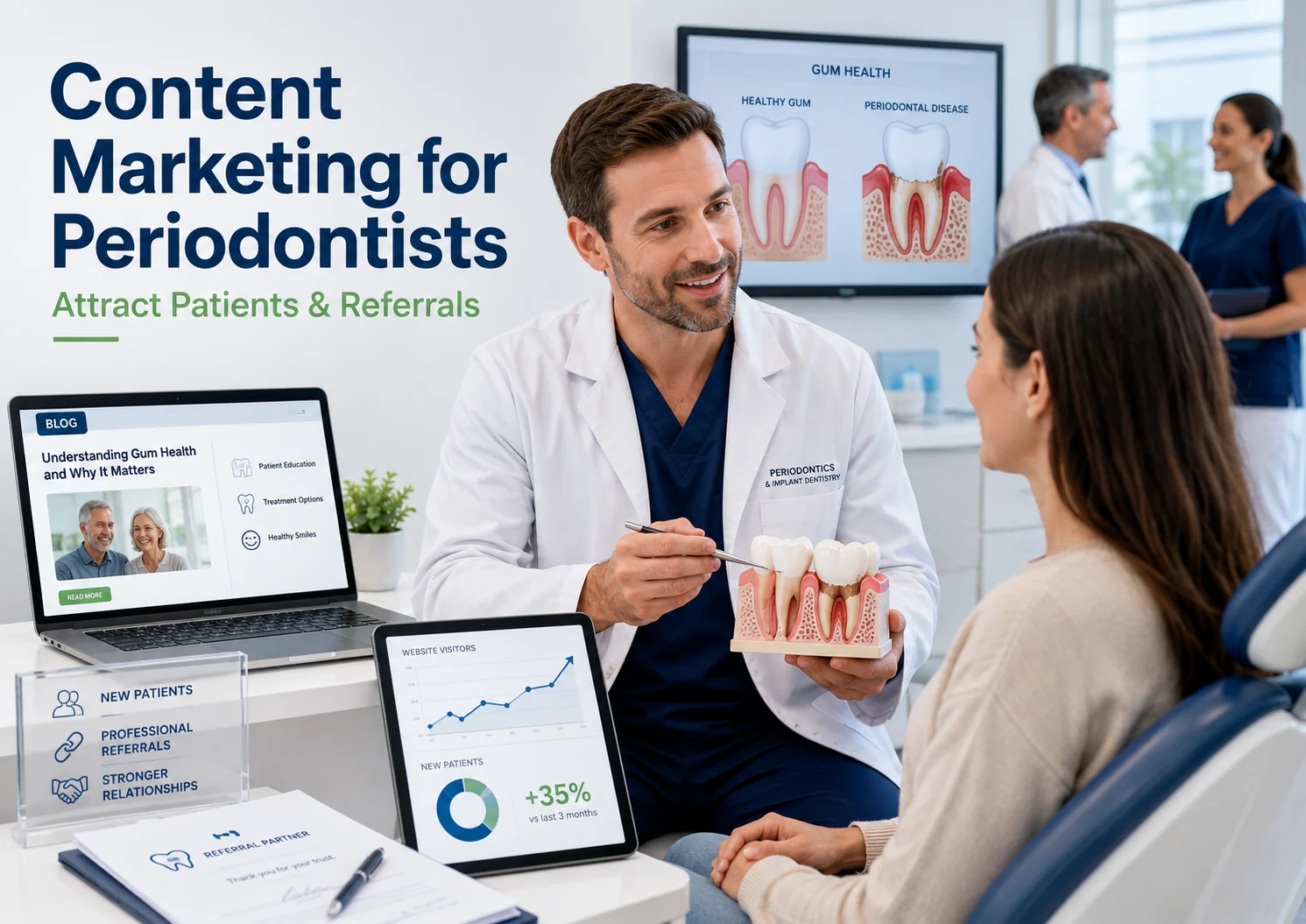 Content marketing for periodontists works best when it is built to attract the two sources of growth a specialty practice depends on: prospective patients researching gum disease and treatments like dental implants, and referrals from the general dentists who send complex cases. Content marketing for periodontists works best when it is built to attract the two sources of growth a specialty practice depends on: prospective patients researching gum disease and treatments like dental implants, and referrals from the general dentists who send complex cases.
Most dental marketing advice assumes a single patient audience. For a periodontal practice, that assumption leaves the larger growth lever—referring providers—untouched, and it ignores how differently search now treats health topics.
Here is the core problem: periodontal disease is often silent until it is advanced, so many of the patients you most want to reach are not yet searching for a periodontist—they are searching for symptoms, causes, and reassurance. At the same time, general dentists increasingly place their own implants and manage early gum disease, which means your content has to earn the complex, surgical, and higher-risk cases that genuinely need a specialist. Content marketing is how you do both: educate patients into demand, and keep referring dentists confident that hard cases belong with you.
What this guide covers: how content marketing differs for a specialty practice, how to build the experience and authority signals that decide whether health content ranks at all, how to map topics to the periodontal patient journey, how to earn and protect referrals without crossing compliance lines, how to stay visible as AI answers reshape search, and how to measure what actually produces consultations.
New to specialty marketing, or inheriting a practice with almost no content? Start with the dual-audience model below—it changes nearly every downstream decision.
Written for: periodontists, periodontal practice owners, and the marketing teams and DSOs that support specialty practices and want content that produces both patient inquiries and referral relationships.
TL;DR
If you do only a few things, do these:
| • |
Build for two audiences - patients researching treatment AND the general dentists who refer complex cases; most practices serve only the first
|
| • |
Fix E-E-A-T before volume - real, credentialed clinician authorship (Diplomate of the American Board of Periodontology; AAP membership) is what lets health content rank and get cited by AI
|
| • |
Target the silent-disease gap - create demand by ranking for symptoms and risk factors (bleeding gums, loose teeth, gum recession, diabetes and gum disease), not just “periodontist near me”
|
| • |
Split your search strategy - win AI answers on treatment-research questions and protect the local pack for “near me,” because Google now treats those two query types very differently
|
| • |
Respect the guardrails - HIPAA authorization for testimonials and before/after photos, FTC rules on reviews, and anti-kickback caution when marketing to referrers
|
| • |
Measure consultations, not clicks - tie content to booked surgical consults and referral sources, not vanity traffic |
Table of Contents
Why content marketing works differently for periodontists
The defining difference is the referral relationship. A general dentist markets almost entirely to patients. A periodontist typically receives a large share of new patients from referring general dentists, with the rest finding the practice directly. That creates a dual funnel, and content that ignores either half leaves growth on the table.
In our work with specialty practices, a pattern we commonly see is strong patient-facing pages paired with almost nothing built for the referring-dentist audience. Yet the referring relationship is often the single most valuable and most defensible source of new cases—especially the complex, surgical work that justifies a specialist.
Three things make periodontal content distinct:
| • |
The silent-disease demand gap - Periodontal disease is frequently without symptoms in its early stages, so patients search for worries like bleeding gums, bad breath, or loose teeth long before they search for a periodontist; content that answers those upstream questions creates demand rather than only competing for it
|
| • |
Competition from general dentistry - Many general dentists now place implants and provide non-surgical periodontal therapy, so your content has to clarify when a case genuinely needs specialist care (bone grafting, complex extractions, failing implants, advanced disease) so the right cases reach you
|
| • |
The stakes of health content - Periodontal topics are what Google calls “Your Money or Your Life” content, judged against a higher bar for trust and accuracy, which shapes how you write, who you credit as the author, and whether you appear in AI answers at all |
Content is one channel inside a broader patient acquisition strategy and a core part of your overall periodontal practice marketing, but for specialists it carries unusual weight because it feeds both the patient funnel and the referral funnel. Get the dual-audience frame right and nearly every later decision—topics, authorship, formats, distribution—follows from it.
> Back to Table of Contents
Start with E-E-A-T: the foundation for ranking on health topics
E-E-A-T stands for Experience, Expertise, Authoritativeness, and Trustworthiness. For health topics, Google applies this framework with unusual rigor, and it increasingly decides not just whether you rank but whether an AI answer will cite you.
The reason it matters more for periodontists is that search engines and AI systems are cautious with medical content; they favor clearly authoritative, clearly authored sources. Anonymous, generic “dental blog” content struggles on treatment queries, while content that visibly comes from a board-certified specialist has a structural advantage.
Practical ways to build it:
| • |
Put a real clinician on every clinical page - A named author with credentials (for example, Diplomate of the American Board of Periodontology and member of the American Academy of Periodontology), a genuine bio, and a photo; this is the single highest-leverage trust signal for health content
|
| • |
Show experience, not just credentials - Reference real, de-identified case patterns, years in practice, and the kinds of complex cases you manage, because experience is now an explicit part of the framework
|
| • |
Add medical-review signals - A “clinically reviewed by” line with a date and reviewer credentials communicates process and accountability
|
| • |
Cite authoritative sources - Reference the American Academy of Periodontology, peer-reviewed literature, and recognized clinical frameworks (such as the current AAP and EFP staging-and-grading classification) rather than making unsupported claims
|
| • |
Be transparent and accurate - Avoid guarantees and specific outcome promises, and clearly separate what is established from what is still being studied |
One area that rewards care is the systemic-health connection. Periodontal disease is associated with conditions such as diabetes and cardiovascular disease, and that association is well documented—but the science on causation is still developing. Framing these links accurately, as associations rather than proven cause and effect, is itself an expertise signal that careful readers and reviewers notice.
> Back to Table of Contents
Patient-facing content: map topics to the periodontal journey
The most reliable way to plan patient content is to map it to the patient journey: whether someone is aware of a symptom, weighing treatment, or ready to decide.
Awareness content (symptoms and risk factors)
This is where you create demand. Target the questions patients ask before they know they need a specialist: what causes bleeding gums, why gums recede, whether loose adult teeth can be saved, whether gum disease causes bad breath, and how diabetes and gum disease are connected. These pages rarely convert on the first visit, but they capture early-journey searchers and are exactly the informational questions that now trigger AI answers—so being the cited source matters.
Consideration content (treatment options and comparisons)
Here patients are weighing what to do, so explain procedures in plain language: non-surgical periodontal therapy (scaling and root planing), pocket-reduction surgery, gum grafting for recession, bone grafting, sinus augmentation, and dental implants and their alternatives. Address the questions that drive hesitation: whether a procedure is painful, how long recovery takes, what the risks are, and why a periodontist rather than a general dentist should handle it.
Decision content (what to expect, recovery, and financing)
At this stage, content should reduce friction to booking: what a consultation involves, how to prepare, recovery timelines, sedation options, and financing and insurance in general terms without specific prices. This is also where multi-touch behavior is normal—a patient reads an awareness article, returns weeks later for a treatment page, then finally calls. These multi-touch journeys are the rule for high-consideration procedures, not the exception.
> Back to Table of Contents
Referral-facing content: the specialist’s growth engine
This is the content most periodontal practices neglect, and it is often the highest-return work available to them. Referring general dentists are a concentrated, high-value audience, and building a referral network can be worth more than months of patient-facing traffic—a single strong referral relationship often outproduces a lot of website visits.
What referral-facing content looks like:
| • |
“When to refer” resources - Clinically credible guidance that helps general dentists recognize which cases benefit from specialist care (advanced periodontitis, complex implant sites, bone grafting, failing implants, medically complex patients), which positions you as a resource rather than only a recipient
|
| • |
Case documentation and outcomes - De-identified case write-ups and before/after documentation, with proper authorization, that show how you handle referred cases and return patients to the referring practice for restorative work
|
| • |
Continuing education and professional content - Study-club materials, CE events, and technique explainers that keep you top-of-mind with the local dental community
|
| • |
Co-branded patient education - Materials referring offices can share with their own patients, which reinforces the referral and extends your reach |
A compliance note on referral marketing: Marketing to referring dentists is normal and appropriate, but there is a line. Federal and state law restrict paying for referrals: the federal Anti-Kickback Statute prohibits offering anything of value to induce referrals for services payable by federal healthcare programs, and many state dental practice acts prohibit fee-splitting and referral fees regardless of payer. Educational content, CE, and genuine professional relationships are fine; cash, gifts of value tied to referral volume, or fee-splitting arrangements are not. This is general information, not legal advice—have referral and marketing arrangements reviewed by qualified healthcare counsel.
> Back to Table of Contents
Win AI Overviews without losing local search
Search for health topics has split into two very different games, and periodontists need to play both. Content marketing and SEO for periodontists are really one project here: the content that answers patient questions is the same content that earns rankings and AI citations.
On informational and treatment-research questions—the awareness and consideration content above—AI Overviews now appear on a large and growing share of results and can meaningfully reduce clicks to websites, which is why preparing for AI search now matters as much as classic ranking. But Google applies a higher trust bar for this health content and tends to cite authoritative, clearly sourced pages, so the goal is to be the source the AI summarizes.
On local “near me” and provider-intent searches—“periodontist near me” or “gum specialist” plus a city—Google has largely removed AI Overviews. Here the local pack, your Google Business Profile, and traditional local SEO still drive the click, and these are the booking-ready patients.
How to earn AI citations
| • |
Answer the question directly and early - Lead with a clear, self-contained answer a summary engine can lift, then expand
|
| • |
Structure for extraction - Clear headings, concise definitional passages, and genuine question-and-answer content help both readers and AI; Google retired FAQ rich results in 2026, but well-structured, visible answers still help AI Overviews, featured snippets, and voice search extract and cite your page
|
| • |
Make authorship and sources unmistakable - The same E-E-A-T signals that help you rank are what make AI systems comfortable citing you on health topics |
How to protect local visibility
| • |
Keep your Google Business Profile accurate and complete - Correct categories, services, hours, and location data, and audit periodically because profile fields and features change over time
|
| • |
Maintain consistent name, address, and phone across directories - Inconsistency undermines local ranking
|
| • |
Earn and manage reviews carefully - Reviews shape local trust; respond without confirming patient status or disclosing any health information |
> Back to Table of Contents
Formats, distribution, and repurposing
Content marketing is not only blogging. For a periodontal practice, the highest-value formats reflect how patients make high-consideration decisions and how referrers stay informed.
| • |
Long-form clinical pages and articles - The backbone: treatment pages and educational articles that carry your E-E-A-T and earn search visibility
|
| • |
Video - Procedure explainers and “what to expect” videos reduce fear and are frequently surfaced in AI answers for health topics
|
| • |
Before/after galleries - Powerful for implants and grafting, but only with signed patient authorization
|
| • |
Email to referring offices - A simple, periodic update to referring dentists keeps you top-of-mind and reinforces relationships
|
| • |
Patient stories and reviews - Testimonials and reviews, used with authorization and within advertising rules |
Distribution matters as much as creation. Repurpose one strong article into video, social, and email, amplify your best-performing pieces, and pair organic content with paid ads where it accelerates results for high-value procedures.
> Back to Table of Contents
Stay compliant: HIPAA, reviews, and YMYL accuracy
Health content carries obligations general marketing does not—from HIPAA to FTC advertising rules—and getting them wrong risks both patient trust and regulatory exposure.
| • |
Testimonials and before/after photos need authorization - Patient images and stories are protected health information, so obtain signed HIPAA authorization before publishing and keep it on file; both intraoral and facial photos require care
|
| • |
Respond to reviews without disclosing anything - You generally cannot confirm that someone is a patient or reference their care in a public reply, so keep responses generic and service-oriented
|
| • |
Follow current review rules - The FTC rule on consumer reviews prohibits buying reviews and incentivizing reviews that are conditioned on positive sentiment, and disclosure does not cure a sentiment-based incentive; never buy or fabricate reviews
|
| • |
Hold clinical content to a high accuracy bar - Cite credible sources, avoid guarantees and specific outcome claims, and frame still-debated science, such as systemic-health links, accurately
|
| • |
Be careful with website tracking on patient pages - Tracking technologies on pages tied to patient information raise HIPAA questions, and the regulatory picture has shifted recently, so configure analytics conservatively and seek guidance before tracking anything that could tie an individual to health information |
None of this is legal advice; work with qualified counsel and your compliance resources on specifics.
> Back to Table of Contents
Measure what actually drives consultations
Traffic is not the goal; booked surgical consultations and healthy referral relationships are. Set up Google Analytics 4 to measure the actions that matter, not vanity metrics.
| • |
Define the right key events in GA4 - In Google Analytics 4, meaningful actions are tracked as key events (the current term, formerly called conversion events); track consultation requests, appointment-form submissions, and calls, not just pageviews
|
| • |
Attribute by content and journey - Identify which articles precede consultations, remembering that high-consideration patients touch several pages over weeks before booking
|
| • |
Track referral sources - Know which referring offices send patients and whether your referral content corresponds with referral activity, so you can invest in the relationships that produce cases
|
| • |
Expect AI to change your traffic baseline - As AI answers absorb informational clicks, judge content by its influence on consultations and citations, not raw sessions alone |
Content that generates calls only pays off if those calls are answered and booked, so once your content is producing inquiries, your intake process determines whether that demand becomes patients.
> Back to Table of Contents
Your first 90 days: a practical content plan
You do not need to build everything at once. A phased rollout produces results without overwhelming a clinical team.
| 1. |
Weeks 1–3: Foundation - Establish credentialed author profiles and a medical-review process, audit and correct your Google Business Profile and directory listings, and identify your highest-value procedures and referral relationships
|
| 2. |
Weeks 4–7: Core patient content - Publish or upgrade the treatment pages for your priority procedures (for example, dental implants, gum grafting, and periodontal disease treatment) with strong E-E-A-T and clear, extractable answers
|
| 3. |
Weeks 8–10: Awareness and referral content - Add upstream symptom and risk-factor articles to create demand, and launch your first “when to refer” resource and referring-office update
|
| 4. |
Weeks 11–12: Measure and refine - Confirm your GA4 key events fire correctly, review which content is influencing consultations, and plan the next quarter around what produced inquiries and referrals |
Results vary by market, competition, and capacity; this is a framework for sequencing, not a guarantee of specific outcomes.
> Back to Table of Contents
Partner with a dental marketing team
Building content that satisfies both patients and referring dentists—while meeting the trust bar that health topics now demand—takes clinical sensitivity, marketing strategy, and technical execution. WEO Media - Dental Marketing works with periodontal practices and specialty groups to plan, produce, and measure content that grows both patient demand and referral relationships. To talk through a content strategy for your practice, call 888-246-6906 or schedule a consultation.
> Back to Table of Contents
FAQs
What is content marketing for a periodontal practice?
Content marketing for periodontists is creating educational material—articles, treatment pages, videos, and referral resources—that attracts prospective patients and keeps referring dentists confident sending complex cases. Unlike general dental content, it serves two audiences at once: patients researching treatment and the general dentists who drive much of a specialist’s new-patient volume.
How is periodontist content marketing different from general dentist marketing?
The biggest difference is the referral audience. General dentists market almost entirely to patients, while periodontists receive many patients through referrals from other dentists. Effective periodontal content therefore builds both patient-facing education and professional, referral-facing resources, and it must clear the higher trust bar that health topics require.
Why does E-E-A-T matter so much for periodontal content?
Periodontal topics are “Your Money or Your Life” content, which search engines and AI systems evaluate for experience, expertise, authoritativeness, and trustworthiness with extra rigor. Content clearly authored by a credentialed specialist, such as a Diplomate of the American Board of Periodontology, has a structural advantage in ranking and in being cited by AI answers.
Will AI Overviews hurt my periodontal practice website traffic?
AI Overviews appear on a large share of informational and treatment-research health queries and can reduce clicks to websites. However, Google has largely removed AI Overviews from local “near me” searches, where booking-ready patients look. The strategy is to earn AI citations on educational topics while protecting local visibility through your Google Business Profile and local SEO.
What content topics attract periodontal patients?
Effective topics follow the patient journey: symptom and risk-factor questions (bleeding gums, receding gums, loose teeth, the link between diabetes and gum disease), treatment explanations (scaling and root planing, gum grafting, dental implants, bone grafting), and decision-stage content (what to expect, recovery, and financing in general terms). Symptom-focused content is especially valuable because periodontal disease is often silent early on.
Can I use patient before/after photos and testimonials?
Only with signed HIPAA authorization. Patient images and stories are protected health information, so you must obtain and keep written authorization before publishing them. You also should not confirm patient status or disclose any care details when responding to online reviews.
Is it legal to market to referring dentists?
Yes, professional and educational marketing to referring dentists is normal. The limit is paying for referrals: the federal Anti-Kickback Statute and many state fee-splitting rules restrict giving anything of value to induce referrals. Educational content and genuine relationships are fine; paid referral arrangements are not. This is general information, not legal advice.
How do I measure whether content marketing is working?
Measure booked consultations and referral activity, not just traffic. In Google Analytics 4, track meaningful actions as key events—consultation requests, form submissions, and calls—and identify which content influences consultations, recognizing that patients often visit several pages over weeks before booking.
How long does content marketing take to produce results?
It varies by market, competition, and how much content already exists, but content marketing is a compounding, longer-term investment rather than an instant channel. A phased rollout—foundation and listings first, then core treatment pages, then awareness and referral content—builds momentum over the first several months. |
|