Periodontal Practice Marketing
Posted on 2/21/2026 by WEO Media |
The Complete Guide to SEO, Google Ads, and Referral Growth
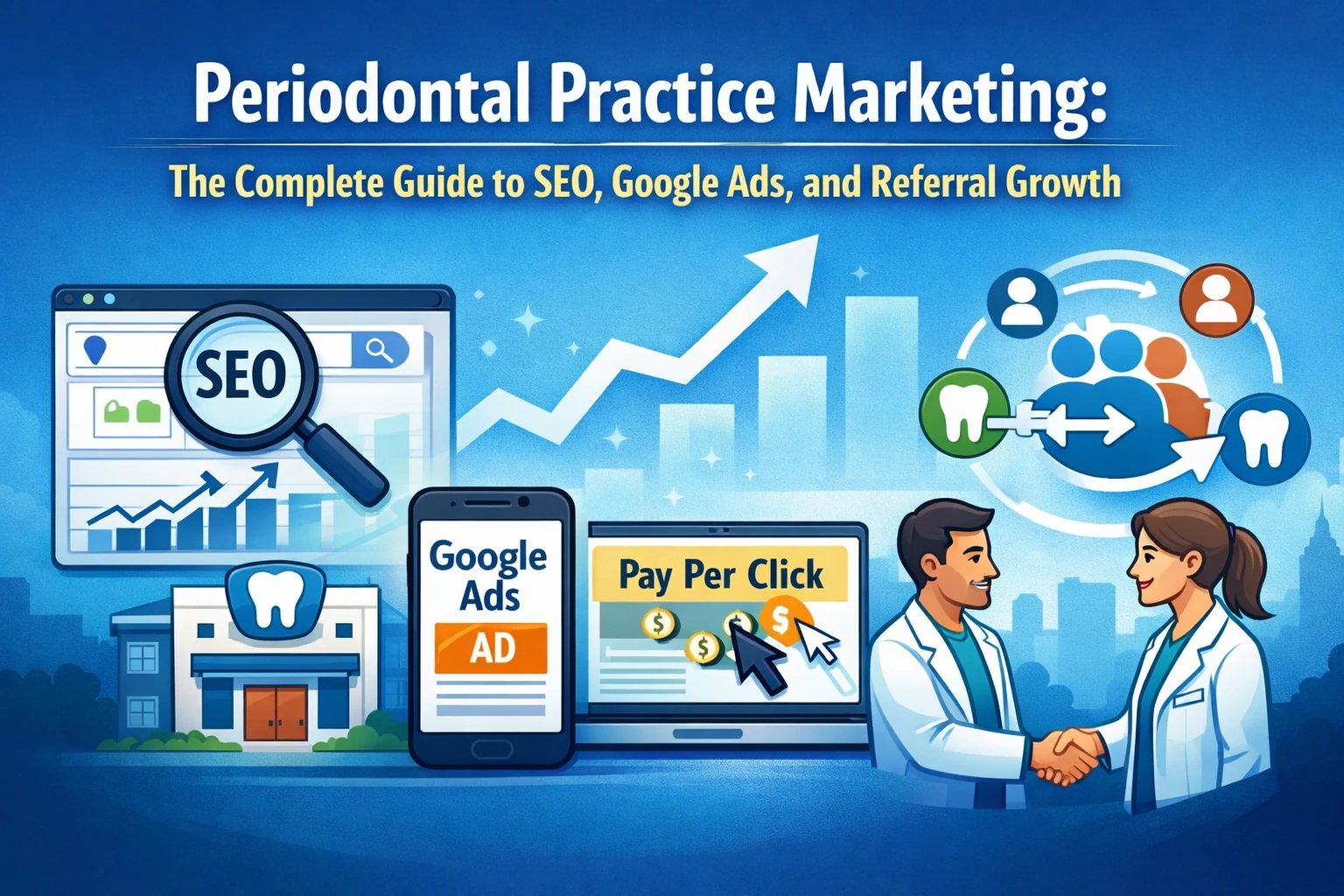 Periodontal practice marketing is a coordinated growth strategy that combines SEO, Google Ads, and structured referral programs to help periodontists attract patients directly, strengthen referring-dentist relationships, and build specialty visibility in their market. Unlike general dental marketing, periodontal marketing must solve a dual problem: most patients don’t search for a periodontist by name or specialty, and the traditional referral pipeline from general dentists is narrowing as more GPs keep implant and soft-tissue cases in-house. A well-built periodontal marketing program addresses both sides—growing direct-to-patient visibility through search and paid channels while protecting and expanding the referral network that still drives a significant share of perio caseload. Periodontal practice marketing is a coordinated growth strategy that combines SEO, Google Ads, and structured referral programs to help periodontists attract patients directly, strengthen referring-dentist relationships, and build specialty visibility in their market. Unlike general dental marketing, periodontal marketing must solve a dual problem: most patients don’t search for a periodontist by name or specialty, and the traditional referral pipeline from general dentists is narrowing as more GPs keep implant and soft-tissue cases in-house. A well-built periodontal marketing program addresses both sides—growing direct-to-patient visibility through search and paid channels while protecting and expanding the referral network that still drives a significant share of perio caseload.
The shift is real: more general dentists are placing their own implants, offering scaling and root planing, and contracting with traveling periodontists rather than referring out. That means waiting for the phone to ring is no longer a growth strategy. The practices seeing the strongest new-patient numbers are the ones running a coordinated mix of search engine optimization, paid search campaigns, reputation management, and structured referral outreach—all tailored to the services and patient intent patterns that are unique to periodontics.
This guide focuses on periodontal-specific marketing strategy. If you’re looking for broader dental marketing fundamentals, start with what dental marketing involves and come back here for the specialty layer.
This guide covers everything from building a periodontal website that converts specialist searches, to running Google Ads for implant and gum-disease keywords, to creating a referral program that keeps general dentists engaged without competing against them. Each section includes specific tactics, benchmarks, and the operational steps needed to execute.
Start here: website optimization, SEO for periodontists, Google Ads, referral programs, reputation management, ROI tracking.
Written for: periodontists, periodontal practice owners, office managers, and marketing teams responsible for growing a specialty practice in a market where referral dependency is no longer enough.
TL;DR
If you focus on seven things, focus on these:
| • |
Build a dual-channel strategy - stop relying solely on GP referrals; combine referral marketing with direct-to-patient digital channels so one declining source doesn’t stall growth
|
| • |
Optimize your website for specialist searches - dedicated service pages for implants, gum grafting, osseous surgery, and laser therapy with condition-specific content that converts patients who bypass the GP referral path entirely
|
| • |
Run Google Ads on high-intent perio keywords - “periodontist near me,” “dental implant specialist,” and “gum disease treatment” capture patients actively looking for specialty care
|
| • |
Invest in local SEO and your Google Business Profile - periodontists compete in a smaller keyword pool than general dentists, which means strong local SEO can produce outsized visibility gains
|
| • |
Build a structured referral program - make it easy for GPs to refer with digital portals, fast turnaround communication, and reciprocal value so the relationship is collaborative, not transactional
|
| • |
Manage your online reputation proactively - specialty patients research harder before committing; a steady flow of recent, specific reviews on Google and Healthgrades reduces hesitation
|
| • |
Track the right numbers - separate referral-source patients from direct-acquisition patients so you know which channels are working and where to invest next |
Table of Contents
Why periodontal practices need a dual-channel marketing strategy
For decades, the periodontal business model was simple: general dentists diagnosed, periodontists treated. Referrals came in steadily, and marketing meant lunch-and-learns with local GPs. That model still matters—but it’s no longer sufficient on its own.
A pattern we commonly see in the practices we work with is this: referral volume from general dentists has either plateaued or declined over the past several years, while patient self-referral (driven by Google searches, online reviews, and direct advertising) has grown. Several forces are driving this shift.
| • |
GPs are keeping more cases in-house - advances in guided surgery, shorter implant courses, and the economics of case retention mean many general dentists now place their own implants and manage mild-to-moderate periodontal disease without referring out; a strong dental implant marketing program helps periodontists recapture this case volume directly
|
| • |
Patients research specialists independently - when a GP does recommend a periodontist, the patient often searches online before booking, which means your digital presence influences whether that referral converts
|
| • |
Direct-to-patient search volume is meaningful - keywords like “periodontist near me,” “gum disease treatment,” and “dental implant specialist” represent patients who are bypassing the GP referral path entirely
|
| • |
Insurance and access barriers push patients to search - patients whose insurance doesn’t require a referral, or who are dissatisfied with a previous provider, search directly for a specialist |
The practices growing the fastest aren’t choosing between referrals and digital marketing. They’re running both simultaneously—using digital channels to capture direct searches while investing in referral systems that keep GPs engaged and loyal.
What a dual-channel strategy looks like in practice: your marketing funnel feeds from two sources. The referral channel relies on GP outreach, communication systems, and co-treatment positioning. The direct channel relies on SEO, paid ads, reputation, and content. Both converge at the same patient pipeline—and both need to be tracked separately so you know where your patients are actually coming from.
> Back to Table of Contents
How to build a periodontal website that converts
Your website is the single asset that serves both referral and direct-acquisition patients. A referring GP’s staff will check it before sending a referral. A patient researching “periodontist near me” will judge your credibility in seconds. And a patient who was referred but hasn’t committed will visit your site to decide whether to book. That means your dental website needs to do more than look professional—it needs to function as a conversion tool for multiple audience types.
Service pages that match how patients search
Most periodontal websites make the mistake of lumping all services onto one or two pages. This weakens SEO and forces patients to hunt for the information that matters to them. Instead, build dedicated pages for each major service category.
| • |
Dental implants - single-tooth implants, implant-supported bridges, implant-supported dentures, All-on-4/All-on-6, and implant candidacy; this is typically the highest-value keyword cluster for a perio practice and deserves multiple pages if search volume supports it
|
| • |
Gum disease treatment - scaling and root planing, osseous surgery, LANAP/laser periodontal therapy, and periodontal maintenance; explain what each treatment involves, who it’s for, and what recovery looks like
|
| • |
Gum grafting and soft-tissue procedures - connective tissue grafts, free gingival grafts, the pinhole surgical technique, and crown lengthening
|
| • |
Bone grafting and regenerative procedures - socket preservation, ridge augmentation, sinus lifts, and guided bone regeneration
|
| • |
Sedation options - if your practice offers IV sedation or oral conscious sedation, a dedicated page builds confidence for anxious patients and differentiates you from GPs who don’t offer those options |
Each page should include a clear description of the condition or procedure, what makes a specialist’s approach different, what a patient can expect during recovery, and a prominent call to action. The website messaging on each page matters as much as the structure—vague language loses patients, while specific messaging builds confidence. Make sure every service page includes a strong, clear call to action that makes the next step obvious. Before-and-after galleries add credibility, especially for implant and soft-tissue cases where visual results matter, and professional practice photography elevates those galleries further.
A referral portal that reduces friction
Make it as easy as possible for a GP’s front desk to send you a patient. A dedicated referral page—linked prominently in your navigation—should include a secure, HIPAA-compliant referral form, your office’s direct scheduling line, and clear instructions on what information you need. Any patient-facing forms should also support online appointment scheduling so referred patients can self-book when the GP’s office shares your link. The fewer clicks and phone calls required, the more likely the referral actually converts to a booked appointment. If you’re collecting patient data through digital forms, review our guide on HIPAA privacy risks in dental digital marketing to make sure your referral portal meets compliance requirements.
If referring offices regularly cite difficulty reaching your team or confusion about what records to send, that’s a website problem as much as an operations problem. Solve it by putting the referral workflow front and center, not buried three clicks deep.
Technical performance basics
A website that loads slowly on mobile loses patients before they read a single word. Periodontal patients skew older than the average dental patient, and many are searching from mobile devices during or after a GP appointment. Make sure your site loads in under three seconds, works seamlessly on phones and tablets, and uses clear navigation. If your current site feels sluggish or outdated, our guide on fixing a slow dental website covers the most common culprits.
> Back to Table of Contents
SEO for periodontists: ranking for specialty searches
Search engine optimization is one of the highest-leverage channels for periodontal practices because the keyword landscape is less crowded than general dentistry. Fewer periodontists compete for local search terms compared to the dozens of general practices in a typical market, which means a well-optimized site can achieve strong visibility faster. Understanding the top local SEO ranking factors helps you prioritize where to invest first, and making sure your site is structured for higher Google rankings gives your content the technical foundation it needs to perform.
The keywords that matter for periodontal SEO
Periodontal search behavior falls into three categories, and your SEO strategy should cover all of them.
| • |
Specialist-intent keywords - “periodontist near me,” “periodontist [city],” “gum specialist”; these searchers already know they need a specialist and are ready to choose one
|
| • |
Condition-driven keywords - “gum disease treatment,” “receding gums fix,” “loose teeth treatment,” “gum infection treatment”; these searchers may not know they need a periodontist yet, which is an opportunity to educate and capture
|
| • |
Procedure-specific keywords - “dental implant specialist,” “gum graft surgery,” “LANAP laser treatment,” “bone graft for dental implant”; these indicate a patient who is researching a specific treatment and comparing providers |
Build dedicated, optimized pages for each keyword cluster. A single “services” page cannot rank for all of these terms. Each page needs unique content, a specific title tag and meta description, and internal links connecting related topics. For a deeper dive into keyword-level planning, our guide on dental PPC keywords covers intent-based targeting that applies to both paid and organic.
Google Business Profile optimization
Your Google Business Profile (GBP) is often the first thing a patient sees—before your website, before your ads. For periodontal practices, GBP optimization includes several specialty-specific steps. Ranking in the Google Map Pack is especially valuable for periodontists because patients searching “periodontist near me” see map results before organic listings.
| • |
Choose the right primary category - “Periodontist” should be your primary category, with secondary categories like “Dental Implants Provider” and “Dental Clinic” where applicable; our guide on optimizing Google Business Profile categories walks through the selection process
|
| • |
Populate all service attributes - list every procedure you offer using the built-in service editor; Google uses these to match your profile to patient searches
|
| • |
Post regularly - Google Business posts about new technology, patient education topics, or community involvement signal activity and relevance
|
| • |
Build review volume - reviews are the strongest local ranking signal; we cover this in detail in the reputation section below |
If you serve patients across multiple cities, building geo-targeted service area pages helps you appear in searches outside your immediate zip code without opening additional locations.
Content strategy for topical authority
Google rewards websites that demonstrate depth on a topic. For a periodontal practice, that means publishing content that covers the full spectrum of periodontal conditions, treatments, and patient concerns—not just a few thin blog posts. Building content clusters around your core treatment areas creates the kind of interconnected topical depth that moves your site up in rankings over time. Connecting those clusters with a deliberate internal linking strategy ensures Google can crawl and understand the relationships between your pages.
Strong periodontal content topics include the connection between gum disease and systemic health conditions (heart disease, diabetes), what to expect during and after specific procedures, how to evaluate whether you need a specialist vs. a general dentist, and the differences between treatment approaches like traditional surgery vs. laser therapy.
> Back to Table of Contents
Google Ads for periodontal practices
Paid search is the fastest way to put your practice in front of patients who are actively looking for periodontal care right now. While SEO builds long-term visibility, pay-per-click advertising delivers leads within days of campaign launch—which matters when you’re trying to fill a surgical schedule or grow implant case volume.
Campaign structure for periodontal PPC
The most effective periodontal PPC accounts organize campaigns around service lines, not a single catch-all campaign. Each service has different search intent, different competition levels, and different patient values. For a detailed walkthrough of this approach, our guide on structuring dental PPC campaigns for high-value cases covers the full setup.
| • |
Implant campaign - targets “dental implant specialist,” “dental implants [city],” “implant dentist near me”; implant keywords tend to have higher cost-per-click but also higher case values, making them worthwhile when landing pages and intake are optimized; our complete guide to targeted dental implant advertising covers the full campaign build
|
| • |
Gum disease campaign - targets “gum disease treatment,” “periodontist for gum disease,” “deep cleaning specialist”; these patients often need ongoing periodontal maintenance, making the lifetime value significant
|
| • |
Specialist/brand campaign - targets “periodontist near me,” “periodontist [city],” “best periodontist [city]”; these are high-intent, lower-funnel searches where conversion rates are typically strongest
|
| • |
Procedure-specific campaigns - targets “gum graft,” “bone graft dental,” “laser gum surgery,” “All-on-4 specialist”; effective for practices that want to grow specific service lines |
Each campaign should point to a dedicated landing page—not your homepage. A patient who clicks an ad for “dental implant specialist” should land on a page about implants, not a generic welcome page. Strong PPC ad copy paired with a matched landing page is where conversion happens. For guidance on building pages that convert, see our guide on dental landing pages that turn clicks into patients.
Budget and bidding considerations
Dental specialty keywords typically cost more per click than general dentistry terms. Implant-related keywords can range from roughly $8–$25+ per click depending on your market’s competition. In dense metro areas, expect the higher end of that range. Smaller or mid-sized markets can often achieve strong results with monthly budgets in the $1,500–$3,000 range, while competitive urban markets may require $3,000–$5,000+ to maintain visibility. For guidance on setting an overall budget across all channels, our walkthrough on setting a profitable dental marketing budget covers the framework.
The critical metric isn’t cost per click—it’s cost per booked appointment. If your average implant case generates several thousand dollars in revenue and your cost to acquire that patient through Google Ads is a few hundred dollars, the return is strong even at higher CPCs. Track cost per lead and cost per acquisition consistently, and use that data to optimize. For a detailed breakdown of reducing acquisition costs, lowering CPA without sacrificing lead quality walks through the process.
Common periodontal PPC mistakes
These issues apply broadly across dental PPC—our guide on Google Ads mistakes that waste the most money covers even more—but they’re especially costly in specialty markets where each wasted click costs more.
| • |
Running broad match without negatives - keywords like “periodontist” on broad match will trigger searches for “periodontist salary,” “periodontist school,” and “periodontist assistant jobs”; build your negative keyword list before launch
|
| • |
Sending all traffic to the homepage - each campaign needs a dedicated landing page that matches the ad’s promise; mismatched landing pages kill conversion rates and inflate costs
|
| • |
Ignoring call tracking - most periodontal leads come through phone calls, not form submissions; without call tracking, you can’t measure which campaigns are actually producing booked appointments
|
| • |
Setting and forgetting - PPC requires active management; review search term reports weekly, adjust bids based on performance, and test ad copy regularly; running a quarterly PPC audit catches waste before it compounds |
> Back to Table of Contents
How to build a referral program that keeps GPs engaged
Referrals from general dentists remain a significant patient source for most periodontal practices. The mistake isn’t investing in referral marketing—it’s treating it as passive. The periodontists maintaining strong referral volume are running structured, repeatable referral programs, not relying on personal relationships alone.
What makes a referral program work
A referral program succeeds when it makes the referring dentist’s decision easy, fast, and rewarding—professionally, not financially. The goal is collaborative positioning, not transactional incentives.
| • |
Communication speed - send a same-day or next-day treatment summary back to the referring GP after every referred patient’s visit; this is the single highest-impact referral retention tactic because it signals professionalism and keeps the GP informed
|
| • |
Digital referral forms - a secure online referral portal on your website eliminates the fax-and-call loop that frustrates GP front desk teams; include fields for patient demographics, the reason for referral, relevant imaging, and preferred contact method
|
| • |
Co-treatment positioning - frame your relationship as collaborative rather than competitive; when you place implants, refer the restorative phase back to the GP; when you treat periodontal disease, send the patient back for ongoing hygiene and maintenance
|
| • |
Education and visibility - offer CE lunch-and-learns, share case studies (with patient consent), and provide referring offices with patient education materials they can hand out; these touchpoints maintain awareness without being pushy
|
| • |
Dedicated referral coordinator - assign one team member as the point of contact for all referring offices; consistency in communication builds trust faster than rotating staff; this role also owns the intake process for referred patients, making sure no referral falls through the cracks |
How digital marketing supports referral growth
Direct-to-patient marketing doesn’t compete with referrals—it reinforces them. When you advertise implant services directly to patients, you attract cases that need both surgical and restorative work. By partnering with referring GPs on the restorative phase, you create a reciprocal relationship: you send restorative cases to them, and they send complex surgical cases to you. This turns your advertising into a referral-building engine. The key is positioning around specialist qualifications rather than price—our guide on marketing dental implants without attracting price shoppers explains how to attract quality-focused patients instead.
A strong online reputation also helps. When a GP considers which specialist to recommend, they often check the same Google reviews their patients will see. A practice with 200+ recent reviews and a 4.8 rating earns referrals more easily than one with 30 reviews and no recent activity.
> Back to Table of Contents
Reputation management for periodontal specialists
Specialty patients do more research before committing than general dental patients. Periodontal procedures are often more invasive, more expensive, and more anxiety-inducing—which means patients read reviews more carefully, look at more profiles, and take longer to decide. Your online reputation either accelerates that decision or stalls it. Patients check Google first, but many also review specialty profiles on Healthgrades and similar directories before choosing a periodontist.
Why review volume matters more than perfection
A periodontal practice with 50 reviews and a 5.0 average often looks less credible than a practice with 250 reviews and a 4.7 average. Volume signals that your practice sees a high number of patients and that the positive reviews aren’t cherry-picked. Patients expect to see an occasional lower review—what they’re evaluating is how you respond and whether the overall pattern is strong.
What strong periodontal reviews mention: patients value reviews that reference the specific procedure they’re considering (“great experience with my gum graft” carries more weight than “nice office”), describe the provider’s communication style, and address pain management or anxiety. Encourage patients to share details about their experience—specific reviews build more trust than generic ones.
How to systematize review collection
Don’t rely on patients to leave reviews unprompted. Build review requests into your post-treatment workflow. For a comprehensive framework on increasing your review volume, our guide on generating more five-star Google reviews covers the full system.
| • |
Timing - send the request 1–2 hours after the appointment, not days later; recency increases response rates significantly
|
| • |
Channel - text message with a direct Google review link converts at higher rates than email for most practices
|
| • |
Scripting - a brief, genuine message works best: “Thank you for choosing our practice for your [procedure]. If you have a moment, a Google review helps other patients find our office”
|
| • |
Consistency - ask every patient, not just the ones you think had a great experience; selective asking introduces bias and limits volume |
For a broader strategy on turning reviews into a growth engine, our guide on dental reputation strategies that grow patient volume covers the full framework.
Responding to negative reviews
Negative reviews happen. In periodontics, they often relate to post-operative discomfort, billing confusion, or scheduling friction—not clinical outcomes. Respond promptly, professionally, and without disclosing protected health information. Acknowledge the concern, express willingness to resolve it, and take the conversation offline. A thoughtful response to a negative review often builds more trust than the review erodes. For response templates and a repeatable SOP, see our guide on dental patient review responses.
> Back to Table of Contents
Content marketing and social media for periodontists
Content marketing serves two purposes for a periodontal practice: it builds SEO authority (discussed above) and it educates patients who are in the consideration phase. Social media extends that educational content to a wider audience and reinforces the trust signals that make patients choose your practice over a competitor.
Content topics that drive perio patient engagement
The highest-performing content for periodontal practices typically falls into three buckets.
| • |
Condition education - “Signs you have gum disease and don’t know it,” “Why gum recession gets worse without treatment,” “The connection between gum disease and heart health”; these attract patients who are early in their awareness journey
|
| • |
Procedure demystification - “What to expect during a gum graft,” “LANAP vs. traditional gum surgery,” “Same-day implants: who qualifies?”; these reduce anxiety and move patients closer to booking
|
| • |
Specialist differentiation - “Why a periodontist for your dental implant?,” “Periodontist vs. general dentist for gum treatment”; this content builds the case for choosing a specialist over a GP, which supports both your direct marketing and your referral relationships |
Social media strategy for periodontal practices
Periodontists don’t need to be on every platform. Focus where your patients actually spend time and where the content format fits your practice.
| • |
Facebook - remains the strongest platform for reaching adults 35+ who are the primary demographic for implants and periodontal treatment; patient testimonials (with consent), educational posts, and community involvement perform well
|
| • |
Instagram - before-and-after photos, short procedure walkthroughs, and team introductions build familiarity; visual content showing gum graft healing or implant transformations tends to generate high engagement
|
| • |
YouTube - dental video content has strong search visibility; procedure explainer videos, patient testimonial videos, and “what to expect” walkthroughs can rank on both YouTube and Google, driving organic discovery; a broader dental video marketing strategy helps you repurpose this content across channels |
For paid social, Meta Ads for dentists can be effective for implant awareness campaigns, targeting users in your geographic area who match the demographic profile of implant candidates.
Email marketing for patient retention and reactivation
Periodontal maintenance patients are your most reliable recurring revenue source. They need to return every 3–4 months, and many will lapse without reminders. Automated email sequences that remind patients of upcoming maintenance, share educational content about the importance of continued care, and re-engage patients who have missed appointments help protect this revenue stream. Pairing email with text message reminders further reduces no-shows and late cancellations.
For practices with a backlog of inactive perio maintenance patients, a structured patient reactivation campaign can recover meaningful production without any new patient acquisition spend.
> Back to Table of Contents
Tracking and measuring periodontal marketing ROI
Periodontal marketing only works if you can measure it. The most common mistake we see is lumping all new patients into one bucket without distinguishing how they found the practice. When referrals decline and Google Ads picks up the slack, you need to see that shift—otherwise you’re allocating budget blind. Understanding your dental patient journey—from first awareness through treatment acceptance—helps you identify where each channel’s patients enter and where they drop off.
Key metrics for periodontal marketing
| • |
New patients by source - separate referral patients from direct-acquisition patients (Google organic, Google Ads, social, directory listings); this tells you which channels are actually driving growth
|
| • |
Cost per lead by channel - total spend on a channel divided by the number of leads it generated; compare across channels to identify your most efficient sources
|
| • |
Cost per booked appointment - total spend divided by patients who actually booked; this matters more than cost per lead because it accounts for intake conversion quality
|
| • |
Case acceptance rate by source - do referral patients accept treatment at a higher rate than direct patients? In most practices, they do—which affects how you value each channel; if direct patients show lower acceptance, patient financing options and stronger treatment presentation often close the gap
|
| • |
Patient lifetime value by service line - an implant patient who also needs bone grafting and eventual maintenance has a different lifetime value than a single-visit scaling patient; track this to understand the true return on your marketing investment
|
| • |
Referral source tracking - which GP offices are sending patients, how many, and whether that volume is increasing or decreasing; a quarterly referral source report lets you focus relationship-building efforts where they’ll have the most impact |
Tools and systems for tracking
At minimum, a periodontal practice should have call tracking tied to marketing channels, a CRM or intake system that captures referral source at the point of first contact, and a monthly reporting cadence that reviews performance by channel. If you’re using Google Ads, conversion tracking should be configured for both phone calls and form submissions. For a complete walkthrough, tracking marketing ROI by channel covers the setup process.
Integration matters: if your intake form asks “how did you hear about us?” but no one reviews the data, it’s theater. Assign one person to own the reporting and review it monthly with the team. The goal is to make marketing investment decisions based on data, not assumptions about which channels “feel” like they’re working.
> Back to Table of Contents
Get a periodontal marketing strategy built for your practice
Periodontal marketing requires a different approach than general dental marketing. The referral dynamics, keyword landscape, patient decision timeline, and competitive positioning are all specialty-specific—and your marketing strategy should reflect that.
WEO Media works with periodontal practices to build marketing programs that address both sides of the growth equation: strengthening referral pipelines while building direct-to-patient visibility through SEO, paid search, reputation management, and conversion-optimized websites. If your current marketing isn’t producing the case volume or patient quality your practice needs, schedule a consultation and we’ll evaluate your market, your current performance, and where the biggest opportunities are.
> Back to Table of Contents
FAQs
How is marketing for a periodontal practice different from general dental marketing?
Periodontal marketing serves two distinct audiences—patients searching directly for a specialist and general dentists who refer patients to you. A general dental practice focuses primarily on attracting patients. A periodontal practice must also maintain and grow its referral network, which requires different messaging, different outreach tactics, and separate tracking for each channel. The keyword landscape is also different: periodontal searches are lower volume but higher intent, and the patient decision cycle for procedures like implants or gum surgery is longer than for routine dental care.
How much should a periodontal practice spend on marketing?
Marketing budgets vary based on market size, competition, and growth goals, but many periodontal practices allocate between 5% and 10% of gross revenue to marketing. A practice looking to maintain current volume may spend on the lower end, while a practice actively growing or entering a competitive market will often invest more. The key is tracking cost per acquired patient by channel so you can see which investments produce the strongest returns and adjust accordingly.
What are the best keywords for periodontal PPC campaigns?
The highest-converting keywords for periodontal PPC typically include specialist-intent terms like “periodontist near me” and “periodontist [city],” procedure-specific terms like “dental implant specialist,” “gum graft surgery,” and “laser gum treatment,” and condition-based terms like “gum disease treatment” and “receding gums treatment.” Organizing these into separate campaigns with dedicated landing pages produces the best results. Be sure to build negative keyword lists to filter out job seekers, students, and informational searches.
How can a periodontist get more referrals from general dentists?
The most effective referral-building tactic is fast, consistent communication. Send treatment summaries back to the referring dentist the same day or next business day after every patient visit. Beyond that, make the referral process easy with a digital referral portal, position your practice as collaborative by referring restorative work back to the GP, and maintain visibility through periodic CE events or case study sharing. Assigning a dedicated referral coordinator gives referring offices a consistent point of contact, which builds trust and reliability over time.
Does SEO work for periodontists or is PPC better?
SEO and PPC serve different timelines and work best together. SEO builds sustainable organic visibility over months and is especially valuable for periodontists because the specialist keyword space is less competitive than general dentistry, meaning strong rankings are achievable with consistent effort. PPC delivers leads quickly and is ideal for filling a surgical schedule, launching a new service line, or growing in a new market. Most successful periodontal practices run both—PPC for immediate patient volume and SEO for compounding long-term growth.
How important are online reviews for a periodontal practice?
Online reviews are critical for periodontal practices because specialty patients research more carefully before committing. The procedures are often more invasive and more expensive than general dental care, which means patients weigh reviews more heavily. Review volume, recency, and specificity all matter. A steady stream of reviews that mention specific procedures and outcomes builds the trust needed to convert both direct-search patients and referred patients who check your profile before booking.
Should a periodontist advertise implants if general dentists in the area also place them?
Yes. Advertising implants as a specialist creates an opportunity to attract patients directly while also generating referrals. When patients come to you for implant placement, the restorative phase (crowns, bridges) can be referred back to a general dentist, creating a collaborative pipeline that benefits both practices. The key is positioning your advertising around specialist qualifications, complex case capability, and advanced techniques rather than competing on price. This attracts quality-focused patients and reinforces your value to referring GPs.
How do I track whether my periodontal marketing is working?
Track new patients by acquisition source—separating referral patients from direct-search patients—so you know which channels are driving growth. The essential metrics are cost per lead by channel, cost per booked appointment, case acceptance rate by source, and referral volume by referring office. Use call tracking to attribute phone leads to specific campaigns, configure conversion tracking on Google Ads, and review a monthly report that compares performance across all channels. This data should drive your budget allocation decisions. |
|