DSO Reputation Management at Scale
Posted on 7/18/2026 by WEO Media |
How to Build a Compliant, Repeatable Review System Across Every Location
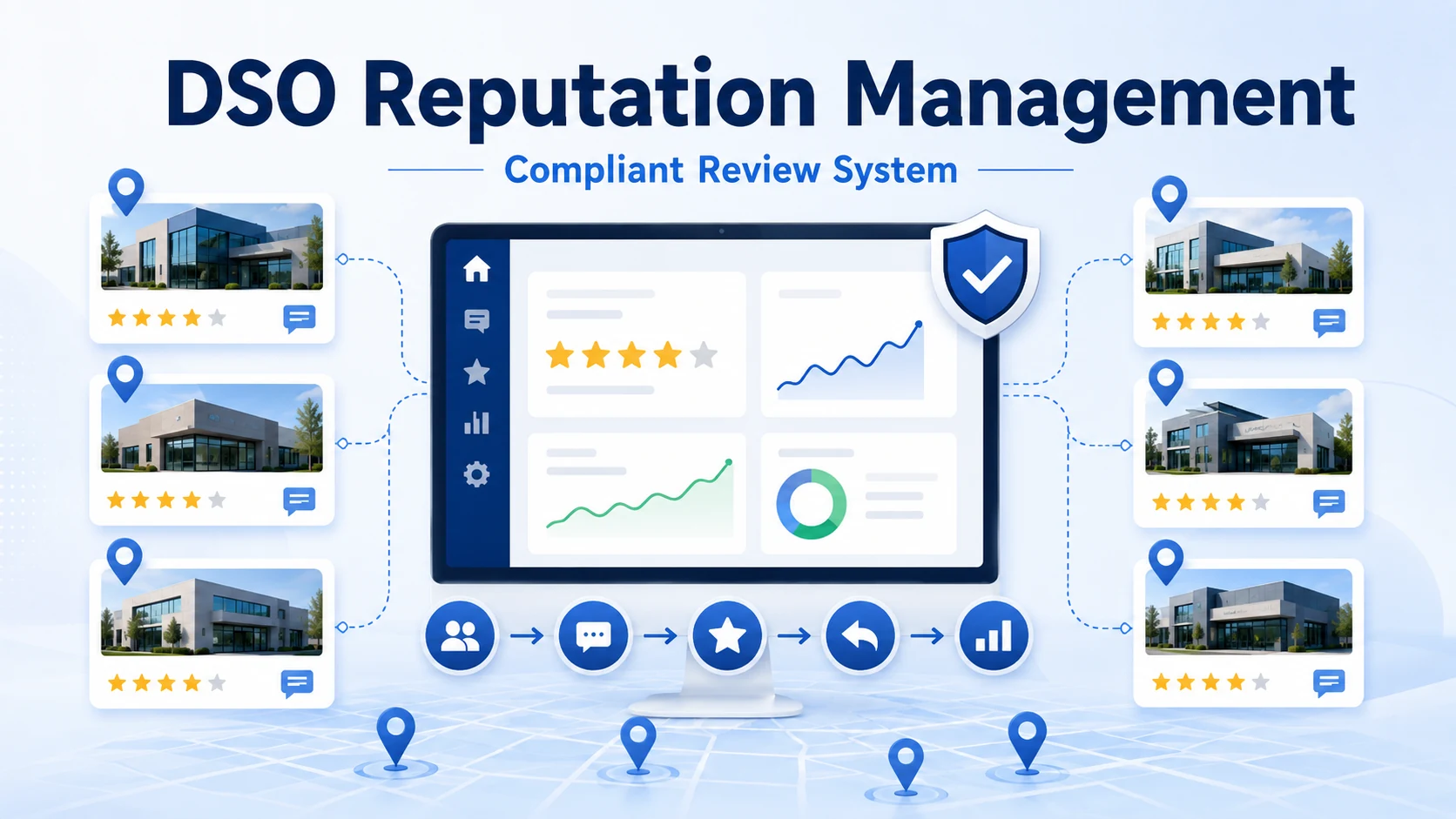 DSO reputation management at scale is the practice of building one compliant, repeatable review system that standardizes how every location in a dental support organization earns, monitors, and responds to patient reviews—so a multi-location dental group can protect its ratings, local search rankings, and new-patient flow without creating HIPAA, FTC, or Google-policy risk at any single office. DSO reputation management at scale is the practice of building one compliant, repeatable review system that standardizes how every location in a dental support organization earns, monitors, and responds to patient reviews—so a multi-location dental group can protect its ratings, local search rankings, and new-patient flow without creating HIPAA, FTC, or Google-policy risk at any single office.
If you oversee reviews for a portfolio of practices, the problem is rarely a single bad rating. It is the absence of a repeatable system that behaves the same way in every market, every operatory, and every acquisition you fold in.
Here is the core tension: the tactics that work for one practice—a manager who personally asks happy patients, a heartfelt reply to a tough review—quietly become liabilities when copied across dozens or hundreds of locations. What reads as attentive at one office reads as review gating, staff-name solicitation, or a HIPAA disclosure when it is systematized at scale. The regulators and platforms that govern reviews have tightened significantly, and enforcement is now automated and portfolio-wide.
Already running a single-location review process? The governance, compliance, and measurement models below are what convert that into something you can operate across an entire group without inheriting risk.
Below, you will learn how to build the governance layer, the compliant review-generation engine, the HIPAA-safe response playbook, the portfolio scoreboard, and the local-visibility connection that together make reputation a managed asset rather than a scattered set of local habits—plus a 90-day rollout you can run.
Written for: DSO executives, marketing directors, regional and area managers, and operations leaders responsible for reviews, local visibility, and compliance across many dental practice locations.
TL;DR
If you only build five things, build these:
| 1. |
A compliance foundation first - design every review workflow around HIPAA, the FTC Consumer Review Rule, and Google’s review policy before you optimize for volume
|
| 2. |
A governance model - centralize policy, templates, escalation, tooling, and dashboards; localize only the point-of-care ask and the local relationship
|
| 3. |
A gating-free generation engine - ask every patient the same way, with no incentives, no kiosks, no staff-name quotas, and no sentiment screening
|
| 4. |
A HIPAA-safe response playbook with SLAs - approved templates, trained responders, and response-time targets that never confirm a reviewer is a patient
|
| 5. |
A portfolio scoreboard - per-location and rolled-up metrics for rating, velocity, recency, response rate, and response time so you can coach the outliers |
Table of Contents
What DSO reputation management at scale really means
At the single-practice level, reputation management is mostly a set of good habits: ask satisfied patients for reviews, keep the profile current, reply thoughtfully. At the level of a dental support organization, those habits have to become a system—documented, trained, monitored, and enforced—because the same action multiplied across many locations creates both compounding upside and compounding risk.
Three things change when you move from one office to a portfolio. First, consistency becomes the product: a patient in one market should experience the same ask and the same standard of response as a patient three states away. Second, compliance becomes non-negotiable, because a single non-compliant habit—copied into a standard operating procedure—is no longer an isolated mistake but a portfolio-wide exposure. Third, measurement has to roll up, so leadership can see the health of the whole group and still drill into the one location dragging the average down.
A pattern we commonly see in groups that grow by acquisition: every acquired practice arrives with its own rating history, its own review-collection tool, and its own informal response habits. Without a governance layer, the DSO inherits all of it—including whatever non-compliant practices were baked in before the deal closed. Reputation management at scale is the discipline that standardizes the messy inheritance into one defensible system.
> Back to Table of Contents
Why single-location review tactics break across a portfolio
The tactics most single practices rely on do not fail because they are wrong at one office. They fail because scale changes their legal and algorithmic meaning. When an isolated behavior becomes a documented, repeated policy across locations, platforms and regulators treat it as a system—and systems are exactly what current enforcement is built to detect.
Here are the most common tactics that quietly break at scale:
| • |
Asking only happy patients - charming at one office; at scale it is textbook review gating, which both Google and the FTC now treat as prohibited sentiment screening
|
| • |
Personal, detailed replies to negative reviews - well-meaning, but repeated across locations they multiply the odds that someone confirms a reviewer is a patient, which is a HIPAA disclosure
|
| • |
Incentives and contests - a gift card for a review at one practice becomes a portfolio-wide incentivized-review program that violates platform policy
|
| • |
Asking patients to name the provider or hygienist - a friendly local habit that is now an explicit Google policy violation when it is coached or quota-driven
|
| • |
Front-desk tablets and review kiosks - convenient at one location; now treated as on-premises pressure and prohibited review-station behavior |
The through-line is that enforcement is automated and pattern-based. Platforms detect repeated behavior across a network far more easily than a one-off action at a single storefront. That is why a DSO cannot simply scale up single-practice tactics—it has to redesign them to be compliant by construction.
> Back to Table of Contents
The compliance foundation: HIPAA, FTC, and Google policy
Most reputation guides treat compliance as a footnote. For a DSO it is the foundation, because every location is a HIPAA-covered entity and every review workflow is a repeated, documented process that regulators and platforms can examine as a whole. Build the compliance layer first; optimize for volume second.
HIPAA: why even acknowledging a patient is a violation
The single most dangerous move in healthcare reputation management is responding to a review in a way that confirms the reviewer is a patient or reveals anything about their care. Under the HIPAA Privacy Rule, protected health information cannot be disclosed without authorization—and the U.S. Department of Health and Human Services Office for Civil Rights has imposed civil monetary penalties on dental practices that disclosed patient information while replying to online reviews. Critically, even acknowledging that someone is a patient—or writing something as innocuous as thanking them for a recent visit—can itself be an impermissible disclosure. The same rule shapes every channel, which is why HIPAA compliance for dental marketing has to be engineered into your systems rather than bolted on afterward.
For a DSO this is a scale problem, not a one-office problem. A response habit that feels natural to a single manager becomes a repeated exposure when it is the default across every location. The safe posture is a policy that no public response ever confirms treatment, names a service, or references specifics—and that all sensitive matters move to a private channel. Some malpractice carriers restrict or prohibit responding to reviews at all, so your policy should be reconciled with your coverage. You can read the American Dental Association’s overview of the rules at Managing Dental Practice Online Reviews.
The FTC Consumer Review Rule: gating, incentives, and suppression
The FTC’s rule on fake and manipulated reviews took effect on October 21, 2024, and it applies to businesses and the marketers acting on their behalf. It prohibits fake or AI-generated reviews, buying or selling reviews, undisclosed insider reviews, the suppression of honest negative reviews, and incentivizing reviews that express a particular sentiment. Knowing violations carry significant per-violation civil penalties, and the FTC issued its first round of warning letters in December 2025—so this has moved from theory to active enforcement.
The DSO-specific risk is that a well-intentioned program—“let’s send review requests only to patients who rated us highly on the internal survey”—is precisely the sentiment screening the rule targets, and at scale it is a documented, repeatable practice rather than a judgment call. The compliant standard is simple: invite every patient the same way, and never condition the ask on predicted sentiment. This sits alongside the broader FTC advertising rules for dentists that govern how practices make claims and use testimonials. The FTC’s announcement of the rule is available at the Federal Trade Commission’s official release.
Google’s review policy in 2026: what changed and why it matters
Google enforces its own review policy for dental practices independently of the FTC, and in 2026 it tightened the rules and automated enforcement. Review gating is prohibited, and Google now targets the software tools that facilitate it—with penalties that can extend to the removal of a location’s reviews rather than just the gated ones. Incentivizing reviews with money, gifts, discounts, or loyalty points is prohibited, including offering anything in exchange for revising or removing a negative review.
Two 2026 updates matter most for multi-location dental groups:
| • |
Staff-name solicitation and quotas are banned - as of an April 2026 policy update, asking patients to mention a specific provider or hygienist by name, or setting staff review quotas, is an explicit Rating Manipulation violation; organic mentions from patients remain fine
|
| • |
On-premises pressure and kiosks are prohibited - shared tablets, in-office review stations, and pressuring patients to review while still on-site are now against policy
|
| • |
Enforcement is now automated - Google deployed model-driven, pre-publication detection in April 2026 and reported removing hundreds of millions of policy-violating reviews across a single year |
For a DSO, the takeaway is that any coached script, incentive, or kiosk baked into your standard operating procedure is now a network-wide liability. The programs that survive are the ones that ask neutrally, at the right moment, without pressure or reward.
> Back to Table of Contents
Build a governance model: centralize standards, localize execution
The organizing principle for reputation at scale is centralize the standard, localize the relationship. Headquarters owns the rules, the templates, the tooling, and the scoreboard. The location owns the moment of care and the authentic ask. This is the same balance of DSO brand consistency and local marketing that governs the rest of your program, and if you are still choosing an operating model, our comparison of consolidated, location-specific, and hybrid DSO marketing structures maps the tradeoffs. Getting this split right is what lets a group stay consistent and compliant without smothering the human relationships that actually earn reviews.
What to centralize:
| • |
Policy and compliance training - one written standard covering HIPAA-safe responses, the no-gating rule, no incentives, and no staff-name solicitation, retrained on a fixed cadence
|
| • |
The template library - approved response templates for positive, neutral, and negative reviews that never confirm patient status
|
| • |
Escalation paths - who reviews and approves responses to sensitive or clinical complaints, and how fast
|
| • |
Tooling and integrations - a single compliant review-request platform and one dashboard, so you are not auditing a dozen local tools
|
| • |
Measurement - the metric definitions and the rollup, owned centrally so every location is scored the same way |
What to localize:
| • |
The point-of-care ask - the actual invitation, delivered by the people the patient just trusted with their care
|
| • |
Profile accuracy - hours, services, photos, and responsiveness for that specific location’s Google Business Profile
|
| • |
Local relationships - responding to community context within the centrally approved guardrails |
A practical rule of thumb: if getting it wrong creates legal or platform risk, centralize it; if getting it right depends on the patient relationship, localize it within guardrails.
> Back to Table of Contents
A compliant review-generation engine for every location
A generation engine is the repeatable, compliant way every location invites reviews. The design goal is maximum volume with zero sentiment screening—because volume and recency are what move both patient trust and local rankings, and screening is what triggers regulators and platforms.
The compliant pattern has four properties:
| 1. |
Universal - every patient gets the same invitation, regardless of how their visit or an internal survey went; you never route the ask based on predicted rating
|
| 2. |
Well-timed - the request goes out shortly after the visit, when the experience is fresh, through the channel the patient prefers
|
| 3. |
Neutral and unincentivized - no gift, discount, loyalty point, or contest is attached; the ask does not request a specific rating or that a provider be named
|
| 4. |
Effortless - one tap to the location’s review profile, with no on-site kiosk, no shared tablet, and no pressure to review before the patient leaves |
What we typically find is that groups worried a universal, unincentivized ask will lower their ratings discover the opposite: asking everyone generates more reviews and a more believable rating distribution, which patients and platforms both reward. A profile that is all five-star with no texture reads as manufactured; a strong-but-realistic distribution reads as trustworthy. Compliance and performance point the same direction here.
Because Google dominates review volume for local businesses, most of your engine should point there, while you keep secondary profiles accurate. The point is not to spread thin across every platform—it is to run one compliant, high-volume motion where patients actually look.
> Back to Table of Contents
A HIPAA-safe response playbook and cross-location SLAs
Responding to reviews at scale is where good intentions create the most risk, so the playbook has to be explicit, templated, and enforced by service-level agreements. The two governing rules: no public response ever confirms a reviewer is a patient or references their care, and every response comes from a trained, authorized responder using an approved template. Our dental patient review-response SOP supplies the examples and templates this playbook assumes.
Response standards by review type:
| • |
Positive reviews - a brief, warm thank-you that speaks to the team and the practice generally, without confirming a visit, a treatment, or that the reviewer is a patient
|
| • |
Neutral or vague reviews - a short, gracious acknowledgment and an invitation to share more through a private channel
|
| • |
Negative reviews - a calm, non-defensive reply that expresses commitment to patient care and moves the conversation offline, again without confirming any specifics
|
| • |
Suspected fake or competitor reviews - do not argue publicly; document, respond neutrally if at all, and use the platform’s reporting process to request removal |
Cross-location SLAs turn the playbook into an operating standard. A workable model: acknowledge or respond to every review within one to two business days; route negative or clinical-complaint reviews to a privacy officer or office manager the same business day; and restrict response authority to a small set of trained people per region. The SLA is what keeps a hundred locations behaving like one well-run practice.
A limitation worth stating plainly: templates reduce risk but do not eliminate judgment. Any review hinting at a clinical or safety issue should escalate to a human with authority, not be closed out with a canned reply. The playbook exists to make the safe path the default, not to replace oversight.
> Back to Table of Contents
The portfolio reputation scoreboard
You cannot manage at scale what you cannot see at scale. The scoreboard has two layers: a per-location view for coaching and a portfolio rollup for leadership, and our walkthrough of building a dental group marketing dashboard that tracks every location shows how to operationalize it. The same metric definitions apply everywhere, so a location in one market is scored exactly like a location in another.
Per-location metrics to track:
| • |
Average rating and distribution - not just the star average, but the spread, which signals authenticity
|
| • |
Review velocity - new reviews per month, the strongest indicator that the generation engine is actually running
|
| • |
Recency - how fresh the most recent reviews are, since patients and platforms both weight recent feedback
|
| • |
Response rate and median response time - the share of reviews answered and how quickly, measured against your SLA
|
| • |
Sentiment themes - recurring topics in the text, which often point to operational fixes, not marketing ones |
Portfolio rollup metrics for leadership:
| • |
Weighted average rating - across the group, so growth does not mask a weak segment
|
| • |
Locations below threshold - the count of offices under your minimum rating or velocity target, which is your coaching queue
|
| • |
SLA compliance - the percentage of reviews answered within the response window, by region
|
| • |
Velocity and recency trends - direction over time, so you catch a location whose engine has stalled before the rating slides |
The discipline that makes this work is treating the scoreboard as a coaching tool, not a scoreboard for blame. This turns “we think our reputation is fine” into “we measured it, here are the three locations to help this month.”
> Back to Table of Contents
How reviews drive local rankings and AI-era discovery
Reviews are not just trust signals—they are ranking and discovery inputs, and the way they matter has shifted. For local, provider-intent searches, reviews feed the local pack and the Google Business Profile listing that patients actually click. Recency, volume, rating, and the presence of owner responses are among the local search ranking factors that determine how competitive a location looks in its market.
Here is the current-landscape nuance that changes DSO strategy: through 2025 and into 2026, Google removed AI Overviews from local healthcare provider queries—the “dentist near me” style searches—so those results are handled by traditional local listings rather than AI summaries. At the same time, AI Overviews appear on the large majority of clinical and informational healthcare queries. The practical implication for a DSO:
| • |
For “near me” discovery - your local pack, Google Business Profile accuracy, and review signals remain the primary visibility channel, because AI summaries are not competing for that real estate
|
| • |
For informational discovery - your website content is what earns AI Overview and assistant citations earlier in the patient journey, before the local search happens
|
| • |
For AI-assisted provider research - a growing share of patients now use AI tools to research providers, and those tools read the same public review corpus you are managing |
So the review system does double duty: it strengthens the local rankings that drive “near me” bookings today, and it shapes the public reputation that surfaces when patients use AI search to research providers. Managing Google Business Profiles accurately across every location—correct categories, hours, services, and responsive profiles—is the connective tissue between reputation and discoverability at scale.
> Back to Table of Contents
A 90-day rollout and operating rhythm
A portfolio-wide system is only as good as its rollout. The goal of the first 90 days is to make the whole group compliant and measurable, then tune for volume. Documented marketing SOPs and workflows are what make that rollout repeatable across locations. Rushing to volume before compliance and measurement are in place is how groups scale their risk instead of their reputation.
Days 1–30: audit and standardize.
| 1. |
Claim and verify every Google Business Profile and baseline each location’s rating, volume, velocity, and response rate
|
| 2. |
Inventory every review tool and habit in use, and immediately retire anything non-compliant: gating logic, incentives, kiosks, and staff-name scripts
|
| 3. |
Write the policy and template library and assign a small set of trained responders per region |
Days 31–60: train and launch.
| 1. |
Train every location and responder on the HIPAA-safe standard and the universal, unincentivized ask
|
| 2. |
Turn on the single generation engine and the response SLA across all locations at once, so the standard is uniform from day one
|
| 3. |
Stand up the scoreboard with per-location and rollup views |
Days 61–90: monitor and coach.
| 1. |
Review the rollup weekly, identify locations below threshold, and coach them with specifics rather than pressure
|
| 2. |
Tighten SLAs where response times lag and reallocate responder coverage
|
| 3. |
Reconcile the policy with malpractice-carrier requirements and any new platform updates |
The operating rhythm that sustains it: a weekly per-location check, a monthly portfolio rollup for leadership, and a quarterly compliance retraining plus policy refresh—because the rules genuinely change, as the 2026 platform updates showed. Results vary by market, staffing, and the state of the profiles you inherit; this is a model for building a durable system, not a guarantee of a specific rating.
> Back to Table of Contents
Partner with WEO Media
Building a compliant, measurable reputation system across an entire DSO is exactly the kind of multi-location, compliance-sensitive work our team does every day—you can see the results in our DSO and multi-location case studies. If you want help auditing your locations, standardizing your review workflow, and connecting reputation to local rankings across your portfolio, our dental marketing team can help you design and run it. Call us at 888-246-6906 or schedule a consultation to talk through your group’s reputation strategy.
> Back to Table of Contents
FAQs
What is DSO reputation management at scale?
It is the practice of standardizing how every location in a dental support organization earns, monitors, and responds to patient reviews under one centrally governed system. The goal is consistent, compliant review management across the whole portfolio, so ratings, local rankings, and new-patient flow are protected at every office rather than managed ad hoc location by location.
Is review gating allowed for dental practices?
No. Review gating, which means screening patients by predicted sentiment and only inviting satisfied ones to post publicly, is prohibited by Google’s review policy and by the FTC Consumer Review Rule that took effect in October 2024. At the multi-location scale of a DSO, gating becomes a documented, repeatable practice that is easier for platforms and regulators to detect. The compliant approach is to invite every patient the same way, with no sentiment screening.
How should a dental practice respond to a negative review without violating HIPAA?
Respond in a way that never confirms the reviewer is a patient and never references their care. A safe reply expresses commitment to patient care and invites the person to continue the conversation through a private channel. Even acknowledging that someone is a patient, or thanking them for a specific visit, can be an impermissible disclosure of protected health information, and regulators have penalized dental practices for exactly that.
Can a DSO offer incentives for patient reviews?
No. Google’s review policy prohibits incentivizing reviews with money, gifts, discounts, or loyalty points, including anything offered in exchange for revising or removing a negative review, and the FTC rule targets incentivized reviews that express a particular sentiment. Across a portfolio, an incentive program becomes a network-wide violation rather than a single misstep. The durable strategy is a neutral, unincentivized ask delivered to every patient.
Can we ask patients to mention their dentist or hygienist by name?
Coaching or requiring patients to name a specific provider became an explicit Google policy violation in a 2026 update, and staff review quotas are prohibited as well. Organic mentions that patients choose to include on their own remain acceptable. For a DSO, the safe standard is to remove any script or quota that steers patients to name individuals, while allowing natural, unprompted mentions.
Do online reviews still affect local search rankings for dental offices?
Yes. For local, provider-intent searches, review signals such as rating, volume, recency, and the presence of owner responses contribute to how competitive a location’s Google Business Profile and local pack listing are. Notably, Google removed AI Overviews from local healthcare provider queries through 2025 and into 2026, which keeps the local pack and Business Profile as the primary visibility channel for near-me searches, making reviews especially important for local discovery.
What metrics should a DSO track for reputation at scale?
Track the same metrics at every location and roll them up for leadership: average rating and distribution, review velocity, recency, response rate, and median response time against your service-level agreement, plus recurring sentiment themes. At the portfolio level, watch weighted average rating, the count of locations below your threshold, and SLA compliance by region. Consistent definitions across locations are what make the rollup trustworthy.
How do we handle reviews for practices we acquire?
Treat every acquisition as an inheritance that must be standardized. Audit the acquired location’s Google Business Profile, baseline its rating and review history, and immediately retire any non-compliant tools or habits it arrived with, such as gating logic, incentives, or kiosks. Then fold it into the same governance model, template library, response SLA, and scoreboard as the rest of the portfolio so it behaves like every other location. |
|