11 Orthodontic Marketing Strategies to Attract More Patients
Posted on 2/17/2026 by WEO Media |
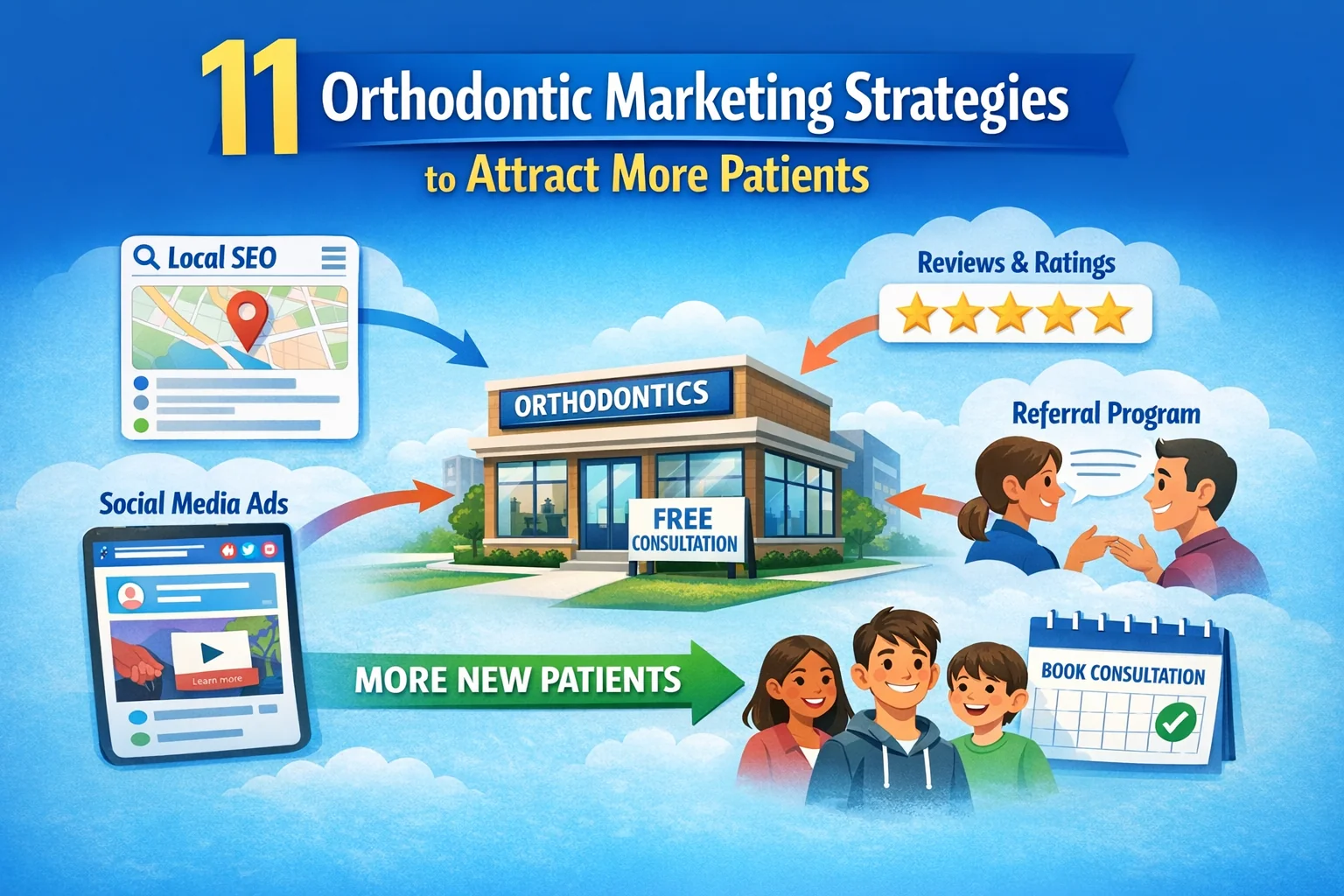 A consistent flow of new consultations starts with the right orthodontic marketing strategies—not more spending. Most orthodontic practices already invest in some form of marketing, but the ones that grow predictably are the ones that build a system: they show up where patients search, earn trust before the first visit, and make it easy to book. The practices that struggle tend to rely on a single channel, skip measurement, or lose potential patients between the first click and the kept consultation. A consistent flow of new consultations starts with the right orthodontic marketing strategies—not more spending. Most orthodontic practices already invest in some form of marketing, but the ones that grow predictably are the ones that build a system: they show up where patients search, earn trust before the first visit, and make it easy to book. The practices that struggle tend to rely on a single channel, skip measurement, or lose potential patients between the first click and the kept consultation.
This guide covers 11 strategies organized from foundational visibility (local SEO and Google Business Profile) through paid advertising, reputation building, content marketing, conversion optimization, and measurement. Each strategy includes specific steps you can implement—not just concepts. Whether you’re launching a new practice, adding a second location, or trying to fill capacity you’ve already built, these strategies work together to create a marketing system that compounds over time.
If your lead volume is strong but consultations aren’t converting to starts, the issue may be downstream. See our guide on patient acquisition for that side of the equation.
Start here: If you need more visibility, begin with local search optimization. If you’re already visible but need more leads, skip to paid advertising. If leads are coming in but not converting, focus on conversion optimization and measurement.
Written for: orthodontic practice owners, office managers, and marketing coordinators who want a practical, channel-by-channel plan for attracting more consultations and converting them into starts.
TL;DR
If you focus on seven things, focus on these:
| • |
Own local search - optimize your website for orthodontic keywords in your market and build out your Google Business Profile completely so you appear when patients search “orthodontist near me”
|
| • |
Run targeted paid ads - use Google Ads on high-intent keywords and geo-targeted social ads to reach parents and adults actively considering treatment
|
| • |
Build a review generation system - ask consistently, respond to every review, and maintain volume and recency on Google so trust is visible before the first call
|
| • |
Create a patient referral program - make it easy for current patients and families to refer, and track which referral sources produce starts
|
| • |
Publish educational content - answer the questions patients actually search (treatment comparisons, age timing, cost factors) and use before-and-after content on social platforms
|
| • |
Lower the first-step barrier - offer virtual consultations and build referral relationships with general dentists and pediatric dentists who send you qualified patients
|
| • |
Track every lead source and measure cost per start - call tracking, form attribution, and a monthly review rhythm turn marketing from a guess into a system |
Table of Contents
Foundation: local search visibility (Strategies 1–2)
Most orthodontic patient journeys start with a search. Whether it’s a parent researching “braces for my teenager” or an adult looking into clear aligners, Google is typically the first stop. Practices that dominate local search results get a disproportionate share of consultations—and the advantage compounds over time because organic visibility doesn’t disappear when you stop paying for it.
A pattern we commonly see: a practice invests in paid ads but neglects its organic foundation. Ads bring in leads, but the moment the budget pauses, the phone stops ringing. Building local search visibility takes longer, but it creates a baseline of demand that paid channels layer on top of rather than replace.
1. Optimize your orthodontic website for local search intent
Your website needs to do two things well: rank for the terms patients actually search, and convert visitors into consultation requests once they arrive. Both start with how you structure your content.
Service-specific pages are essential. A single “Services” page that lists braces, clear aligners, surgical orthodontics, and early treatment in a few sentences each won’t rank for any of them. Each major treatment category needs its own dedicated page with enough depth to answer the questions a prospective patient would have. In our work with orthodontic practices, the ones that build individual pages for braces, Invisalign/clear aligners, early interceptive treatment, adult orthodontics, and surgical orthodontics consistently outperform those that consolidate everything.
Location-specific content matters for multi-location practices. If you serve multiple cities or neighborhoods, each location should have a dedicated page that includes the address, a unique map embed, location-specific staff or doctor information, and content tailored to that community. Generic pages duplicated across locations with only the city name swapped rarely rank well.
Technical fundamentals to verify:
| • |
Mobile performance - over 60% of orthodontic searches happen on mobile devices; your site must load fast and function smoothly on phones, especially forms and click-to-call buttons. A technical SEO audit can identify the biggest speed and usability issues
|
| • |
Page speed - aim for a Largest Contentful Paint under 2.5 seconds; compress images, defer non-critical scripts, and test with Google PageSpeed Insights
|
| • |
Schema markup - implement LocalBusiness and Dentist schema on every location page so search engines can parse your practice information correctly
|
| • |
Internal linking - connect service pages, blog posts, and location pages with contextual links so search engines understand your site’s topical structure |
2. Build out your Google Business Profile completely
Your Google Business Profile (GBP) is often the first thing a prospective patient sees—before your website, before your social media, before anything else. In the local map pack, your GBP listing determines whether someone clicks through to learn more or scrolls past to a competitor.
Complete every field. Practices that fill out every available section—business description, services, insurance accepted, appointment links, attributes, and Q&A—consistently outperform those that leave fields blank. Google rewards completeness with better visibility, and patients reward it with higher click-through rates.
Post weekly updates. Google Business Profile posts are a low-effort way to signal activity. Share treatment tips, before-and-after results (with consent), team announcements, or community involvement. Posts don’t need to go viral—they need to show Google and patients that your practice is active and engaged.
Add photos regularly. Practices with 100+ photos on their GBP listing typically receive significantly more direction requests and website clicks than those with fewer than 10. Add office photos, team photos, and treatment-related images monthly. Authentic photos of your actual office and team outperform stock imagery.
Manage the Q&A section proactively. Seed your Q&A with common questions (and answers) before patients or competitors add their own. Questions like “Do you offer payment plans?” and “What age should my child first see an orthodontist?” are easy to answer and immediately helpful to searchers.
> Back to Table of Contents
Paid advertising that targets ready-to-act patients (Strategies 3–4)
Organic visibility takes time to build. Paid advertising fills the gap by putting your practice in front of patients who are actively searching for orthodontic treatment right now. The key is targeting: orthodontic paid campaigns perform best when they focus on high-intent keywords and well-defined audiences rather than broad awareness.
3. Run Google Ads on high-intent orthodontic keywords
Google Ads lets you appear at the top of search results for the exact terms prospective patients type when they’re ready to take action. For orthodontic practices, the highest-converting keywords tend to fall into a few categories:
High-intent keyword categories:
| • |
Provider searches - “orthodontist near me,” “orthodontist [city name],” “best orthodontist [city]”
|
| • |
Treatment-specific searches - “Invisalign [city],” “braces for adults [city],” “clear aligners near me”
|
| • |
Cost and comparison searches - “braces cost [city],” “Invisalign vs braces,” “affordable orthodontist [city]”
|
| • |
Age-specific searches - “braces for teenagers,” “adult braces options,” “when should my child see an orthodontist” |
Landing pages matter more than ad copy. A common mistake is sending ad traffic to the homepage. Every ad group should point to a dedicated landing page that matches the searcher’s intent, includes a clear call to action (schedule a consultation), and loads fast on mobile. In our experience, practices that use treatment-specific landing pages see consultation request rates 2–3 times higher than those sending traffic to generic pages.
Call tracking is non-negotiable. Without call tracking, you can’t distinguish a consultation request from a billing question or vendor call. Assign unique tracking numbers to each campaign so you can measure cost per consultation request—not just cost per click.
Set geographic boundaries tightly. Orthodontic patients typically travel 15–25 minutes for treatment. Set your geo-targeting to match your realistic service area and exclude locations outside it. Wasted spend on clicks from patients who will never travel to your office is one of the most common budget leaks we see.
4. Use geo-targeted social media advertising
Social media ads work differently than search ads. Search captures existing demand—someone is already looking for an orthodontist. Social ads create demand by reaching people who haven’t started searching yet but fit your ideal patient profile.
Facebook and Instagram are the primary platforms for orthodontic social ads. The targeting options let you reach parents of children aged 8–17, adults in specific age ranges, and people in your geographic area. Lookalike audiences built from your existing patient list can be especially effective because they target people who share demographic and behavioral characteristics with your current patients.
Creative that performs:
| • |
Before-and-after transformations - with proper patient consent and HIPAA compliance, these consistently generate the highest engagement and click-through rates
|
| • |
Patient testimonial videos - short (30–60 second) videos of real patients sharing their experience feel authentic and build trust faster than polished ads
|
| • |
Limited-time consultation offers - a complimentary or reduced-fee initial consultation lowers the barrier for someone who hasn’t committed to treatment yet
|
| • |
Educational content - “5 signs your child may need early orthodontic evaluation” or “what adults wish they knew before getting braces” positions your practice as a resource, not just an advertiser |
Retargeting is where social ads get efficient. Someone visits your website, looks at your Invisalign page, but doesn’t book. A retargeting ad reminds them to take the next step. Retargeting audiences are smaller but convert at significantly higher rates because these people have already shown interest.
> Back to Table of Contents
Reputation and referrals: earning trust at scale (Strategies 5–6)
Reviews and referrals share a common foundation: trust. Online reviews build trust with strangers before they ever contact you. Patient referrals leverage the trust that already exists between your current patients and their friends, family, and colleagues. Both are among the highest-converting lead sources for orthodontic practices because they come pre-loaded with credibility.
5. Build a review generation system
A handful of glowing reviews from three years ago won’t move the needle. What matters is volume, recency, and consistency. Prospective patients look at how many Google reviews you have, how recently they were posted, and how you respond—especially to negative feedback.
Make asking systematic, not occasional. The practices with the strongest review profiles don’t rely on staff remembering to ask. They build review requests into their workflow at natural moments:
| • |
Debond/completion day - the moment braces come off is the highest-emotion point in the patient journey and the single best time to request a review
|
| • |
After milestone appointments - six-month progress checks, aligner refinements, or any visit where the patient sees visible progress
|
| • |
Post-compliment - when a patient or parent offers a verbal compliment in the office, that’s a natural prompt: “We’d love it if you shared that on Google—it helps other families find us” |
Respond to every review. Thank positive reviewers specifically (reference something unique about their experience when possible). For negative reviews, respond professionally, acknowledge the concern, and offer to resolve it offline. How you handle criticism tells prospective patients more about your practice than five-star reviews alone.
Prioritize Google. Reviews on Google directly influence your local search visibility and map pack rankings. While Facebook, Healthgrades, and other platforms matter, Google should be your primary focus.
6. Create a structured patient referral program
Referrals are often the highest-converting and lowest-cost lead source for orthodontic practices, yet most practices leave them to chance. A structured program turns occasional referrals into a predictable channel.
Keep it simple and easy to act on. Complicated referral programs with tiers, points, and fine print get ignored. What works: a clear, simple offer that current patients can explain in one sentence to a friend. “Refer a friend who starts treatment and you both receive a credit toward your account” is straightforward and motivating.
Make referral tools available. Give patients something tangible—referral cards in the office, a shareable link via text or email, or a simple online form. The easier you make it to refer, the more referrals you’ll receive. In our work with practices, the ones that provide digital referral tools (a text-friendly link patients can send to friends) see meaningfully higher referral volume than those relying on physical cards alone.
Track and acknowledge every referral. When someone refers a patient, acknowledge it quickly—a handwritten thank-you note, a small gift, or the promised credit applied within days, not weeks. Recognition reinforces the behavior and encourages repeat referrals. Equally important: track which patients refer most frequently and which referral sources actually convert to starts, not just consultations.
> Back to Table of Contents
Content and social media: educating before the consultation (Strategies 7–8)
Orthodontic treatment is a significant decision—financially, aesthetically, and in terms of time commitment. Patients and parents research extensively before booking a consultation. Practices that provide helpful, trustworthy content during that research phase position themselves as the obvious choice when the patient is ready to act.
7. Publish blog content around the questions patients actually ask
The best orthodontic content strategy doesn’t start with keyword tools—it starts with your front desk. The questions patients and parents ask during phone calls, consultations, and follow-up visits are the same questions thousands of people are typing into Google.
High-value content categories for orthodontic practices:
| • |
Treatment comparisons - “Invisalign vs. traditional braces: which is right for you?” These pages capture patients in the decision-making phase and tend to rank well because the search intent is clear
|
| • |
Age and timing content - “When should my child first see an orthodontist?” and “Is it too late for adult braces?” address common concerns that drive consultation requests
|
| • |
Cost and insurance content - “How much do braces cost?” is one of the most-searched orthodontic queries; a well-written page that explains factors affecting cost (without listing specific prices) builds trust and captures high-intent traffic
|
| • |
Treatment experience content - “What to expect during your first month with braces” and “How to care for your Invisalign aligners” serve current patients while attracting new ones through search
|
| • |
Local and community content - sponsoring a school event, participating in a community health fair, or hosting an open house creates content opportunities that build local relevance and backlinks |
Depth matters more than frequency. One comprehensive, well-researched article per month outperforms four thin posts that barely scratch the surface. Aim for content that a prospective patient could read and feel genuinely more informed about their decision—not content that exists solely to target a keyword.
8. Use before-and-after transformations and video on social platforms
Orthodontic treatment is inherently visual, which gives practices a significant advantage on social media. A well-organized smile gallery is compelling content that resonates with prospective patients in a way that text-based marketing cannot.
Before-and-after content guidelines:
| • |
Always obtain written consent - use a photo/video release form that specifies how and where images will be used, and keep it on file; HIPAA compliance is non-negotiable
|
| • |
Show diverse cases - feature a range of ages, treatment types, and case complexities so prospective patients can see themselves in your results
|
| • |
Pair visuals with context - include treatment type, approximate duration, and a brief description of the patient’s goals; this adds educational value and helps viewers understand what’s possible for their situation |
Video content is increasingly important. Short-form video (30–90 seconds) on Instagram Reels, TikTok, and YouTube Shorts reaches audiences that static posts miss. Effective orthodontic video content includes office tours, “day in the life” clips, braces-removal reveals, patient testimonials, and quick educational tips. The content doesn’t need to be professionally produced—authenticity often outperforms polish on these platforms.
Consistency beats virality. Posting 2–3 times per week with a mix of educational content, patient transformations, and behind-the-scenes glimpses builds a following over time. Practices that post sporadically (a burst of content followed by weeks of silence) rarely build the audience engagement that drives consultations.
> Back to Table of Contents
Conversion optimization: making it easy to say yes (Strategies 9–10)
Visibility without conversion is wasted spend. Every strategy above drives prospective patients toward your practice—but if the path from “interested” to “booked consultation” has too much friction, patients will choose the competitor who makes it easier. Conversion optimization focuses on removing barriers in your patient pipeline.
9. Offer virtual consultations to lower the first-step barrier
For many prospective patients, the biggest obstacle to booking isn’t cost or even interest—it’s the commitment of an in-person visit before they’ve decided whether treatment is right for them. Virtual consultations solve this by letting patients take a low-commitment first step from home.
How virtual consultations work in practice: the patient submits photos of their teeth (or completes a brief video call), and the orthodontist provides an initial assessment, discusses potential treatment options, and invites them to an in-person evaluation if appropriate. The process takes less than 15 minutes of clinical time and converts a “maybe later” into a “let’s talk.”
What we typically find: practices that add a virtual consultation option see an increase in total consultation volume because they’re capturing patients who would not have called or booked an in-person visit otherwise. These aren’t replacing in-office consultations—they’re adding a new entry point to the marketing funnel.
Implementation tips:
| • |
Make it prominent on your website - a virtual consultation button should be visible on every service page and in your main navigation, not buried on a subpage
|
| • |
Respond quickly - virtual consultation requests that receive a response within 2–4 hours convert at significantly higher rates than those that wait 24–48 hours; assign a specific team member to own the response workflow
|
| • |
Follow up systematically - not every virtual consultation converts immediately; a structured follow-up sequence (email or text at day 3, day 7, and day 14) keeps your practice top of mind without being pushy |
10. Build referral relationships with general dentists and pediatric dentists
General dentists and pediatric dentists remain one of the most valuable referral sources for orthodontic practices. A strong referral network provides a steady stream of patients who arrive with a recommendation from a provider they already trust—which means shorter decision timelines and higher case acceptance rates.
Building referral relationships takes consistency, not grand gestures. The practices with the strongest GP referral networks do a few things well:
| • |
Make communication easy - send timely, professional treatment updates and progress reports back to the referring dentist; this shows respect for the relationship and keeps the GP informed about their patient
|
| • |
Provide value beyond referrals - offer CE lunch-and-learns at referring offices, share relevant clinical resources, or provide guidance on when to refer; practices that give before they ask build stronger, more durable relationships
|
| • |
Stay visible - regular check-ins (quarterly at minimum), a referral coordinator who “owns” the relationship, and consistent communication keep your practice top of mind when the dentist identifies a patient who needs orthodontic evaluation
|
| • |
Track referral patterns - know which providers refer most frequently, which referrals convert to starts, and which relationships need attention; this data helps you focus your relationship-building efforts where they produce the most value |
Don’t overlook pediatric dentists. They see patients at the ideal age for early orthodontic evaluation (age 7–8) and are often the first provider to identify a need for orthodontic referral. Building relationships with pediatric dental practices in your area can create a reliable pipeline of young patients and their families.
> Back to Table of Contents
Measurement and optimization (Strategy 11)
The difference between orthodontic practices that grow predictably and those that wonder “is our marketing working?” comes down to tracking marketing ROI. Without tracking, every marketing decision is a guess. With it, you can see exactly which channels produce consultations, which produce starts, and what each one costs.
11. Track every lead source and measure cost per start
The metric that matters most is cost per start, not cost per lead. A channel that generates 50 leads at a low cost but only 2 starts is far less valuable than a channel that generates 15 leads but converts 8 into treatment. Tracking cost per start requires connecting your marketing data to your patient management system so you can follow a lead from first contact through case acceptance.
Essential tracking infrastructure:
| • |
Call tracking - assign unique phone numbers to each marketing channel (website, Google Ads, social ads, GBP listing) so you know which channels drive phone calls; this is the single most impactful tracking improvement for most practices
|
| • |
Form and chat attribution - ensure every online form submission and chat interaction captures the traffic source so you know whether a web lead came from organic search, paid ads, or a social media campaign
|
| • |
Consultation source tracking - train your intake team to ask “how did you hear about us?” and record it consistently in your practice management system; this captures referral sources and word-of-mouth that digital attribution misses
|
| • |
Start attribution - connect each new patient start back to the original lead source so you can calculate true cost per start by channel; this often requires a monthly reconciliation between your marketing dashboard and your PMS |
Build a monthly review rhythm. Data that sits in a dashboard unreviewed doesn’t improve anything. Set a monthly meeting—even 30 minutes—to review lead volume by channel, cost per lead, consultation-to-start conversion rate, and cost per start. Look for trends over 3–6 month windows rather than reacting to single-month fluctuations.
A practical example: in our work with orthodontic practices, a monthly review might look like this—Google Ads generated 45 consultation requests at an average cost per lead of $85; 22 of those became starts, producing a cost per start of $174. Organic search generated 30 consultations at no marginal cost per lead; 18 became starts. Referrals from GPs produced 12 consultations with 10 starts. This level of clarity lets you invest more in what works and fix or cut what doesn’t.
Results vary by market, competition level, and case mix. The specific numbers above are illustrative—your benchmarks will depend on your local market, fee schedule, and the types of cases you accept. What matters is building the measurement system so you can establish your baselines and improve from there.
> Back to Table of Contents
Next steps
Building a complete orthodontic marketing system takes time, but you don’t have to implement all 11 strategies at once. Start with the foundation (local SEO and Google Business Profile), add paid advertising to fill near-term capacity, and layer in reputation, content, and referral strategies as your team develops the capacity to sustain them. The practices that grow most consistently are the ones that treat marketing as a system to manage—not a series of one-off campaigns.
If you’d like help identifying which strategies will have the biggest impact for your practice—or you want a partner to implement and manage them—WEO Media works exclusively with dental and orthodontic practices. Contact us at 888-246-6906 to start the conversation.
> Back to Table of Contents
FAQs
How much should an orthodontic practice spend on marketing?
Most established orthodontic practices allocate between 3% and 8% of gross revenue to marketing, with newer practices or those in competitive markets often investing closer to 10–12% during growth phases. The right budget depends on your growth goals, market competition, and how many channels you need to maintain. What matters more than the total spend is tracking cost per start by channel so you can see which investments are actually producing treatment cases.
What is the most effective marketing channel for orthodontists?
No single channel is universally “best” because effectiveness depends on your market, competition, and patient demographics. That said, local SEO and Google Business Profile optimization consistently deliver the highest long-term return for orthodontic practices because they capture patients who are actively searching for treatment. Paid search (Google Ads) is typically the fastest way to generate new consultations. The strongest marketing systems combine multiple channels so you are not dependent on any one source.
How long does orthodontic SEO take to show results?
Most orthodontic practices begin seeing measurable improvements in organic search visibility within 3–6 months, with more significant ranking improvements and traffic growth typically appearing between 6–12 months. Factors that influence timeline include the competitiveness of your local market, the current state of your website, and the consistency of content and optimization efforts. SEO is a compounding investment: the results build over time rather than appearing immediately.
Should orthodontists advertise on social media?
Social media advertising can be effective for orthodontic practices, particularly for reaching parents of teenagers and adults considering aesthetic treatment options like clear aligners. The key difference from search advertising is that social ads generate awareness and interest among people who are not yet actively searching, which means conversion timelines tend to be longer. Practices that pair social ads with retargeting campaigns and a strong organic social media presence typically see better results than those running ads in isolation.
How do I get more Google reviews for my orthodontic practice?
Build review requests into your workflow at high-emotion moments: the day braces come off, after a milestone progress appointment, or immediately after a patient offers a verbal compliment. Make the process easy by sending a direct link to your Google review page via text message. The practices with the strongest review profiles ask consistently at every appropriate opportunity rather than relying on occasional campaigns or staff memory.
Is it worth offering virtual orthodontic consultations?
Virtual consultations typically add consultation volume by capturing patients who would not have booked an in-person visit as their first step. They are especially effective for adult patients and for practices in competitive markets where reducing the commitment barrier can differentiate your practice. The key to success is responding to virtual consultation requests quickly (within a few hours, not days) and having a structured follow-up sequence to convert initial interest into in-office evaluations.
How do I track which marketing channels bring in the most patients?
Start with call tracking (unique phone numbers per channel), form attribution (capturing traffic source on every web submission), and consistent “how did you hear about us?” tracking at intake. Then connect lead source data to your practice management system so you can follow each patient from first contact through case acceptance. This lets you calculate cost per start by channel, which is the metric that reveals where your marketing budget produces the most value.
What makes orthodontic marketing different from general dental marketing?
Orthodontic marketing has several distinct characteristics: treatment decisions often involve two decision-makers (the parent and the patient), the treatment commitment is longer (12–36 months vs. a single visit), the case value is higher, and the decision timeline is longer because patients often research and compare multiple providers. These factors mean orthodontic marketing needs to build trust and educate more thoroughly before the consultation, and conversion optimization at the consultation stage has an outsized impact on practice growth compared to volume-focused general dental marketing. |
|