Google Ads for Endodontists
Posted on 4/18/2026 by WEO Media |
How to Build a PPC Strategy That Converts
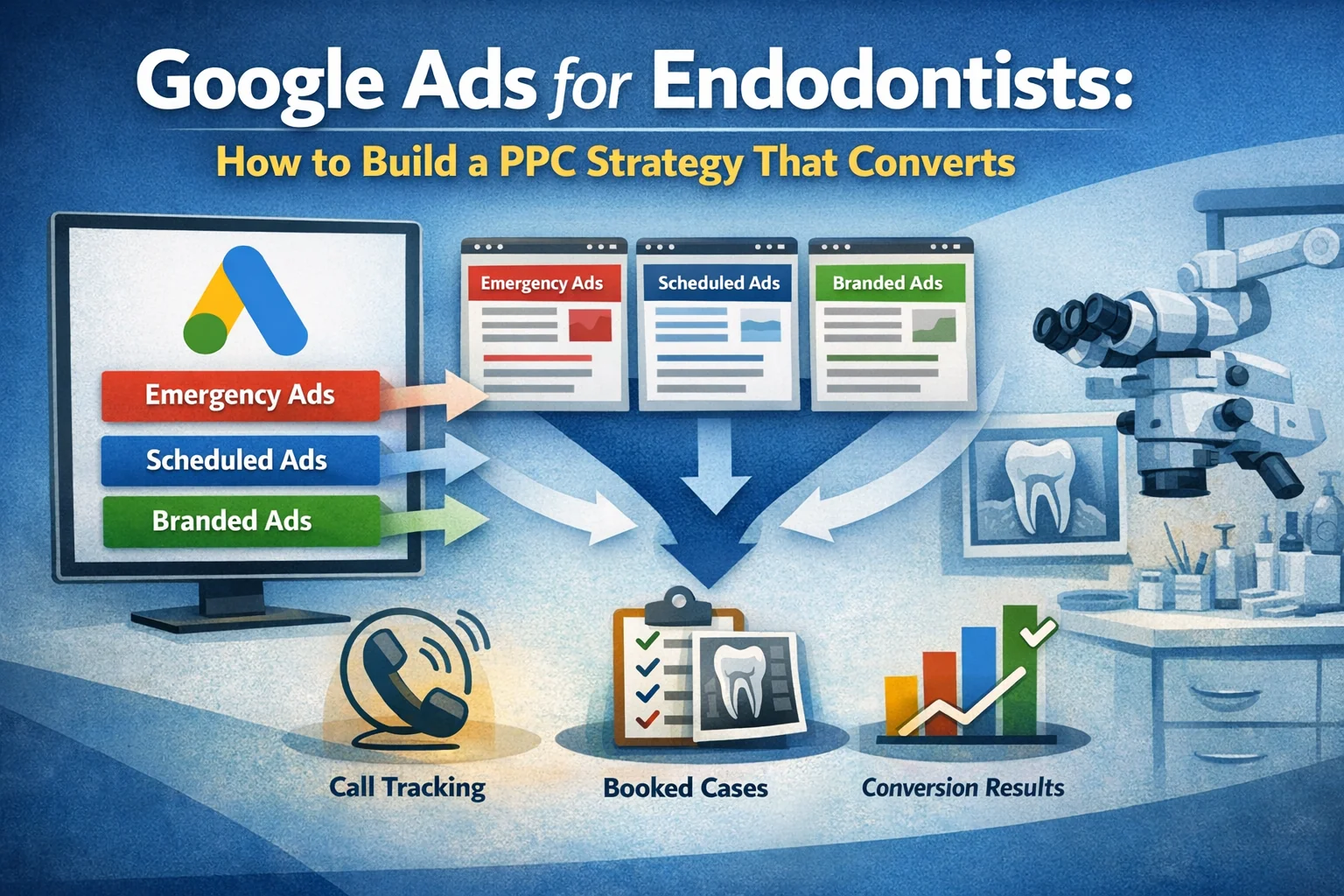 Building a Google Ads PPC strategy for endodontists that converts requires separating emergency, scheduled, and branded search audiences into dedicated ad groups with matched landing pages and case-level conversion tracking—rather than running generic dental campaigns that waste budget and cannibalize referring-doctor relationships. Building a Google Ads PPC strategy for endodontists that converts requires separating emergency, scheduled, and branded search audiences into dedicated ad groups with matched landing pages and case-level conversion tracking—rather than running generic dental campaigns that waste budget and cannibalize referring-doctor relationships.
This guide shows endodontic practices how to build a PPC program that captures high-intent searches, protects referral networks, and tracks booked cases (not just clicks) so every dollar is accountable.
Why most endodontic PPC underperforms: endodontists are specialists with a narrow service menu, high case value, and a referral-heavy business model. Running the same broad-match campaign a family dentist might use burns budget on low-intent clicks, undermines goodwill with referring GPs, and buries the one or two emergency searches that could actually book a meaningful case. The fix isn’t a bigger budget—it’s a tighter endodontic marketing structure that treats PPC as one coordinated channel, not a standalone experiment.
If you’re evaluating whether paid ads make sense alongside your SEO program, the SEO vs. PPC comparison covers where each channel fits in a specialty marketing mix.
Below, you’ll learn how to segment campaigns by intent (emergency → scheduled → branded), build keyword lists that respect referral relationships, write ad copy that earns the click from patients in pain, design landing pages that convert, and—most importantly—track what matters: booked endodontic cases, not vanity metrics.
Written for: endodontists, practice owners, office managers, and marketing decision-makers who want Google Ads to produce accountable case volume without undermining referring-doctor relationships.
TL;DR
If you only remember five things, remember these:
| 1. |
Segment campaigns by intent - separate emergency, scheduled/clinical, and branded traffic because each one needs different bids, copy, and landing pages
|
| 2. |
Build tight keyword lists with heavy negatives - endodontics is a small menu; broad match burns budget on general dentistry and cost-shopping queries
|
| 3. |
Match landing pages to ad groups - sending emergency root canal clicks to your homepage wastes them; build pages that answer the specific query
|
| 4. |
Track cases, not clicks - call tracking, GA4 key events, and offline conversion imports turn PPC from guesswork into ROI math
|
| 5. |
Protect referral relationships - clear specialist positioning in ad copy signals that you’re supporting GPs, not competing for their everyday patients |
Table of Contents
Why Google Ads for endodontists is different
Endodontics is a specialty with characteristics that make generic dental PPC advice actively harmful when applied without modification. Four factors change the math:
| • |
Referral-driven revenue - a significant majority of endodontic cases come from referring general dentists, so paid ads are a supplement to referrals, not a replacement
|
| • |
Higher case value - a single molar root canal or retreatment produces revenue well above a routine hygiene visit, which changes the cost-per-acquisition math substantially
|
| • |
Narrow service menu - primary services are root canal therapy, retreatment, apicoectomy, and trauma/cracked tooth care, which creates tight, defensible keyword clusters
|
| • |
Split audience intent - searchers are either in acute pain (emergency) or have been told they need specialist care (scheduled), and these two groups need completely different ad experiences |
These factors mean endodontic PPC should be built around a small number of high-intent keywords, tightly themed ad groups, and measurement focused on case volume rather than click volume.
A pattern we commonly see: endodontic practices inherit a PPC account that was originally built from a general dentistry template. It has 40 keywords, half of them on broad match, all pointing at the homepage. It spends several thousand a month and generates several hundred clicks, a handful of form fills, and maybe two cases. The problem isn’t the platform—it’s the structure.
> Back to Table of Contents
Campaign structure that fits endodontic demand
Tight structure is the difference between PPC that funds itself and PPC that drains budget. For most endodontic practices, a three-campaign structure works best—the same principle structured dental PPC campaigns use to attract high-value cases across specialties. Each campaign has its own audience, its own bidding logic, and its own landing page strategy.
Campaign 1: Emergency / Urgent
This campaign targets patients in acute pain who are searching for immediate help. Keywords include variations of “emergency root canal,” “tooth pain specialist,” and “emergency endodontist near me.” Characteristics:
| • |
Higher bids justified - these searchers often convert within hours, not weeks
|
| • |
Mobile-heavy - typically dominated by mobile devices, so ad copy and landing pages must be mobile-first
|
| • |
Call-focused - the majority of conversions happen by phone, not by form submission
|
| • |
Ad schedule limits - only run emergency ads during hours your practice can actually see emergency patients |
Campaign 2: Scheduled / Clinical
This campaign targets patients whose GP recommended a specialist or who are actively researching procedures like retreatment or apicoectomy. Keywords are longer, more clinical, and lower volume but higher-margin:
| • |
Service-specific ad groups - separate groups for root canal retreatment, apicoectomy, cracked tooth diagnosis, and microscope endodontics
|
| • |
Educational landing pages - these patients are researching before booking, so content depth matters
|
| • |
Lower bids, higher match-type discipline - exact and phrase match dominate; broad match is rarely appropriate
|
| • |
Form and call conversions both matter - some patients book online, others call, so both channels need measurement |
Campaign 3: Branded
This campaign defends your practice name against competitors who may bid on it. It’s usually inexpensive and delivers some of the highest conversion rates in the entire account:
| • |
Small budget, high ROI - typically 5–10% of total spend
|
| • |
Protects direct-search traffic - patients who Google your name after a GP referral shouldn’t see a competitor’s ad above your listing
|
| • |
Should be monitored for cannibalization - if organic branded traffic is strong, paid branded can be scaled back to avoid paying for clicks you would have earned organically |
Additional campaign types (display remarketing, Performance Max, YouTube) can be layered in later, but only after the core search campaigns are producing predictable results.
> Back to Table of Contents
Keyword strategy: emergency, scheduled, and branded
Endodontic keyword lists should be short, specific, and ruthlessly filtered. A well-run account often has 20–60 active keywords, not 200+. The same principles that drive SEO for endodontists targeting root canal keywords apply to PPC, but with tighter filtering because every click costs money. Here’s how to think about each bucket.
Emergency-intent keyword clusters
These are the searches that convert fastest when capturing high-intent emergency dentist searches is built into the campaign:
| • |
Near-me queries - “emergency root canal near me,” “emergency endodontist near me”
|
| • |
City-specific urgency - “emergency endodontist [city],” “root canal today [city],” “walk-in root canal”
|
| • |
Symptom-based - “severe tooth pain dentist,” “cracked tooth emergency,” “tooth pain specialist” |
Scheduled/clinical keyword clusters
| • |
Specialist identifiers - “endodontist [city],” “root canal specialist [city]”
|
| • |
Procedure-specific - “root canal retreatment,” “apicoectomy [city],” “microscope root canal”
|
| • |
Problem-specific - “failed root canal specialist,” “cracked tooth endodontist,” “tooth infection specialist” |
Branded keyword clusters
| • |
Practice name variations - your practice name with and without city modifiers
|
| • |
Doctor names - common patient searches using doctor last names
|
| • |
Reputation queries - “[practice name] reviews,” “[practice name] ratings” |
Negative keywords are where accounts are won or lost
Negative keywords prevent your ads from showing on searches that waste budget. Understanding which dental PPC keywords waste budget vs. drive high ROI is foundational to this discipline. For endodontics, a robust negative list typically includes:
| • |
Price/cost queries - “cheap root canal,” “free dental,” and similar cost-shopping terms that rarely book specialist care at specialist fees
|
| • |
DIY and home remedies - “root canal at home,” “root canal pain relief remedies”
|
| • |
General dentistry - “general dentist,” “family dentist,” “cleaning,” “whitening,” “veneers”
|
| • |
Job and training searches - “endodontist salary,” “endodontic residency,” “dental assistant jobs”
|
| • |
Educational/no-commercial-intent - “what is a root canal,” “root canal steps,” “root canal procedure video” |
Review the search terms report weekly during the first month and at least monthly after that. Every irrelevant query you see is a chance to add a negative and tighten the funnel.
> Back to Table of Contents
Writing ad copy that converts without undermining referrals
Endodontic ad copy has to do two things at once: earn the click from a patient in pain or research mode, and signal clearly that you’re a specialist—not a general dentist competing for everyday appointments. That second signal is what keeps your referring GPs comfortable. The fundamentals of dental PPC ad copy that converts apply here, but specialty messaging changes the emphasis toward credentials and procedures.
Headline patterns that work
| • |
Urgency-led (emergency) - “Same-Day Root Canal Relief,” “Stop Tooth Pain Today”
|
| • |
Credential-led - “Board-Certified Endodontist,” “Specialist in Saving Teeth”
|
| • |
Location + service - “Emergency Endodontist in [City],” “Root Canal Specialist in [City]”
|
| • |
Procedure-specific (scheduled) - “Root Canal Retreatment Specialist,” “Microscope-Guided Endodontics”
|
| • |
Referral-friendly - “Referred by Your Dentist? Book Here,” “Trusted by Local GPs” |
Description line principles
| • |
Lead with specialist credentials - “Board-certified endodontist” outperforms generic “experienced dental team” copy
|
| • |
Name the specific procedure - patients researching retreatment want to see “retreatment” in the ad, not a vague “dental services” line
|
| • |
Use urgency signals only when true - “same-day available” should reflect actual capacity, not aspirational availability
|
| • |
End with a clear next step - “Call 888-246-6906” or “Book Online” beats soft language like “learn more” |
Responsive search ad setup
Google has consolidated around responsive search ads (RSAs). Each ad group should have at least one RSA with 12–15 headlines and 3–4 descriptions. Pin headlines only when necessary (brand name, required disclaimer) because pinning limits Google’s ability to combine assets in testing. Use asset-level reporting to identify which headlines and descriptions are pulling weight, and rotate out low performers monthly.
Ad extensions that matter for endodontic practices
Extensions expand your ad real estate and improve click-through rate. For endodontics, the highest-leverage extensions are:
| • |
Call extensions - critical for emergency campaigns; enable call reporting so call data flows into conversion tracking
|
| • |
Location extensions - pulls address from Google Business Profile and reinforces local relevance
|
| • |
Sitelinks - link to specific procedure pages (root canal therapy, retreatment, apicoectomy, trauma care)
|
| • |
Structured snippets - highlight services with a “Services” header listing “Root Canals, Retreatment, Apicoectomy, Trauma Care”
|
| • |
Callout extensions - reinforce trust signals like “Board Certified,” “Same-Day Emergencies,” “Most Insurance Accepted” |
> Back to Table of Contents
Landing pages built for endodontic intent
The landing page is where most endodontic PPC accounts lose money. A common mistake is sending every click to the homepage. Homepages are designed for multiple audiences—existing patients, referring doctors, prospective patients, job seekers—which means they don’t answer any one searcher’s question fast enough. The principles behind dental landing pages that convert apply doubly to specialty PPC: every ad group should map to a dedicated landing page that mirrors the ad’s intent. Emergency root canal ads go to a page built for emergency patients. Retreatment ads go to a retreatment page. Branded ads go to the homepage or a practice-overview page.
What an endodontic emergency landing page needs
| • |
Above-the-fold phone number - large, tappable, wired to a tracked number
|
| • |
Clear specialist positioning - “Board-certified endodontist” visible in the first screen
|
| • |
Same-day availability signal - when offered, state it explicitly and accurately
|
| • |
Trust elements - credentials, years in practice, review snippets, and relevant technology (operating microscope, CBCT imaging, digital workflow)
|
| • |
Short backup form - name, phone, preferred time; not a 12-field intake
|
| • |
Insurance and payment clarity - what you accept and how payment works, without quoting specific prices
|
| • |
Parking, location, and directions - reduces friction for patients already in pain |
What a scheduled/retreatment landing page needs
| • |
Procedure explanation at appropriate depth - patients researching retreatment want substance, not generic “what is endodontics” filler
|
| • |
Differentiators specific to the procedure - microscope use, CBCT imaging, and general success-rate framing
|
| • |
Referring-doctor language - “If your dentist referred you, bring your referral paperwork” signals professional coordination
|
| • |
Clear booking options - both phone and online scheduling where available
|
| • |
FAQ section - addresses common patient concerns (pain, duration, recovery) to reduce pre-booking hesitation |
A practical mobile rule: the phone number and primary call-to-action must be visible without scrolling on a standard smartphone. Google’s Largest Contentful Paint threshold is 2.5 seconds for good page experience—miss that and bidding efficiency suffers regardless of copy quality.
> Back to Table of Contents
Bidding, budget, and geographic targeting
Bidding strategy should follow your conversion tracking maturity, not the other way around. New accounts without reliable conversion data should start on Maximize Clicks or Manual CPC to build a data baseline. Once you have 30+ conversions in a 30-day window, shift to Maximize Conversions. Once you have stable cost-per-acquisition data, add a Target CPA setting within Maximize Conversions to guide the algorithm toward efficient cost per case. For accounts already running, the tactics that lower dental Google Ads cost per acquisition without losing lead quality apply directly to endodontic campaigns.
Budget allocation for endodontic accounts
Budget needs depend on market competitiveness, chair capacity, and how much of the practice is already covered by referrals. A typical starting allocation for a single-doctor endodontic practice looks like:
| • |
Emergency campaign - 40–60% of budget (highest intent, typically best return on ad spend)
|
| • |
Scheduled/clinical campaign - 30–45% of budget (longer conversion window, higher-value research patients)
|
| • |
Branded campaign - 5–10% of budget (defensive spend with typically high conversion rate) |
These ratios shift as the account matures. Some specialty practices with strong referral networks find branded spend is unnecessary; others with aggressive local competitors find it essential.
Geographic targeting for specialists
Endodontists typically draw from a wider radius than general dentists because patients are willing to drive farther for specialist care. Common targeting approaches:
| • |
Radius targeting - a 15–25 mile radius around the practice works for most urban and suburban settings
|
| • |
ZIP code list - more precise than radius, especially where geography (highways, rivers, state lines) distorts actual drive time
|
| • |
Exclusions - exclude areas dominated by competing specialists your referring GPs also use, or areas where drive time exceeds patient tolerance
|
| • |
Location bid adjustments - bid up in ZIPs with the strongest referral relationships and proven case volume; bid down in ZIPs that have consumed budget without producing cases |
> Back to Table of Contents
Conversion tracking that captures endodontic cases
If you can’t measure cases, you can’t optimize. Most endodontic PPC accounts fail here because they measure clicks and form fills but not actual booked and kept cases. Multi-touch journeys are normal for specialty practices, so attribution needs to account for research-to-book timelines that can span days or weeks. A strong tracking stack includes three layers.
Call tracking
The majority of endodontic leads arrive by phone, especially for emergencies. Without dental call tracking, you’re optimizing blind and can’t measure marketing ROI by source. A proper setup includes:
| • |
Dynamic number insertion (DNI) - shows a trackable number only to PPC visitors; your main number stays visible to organic and referral traffic
|
| • |
Call duration thresholds - count calls of 60+ seconds as conversions to filter out hang-ups and wrong numbers
|
| • |
Call recording with consent - lets you hear what happens after the click, which surfaces intake process issues that no keyword change can fix
|
| • |
Call categorization - new patient, existing patient, referral coordination, or spam, so ROI math reflects actual new-patient calls |
GA4 and website conversions
Google Analytics 4 uses key events for what were previously called goals in Universal Analytics. Configure key events for:
| • |
Contact form submissions - separate by form type (new patient, referral coordination, general contact)
|
| • |
Online booking completions - if your practice offers online scheduling through a third-party tool, set up the completion event
|
| • |
Phone number clicks on mobile - useful as a directional signal, though paired call tracking is far more reliable
|
| • |
Key page engagement - time on procedure pages and scroll depth for research-intent patients |
Offline conversion imports
This is what separates accounts that know their ROI from accounts that guess. When a call or form becomes a booked and completed case, that data should flow back into Google Ads as an offline conversion. This lets Google’s bidding algorithms optimize toward actual cases rather than surface-level form fills. Setup usually involves:
| • |
Capturing the Google Click ID (GCLID) on form submissions and within the call tracking tool
|
| • |
Connecting the GCLID to the practice management system or a CRM layer that records case outcomes
|
| • |
Uploading converted cases back to Google Ads on a weekly schedule or through an automated integration |
> Back to Table of Contents
Common Google Ads mistakes endodontists make
A pattern we commonly see when auditing endodontic PPC accounts is that the same handful of mistakes account for most wasted spend. Many of these overlap with the Google Ads mistakes dentists make across all specialties, but a few are especially damaging for endodontic practices. Avoid these:
| 1. |
Running general dental keywords - bidding on “dentist near me” or “family dentist” burns budget on patients who will never need a specialist
|
| 2. |
No negative keyword list - without exclusions, ads show for job searches, DIY queries, and cost-comparison traffic that rarely converts
|
| 3. |
Sending every click to the homepage - homepages serve too many audiences to convert high-intent specialty traffic
|
| 4. |
Measuring clicks and impressions instead of cases - “we got 500 clicks last month” is meaningless without knowing how many booked
|
| 5. |
Ignoring Quality Score - low Quality Score drives higher CPCs and lower ad positions; the root cause is usually ad relevance or landing page experience
|
| 6. |
Letting underperforming keywords run indefinitely - a keyword with 100 clicks and zero conversions over 90 days is telling you something
|
| 7. |
Running ads during hours the office is closed - emergency-intent ads especially should align with when you can actually take the call
|
| 8. |
Competing with referring GPs on their keywords - bidding on “family dentist [city]” when that practice refers to you damages the relationship
|
| 9. |
No call tracking - optimizing a phone-first channel without phone data is guesswork
|
| 10. |
Changing everything at once - if keywords, bids, and landing pages all change in the same week, you won’t know what moved the numbers |
> Back to Table of Contents
Measuring ROI and working with your PPC partner
PPC for specialists should be measured in cost per case, not cost per click. The math is straightforward once tracking is reliable.
Cost per case: total monthly ad spend ÷ number of booked cases attributed to PPC. A cost per case well below average case value indicates a healthy account. A cost per case approaching or exceeding case value indicates the account needs work.
Lead-to-case conversion rate: leads from PPC (calls plus forms) ÷ cases that came from those leads. This number exposes intake process issues. If PPC generates 40 leads and only 8 become cases, the problem may be front-desk handling, not the ad account.
Questions to ask your PPC partner monthly
| • |
What was our cost per case this month? - if the answer is a click metric, tracking is incomplete
|
| • |
Which keywords generated cases? - not clicks, cases
|
| • |
What negative keywords were added? - well-managed accounts add multiple negatives per month in early stages
|
| • |
Which ad groups are over or under pacing? - either direction needs attention
|
| • |
What was the landing page conversion rate? - under 3–5% usually indicates a landing page issue rather than a traffic problem
|
| • |
How does this month compare to last month and last quarter? - trend matters more than any single data point |
What to do if PPC isn’t working
Before concluding that paid search doesn’t work for your practice, diagnose the actual failure point. A dental PPC audit walks through the five stages where an account can fail: impressions, clicks, landing page engagement, lead generation, or case conversion. Running through each stage in order typically reveals the real bottleneck—often a front desk process issue losing booked appointments rather than the ad campaigns themselves.
> Back to Table of Contents
Build a PPC strategy that fits your practice
Endodontic PPC done right is accountable, measurable, and supportive of your referral network. At WEO Media, we build Google Ads programs specifically for dental specialists—with tight campaign structure, specialty-aware keyword strategy, conversion tracking that captures booked cases, and monthly reviews that report on what matters. If your current PPC program is producing clicks but not cases, or if you’re considering launching paid ads for the first time, call 888-246-6906 or visit our dental PPC services page (or our dedicated endodontist marketing page) to talk with our team about an audit or a new campaign build.
> Back to Table of Contents
FAQs
How much should an endodontist spend on Google Ads per month?
A typical starting range for a single-doctor endodontic practice is several thousand dollars per month, allocated across emergency, scheduled/clinical, and branded campaigns. Budget needs depend on market competitiveness, referral network strength, and case capacity. Practices in large metros with multiple competing endodontists often need higher budgets to maintain impression share, while practices with strong referral networks may run PPC lean as a supplement rather than a primary patient source.
Will running Google Ads hurt my relationships with referring general dentists?
Not if the campaigns are built correctly. Ads that clearly position you as a specialist handling procedures GPs refer out (root canals, retreatments, apicoectomies, trauma) signal that you support the referral relationship rather than compete with it. Problems arise when endodontic practices bid on general dentistry keywords or run ad copy that looks like it targets GP services. Reviewing ad copy and keyword lists with an eye toward referring-doctor perception is a standard part of ethical specialty PPC management.
What is a good cost per case for endodontic Google Ads?
Cost per case varies significantly by market, but mature endodontic campaigns often target a cost per booked case that represents a small fraction of average case value. With an average endodontic case value well above a routine dental visit, even moderate cost per case produces a strong return on ad spend. Cost per case that approaches or exceeds case value typically indicates tracking gaps, poor campaign structure, or intake issues that are losing booked appointments before they convert to treated cases.
Should I run Google Ads if I’m fully referral-based?
Even strongly referral-based endodontic practices benefit from a small branded campaign to defend against competitors bidding on their name, and from a focused emergency campaign to capture patients whose GP isn’t available. If referrals fully cover chair capacity and you have no growth goals, paid ads can wait. If there’s unused capacity, you’re expanding locations, or you’re trying to diversify your new-patient sources, paid ads can fill gaps that referrals don’t reach.
How long does it take for endodontic Google Ads to show results?
Emergency campaigns can produce calls within the first week because patient intent is immediate. Scheduled and clinical campaigns have longer decision windows and typically take 30 to 90 days to stabilize, as patients research specialists before booking. Plan for a 90-day optimization window before evaluating overall performance, and expect the first 30 days to be heavy on negative keyword additions and search term cleanup as the account calibrates to real search behavior.
Do I need separate landing pages for each endodontic service?
At minimum, separate landing pages for emergency root canal and retreatment are recommended because the searchers have fundamentally different intent and informational needs. Adding dedicated pages for apicoectomy and cracked tooth diagnosis is beneficial if those services are meaningful parts of the practice. A single catch-all services page trying to cover every endodontic procedure typically underperforms dedicated pages by a wide margin in both conversion rate and Quality Score.
Can I run Google Ads for my endodontic practice myself?
It is possible for an office manager or owner with time and technical aptitude to run a basic PPC account, but the learning curve is significant and mistakes are expensive. Conversion tracking setup, negative keyword discipline, landing page optimization, and bidding strategy selection are specialized skills that take time to develop. Most practices find that the cost of professional management is recovered through better cost per case and reduced wasted spend within the first few months.
What conversion tracking do I need for endodontic PPC to work?
At minimum, you need call tracking with dynamic number insertion, form conversion tracking configured in GA4 as key events, and a workflow to match booked cases back to their originating ad click. More advanced setups include offline conversion imports that feed booked-case data back into Google Ads so bidding algorithms optimize toward actual cases rather than surface-level leads. Without these layers, you are optimizing on clicks and form fills rather than on revenue.
How does Google Ads compare to SEO for endodontists?
SEO and PPC serve different roles and work best together. SEO builds long-term organic visibility and credibility, particularly for research-intent queries like root canal retreatment. PPC delivers immediate visibility for high-intent queries, especially emergency searches where timing matters. Most endodontic practices benefit from running both, with SEO as the foundation and PPC as the accelerator for specific high-value traffic segments the practice wants to grow.
|
|