Root Canal Myths: A Content Marketing Guide to Turn Patient Fear Into Booked Treatment
Posted on 7/17/2026 by WEO Media |
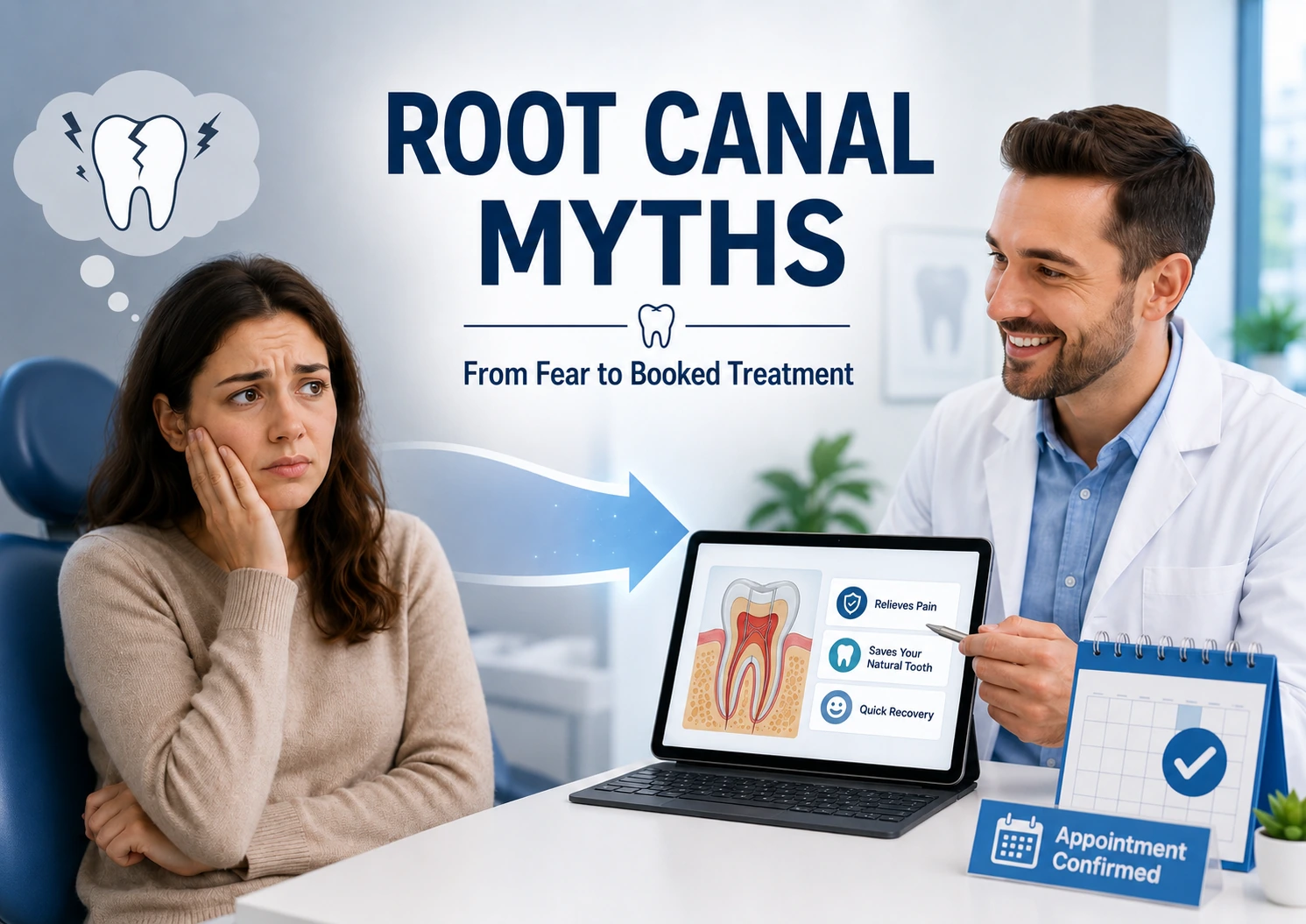 This guide shows dental practices and their marketing teams how to build a content marketing program that debunks root canal myths—turning patient fear into booked endodontic treatment and AI-cited search visibility. This guide shows dental practices and their marketing teams how to build a content marketing program that debunks root canal myths—turning patient fear into booked endodontic treatment and AI-cited search visibility.
Root canal myths—that they’re unbearably painful, that they cause illness, that it’s better to just pull the tooth—don’t only worry patients. They quietly suppress case acceptance and hand high-intent demand to whoever answers the questions first.
The pattern is predictable: a patient hears “you need a root canal,” panics, searches the fear instead of the treatment, and lands on decades-old misinformation. If your practice isn’t the calm, accurate source answering “do root canals hurt?” and “are root canals dangerous?”, someone else is—and that someone shapes whether the patient books, delays, or asks to have a savable tooth extracted instead.
Done well, myth-busting content does three jobs at once: it captures informational search demand, it earns citations in AI Overviews and featured snippets, and it pre-answers the objections that stall treatment—so the conversation in the operatory starts from trust instead of fear. Below you’ll find the myths worth targeting, how to structure content so search engines and AI systems cite it, the compliance guardrails that protect a healthcare brand, and how to measure whether any of it actually books patients.
Written for: dental and endodontic practice owners, office managers, DSO marketing teams, and content strategists who want root canal content that ranks, earns AI citations, and moves patients from fear to booked treatment.
TL;DR
If you only do six things, do these:
| 1. |
Target the fear, not just the procedure - build content around what anxious patients actually search (“do root canals hurt,” “are root canals dangerous,” “root canal vs extraction”)
|
| 2. |
Lead every answer with the truth in 2–3 sentences - a direct, self-contained answer up top is what earns featured snippets and AI Overview citations
|
| 3. |
Anchor claims to authoritative sources - reference the American Association of Endodontists (AAE) and peer-reviewed research, because health topics are held to Google’s strictest quality standard
|
| 4. |
Attribute and review clinically - a named author plus a credentialed clinician reviewer is table stakes for ranking and citation on health content
|
| 5. |
Separate myth content from local pages - informational myth articles compete for AI Overviews and snippets; “endodontist near me” visibility is won in your Google Business Profile and Map Pack
|
| 6. |
Measure assisted conversions, not just last click - myth content usually influences the decision earlier in the journey, so track key events and case acceptance, not only direct bookings |
Table of Contents
Why root canal myths are a marketing problem
Root canal myths are usually treated as a chairside issue—something the dentist explains once the patient is already in the operatory. But by then the myth has often done its damage. Anxious patients search their fear long before they reach the chair, and the pages they find shape the decision they arrive with. When your site is silent on those questions, misinformation and competitors fill the gap.
The demand is large and steady. Millions of root canals are performed in the United States every year, and the questions behind them—pain, safety, extraction versus saving the tooth—get searched constantly. That is a reliable stream of high-intent root canal search demand that a practice can either capture or cede.
Left unanswered, myths carry real costs:
| • |
Delayed treatment - patients “wait and see” while an infection worsens, lowering the odds the tooth can be saved
|
| • |
Requested extractions - patients ask to pull a savable tooth because they believe pulling is simpler or safer
|
| • |
Lost case acceptance - recommended endodontic treatment stalls, and the revenue and the relationship stall with it
|
| • |
Ceded visibility - when your site says nothing, the high-intent searches go to misinformation and to competitors |
Content marketing is how you scale the chairside conversation to every patient before they arrive—the same principle behind root canal marketing that reduces patient fear. A well-built myth-busting library does the reassurance work at scale, at the exact moment the patient is looking for it.
> Back to Table of Contents
The root canal myths your content must address
These are the myths that most often stall treatment, along with the accurate reframe your content should make. Treat what follows as source material for patient-facing pages—always attribute the clinical claims to authoritative bodies such as the American Association of Endodontists (AAE) and peer-reviewed research, and have a licensed clinician review the copy before it publishes.
Myth: “A root canal is unbearably painful”
This is the single most common objection, and it is outdated. Modern root canal treatment is designed to relieve pain, not cause it—most patients arrive in pain from an infected or damaged tooth, and the procedure removes the source of that pain. With current anesthesia and techniques, the AAE describes the experience as comparable to having a filling placed, and cites survey data showing patients who have actually had a root canal are far more likely to call it painless than those who have only imagined it. The content move: acknowledge the fear as understandable—the same empathy behind an endodontist website designed for anxious patients—then replace the outdated image with what treatment is like today.
Myth: “Root canals cause illness or cancer”
There is no valid scientific evidence linking root canal treatment to disease elsewhere in the body. This claim traces back to focal-infection research by Dr. Weston A. Price nearly a century ago—work that used flawed methods and was discredited by better-designed studies within a couple of decades. The AAE points to modern, peer-reviewed research that finds no such link; one widely cited study even found an association between multiple endodontic treatments and a lower cancer risk. Coach your writers to present that as an association, not a claim that root canals prevent cancer, and to link the reader to primary sources. On a health topic this sensitive, careful framing is both an accuracy and a trust decision.
Myth: “It’s better to just pull the tooth”
For most savable teeth, keeping the natural tooth is the preferred option. Endodontic treatment has high long-term success and survival—large outcome studies report the great majority of treated teeth still functioning many years later—and saving the tooth preserves the natural bite and the surrounding bone. Extraction is best framed as a last resort when a tooth genuinely cannot be saved, and replacement options come with their own procedures and long-term maintenance. The content move: reframe “pull it” from the easy default to the option of last resort, and let the reader’s dentist or endodontist assess the specific tooth.
Myth: “No pain means no problem”
Plenty of patients assume that if a tooth stops hurting, the problem resolved itself. In reality, an infection can be present or progressing without obvious pain, and a tooth can need treatment even when it feels fine. This myth is quietly dangerous because it rationalizes delay. Content that explains why a symptom-free tooth can still need attention gives patients a reason to keep the appointment they were tempted to cancel.
Keep a running list of secondary myths for your content calendar, too: that a root canal always takes several long visits, that a treated tooth is “dead” and will fall out, or that an implant is a permanent, maintenance-free upgrade. Each is a natural article, an FAQ entry, or a short explainer video that builds patient confidence.
> Back to Table of Contents
How to build the myth-busting content program
Accurate myths and reframes are the raw material. Turning them into traffic and booked treatment takes deliberate structure—matching content to how patients search, formatting it so machines can cite it, and backing it with the trust signals that health content lives and dies by.
Map each myth to real search intent
Start from the query, not the topic. Anxious patients type their fear (“do root canals hurt,” “are root canals safe,” “root canal or extraction”), so build a pillar page on root canal myths supported by focused articles that each own one question. Crucially, separate two very different search types. Informational myth queries are where AI Overviews and featured snippets are won, and citations there frequently go to pages ranking well beyond the top three. Local intent—“endodontist near me”—behaves differently: Google has pulled AI Overviews from many local healthcare provider searches, so that visibility is earned through your Google Business Profile and the Map Pack, not through a myth article. Build each piece for the job it can actually win.
Structure answers so AI and search engines can cite them
Extraction-friendly formatting is what gets content pulled into an AI Overview or a featured snippet. Lead every page and every section with a direct, self-contained answer of two to three sentences, then expand beneath it. Use real questions as your headers, keep myth-and-fact pairs tight, and add FAQPage structured data. One nuance to get right: the FAQ rich result—the expandable dropdown that used to show in search—has been retired, so FAQ markup no longer earns that visual feature. The schema still helps machines parse your questions and answers cleanly, which supports snippet and AI Overview extraction, so keep it accurate rather than stuffing it.
Build E-E-A-T with authorship and clinical review
Google treats health content as “Your Money or Your Life,” which means Experience, Expertise, Authoritativeness, and Trustworthiness carry extra weight—and trust is the piece Google has called the most important. Publish under a named author, add a credentialed clinician reviewer with a linked bio, cite primary sources such as the AAE and peer-reviewed studies, and keep site-level hygiene tight (secure pages, transparent contact and editorial information). Ghost-written, uncredited health pages are systematically downweighted, and the same trust signals that help you rank are what AI systems favor when they choose which sources to cite.
> Back to Table of Contents
Compliance and trust guardrails
Root canal content is healthcare marketing, which means accuracy and compliance are not optional polish—they are the foundation the whole program sits on. Before you scale, get the specifics down: HIPAA compliance for dental marketing, the FTC advertising rules for dentists, ADA website accessibility, and your state dental board advertising rules.
The non-negotiables:
| • |
Accuracy first - because this is YMYL content, cite authoritative sources, have a licensed clinician review every clinical claim, and never overstate outcomes or promise results
|
| • |
HIPAA - a patient’s story, image, or identifiable details require valid written authorization before you publish; de-identify anything you are not authorized to use
|
| • |
FTC - reviews and testimonials must be truthful, reflect typical results, and disclose any material connection; the FTC’s rule against fake and undisclosed-incentive reviews took effect in October 2024 and carries significant civil penalties
|
| • |
Advertising standards - follow American Dental Association advertising guidance and your state dental board’s rules, including how specialist terms and superlative claims may be used
|
| • |
Accessibility - under the Americans with Disabilities Act, WCAG 2.1 AA is the practical benchmark courts and the DOJ have applied to websites, so build content that meets it |
The through-line is simple: on a health topic, trust is the product. Content that is transparent about its sources, honest about what treatment can and cannot do, and reviewed by a qualified clinician is exactly what patients, regulators, and Google’s systems all reward.
> Back to Table of Contents
How to measure what actually works
Myth content rarely closes the booking by itself—it usually assists the decision earlier in the journey—so measuring it by last-click bookings alone will make good work look like it failed. Track the full path instead.
What to watch:
| • |
Visibility - rankings for your target myth queries, plus whether you are being cited in AI Overviews and featured snippets for those searches
|
| • |
Engagement - how far readers get and whether they move from a myth article to a service or consultation page
|
| • |
Key events - calls, form submissions, and appointment requests captured as GA4 key events (the setting Google renamed from “conversion events”)
|
| • |
Assisted conversions - the role myth content plays in journeys that convert later, not only the sessions that book on the spot
|
| • |
Case acceptance - the downstream measure that matters most, connecting content to endodontic treatment actually started |
Set a simple baseline before you publish—ideally in Google Analytics 4—then review monthly. When a myth article starts earning citations and feeding consultations, that is your signal to expand the cluster around it—more questions, more depth, the same accuracy and review standard.
> Back to Table of Contents
Work with WEO Media
WEO Media - Dental Marketing helps dental and endodontic practices and DSOs turn patient questions into content that ranks, earns AI citations, and books treatment—built on the accuracy and compliance standards healthcare marketing demands. If you want a myth-busting content program planned, produced, and measured for your practice, call 888-246-6906 to talk with our team or schedule a consultation.
> Back to Table of Contents
FAQs
Do root canal myth blog posts actually bring in patients?
They influence the decision more than they book it directly. Myth content captures anxious, high-intent informational searches earlier in the journey and builds trust that shows up later as booked treatment and higher case acceptance. Measure assisted conversions and case acceptance, not just last-click bookings.
What are the most important root canal myths to address?
The three most damaging are that root canals are painful, that they cause illness or cancer, and that extraction is a better option than saving the tooth. Strong additions include “no pain means no problem” and the idea that a root canal always requires several long visits.
Can root canal myth content appear in Google’s AI Overviews?
Yes. Informational myth queries frequently trigger AI Overviews, and citations often come from pages ranking well beyond the top three when the answer is clear and extractable. Note that Google has pulled AI Overviews from many local healthcare provider searches, so “endodontist near me” behaves differently from “do root canals cause illness.”
Does FAQ schema still help now that FAQ rich results are gone?
The FAQ rich result—the expandable dropdown in search—has been retired, so FAQ markup no longer earns that visual feature. FAQPage structured data still helps machines parse your questions and answers, which supports featured-snippet and AI Overview extraction. Keep it accurate and avoid stuffing it.
Who should write and review root canal myth content?
Health content is treated as “Your Money or Your Life,” so trust signals carry extra weight. Publish under a named author, add a credentialed clinician reviewer with a linked bio, and cite primary sources such as the AAE and peer-reviewed studies. Ghost-written, uncredited pages are systematically downweighted.
Is it compliant to use patient testimonials about root canals?
Only with care. HIPAA requires valid written authorization before you publish a patient’s story, image, or identifiable details, and the FTC requires reviews and testimonials to be truthful, non-incentivized, and reflective of typical results. Never post fabricated reviews or undisclosed paid endorsements.
How is myth-busting content different from a service page?
A service page targets patients who are ready to book a root canal; myth content targets patients who are afraid, skeptical, or undecided. Myth content answers objections, links to the service page, and moves the reader toward a consultation rather than pushing an immediate booking.
How do we measure ROI on root canal myth content?
Track rankings and AI Overview or snippet citations for target myth queries, engagement on the page, and key events such as calls, form submissions, and appointment requests. Then connect those to downstream endodontic case acceptance, since myth content usually assists the conversion rather than closing it. |
|