Dental Procedure Videos: How to Build Patient Confidence
Posted on 6/7/2026 by WEO Media |
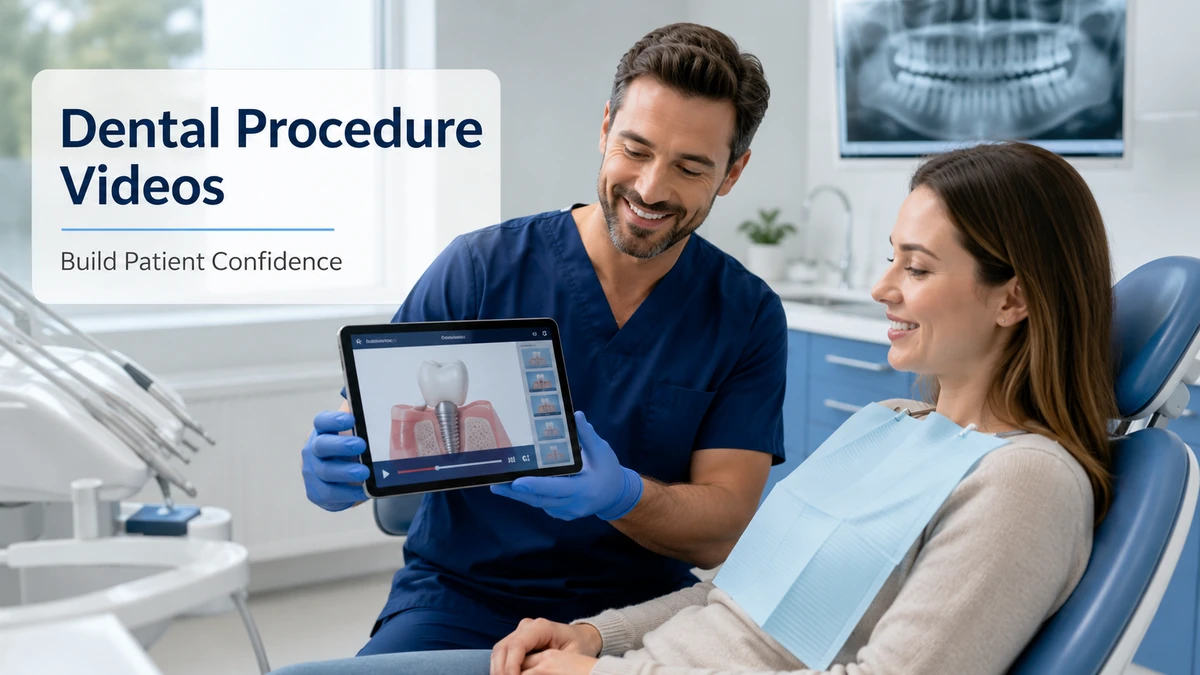 Dental procedure videos build patient confidence by showing prospective patients exactly what a treatment involves—before, during, and after—which is how a dental practice turns fear of the unknown into informed trust and more accepted cases. Dental procedure videos build patient confidence by showing prospective patients exactly what a treatment involves—before, during, and after—which is how a dental practice turns fear of the unknown into informed trust and more accepted cases.
Most patients don’t hesitate because they doubt your skill. They hesitate because they can’t picture what is about to happen to them, and uncertainty feels like risk. A short, honest video answers the quiet question every anxious patient is asking: “What is this actually going to be like?”
Here is the opportunity: the procedures patients fear most—root canals, extractions, implants, deep cleanings—are exactly the ones where a clear explainer changes the decision. When someone can watch a calm walkthrough of what to expect, the conversation in the operatory shifts from convincing to confirming. The video does the reassurance work before the patient ever sits in the chair, which protects both your schedule and your team’s energy.
Short on time? Jump to the video types that reduce anxiety
, the HIPAA, consent, and honest-claims rules
, or how to measure whether your videos work
.
Below, you’ll learn which dental procedure videos actually calm nervous patients, how to plan and film them without a studio budget, the compliance lines you cannot cross, and how to make each video easy to find in search and AI answers—then how to tell whether any of it is moving your numbers.
Written for: dental practice owners, office managers, and marketing coordinators who want video that reassures patients, protects the practice, and turns interest into booked treatment.
TL;DR
If you only remember five things, remember these:
| 1. |
Confidence comes from clarity - patients hesitate over the unknown, so “what to expect” videos that walk through a procedure step by step do more than polished brand films
|
| 2. |
Pick the procedures that scare people - put your energy into explainers for the treatments patients delay most, like root canals, extractions, implants, and deep cleanings
|
| 3. |
Consent is not optional - any identifiable patient on camera requires specific written HIPAA marketing authorization, separate from the consent-to-treat form, and full-face footage is protected even without a name
|
| 4. |
Be honest, not promotional - set realistic expectations and avoid guaranteeing a pain-free experience or a specific outcome, because trust is what builds confidence
|
| 5. |
Make the video findable and measurable - add captions and a transcript, mark it up with VideoObject schema on the page where it plays, then track engagement and new-patient calls instead of raw view counts |
Table of Contents
Why dental procedure videos build patient confidence
Fear of dental treatment is rarely about pain alone. It is about not knowing—how long it will take, what the sounds and sensations mean, whether it will hurt, and what recovery looks like. That uncertainty is what turns a recommended treatment into a “let me think about it.” A procedure video removes the uncertainty by letting a patient rehearse the experience safely, on their own time, before they ever commit.
There is a trust dimension too. When a practice is willing to show exactly what happens during a procedure, it signals nothing to hide—and transparency is one of the fastest ways to earn confidence from a stranger. A pattern we see across dental practices is that the treatments with the highest hesitation are also the ones with the least patient understanding. Closing that knowledge gap is often more persuasive than any discount or guarantee.
What confidence-building video does for the practice:
| • |
Shortens the yes - patients arrive already understanding the procedure, so case presentation becomes confirmation rather than persuasion
|
| • |
Protects the schedule - informed patients cancel and no-show less because they know what they agreed to and why it matters
|
| • |
Frees up your team - the video answers the same questions your front desk and assistants explain all day, consistently and without fatigue
|
| • |
Works around the clock - the reassurance happens at 11 p.m. when a nervous patient is researching, not only during business hours |
The goal is not to dazzle. It is to make a worried person feel that they already know you and already know what to expect.
> Back to Table of Contents
The dental procedure videos that actually reduce anxiety
Not every video calms a patient. Brand sizzle reels and drone shots of your building look nice but answer none of the questions an anxious patient is asking. The videos that build confidence are specific, honest, and focused on the patient’s experience. Start with a small set and expand as you learn what your patients respond to.
“What to expect” procedure walkthroughs
This is the workhorse. In 60 to 90 seconds, your dentist explains a single procedure from the patient’s point of view: why it is needed, what will happen step by step, what they will feel, and what recovery looks like. You do not need to film a live surgery—a doctor talking to camera, paired with a model, diagram, or simple animation, is enough. Make one for each high-anxiety treatment and you have covered most of the hesitation in your practice.
Doctor-to-camera introductions
Patients want to know who will be treating them. A short, warm introduction from the dentist—explaining their approach to nervous patients and how they keep people comfortable—humanizes the practice before the first visit. This is where you address sedation options and pain management honestly, without overpromising.
Office and technology tours
A quick tour that shows the operatory, the chair, and the equipment demystifies the environment. For patients whose anxiety spikes the moment they walk in, seeing the space in advance lowers the surprise. If you use technology that improves comfort or shortens visits, show it and explain in plain language what it means for the patient.
Recovery and aftercare guidance
Some of the most valued videos cover what happens after the procedure: what is normal, what is not, how to manage discomfort, and when to call. Aftercare videos reduce anxious post-op phone calls and reinforce that you are with the patient through the whole process, not just the appointment.
Patient stories and before-and-after, handled carefully
Real patients can be powerful, but this is the category with the most compliance risk. A genuine story from a once-fearful patient builds confidence in a way a script cannot—provided you have proper written authorization and you let the patient speak honestly rather than reciting marketing copy. Treat any before-and-after content as a claim that must be truthful and representative, and we cover the rules in the compliance section below.
> Back to Table of Contents
How to plan and film procedure videos without a big budget
You do not need a production company to start. A modern smartphone, decent lighting, a clip-on microphone, and a quiet room produce video that is more than good enough for a website and social channels. What matters far more than gear is clarity, warmth, and a script that answers the patient’s real questions.
A simple, repeatable production process:
| 1. |
Choose one procedure and one question - script around the single thing patients most want to know about that treatment
|
| 2. |
Write for the ear, not the page - short sentences, plain words, and a calm tone; have the dentist say it out loud and adjust what feels stiff
|
| 3. |
Capture three shots - a doctor-to-camera intro, a close walkthrough using a model or animation, and a reassuring close with the next step
|
| 4. |
Keep it short - aim for 60 to 90 seconds for a single-procedure explainer, and resist the urge to cover everything in one video
|
| 5. |
Caption, review, and publish - add captions and a transcript, have a clinician confirm accuracy, then post it where patients will see it |
A few practical notes from working with practices: film several videos in one sitting to protect everyone’s time, because the hardest part is getting the team in front of the camera, not the filming itself. Expect the dentist to be camera-shy at first—a short bulleted outline taped below the lens works better than a full script read word for word. And keep a running list of the questions patients actually ask at the front desk; that list is your content calendar.
Accuracy is part of the brand. Because these videos explain clinical procedures, a clinician should review every script before it goes live. A confident, friendly video that gets a medical detail wrong does the opposite of building trust, and it can create real liability.
> Back to Table of Contents
Stay compliant: HIPAA, consent, and honest claims
This is the section practices skip and later regret. Procedure videos that explain treatment in general—a dentist talking, a model, an animation, no identifiable patient—carry little privacy risk. The moment a real, identifiable patient appears, you are handling protected health information, and the rules are strict.
When you need written authorization
Using an identifiable patient in marketing requires specific written HIPAA authorization that is separate from your consent-to-treat form. A general treatment consent does not cover marketing use. The authorization should state how and where the video will be used. The American Dental Association publishes a sample authorization form for using patient images in marketing, and it is a sensible starting point to adapt with your own counsel.
“We didn’t use their name” is not a defense
A common and costly misconception is that omitting a patient’s name keeps you compliant. Under HIPAA, a full-face photograph or comparable image is protected health information on its own. So are indirect identifiers—a distinctive tattoo, a name tag in the background, a visible room number, even a reflection in a mirror. If a patient could be recognized, you need authorization.
Patients can change their minds
Authorization can be revoked. A patient who agreed to appear can later ask you to stop using the footage, and you should have a plan to remove and replace it. Because anything published online can be copied or screenshotted, weigh how much control you are willing to give up before featuring a patient. Many practices reduce this risk by leaning on doctor-led explainers and animation, and reserving real-patient stories for a few carefully managed pieces.
Honest claims build more confidence than bold ones
Dental advertising must be truthful and not misleading, and confidence is built on credibility. Avoid guaranteeing a pain-free experience or promising a specific result. If you show a before-and-after or a testimonial, make sure it is representative and note that results vary by patient. Setting realistic expectations is not a weakness in your marketing—it is the thing that makes the rest of your message believable.
Don’t forget state law and accessibility
Check your state’s privacy rules as well, since some add requirements on top of HIPAA, such as time limits on how long an authorization stays valid. And make your videos accessible: captions for spoken video are a baseline web-accessibility requirement, not a nice-to-have, which we cover next alongside their search benefits.
> Back to Table of Contents
Make your procedure videos findable in search and AI
A confidence-building video only helps if patients actually see it. That means treating each video as a page asset to be optimized, not just a file uploaded to social media and forgotten.
Captions and transcripts do double duty
Search engines cannot watch your video, but they can read its words. Adding accurate captions and a full text transcript to the page gives crawlers—and AI systems—something to understand and index. The same transcript serves accessibility and the many viewers who watch with the sound off. It is one task that pays off for compliance, usability, and discoverability at once.
Mark up the page with VideoObject schema
On the page where the video plays, add VideoObject structured data so search engines understand the content. Google requires at least a name, a thumbnail URL, and an upload date, and recommends adding a description, a duration, and a content or embed URL. Two practical rules: the video must be at least 30 seconds to be eligible for video rich results, and the markup belongs on the page where the patient can actually watch it—pointing it at a page without the video is a poor experience that Google discourages.
Embed on your own site first, then distribute
Make a relevant page on your website the primary home for each video, where the schema, transcript, and surrounding content reinforce one another. From there, distribute the same video to YouTube, your Google Business Profile, social channels, and even waiting-room screens and follow-up emails. One video, many placements—each one another chance for a nervous patient to find the reassurance they need.
Understand where AI sends patients now
Search behavior has shifted. Patients increasingly ask conversational questions of Google’s AI Overviews, ChatGPT, Apple Intelligence, and similar tools before they ever look at a list of providers. For dental discovery, the split matters: by late 2025, Google had removed AI Overviews from local “near me” provider searches, so your Google Business Profile and local SEO still drive who patients choose. But informational questions about procedures—exactly what your explainer videos answer—now trigger AI summaries most of the time. Clear, well-structured procedure content with transcripts is how you become a source those answers draw from.
> Back to Table of Contents
How to measure whether your procedure videos are working
View counts feel good and tell you almost nothing. A video with thousands of views that produces no calls is a vanity asset; a video with modest views that books cases is a winner. Measure the outcomes that matter to the practice, not the applause.
Signals worth tracking:
| • |
Watch-through - how far into the video people get tells you whether the script holds attention and where it loses them
|
| • |
Page engagement - time on the page and scroll depth on pages with the video versus without it
|
| • |
New-patient actions - calls, form fills, and appointment requests originating from pages that feature procedure videos
|
| • |
Case acceptance - whether patients who watched arrive more informed and decide faster, which your clinical team can feel even before the data confirms it
|
| • |
The intake question - simply asking new patients “did anything online help you decide to come in?” surfaces what numbers miss |
Give a new video a fair window before judging it—evergreen explainers build value slowly as they accumulate views and search visibility. And treat results as directional rather than guaranteed: outcomes vary with your patient mix, your local market, and how prominently each video is placed. The point is to learn which videos earn confidence and make more of those.
> Back to Table of Contents
Get help producing procedure videos that convert
Producing a library of procedure videos that are clear, compliant, and built to be found is exactly the kind of work our team handles for dental practices every day. If you want help planning the right videos for your practice, scripting them around your patients’ real questions, and optimizing each one for search and AI discovery, the team at WEO Media - Dental Marketing can help. Call us at 888-246-6906 to talk through a plan that fits your goals.
> Back to Table of Contents
FAQs
What types of dental procedure videos build the most patient confidence?
The most effective are short “what to expect” walkthroughs that explain a single procedure from the patient’s point of view: why it is needed, what happens step by step, what they will feel, and what recovery looks like. Doctor-to-camera introductions and recovery and aftercare videos also work well because they reduce uncertainty and humanize the practice. Polished brand films look nice but rarely calm a nervous patient the way a clear, honest explainer does.
Do we need patient consent to film a dental procedure for marketing?
If the video features an identifiable patient, yes—you need specific written HIPAA authorization for marketing use, and it must be separate from your consent-to-treat form. General educational videos that show only a dentist, a model, or an animation, with no identifiable patient, do not raise the same privacy concerns. When in doubt, get written authorization and confirm the requirements with your own legal counsel.
Can we use a real patient if we don’t show their name?
Omitting the name is not enough. Under HIPAA, a full-face image or any comparable image is protected health information on its own, and so are indirect identifiers such as a visible tattoo, a name tag, or a recognizable background. If a patient could be identified from the footage, you need written authorization before using it in marketing.
How long should a dental procedure video be?
For a single-procedure explainer, roughly 60 to 90 seconds is a good target—long enough to answer the patient’s real questions and short enough to hold attention. Cover one procedure per video rather than trying to explain everything at once. Note that to be eligible for Google video rich results, a video generally needs to be at least 30 seconds long.
Do dental procedure videos need captions?
Yes. Captions for prerecorded video with audio are a baseline web-accessibility requirement, and many businesses target the WCAG standard that courts commonly reference in accessibility cases. Captions also help the large number of people who watch with the sound off, and a paired transcript gives search engines and AI tools crawlable text. It is one task that benefits accessibility, usability, and discoverability together.
Do procedure videos help with SEO and AI search?
They can, when you treat each video as a page asset. Add a transcript and captions so search engines and AI systems can read the content, and mark up the page with VideoObject structured data. This matters because informational questions about procedures now trigger AI summaries most of the time, and well-structured procedure content is what those answers draw from. Local “near me” provider searches, by contrast, are still driven by your Google Business Profile and local SEO.
What if a patient who appears in our video later asks us to remove it?
A patient can revoke their authorization, so you should be prepared to take the video down and replace it. Keep a record of where each patient-featuring video is published so you can remove it from every channel. Because online content can be copied once it is public, many practices limit real-patient features and rely mainly on doctor-led explainers and animation to keep this risk manageable.
How do we know if our procedure videos are actually working?
Look past view counts to outcomes: watch-through rate, time on the pages that feature videos, and new-patient calls or form fills from those pages. Notice whether patients who watched arrive more informed and decide faster, and simply ask new patients whether anything online helped them choose you. Give evergreen explainers time, since they build search visibility and trust gradually. |
|