Voice Search Optimization for Dental Practices
Posted on 6/4/2026 by WEO Media |
How to Get Found When Patients Ask Instead of Type
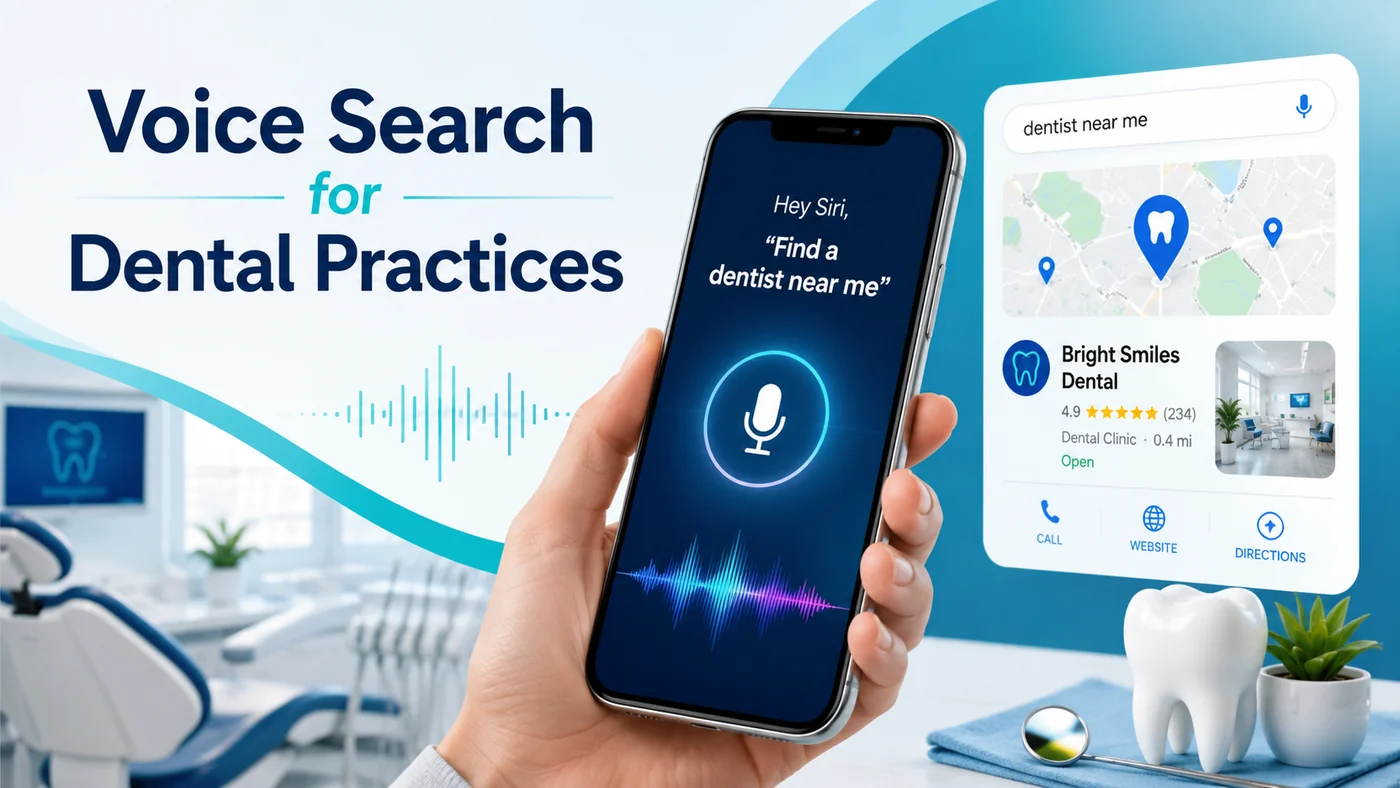 Voice search optimization for dental practices means getting found when patients ask Siri, Google Assistant, Alexa, or an AI assistant for a dentist out loud instead of typing one into a search bar—and it comes down to three things: an accurate local presence, content written the way patients actually talk, and concise answers a device can read aloud. Voice search optimization for dental practices means getting found when patients ask Siri, Google Assistant, Alexa, or an AI assistant for a dentist out loud instead of typing one into a search bar—and it comes down to three things: an accurate local presence, content written the way patients actually talk, and concise answers a device can read aloud.
If your practice ranks fine in a typed Google search but never surfaces in those spoken results, the gap usually isn’t your dentistry—it’s how your information is structured for machines that answer in one sentence instead of ten links.
Here’s what changed: voice and AI assistants don’t hand back a page of blue links. They answer. When a patient says “find a dentist near me that’s open right now,” the device picks a small set of results—often just one—and reads it aloud or shows a single card. That means you are either the answer or you are invisible. There is no page two in a spoken conversation.
In 2026, “voice search” also overlaps heavily with AI assistants. Siri, Google Assistant, Alexa, and conversational tools like ChatGPT and Gemini increasingly interpret a spoken question, decide what the person means, and return a synthesized answer pulled from sources they trust. The good news for dental practices: the work that earns those answers is mostly the same disciplined local SEO and clear, well-structured content you should already be doing—tuned for how people speak.
Written for: dental practice owners, office managers, and marketing teams who want their practice named when patients ask a device for a dentist—not just when they type one into a search bar.
TL;DR
If you only do five things for voice search, do these:
| 1. |
Fix your local foundation first - your Google Business Profile, genuinely accurate hours, and consistent name, address, and phone number across the web are what assistants trust most for “dentist near me” answers
|
| 2. |
Write the way patients talk - use full questions and natural phrasing (“how much does a dental crown cost,” “is an emergency dentist open near me”) instead of clipped keyword phrases
|
| 3. |
Lead each page with one clean answer - put a concise, one-to-two sentence answer near the top of the page or section so a device can read it aloud, then add the detail below
|
| 4. |
Write FAQs for extraction, not rich results - clear questions with concise answers are what assistants and AI Overviews pull; FAQPage markup is optional now that Google ended FAQ rich results in May 2026, and Speakable schema stays limited to news publishers
|
| 5. |
Measure proxies, not “voice rankings” - track calls and direction requests in your Business Profile, question-style queries in Search Console, and key events in GA4, because there is no clean voice-only ranking report |
Table of Contents
How patients actually use voice search to find a dentist
Patients use voice search the way they talk to a person: in full questions, with local intent, and with a job to get done. Instead of typing “dentist near me,” they say “find a dentist near me that takes my insurance and can see me this week” or “who can fix a broken tooth today.” The phrasing is longer, more natural, and almost always tied to a place and a need.
Three patterns show up again and again in dental voice queries:
| • |
Local and immediate - “dentist near me open now,” “emergency dentist close by,” “pediatric dentist near me” — the searcher wants a nearby, available practice, not a national article
|
| • |
Question-shaped - “how much does a dental crown cost,” “does a root canal hurt,” “what is a deep cleaning” — informational questions that often come right before a booking
|
| • |
Hands-busy or on the move - asked from a car, a kitchen, or a couch, often while the person is doing something else and wants a quick, spoken answer |
What “voice search” means in 2026 has also widened. The same spoken question can run through Siri, Alexa, or Google’s assistant—now shifting from Google Assistant to Gemini—and increasingly through conversational AI tools like ChatGPT, each interpreting intent and returning a synthesized answer from sources it trusts. In our work with dental practices, we treat all of these as one discipline: make your practice the easy, obvious, trustworthy answer to a spoken local question.
> Back to Table of Contents
Why voice search changes the math for dental practices
A typed search returns a screen of options. A spoken search returns one answer, or a very short list. That single difference changes the stakes: ranking on page one is no longer enough if the assistant only reads the top result aloud. For a dental practice, this rewards being the clearest, best-verified local answer—and it punishes vague, inconsistent, or hard-to-parse information.
It also raises the value of being structured and specific. When a device has to choose one practice to recommend, it leans on signals it can trust quickly: a complete and accurate Google Business Profile, consistent contact details across the web, real reviews, and content that answers the exact question in plain language. A practice that nails these basics often wins the spoken answer even against larger competitors who never tuned for it.
The encouraging part is that none of this is exotic. A pattern we commonly see is that practices already doing solid local SEO are most of the way there—they just need to sharpen how their information is verified and how their answers are written and structured. Voice optimization is less a brand-new project and more a focused upgrade to work you should already own.
> Back to Table of Contents
Start with your local foundation: Google Business Profile and NAP consistency
Most dental voice queries are local, so your local foundation matters more than any clever content trick. When someone asks for a “dentist near me,” assistants lean heavily on local business data—your Google Business Profile chief among them—to decide who is nearby, open, and worth recommending. If that data is incomplete or inconsistent, you can write perfect content and still get skipped.
Get these fundamentals right before anything else:
| • |
Claim and complete your Google Business Profile - accurate practice name, address, phone, website, and the correct primary category (for example, “Dentist,” with specialty categories added only where they truly apply)
|
| • |
Keep hours genuinely accurate - regular hours, holiday hours, and any midday closures, because “open now” answers depend on them and a wrong hour erodes trust fast
|
| • |
Lock down NAP consistency - your name, address, and phone number should match exactly across your website, Google, and every major directory and listing
|
| • |
Fill out services and descriptions - list the services you actually offer in plain patient language so assistants can match a spoken request to what you do |
A single inconsistency—an old suite number on one directory, a tracking phone number that doesn’t match your main line—can quietly suppress you in local answers. Treat listing accuracy as ongoing hygiene, not a one-time setup, and re-check it whenever you move, change phone systems, or adjust hours.
Reviews shape what assistants recommend
Reviews are part of your local foundation, not a separate vanity metric. Volume, recency, and rating all feed into how local platforms rank and recommend practices, and assistants often surface highly rated nearby options first. The durable approach is simple: consistently invite satisfied patients to leave honest reviews, and respond to reviews promptly and professionally.
One important caution for dental practices: responding to reviews is a HIPAA-sensitive activity. Even a friendly public reply can create risk if it confirms that someone is a patient or references their treatment. Keep responses general and never disclose or confirm protected health information—thank the reviewer, invite them to contact the office directly, and take any specifics offline.
> Back to Table of Contents
Write content the way patients ask out loud
Voice queries are longer and more conversational than typed ones, so content that mirrors natural speech tends to match better. The practical move is to write around the real questions patients ask—in their words, not industry jargon—and answer each one directly.
Start by collecting the questions you already hear. Your front desk, hygienists, and dentists field the same spoken questions every week: “how long does a filling take,” “can you see my kid and me on the same day,” “do you offer payment plans,” “is a chipped tooth an emergency.” Those are your highest-value voice topics because they are exactly how patients phrase things out loud.
Then build content that answers them:
| • |
Use natural-language headings - phrase section headers and FAQ items as full questions a patient would actually speak
|
| • |
Cover long-tail specifics - “emergency dentist near me on a weekend” or “dentist that sees nervous patients” beat generic terms because they match real spoken intent
|
| • |
Write in plain, spoken English - aim for the way you’d explain something to a patient across the counter, not the way a brochure reads
|
| • |
Group related questions by topic - a focused page on, say, dental emergencies that answers ten related spoken questions builds more authority than scattering them |
This is also where topical authority pays off. When assistants and AI Overviews repeatedly find your site giving clear, expert answers across a whole subject—emergencies, implants, kids’ dentistry—they are more likely to treat you as a reliable source to quote for related spoken questions. Depth and consistency matter more than any single keyword.
> Back to Table of Contents
Structure pages so a device can read one clean answer
Even great content gets passed over if a device can’t lift a clean answer from it. Voice and AI assistants favor content they can extract and read aloud in a sentence or two, so structure each answer for easy extraction: put a direct, concise response right where the question is asked, then add the supporting detail underneath.
A reliable pattern for each question or section:
| 1. |
Ask the question as a heading in the patient’s natural words
|
| 2. |
Answer it immediately in one or two clear sentences (roughly 30–50 words) that would make sense read aloud with no other context
|
| 3. |
Then expand with the nuance, steps, exceptions, and examples for readers who want more |
This is the same discipline that earns featured snippets in typed search, and it serves voice for the same reason: the assistant can grab your tight answer and trust it. Keep sentences short, lead with the answer rather than burying it after background, and avoid making the device wade through setup to find the point.
Cover the technical basics: speed, mobile, and security
Voice searches happen on phones and speakers, and slow or clunky pages get dropped. Make sure your site loads quickly, works cleanly on mobile, and runs on HTTPS. These are baseline expectations rather than advanced tactics, but a slow mobile page can quietly cost you spoken answers no matter how good the content is. If your pages drag on a phone, fix that before chasing anything fancier.
> Back to Table of Contents
Use FAQ schema wisely (and skip the schema you don’t need)
Structured data helps search engines and assistants identify the exact answer inside your content. For dental practices, though, be clear-eyed about what it does in 2026: Google ended FAQ rich results in Google Search in May 2026, so FAQPage markup no longer earns those expandable question-and-answer listings under your result. The markup is still a valid format, it is harmless to keep, and non-Google engines and AI tools can still read it—but the lasting value is the content itself: real patient questions, each answered in one clear, concise sentence or two.
Where many guides go wrong is recommending Speakable schema to everyone. Here is the honest picture: Speakable structured data is still a limited beta, and Google restricts it to eligible news publishers, in English, for Google Assistant—not general business or dental websites. Marking up a dental page with Speakable will not unlock voice readouts, so it is not worth your time. Skip it and put that effort into clear, well-structured answers instead.
A few practical notes on FAQ content and schema for dental sites:
| • |
Lead with the answer - phrase each item as a real patient question and follow it immediately with one concise, accurate answer a device can read aloud
|
| • |
Keep answers honest and specific - an extractable answer still has to be accurate and free of medical overpromising, because that is what assistants and patients judge you on
|
| • |
Treat FAQPage markup as optional, not essential - it no longer drives Google rich results, but it is valid and harmless to keep, and some non-Google engines and AI tools still parse it
|
| • |
Validate any markup you do use - structured data is easy to break, so have it implemented and tested properly rather than left to silently error |
The goal is not to chase every schema type or mourn the ones Google retired. It is to write genuine question-and-answer content that reads well out loud, keep any markup you use clean and accurate, and skip the schema—like Speakable—that does nothing for a dental site.
> Back to Table of Contents
Win the high-intent moments: “near me,” “open now,” and emergencies
The most valuable dental voice searches are the urgent, local, ready-to-act ones. “Emergency dentist near me open now” is a patient who wants to book today, not read an article. Winning these moments is where voice optimization turns into actual appointments, so it deserves focused attention.
To compete for high-intent spoken queries, line up the signals that answer “who is nearby, open, and able to help right now”:
| • |
Make “open now” true - accurate, current hours in your Business Profile are what let an assistant confidently recommend you when someone needs care immediately
|
| • |
Have a clear emergency answer - a dedicated, well-structured page that explains how to reach you for dental emergencies, what counts as urgent, and how same-day care works
|
| • |
Make the next step effortless - a tap-to-call number and an easy path to book, since a spoken searcher is usually moving fast and ready to act
|
| • |
Reinforce proximity and trust - consistent location data and strong recent reviews help you surface for nearby, time-sensitive requests |
A few practical realities are worth naming. Multi-location practices need each location set up and verified separately, with its own accurate hours and details, or assistants will struggle to route patients to the right office. And when you describe urgent care, keep claims responsible: explain how to get help and what to expect without promising specific clinical outcomes. The aim is to be the obvious, trustworthy choice in the moment a patient most needs one.
> Back to Table of Contents
How to measure voice search results (and what you genuinely can’t)
Here is the honest truth most guides skip: there is no clean “voice search ranking” report. Assistants and search engines bucket spoken queries together with typed ones, so you usually cannot isolate voice traffic precisely. Anyone promising a tidy voice-only dashboard is overselling. What you can do is track strong proxies and watch them move as you improve.
The proxies worth watching:
| • |
Google Business Profile performance - calls, direction requests, website clicks, and how people found your profile are your best read on local, intent-driven discovery, much of which is voice-influenced
|
| • |
Search Console queries - filter for question-style and longer conversational phrases (“how,” “near me,” “cost,” “open”) to see whether you are appearing for the way people speak
|
| • |
Key events in GA4 - track calls, form submissions, and booking actions as key events so you can tie discovery to real outcomes, not just visits
|
| • |
Calls and bookings at the front desk - the ground truth; a rise in “found you on Google” calls is a meaningful signal even when the analytics are fuzzy |
Set expectations honestly with whoever you report to. Voice and AI-assistant optimization is best measured as part of overall local and organic performance—more calls, more direction requests, more bookings from nearby searchers—rather than a single isolated number. Results also vary with your market, your competition, and how complete your local presence is. Measured this way, the impact is real and trackable, even if it never shows up as one neat “voice” line.
> Back to Table of Contents
Where WEO Media fits in
Voice search optimization touches your listings, your content, your site’s technical health, and your reviews—and pulling those together is exactly the kind of work we do every day. At WEO Media - Dental Marketing, we help dental practices and specialty practices get found across local search, voice, and AI-driven results by getting the foundation right and the content structured the way assistants reward. If you want help making your practice the answer when patients ask out loud, call us at 888-246-6906 to talk through where your biggest opportunities are.
> Back to Table of Contents
FAQs
What is voice search optimization for a dental practice?
Voice search optimization is the process of structuring your dental practice’s online information so that voice and AI assistants—like Siri, Google Assistant, Alexa, and conversational tools—can find, trust, and read it aloud when patients ask a spoken question. In practice, it centers on an accurate local presence, content written the way patients talk, and concise answers a device can extract. It is mostly a focused upgrade to strong local SEO rather than a separate project.
Is voice search worth it for a small dental practice?
Yes, and small practices are often well positioned to win. Because spoken searches return one answer or a short list rather than a full page of options, being the clearest, best-verified local answer matters more than size. A practice with an accurate Google Business Profile, consistent contact details, strong reviews, and clear question-and-answer content can earn spoken recommendations even against larger competitors who never tuned for it.
How do patients usually phrase dental voice searches?
Voice searches are longer and more conversational than typed ones. Instead of “dentist near me,” patients say things like “find a dentist near me that takes my insurance” or “who can fix a broken tooth today.” Many are local and immediate (“emergency dentist open now”) or question-shaped (“how much does a crown cost,” “does a root canal hurt”). Writing content around those real spoken questions helps you match them.
Does my Google Business Profile affect voice search results?
Significantly. Most dental voice searches are local, and assistants lean heavily on local business data—your Google Business Profile especially—to decide who is nearby, open, and worth recommending. An accurate profile with the correct category, genuinely current hours, complete services, and consistent name, address, and phone number is one of the strongest things you can do to appear in spoken “near me” answers.
Should my dental website use Speakable schema?
No. Speakable structured data is still a limited beta that Google restricts to eligible news publishers, in English, for Google Assistant—not general business or dental websites. Marking up a dental page with Speakable will not unlock voice readouts. Your effort is far better spent on clear, well-structured, directly worded answers that voice and AI assistants can extract.
What schema markup helps most for dental voice search?
In 2026, focus on FAQ content first and treat schema as secondary. Google ended FAQ rich results in Google Search in May 2026, so FAQPage markup no longer produces those expandable listings; it is still a valid format and harmless to keep, and some non-Google engines and AI tools read it, but it is no longer a Search-appearance lever. Skip Speakable schema, which Google limits to news publishers. The most durable win is clear question-and-answer content with concise, accurate answers a device can read aloud.
How is voice search related to AI Overviews and AI assistants?
They overlap heavily in 2026. A spoken question can run through Google Assistant, Siri, Alexa, or a conversational AI like ChatGPT or Gemini, and each interprets intent and returns a synthesized answer from sources it trusts. The same fundamentals—an accurate local presence, clear question-and-answer content, and concise extractable answers—help you get surfaced and quoted across voice answers, AI Overviews, and AI assistants alike.
How do I measure voice search results for my dental practice?
There is no isolated voice-ranking report, because assistants and search engines bucket spoken queries with typed ones. Instead, track proxies: calls, direction requests, and discovery in your Google Business Profile performance; question-style and longer conversational queries in Search Console; and calls, forms, and bookings set up as key events in GA4. Read these alongside overall local and organic performance rather than as a single voice-only number. |
|