Dental Procedure Pages vs. Blog Posts for SEO
Posted on 7/20/2026 by WEO Media |
How to Choose the Right Page for Each Keyword
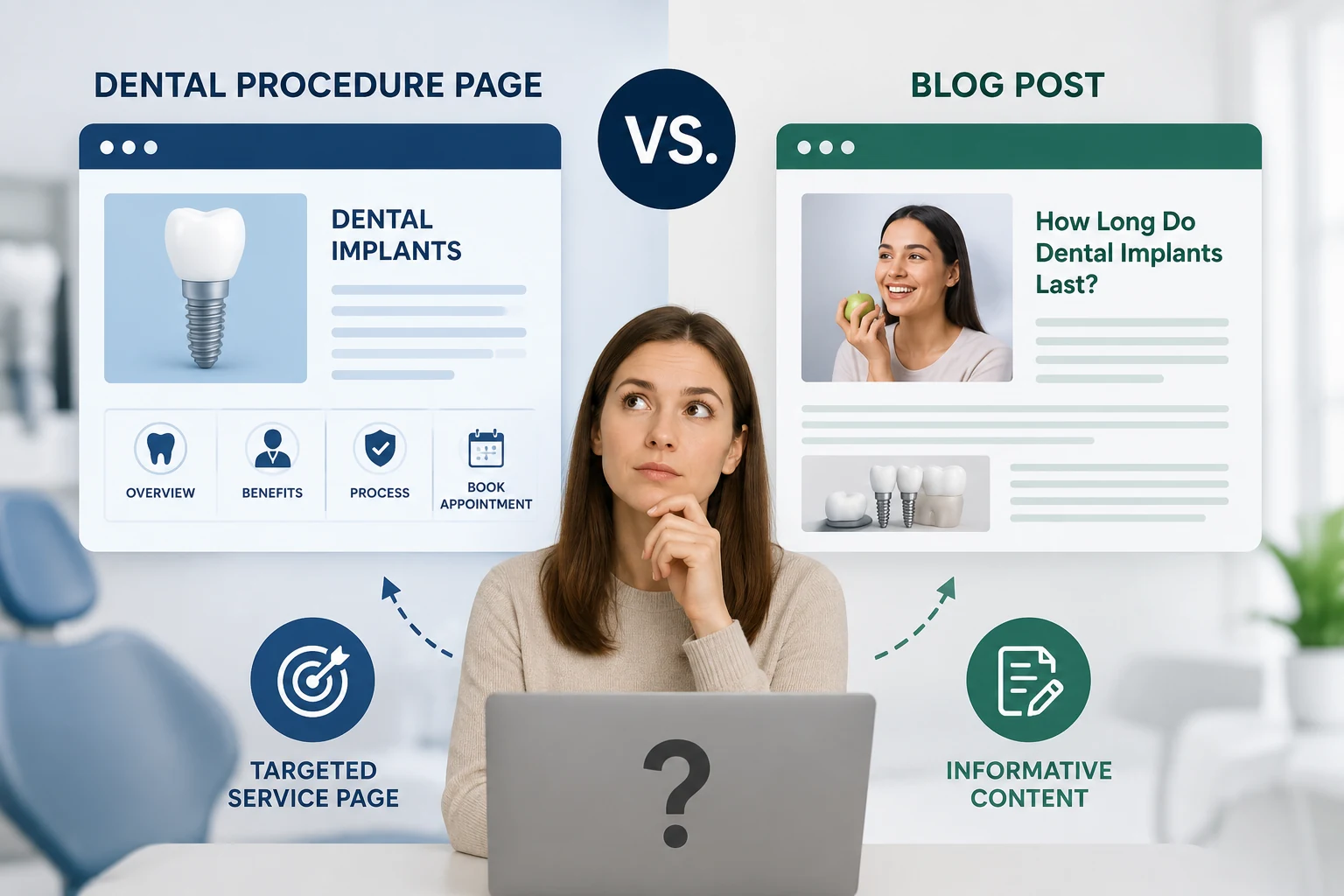 Choosing between a dental procedure page and a blog post for SEO comes down to search intent: build a procedure (service) page when the keyword shows a patient is ready to book a specific treatment, and publish a blog post when the keyword is a research question—then match each keyword to whichever page type already ranks for it. Choosing between a dental procedure page and a blog post for SEO comes down to search intent: build a procedure (service) page when the keyword shows a patient is ready to book a specific treatment, and publish a blog post when the keyword is a research question—then match each keyword to whichever page type already ranks for it.
Publishing the wrong page type for a keyword is one of the most common—and most expensive—dental content mistakes we see, because no amount of keyword tuning or link building fixes a page that is the wrong format for what the searcher actually wants.
Here is the pattern that quietly wastes budget: a practice writes a blog post targeting “dental implants” plus a city name (a commercial, ready-to-book search) and wonders why it never ranks or books a single consult, or it builds a thin treatment page targeting “does a root canal hurt” (a pure research question) and never gets pulled into an answer. When content format and search intent do not match, dwell time drops, conversions flatline, and the page stalls regardless of how strong the rest of your SEO is.
Below, you’ll learn exactly how procedure pages and blog posts differ, how to decide which one to create for any given keyword using a quick SERP test, how to link them into a single system so authority flows to the pages that convert, and how to avoid the cannibalization that happens when a blog and a treatment page fight over the same search.
Written for: dental practice owners, office managers, and dental and DSO marketing teams deciding how to structure treatment pages and content so both rank in search and convert new patients.
TL;DR
If you remember only a few things, remember these:
| • |
Procedure pages convert - treatment and service pages target commercial, transactional, and local intent and capture patients ready to book a specific procedure
|
| • |
Blog posts build authority - informational articles answer research-stage questions, earn topical authority, and feed patients into your procedure pages
|
| • |
Match the page to the SERP - search the exact keyword and build the format Google already rewards for it (treatment pages and a map pack vs. articles and People Also Ask)
|
| • |
Never target the same intent twice - two pages chasing the same keyword and the same intent is cannibalization; two pages on different intents is healthy coverage
|
| • |
Link blogs up to the money pages - use a hub-and-spoke structure so blog authority flows into the treatment pages that book consults
|
| • |
Know where each wins in AI search - clinical questions trigger AI Overviews (blog territory), while local “near me” treatment searches show fewer, giving procedure pages a clearer path to the click
|
| • |
Dental is YMYL - both page types need real experience, clinician review, and accurate claims to rank and get cited |
Table of Contents
What a dental procedure page is (and the patients it captures)
A dental procedure page (also called a service or treatment page) is a dedicated page for one treatment—dental implants, Invisalign, root canals, crowns, teeth whitening, extractions, dentures, or periodontal therapy. Its job is to rank for and convert searches from people who already know what they need and are looking for a provider to deliver it.
The intent it serves is commercial, transactional, and local. These searchers use queries like “dental implants” plus a city, “Invisalign near me,” “emergency dentist,” or “cost of dental crowns” in a specific area. They are at the bottom of the funnel: aware of the treatment, comparing providers, and close to booking. That is why procedure pages are your money pages—the revenue engine of a dental website.
To rank and convert, a strong procedure page usually includes:
| • |
A fast, direct answer - what the treatment is, who it is for, and why to choose your practice, near the top where high-intent visitors decide quickly
|
| • |
Candidacy and what to expect - who is a good candidate, the general process, and recovery basics, without overpromising outcomes
|
| • |
Financing and insurance framing - how patients typically pay and what options exist, addressed generally rather than with fixed prices
|
| • |
Trust and proof - clinician credentials, genuine reviews, and before-and-after examples that build confidence for a health decision
|
| • |
Conversion elements - a clear path to book or call, plus treatment-specific FAQs and local signals so the page ranks for city and near-me searches |
Because dentistry is a Your Money or Your Life (YMYL) topic, trust is not optional. Google holds health pages to a higher standard, so procedure pages need real experience and expertise signals: named clinicians with credentials, content reviewed by a licensed provider, and claims you can stand behind. Reviews should follow the FTC Consumer Review Rule—no fake or incentivized reviews and no suppressing honest negative ones—and before-and-after photos need patient consent and should not imply guaranteed or typical results.
> Back to Table of Contents
What a dental blog post is (and the patients it attracts)
A dental blog post is an informational article that answers a question or educates a reader—think “does a root canal hurt,” “how long do dental implants last,” “Invisalign vs. braces,” “what to eat after a tooth extraction,” or “signs you may need a root canal.” Its job is not to close the sale on the first visit; it is to build authority, capture a wider audience, and move researching patients toward the treatment pages that convert.
The intent it serves is informational, usually earlier in the journey. Some blog topics carry commercial-investigation intent—comparisons, “is it worth it,” and cost-context questions—but the reader is still deciding, not yet booking. Push a hard sell too early and you lose them; answer thoroughly and the blog earns trust and the next click.
Done well, blog posts deliver several SEO jobs at once:
| • |
Topical authority - covering the subtopics around a treatment tells Google your site is a credible authority on it, which lifts your whole cluster
|
| • |
Wider reach - long-tail informational queries bring in patients your procedure pages will never rank for on their own
|
| • |
AI and snippet citations - clear, well-structured answers get pulled into featured snippets and AI Overviews, keeping you visible even when the search does not produce a click
|
| • |
Internal link equity - every post can link up to the relevant procedure page, passing relevance and steering readers toward booking |
One practical note: updating and improving an existing post often produces faster SEO gains than publishing a brand-new one, so a content plan should budget time for refreshing winners, not just adding pages.
> Back to Table of Contents
Procedure pages vs. blog posts: the core SEO differences
The two page types are not better or worse than each other—they are built for different moments in the patient journey. Understanding the differences is what lets you assign the right keyword to the right page.
| • |
Search intent - procedure pages serve commercial, transactional, and local intent; blog posts serve informational and research intent
|
| • |
Funnel stage - procedure pages catch patients ready to book; blog posts reach patients still learning and comparing
|
| • |
Primary goal - procedure pages exist to generate calls and booked consults; blog posts exist to build authority, reach, and citations
|
| • |
Typical keywords - procedure pages target “treatment plus city,” “near me,” and provider-style searches; blog posts target “how,” “what,” “why,” “does,” and “vs.” questions
|
| • |
Structure - procedure pages are focused and conversion-oriented with local and trust signals; blog posts are comprehensive and question-structured for snippets
|
| • |
Success metric - measure procedure pages by calls and booked treatment; measure blog posts by impressions, citations, assisted conversions, and links driven into money pages
|
| • |
Update rhythm - procedure pages stay relatively stable as core assets; blog posts get refreshed as information and search behavior change |
> Back to Table of Contents
How to decide which page to create for a keyword
The fastest, most reliable way to choose is to let Google show you what it already rewards. Do not rely on search volume or difficulty scores alone—search the exact keyword and read the first page of results.
| • |
If the results are treatment or service pages, a map pack, and ads - the intent is commercial and local, so build a procedure page
|
| • |
If the results are articles, guides, and People Also Ask boxes - the intent is informational, so build a blog post
|
| • |
If the SERP is mixed - the topic may need both, split by sub-intent: a procedure page for “treatment plus city” and a blog post for “treatment recovery time” or “treatment vs. alternative” |
Two dental-specific signals make this even simpler. First, almost any “treatment plus city” search (“dental implants” plus your town) wants a procedure or location page, not a blog. Second, if a blog post you already published is ranking for a commercial, ready-to-book keyword, treat that as a signal to build a purpose-made procedure page for it—the blog is telling you the demand exists but is landing on the wrong page type to convert.
> Back to Table of Contents
How procedure pages and blog posts work together
The most common mistake is treating these as competitors when they are meant to be a system. The cleanest structure is a hub-and-spoke content cluster: the procedure page is the hub (your money page), and blog posts are the spokes that support it and link back to it.
Here is the pattern in practice for a single treatment:
| • |
Hub - one strong dental implants procedure page built to convert local, high-intent searches
|
| • |
Spokes - posts like “how long do dental implants last,” “dental implants vs. bridges,” and “what to expect after implant surgery” that answer research questions
|
| • |
The links - every spoke links up to the hub with descriptive anchor text, and the hub can link out to a few deep posts for readers who need more before booking |
Internal links are what make this work. Without them, the authority your blog posts earn never flows to the pages that book consults, and Google gets no clear signal about which page is your canonical commercial answer for the treatment. A well-linked cluster builds topical authority around each procedure and keeps the informational and commercial pages reinforcing each other instead of competing.
> Back to Table of Contents
Where each page type wins in AI Overviews now
AI Overviews and featured snippets increasingly answer informational dental questions before a searcher ever clicks. By late 2025, the large majority of healthcare keywords triggered an AI Overview, and question-style clinical searches—“what is a dental implant,” “how do I relieve tooth pain”—are exactly the type that get one. That is blog-post territory: to be cited, a post should answer the question in its first sentence, use headings that mirror how patients phrase queries, attribute a named author, and carry strong experience and expertise signals.
High-intent local searches behave differently. Google has pulled AI Overviews back on local-provider intent, and in January 2026 it narrowly removed them from certain health queries after an accuracy review. For “treatment near me” and “treatment plus city” searches, AI Overviews are far less dominant, so the organic result and the map pack—your procedure and location pages—still earn the click and the call.
The strategic takeaway: blog posts compete to be cited inside the AI answer, while procedure pages compete to win the click on high-intent local searches. Both matter, and they win in different places. One caution: this is a moving target—Google recalibrates health and local behavior frequently—so track your own query data rather than assume any pattern is permanent.
> Back to Table of Contents
How to avoid keyword cannibalization
Cannibalization is widely misunderstood. It is not two pages that happen to share a keyword—it is two pages targeting the same keyword and the same intent. A procedure page for “dental implants” plus your city and a blog post asking “are dental implants worth it” serve different intents; that is healthy coverage. Two pages both chasing “dental implants” plus your city is a genuine conflict.
When a real conflict exists, Google—and the query fan-out that powers AI Overviews—may split your signals, rank the weaker page, or surface neither. Here is how to find and fix it without overcorrecting:
| • |
Detect it - in Google Search Console, open Performance, filter by the query, and check the Pages tab; multiple URLs for one commercial query, or URLs swapping positions, signals a conflict
|
| • |
Differentiate first - re-optimize the blog toward a distinct informational angle so it stops competing with the procedure page
|
| • |
Consolidate only if truly duplicative - merge or redirect when two pages genuinely serve the same intent and neither adds unique value
|
| • |
Do not reflexively redirect a useful blog - a post that earns informational traffic, citations, and links is worth keeping; point its internal links at the procedure page instead of deleting it |
The best fix is prevention: map each target keyword to a single page type up front, confirm in Google Search Console that no existing page already owns that intent, and apply canonical tags when some overlap between pages is unavoidable.
> Back to Table of Contents
Build a content system, not just more pages
Winning dental SEO is not about publishing more—it is about creating the right page type for each keyword and linking those pages into a system that ranks and converts. WEO Media - Dental Marketing builds treatment pages and supporting content designed to capture high-intent patients and move them from research to booked consult. To map your treatments and content to the searches that matter, call 888-246-6906 or schedule a consultation.
FAQs
Should a dental practice create a procedure page or a blog post for a treatment?
Create a procedure page when the keyword shows commercial or local intent, such as a treatment name paired with a city or “near me,” because those searchers are ready to book. Create a blog post when the keyword is a research question like “how” or “does it hurt.” The fastest way to decide is to search the exact keyword and build whichever format already ranks on the first page.
Can a blog post rank for a “treatment near me” search?
It usually will not rank or convert well, because near-me and “treatment plus city” searches carry local, ready-to-book intent that Google satisfies with treatment and location pages, a map pack, and reviews. If a blog post is accidentally ranking for that kind of query, treat it as a signal to build a dedicated procedure page for the term.
Do dental blog posts still help SEO?
Yes. Blog posts build topical authority, reach patients earlier in their decision, earn featured snippet and AI Overview citations, and pass internal link equity to the procedure pages that convert. They work best as part of a cluster that supports your treatment pages rather than as standalone traffic plays.
What is keyword cannibalization between a service page and a blog post?
Cannibalization happens when two pages target the same keyword and the same search intent, so they compete with each other and split ranking signals. Two pages on different intents—a treatment page for a commercial search and a blog post for a research question—are not cannibalizing; they are covering the topic properly.
How many blog posts should a dental practice publish per month?
There is no universal number. Most practices do well with two to four high-quality, intent-matched posts a month, prioritizing consistency and depth over volume. Budget time to update and improve existing posts too, since refreshing a winner often delivers faster gains than publishing something new.
Do procedure pages or blog posts get cited in Google AI Overviews?
Blog posts are usually what earn AI Overview and featured snippet citations, because clinical and informational questions are what trigger those features. High-intent local searches show fewer AI Overviews, so procedure and location pages tend to win the click there instead. Google adjusts this behavior often, so monitor your own query data.
Should dental procedure pages include reviews and pricing?
Genuine reviews and clear cost framing both help conversion, but handle them carefully. Reviews must follow the FTC Consumer Review Rule—no fake or incentivized reviews and no hiding honest negative ones—and pricing is often best presented as financing and payment options rather than fixed figures. Pair these with clinician credentials and honest before-and-after examples to meet the higher trust bar for health content.
How do I know if a dental page has the wrong search intent?
Search your target keyword and compare your page format to what ranks. If the first page is full of articles and your page is a sales-focused service page—or the reverse—you have an intent mismatch. Watch for low dwell time, weak conversions, and rankings that stall despite good links; those are common symptoms of the wrong content type for the query. |
|