Live Chat ROI for Dental Practices: How to Measure What Chat Actually Books
Posted on 7/21/2026 by WEO Media |
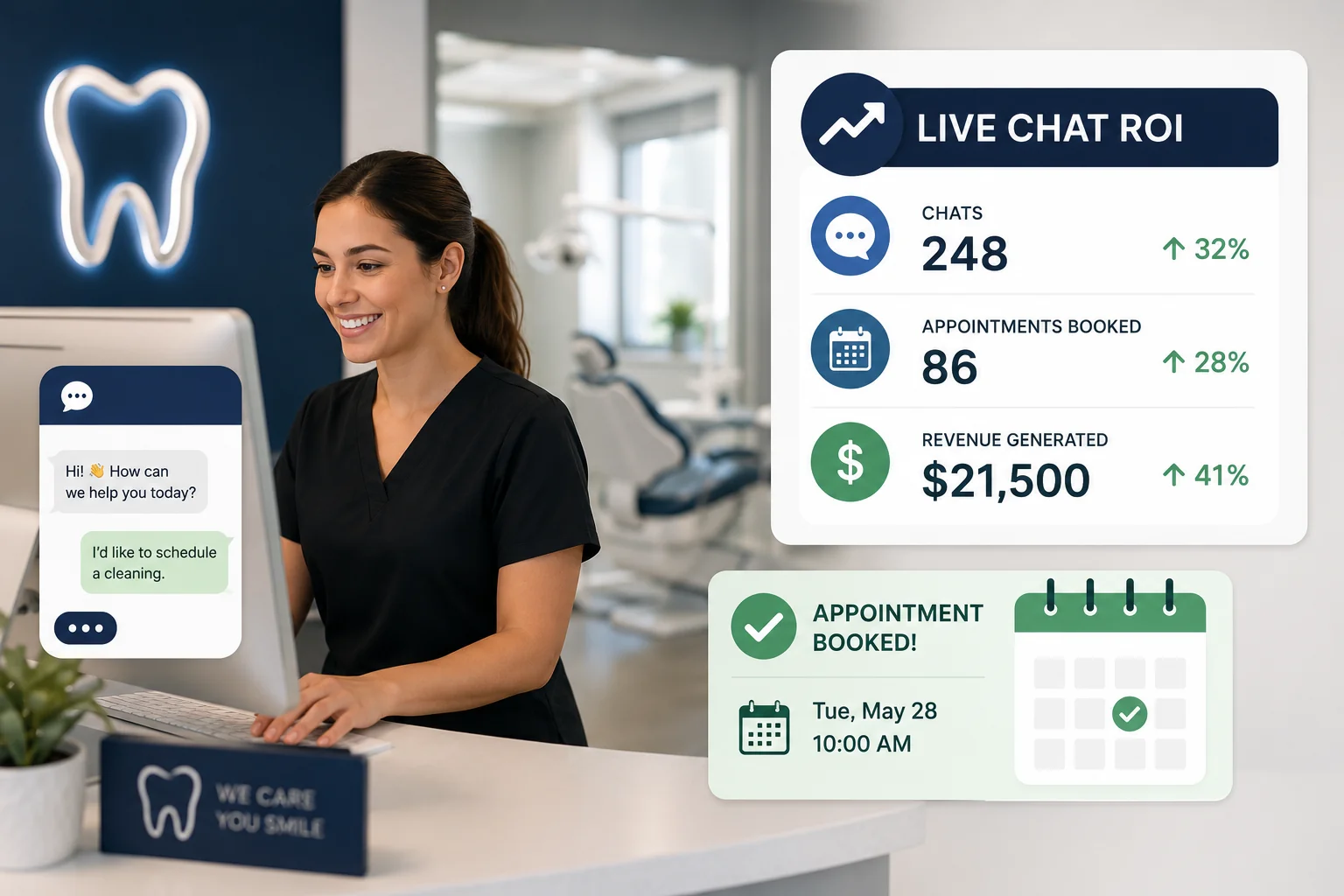 Measuring live chat ROI for a dental practice means tracking every website chat through to booked and kept new patients, then comparing the production those patients generate against what the chat tool and staff time cost—because chat volume alone never proves return. Measuring live chat ROI for a dental practice means tracking every website chat through to booked and kept new patients, then comparing the production those patients generate against what the chat tool and staff time cost—because chat volume alone never proves return.
Most chat dashboards celebrate how many conversations happened. A conversation only matters if it becomes a scheduled appointment that shows up and turns into care. This guide shows you how to connect chat activity to real patients and real production, using your own numbers instead of borrowed benchmarks.
Here is the core problem: live chat tools report chats, engagement, and sometimes “leads,” but none of those metrics tell you whether the practice actually gained patients it would not have gained anyway. A booked appointment that never shows produces nothing. A chat from someone who would have called regardless is a channel shift, not new growth. Real ROI lives further down the funnel—at the kept appointment and the treatment that follows.
Already running chat but unsure it pays off? Keep reading. If you have not set up any conversion tracking yet, start there first—you cannot measure a return you never recorded.
Below, you will learn how to define live chat ROI in dental terms, build a measurement funnel from first message to kept patient, set up tracking that ties chat to real appointments, separate the patients chat created from the patients it merely captured, and do all of it without creating HIPAA or advertising-compliance risk.
Written for: dental and specialty practice owners, office managers, and marketing teams who want to know whether their website live chat earns its keep—and how to prove it with numbers they can defend.
TL;DR
If you only measure a few things, measure these:
| • |
Count kept patients, not chats - follow every chat through booked and kept appointments before you call anything a return
|
| • |
Know your two cost inputs - the chat platform (plus any management retainer) and the staff or vendor time spent answering
|
| • |
Know your two value inputs - new patients booked from chat and the production each new patient generates over time
|
| • |
Test incrementality - separate patients chat created from patients who would have contacted you anyway
|
| • |
Reconcile chat against your PMS - match chat leads to real appointments so a “booked” chat becomes a verified, kept patient
|
| • |
Measure without leaking PHI - keep protected health information out of transcripts and tracking pixels, and sign a BAA with any vendor that can see chat data |
Table of Contents
What live chat ROI actually means for a dental practice
Live chat ROI is the production a practice earns from patients that chat genuinely sourced, minus the cost of running chat, divided by that cost. In plain terms: for every unit of money and time you put into live chat, how much new-patient production comes back out? The trap is measuring the top of the funnel—chats and “leads”—instead of the bottom, where booked, kept, and treated patients actually live.
Each stage of that chain drops off, and the drop-off is where practices deceive themselves. A hundred chats might yield forty real conversations, fifteen booked appointments, eleven kept appointments, and a handful of accepted treatment plans. If you measure at the top, chat looks unstoppable. If you measure at the bottom, you learn the truth. In our work with dental practices, the single most common measurement error is treating a “lead” as if it were a patient.
What actually counts as return:
| • |
Booked new patients who keep the appointment - a no-show produces nothing, so keep rate is part of the math
|
| • |
First-visit production and accepted treatment - the hygiene visit, the exam, and the care the patient agrees to
|
| • |
Long-term patient value - a new patient is years of recare and future treatment, not a single cleaning, though you should model this conservatively |
What looks like return but is not: chats started, engagement rate, average handle time, satisfaction scores, and “leads” that never turned into a scheduled visit. These are useful operational signals, but they are not ROI, and reporting them as ROI is how chat quietly overstates its value.
> Back to Table of Contents
The live chat ROI formula and the inputs you need
The formula itself is simple: live chat ROI equals the production from chat-sourced patients, minus the cost of chat, divided by the cost of chat, expressed as a percentage. The discipline is in the inputs. Two of them are costs and two are value—and each has a dental-specific twist that generic ROI calculators miss.
The cost side
Chat costs more than a monthly subscription. Add up every input honestly:
| • |
Platform fees - the chat software subscription, per-chat charges, or managed-chat retainer
|
| • |
Answering time - staff hours spent monitoring and replying, or the vendor fee if chat is handled by an outsourced team
|
| • |
Setup and integration - the amortized cost of installing the widget, connecting it to your practice management system, and configuring tracking
|
| • |
Management - any agency or internal time spent optimizing scripts, coverage windows, and reporting |
Why it matters: a tool that looks cheap on paper gets expensive once you count the staff hours it pulls from an already-stretched front desk. If answering chat means missing phone calls, that trade-off belongs in the cost column, because a missed call is often a lost patient too.
The value side
Value is not the count of chats. It is the production from patients chat genuinely sourced. Build it from your own practice management system:
| • |
New patients booked from chat - conversations that produced a scheduled first appointment
|
| • |
Keep rate - the share of those appointments that actually showed up, pulled from your PMS
|
| • |
Average new-patient production - your real first-visit and accepted-treatment value, not an industry guess
|
| • |
Retained value over time - a conservative estimate of recare and future treatment, used carefully so you do not inflate a single month |
Put the pieces together and the most useful output is not a single ROI percentage—it is cost per kept new patient. Suppose chat produces forty qualified conversations in a month, fifteen book, and eleven keep. Your cost per kept new patient is your total monthly chat cost divided by eleven. Run the same math for phone calls, web forms, and paid ads. The channel with the lowest cost per kept patient at acceptable volume and quality is where chat either earns its place or does not.
> Back to Table of Contents
Build your measurement funnel: chat started to patient kept
You cannot improve what you cannot see, and chat ROI hides inside a funnel with five stages: chats started → qualified → leads captured → appointments booked → appointments kept. Track the conversion rate between each stage and the leak reveals itself. A pattern we commonly see is strong chat volume with a weak booked rate—plenty of conversations, few real appointments—which points to a qualifying or scheduling problem, not a traffic problem.
Log these fields at each stage:
| • |
Chat started - timestamp, page, and whether it was proactive or visitor-initiated
|
| • |
Qualified - is this a prospective new patient, or an existing patient, spam, a vendor, or a job seeker
|
| • |
Lead captured - name, contact permission, and stated intent (new patient, emergency, insurance question, second opinion)
|
| • |
Appointment booked - the date set, matched to a record in your PMS
|
| • |
Appointment kept - confirmed attendance and the production that followed |
Qualified is the stage most practices skip. If your “chat leads” number includes existing patients asking about a balance, a sales pitch from a supplier, or someone who wandered off after one message, your ROI is built on sand. Separate genuine prospective-patient intent from everything else before you count a single lead, and the rest of the funnel gets honest fast.
> Back to Table of Contents
Set up tracking that connects chat to booked patients
Measurement fails at the handoff between the chat tool and the practice management system. The chat platform knows a conversation happened; the PMS knows a patient showed up; almost nothing connects the two automatically. Closing that gap—and tracking each source through to a booked patient—is the whole job.
Build a tracking stack that spans the funnel:
| • |
GA4 key events - mark chat-started, chat-lead, and appointment-request as key events in Google Analytics 4; note that Google renamed these from “conversions” to “key events” in March 2024, and now reserves the word “conversion” for Google Ads
|
| • |
Chat platform reporting - tag conversations by intent and outcome inside the tool so you can segment new-patient chats from the rest
|
| • |
Source tracking - carry UTM parameters and referral data into the chat record so you know whether the visitor came from search, ads, or your Google Business Profile
|
| • |
PMS reconciliation - the essential step: match chat leads to real appointments and production in your practice management system, weekly, by name or phone
|
| • |
Offline conversion import - feed verified booked or kept outcomes back into GA4 and your ad platform so optimization runs on patients, not clicks |
Reconcile weekly, and reconcile by hand at first. Automated matching is the goal, but a fifteen-minute manual cross-check between the chat log and the schedule teaches you where the data breaks—duplicate leads, mistyped numbers, patients who booked days later by phone. That reconciliation is what turns a “chat lead” into a verified, kept patient you can defend in a report.
> Back to Table of Contents
The attribution problem: creating patients vs. capturing them
Here is the question that separates real analysis from wishful thinking: did chat create a patient, or did it just capture one who was going to contact you anyway? A patient who would have called, but used the chat box because it was there, is a channel shift. The practice gained nothing new—it simply moved the same booking from one lane to another. Counting channel shifts as new growth is the fastest way to overstate chat ROI.
Two disciplines keep attribution honest:
| • |
Deduplicate multi-touch journeys - a single person might chat, call, and submit a form across a week; without rules you triple-count one patient and credit chat for a booking the phone actually closed
|
| • |
Test incrementality - the only way to isolate net-new value is to compare with and without chat: run an on/off test by time or by page, compare periods before and after launch, or simply ask new patients at booking how they first reached you |
No attribution model is perfect, and anyone who promises precision is selling something. The realistic goal is directionally honest, not falsely exact: know roughly how many of your chat-sourced patients are genuinely incremental, discount the channel shifts, and report a number you would still believe if a skeptical CFO asked you to prove it.
> Back to Table of Contents
Human chat, chatbots, and AI chat: how each changes the math
The ROI math shifts depending on who—or what—is answering. Human chat carries a higher cost per conversation but tends to convert complex, anxious, or emergency inquiries better. Rules-based chatbots and AI chat lower the marginal cost of each conversation and cover hours no human is watching, but they can dead-end a high-value patient if they cannot qualify and route well. There is no universal winner; there is only the mix that produces the lowest cost per kept patient for your volume and hours.
Where the value tends to hide:
| • |
After-hours capture - calls that go to voicemail at night and on weekends often never call back; a chat that books or captures those patients is frequently the most genuinely incremental value chat provides
|
| • |
Speed of response - widely cited lead-response research suggests that replying within about five minutes sharply improves the odds of connecting and qualifying an inquiry versus waiting even half an hour; treat that as directional guidance, and hold both live chat and any callback to it
|
| • |
Qualification and handoff - a bot that collects intent and hands a warm, booked or ready-to-book patient to the team earns its keep; one that answers clinical questions it should not, or loops without booking, destroys value quietly |
A dental-specific caution: chat often catches your most valuable and most vulnerable inquiries—the patient in pain, the anxious first-timer, the insurance-confused shopper. Speed and low friction help those patients reach you, but clinical questions belong with your dental team, not an automated script. Design chat to book and route, and let the practice provide the clinical answers.
> Back to Table of Contents
Measure ROI without creating HIPAA or compliance risk
Measurement should never outrun compliance. The moment a chat transcript pairs an identifier with health information—a name plus a symptom, an appointment context, or an insurance detail—that transcript can become protected health information, and how you store, share, and track it falls under HIPAA. Chat that handles PHI is not compliant by default; it must meet the HIPAA Security Rule safeguards, and any vendor that can access chat data must sign a business associate agreement (BAA).
Protect the practice while you measure:
| • |
Minimize PHI in chat - collect enough to book and route, then move sensitive detail into secure intake rather than storing it in a transcript
|
| • |
Get a signed BAA - if the chat vendor, transcript storage, or analytics tool can see patient data, a BAA is the baseline, not a nice-to-have
|
| • |
Distrust marketing claims - “HIPAA compliant” describes a configured state, not a certification; no product is HIPAA certified, and regulators have penalized misleading privacy claims
|
| • |
Watch your tracking pixels - conversion and analytics tags that transmit identifiers alongside health context on healthcare sites have drawn HIPAA scrutiny, and the guidance has shifted through litigation, so coordinate measurement with your compliance advisor and keep health specifics out of event parameters
|
| • |
Capture consent for follow-up - if chat collects a phone number for follow-up texts, record and document consent consistent with TCPA
|
| • |
Set retention and access rules - define how long transcripts live, who can read them, and keep an audit trail |
None of this means chat is too risky to measure. It means the measurement setup—transcripts, pixels, and integrations—deserves the same compliance review you would give a patient portal. Build it right once, and you can track ROI confidently without inviting a breach or an enforcement problem.
> Back to Table of Contents
Common ways practices miscount live chat ROI
Most bad chat ROI numbers come from a short list of repeatable mistakes—the same ones that distort other dental marketing KPIs. Watch for these, and your reporting will already beat most of the field:
| • |
Counting chats or leads as patients - the top of the funnel is not the bottom; only kept, treated patients are return
|
| • |
Ignoring keep rate - booked is not kept, and no-shows quietly erase production you already counted
|
| • |
Double-counting across channels - one patient who chatted, called, and filled a form is one patient, not three
|
| • |
Ignoring incrementality - crediting chat for channel shifts inflates ROI with patients you would have booked anyway
|
| • |
Mistaking vanity metrics for ROI - engagement and satisfaction scores describe the experience, not the return
|
| • |
Missing after-hours value - if you do not measure nights and weekends separately, you miss where chat is often most incremental
|
| • |
Borrowing e-commerce benchmarks - a retail chat conversion rate tells you nothing about a dental practice; measure your own numbers |
The fix for every one of these is the same discipline: define return as a kept new patient and real production, tie chat to your PMS, and be honest about what chat actually created. Do that, and chat ROI stops being a story you tell and becomes a number you can prove.
> Back to Table of Contents
Talk with WEO Media about tracking chat ROI
Setting up chat measurement that survives scrutiny—funnel tracking, PMS reconciliation, honest attribution, and a compliant data trail—is exactly the kind of work WEO Media - Dental Marketing does for dental and specialty practices every day, from 24/7 live chat to full-funnel tracking. If you want help turning your chat dashboard into a defensible cost-per-patient number, our team can build the tracking and reporting for you. Call 888-246-6906 or schedule a consultation to start the conversation.
> Back to Table of Contents
FAQs
What is a good ROI for live chat in a dental practice?
There is no fixed benchmark, and any single number quoted across industries is unreliable for dentistry. The honest measure is your cost per kept new patient from chat compared with the same figure for phone calls, web forms, and paid ads. Chat earns its place when it delivers kept patients at an acceptable cost and volume relative to your other channels, measured with your own practice numbers.
How do I calculate live chat ROI?
Take the production from patients that chat genuinely sourced, subtract the total cost of chat, and divide by that cost to get a percentage. Costs include platform fees, answering time, setup, and management; value comes from new patients booked, your keep rate, and real per-patient production from your PMS. The most practical output is cost per kept new patient, which you can compare directly across channels.
Do chats count as leads?
Not automatically. A chat becomes a lead only when it comes from a prospective new patient and captures contact permission plus clear intent. Existing patients, vendors, job seekers, and one-message drop-offs are not leads, and a lead is still not a return until it becomes a booked and kept appointment.
Should I use a chatbot, AI chat, or human chat?
It depends on your chat volume, the hours you need covered, and how complex your inquiries are. Human chat costs more per conversation but converts anxious, emergency, and complex cases better; bots and AI chat lower cost and cover after-hours gaps but must qualify and route well to avoid dead-ending valuable patients. Many practices use automation to capture and qualify, then hand warm patients to the team to book.
Is live chat HIPAA compliant?
Not by default. Once chat handles protected health information, it must meet HIPAA Security Rule safeguards, and any vendor that can access the data must sign a business associate agreement. Keep protected health information out of transcripts where you can, route sensitive detail into secure intake, and remember that no product is HIPAA certified; compliance is a configured state, not a label.
How do I know if chat created a patient or just captured one?
Test incrementality rather than assuming it. Run an on/off test by time or page, compare booking volume before and after launch, or ask new patients at booking how they first reached you. Then deduplicate multi-touch journeys so one patient who chatted, called, and filled a form is counted once, and discount the channel shifts that would have booked anyway.
What metrics should I track for live chat?
Track the full funnel: chats started, qualified conversations, leads captured, appointments booked, appointments kept, and the production that follows. Add cost per kept new patient as your headline metric, and use engagement, response time, and satisfaction only as operational signals, not as ROI. The stage-to-stage conversion rates show you exactly where chat leaks.
How long before I can measure chat ROI reliably?
Long enough to accumulate a stable number of kept patients, which for most practices means at least a quarter, and longer if chat volume is low. Reliability comes from letting appointments actually keep, reconciling those outcomes against your practice management system, and watching keep rate rather than reacting to a single strong or weak week. |
|