Full-Mouth Rehab Marketing for Prosthodontists
Posted on 6/19/2026 by WEO Media |
How to Attract High-Value Cases and Referrals
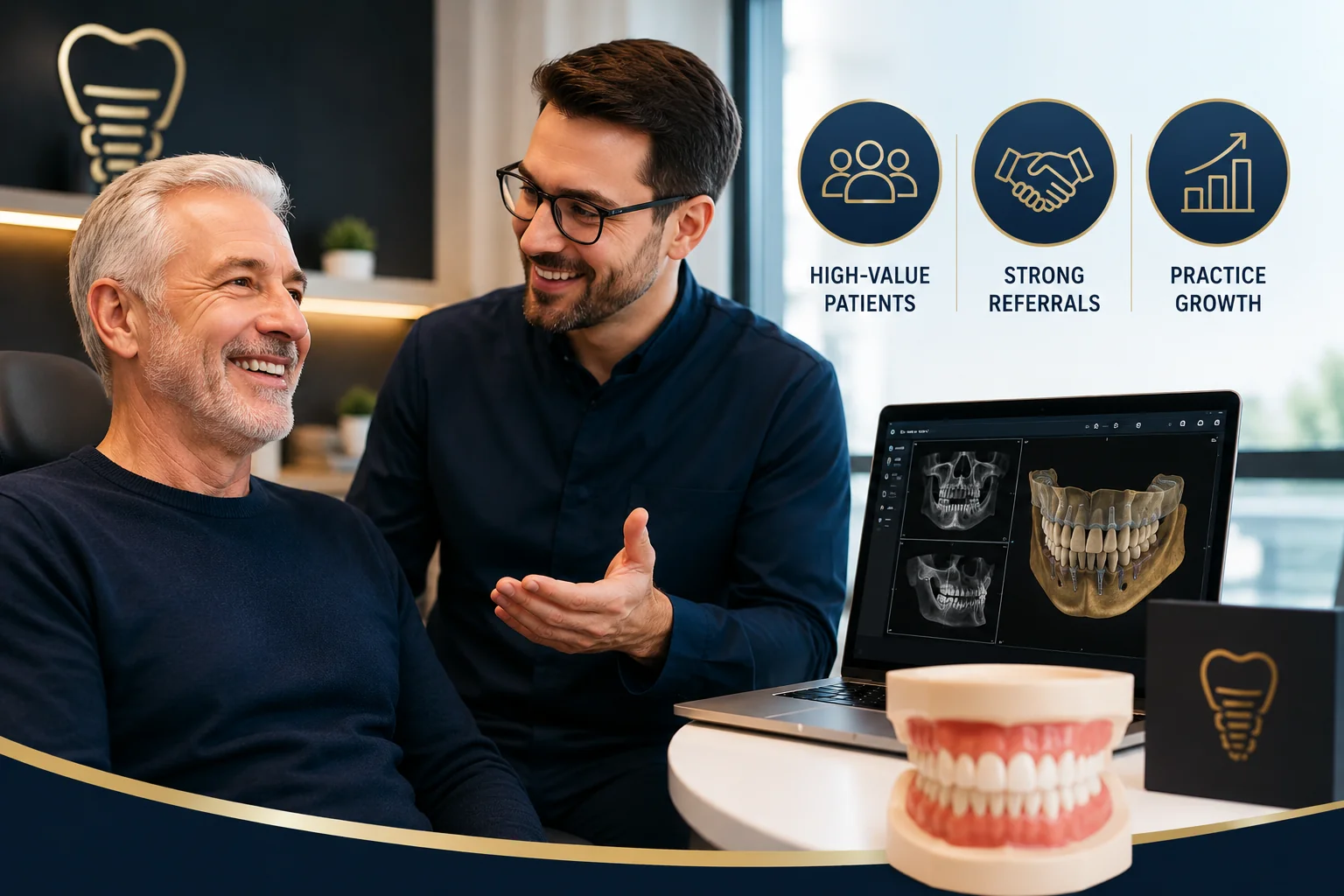 To attract high-value full-mouth rehabilitation cases and a steady stream of general-dentist referrals, a prosthodontic practice needs marketing built for two very different audiences: anxious, high-investment patients researching a major decision, and the referring dentists who hand off their most complex reconstructions. To attract high-value full-mouth rehabilitation cases and a steady stream of general-dentist referrals, a prosthodontic practice needs marketing built for two very different audiences: anxious, high-investment patients researching a major decision, and the referring dentists who hand off their most complex reconstructions.
Full-mouth rehab isn’t an impulse purchase or a single-visit procedure—it’s a months-long, emotionally loaded decision that patients research carefully and that referring dentists hand off only when they trust the specialist. Marketing it well means reaching both audiences and removing the friction that stalls cases between first interest and accepted treatment.
Two things make this different from routine dental marketing. First, demand arrives through two channels that behave nothing alike: high-intent patients searching for answers about failing dentition, and general dentists deciding where to send their most complex cases. Second, the decision cycle is long and rarely linear—a patient may research for weeks or months, involve a spouse, weigh financing, and visit more than one specialist before committing. An approach built for booking same-week cleanings will quietly underperform here.
Already booking consultations but watching cases stall? The section on turning consultations into accepted treatment is where to focus. If the gap is visibility—too few qualified patients and too few referrals—start with the search and referral sections first.
Written for: prosthodontists, practice owners, and the marketing teams supporting specialty restorative practices that want a reliable pipeline of full-mouth and full-arch reconstruction cases.
TL;DR
If you only prioritize five things, make them these:
| 1. |
Market to two audiences, not one - build separate paths for high-intent patients and for the general dentists who refer complex cases
|
| 2. |
Design for a long decision cycle - educate, nurture, and stay visible across the weeks or months patients spend researching before they commit
|
| 3. |
Let the website pre-sell competence - documented cases, clear treatment explanations, financing pathways, and visible specialist credentials build trust before the consultation
|
| 4. |
Protect and grow the referral pipeline - make referring easy, communicate back to the sending dentist, and never compete for their routine work
|
| 5. |
Measure accepted cases and referral volume, not just clicks - high-value marketing is judged by accepted treatment plans and a steady referral base, on attribution windows measured in months |
Table of Contents
What makes full-mouth rehab marketing different
Full-mouth rehabilitation sits at the high end of restorative dentistry: rebuilding function, occlusion, and appearance across both arches, often combining implants, fixed prosthetics, and occlusal reconstruction across multiple phases. Marketing it has little in common with promoting hygiene visits or single crowns. The investment is higher, the deliberation is longer, and the trust threshold a patient or referring dentist must clear is far steeper.
Three structural realities shape what follows:
| • |
High investment, high anxiety - patients weigh a major financial commitment alongside fear, embarrassment about their teeth, and skepticism born of past dental experiences
|
| • |
Two demand channels - cases arrive both from patients searching directly and from general dentists referring complex work they don’t restore in-house, and each channel needs its own message
|
| • |
A long, non-linear path - the journey from first interest to accepted treatment can span weeks or months, with research, second opinions, and family input along the way |
A pattern we see across specialty practices: marketing that treats a full-arch reconstruction like a routine appointment generates clicks and calls but few accepted cases. The volume looks fine; the conversion doesn’t. Fixing that starts with respecting how these decisions actually get made.
> Back to Table of Contents
How patients decide on full-mouth reconstruction
The patient considering full-mouth rehab is usually not shopping for a procedure—they’re trying to solve a problem they’ve lived with for years: teeth that hurt, break, or are missing; difficulty eating; a smile they hide. Understanding that emotional starting point is the foundation of marketing that connects.
The journey typically moves through four stages:
| 1. |
Problem awareness - the patient knows something is seriously wrong but may not know that comprehensive, specialist-led reconstruction is an option
|
| 2. |
Solution research - they explore what’s possible, compare approaches like implant-supported options against alternatives, and form an idea of what good care looks like
|
| 3. |
Provider evaluation - they assess who they trust to do the work, weighing credentials, documented results, reviews, and how the practice made them feel
|
| 4. |
Commitment - they reconcile cost and financing, often involve a spouse or adult child, and decide whether to move forward |
Marketing has a different job at each stage. Early on, educational content that names the problem and explains that reconstruction is achievable meets patients where they are. In the middle, depth and proof matter—explaining options honestly, showing real outcomes, and answering the questions patients are afraid to ask. Near the decision, the friction is usually financial and emotional rather than informational, so clear financing pathways and a reassuring consultation experience carry the most weight.
Two psychological factors deserve special attention. The first is shame: many of these patients have avoided dentistry precisely because they feel judged, so warm, non-judgmental messaging outperforms clinical detachment. The second is skepticism: high-cost dentistry attracts understandable wariness, which is why specific, verifiable proof beats superlatives. “Life-changing results” persuades no one; a clearly documented case and a straightforward explanation of the process build more confidence than any adjective.
> Back to Table of Contents
Build a website that earns trust before the consultation
For a high-consideration service, the website does the heavy lifting of pre-selling competence long before anyone calls. By the time a qualified patient reaches out, they should already believe this practice can handle their case.
A few specific elements build that belief:
| • |
Documented cases - real before-and-after documentation, with proper consent, does more to establish capability than any claim about years of experience
|
| • |
Honest treatment explanations - clear, jargon-light descriptions of the reconstruction process, the phases involved, and what recovery looks like reduce fear and set expectations
|
| • |
Visible specialist credentials - prosthodontic training is a genuine differentiator, but it has to be explained, since most patients don’t know what separates a prosthodontist from a general dentist offering similar services
|
| • |
Financing pathways - without naming prices, the site should make clear that financing exists and that the team will help patients navigate it, because affordability anxiety stalls more cases than any other single factor
|
| • |
Reassurance signals - reviews, a welcoming tone, and content that acknowledges dental anxiety tell hesitant patients they’ll be treated with dignity |
One distinction matters for specialists in particular: patients often can’t tell why a prosthodontist is the right choice for complex work. A short, plain-language explanation of the additional training prosthodontists complete—and the kinds of cases they handle—turns an unfamiliar title into a reason to choose you. It’s also strong material for AI answer engines, which increasingly summarize “what is a prosthodontist” style questions for searchers.
> Back to Table of Contents
Get found: local SEO and AI search for specialty practices
Specialty practices face a different search reality than general dentists. Search volumes for terms like full-mouth reconstruction are lower but carry far higher intent, and patients will travel a wider radius for complex care than they would for a routine cleaning. Visibility has to be built for both traditional local search and the AI tools patients increasingly use to research treatment and providers.
Local search fundamentals still drive provider discovery:
| • |
A complete, accurate Google Business Profile - correct categories, service descriptions, and steady patient reviews remain central to local visibility
|
| • |
Service and location pages - dedicated pages for reconstruction services and for the areas you draw patients from help you appear for high-intent local searches
|
| • |
Consistent practice information - name, address, and phone consistency across directories supports the local signals search engines rely on |
This matters more than ever for a specific reason: for local provider searches—the “prosthodontist near me” type of query a patient uses to find a practice—Google has removed AI Overviews from these high-intent provider searches, returning them to the local pack, maps, and organic listings. Your local SEO investment is what wins that moment.
AI-assisted discovery still matters—just in two distinct places. First, when patients research the treatment itself (options, conditions, what reconstruction involves), Google’s AI Overviews remain prominent, so clear, accurate educational content can surface there and shape which solutions a patient considers. Second, many patients now ask standalone AI tools like ChatGPT Search, Microsoft Copilot, Perplexity, and Apple Intelligence to explain options and suggest providers. To be cited by any of these, content has to read as genuinely authoritative: direct answers to real patient questions, honest explanations of treatment options, and well-structured information an AI can confidently summarize. The same depth that builds patient trust is what earns these citations.
A practical priority for specialists: because your geographic draw is wider than a general practice’s, think in terms of a region rather than a single neighborhood. Content that answers the substantive questions of patients across that region—and that demonstrates real reconstruction expertise—tends to outperform thin pages stuffed with city names.
> Back to Table of Contents
Build and protect a general-dentist referral pipeline
For most prosthodontic practices, referrals from general dentists are the single most valuable source of complex cases—and the channel most often neglected in favor of patient-facing marketing. A general dentist who trusts you will send years of difficult, high-value work. Earning and keeping that trust is a marketing discipline in its own right.
What makes referring dentists choose and stay with a specialist:
| • |
Clinical confidence - they need to believe their patient will receive excellent care, communicated through case examples, credentials, and a track record they can verify
|
| • |
Easy referral logistics - a simple, fast way to refer, with clear instructions and responsive scheduling, removes friction that sends cases elsewhere
|
| • |
Communication back - the most common referral complaint is silence, so sending dentists want timely updates on their patient’s treatment and a clear plan for what happens next
|
| • |
No competition for their patients - referring dentists need confidence that you’ll return the patient for routine care and won’t poach the general work that keeps their practice running |
That last point is worth dwelling on. The fastest way to lose a referral source is to make them feel their patient might not come back. Practices that build durable referral pipelines are explicit—in their communication and their reputation—about respecting the referring relationship and returning patients for ongoing care. Co-management done well turns a one-time referral into a standing partnership.
Building the pipeline is part outreach, part follow-through. In our experience, the practices that grow referrals treat sending dentists as a distinct audience: they introduce their capabilities to area general practices, make the referral process effortless, and—most importantly—close the loop reliably after every case. Reputation among referring dentists compounds; one well-handled, well-communicated case leads to the next.
> Back to Table of Contents
Show results without breaking compliance rules
Documented results are the most persuasive marketing a reconstruction practice has—and the area where compliance missteps are easiest to make. Dental marketing is regulated as health information, which means proof has to be gathered and presented within clear legal limits. Getting this right protects both patients and the practice.
Four compliance essentials apply to reconstruction marketing:
| • |
Patient consent for images - before-and-after photos are protected health information, and using them requires specific, documented patient authorization that covers how and where the images will appear
|
| • |
Truthful, non-misleading claims - results have to be representative and not deceptively edited or staged, and advertising rules require honesty about what patients can expect
|
| • |
No guaranteed outcomes - clinical results vary by patient, and promising specific outcomes is both clinically inaccurate and a regulatory risk
|
| • |
Genuine testimonials - reviews and testimonials must reflect real experiences, with disclosure of any material connection |
A few practical guardrails keep marketing on the right side of the line. Treat every patient image as something that requires written authorization before it appears anywhere public, and keep that documentation on file. Describe what reconstruction can do in honest, qualified terms rather than absolutes—“many patients regain comfortable chewing” rather than “you’ll eat anything again.” And review testimonial and advertising practices against current standards from regulators like the FTC and the rules that govern protected health information, since the specifics are periodically updated. When in doubt, the conservative choice protects the practice without weakening the marketing—one clearly documented case told honestly persuades more than a wall of unverifiable superlatives.
> Back to Table of Contents
Turn consultations into accepted treatment
Marketing’s job is to deliver a qualified, ready patient to a consultation; the consultation and the practice’s follow-through decide whether the case is accepted. For high-value reconstruction, the gap between “interested” and “committed” is where most revenue is won or lost—and much of it comes down to how the practice handles financial and emotional friction.
The most common reasons qualified patients don’t move forward:
| • |
Cost uncertainty - patients who don’t understand their financing options often default to delay, even when treatment is within reach
|
| • |
Information overload - a complex, multi-phase plan presented all at once can overwhelm a patient into inaction
|
| • |
Unaddressed fear - lingering anxiety about pain, time, or judgment quietly blocks commitment when it’s never surfaced and answered
|
| • |
Slow or impersonal follow-up - high-consideration decisions need patient, human follow-through, and a case left to go cold usually stays cold |
Practices that convert well treat the consultation as the start of a relationship, not a sales close. They present financing clearly and early, so cost becomes a solved problem rather than a lurking unknown. They break overwhelming plans into understandable phases. They make space for the patient to voice fears and answer them directly. And they follow up consistently and personally, recognizing that a patient weighing a major decision may need several touchpoints over weeks before committing—not because they’re uninterested, but because the decision genuinely deserves that care.
The marketing and the consultation experience have to tell the same story. If the website promises a warm, expert, judgment-free practice and the consultation feels rushed or transactional, accepted-case rates suffer no matter how strong the lead flow.
> Back to Table of Contents
Track the metrics that matter for high-value cases
High-value case marketing fails when it’s judged by the wrong numbers. Clicks, impressions, and even raw call volume say little about whether reconstruction cases are actually being accepted. The metrics that matter sit closer to revenue and stretch across a longer timeline than routine dental marketing reporting.
The measurements that actually reflect performance:
| • |
Qualified consultation requests - not all inquiries are equal, so track requests from patients who fit the reconstruction profile separately from routine questions
|
| • |
Case acceptance rate - the share of consultations that become accepted treatment plans is the clearest signal of whether marketing and consultation are aligned
|
| • |
Referral volume and source - the number of referrals and which dentists send them reveal the health of your most valuable channel
|
| • |
Cost per accepted case - measured as the relationship between marketing investment and accepted treatment, this matters far more than cost per click for a service of this value
|
| • |
Attribution over months - because the decision cycle is long, judging campaigns on a few weeks of data badly understates what’s working |
One reporting habit separates clarity from confusion: use a longer attribution window than you would for routine services. A patient who first found the practice in spring may not accept treatment until late summer, and short reporting windows will credit the wrong sources—or write off channels that are actually performing. As analytics platforms have changed their terminology and event tracking in recent years, the underlying lesson has held: define the outcomes that map to accepted cases, configure tracking to capture them, and give the long decision cycle room to show up in the data.
> Back to Table of Contents
Work with a team that knows specialty dentistry
Marketing full-mouth rehabilitation well takes more than general dental marketing tactics—it takes an understanding of how high-value cases are researched, referred, and accepted. WEO Media - Dental Marketing works with prosthodontic and specialty restorative practices to build the patient-facing visibility and the referral relationships that complex cases depend on. If you want a marketing approach built for the realities of reconstruction dentistry, our team can help you put one in place. Call 888-246-6906 to start the conversation.
FAQs
What is the most effective way to market full-mouth rehabilitation services?
The most effective approach works two channels at once: high-intent patients searching for solutions to failing dentition, and general dentists who refer complex cases. It pairs a trust-building website—documented results, clear treatment explanations, and financing pathways—with active referral relationships. Because the decision cycle is long, the strategy emphasizes education and consistent follow-up over quick conversions.
How do prosthodontists get more referrals from general dentists?
Referrals grow when a specialist makes referring easy, communicates back reliably, and never competes for the referring dentist’s routine work. General dentists send complex cases to specialists they trust clinically and who return patients for ongoing care. Introducing your capabilities to area practices, streamlining the referral process, and closing the loop after every case builds a durable pipeline.
How long is the decision cycle for full-mouth reconstruction patients?
It commonly spans weeks to months. Patients research options, often seek more than one opinion, weigh financing, and involve a spouse or family member before committing. Marketing and reporting should account for this: short attribution windows understate which channels are working, and consistent nurturing matters more than pushing for an immediate decision.
Can dental practices use before-and-after photos in marketing?
Yes, with proper consent. Before-and-after images are protected health information, so using them requires specific, documented patient authorization covering how and where they appear. Images must be truthful and not deceptively edited. Kept compliant, documented cases are among the most persuasive marketing a reconstruction practice has—far more convincing than claims without proof.
Where do patients research full-mouth reconstruction online?
In two places. To find a provider, patients use local search—and for these “near me” provider queries, Google now shows local results rather than AI Overviews, so local SEO drives discovery. To research the treatment itself, patients use Google’s AI Overviews and standalone tools like ChatGPT Search, Microsoft Copilot, Perplexity, and Apple Intelligence. Clear, authoritative content helps a practice surface in both.
How should a prosthodontic practice measure its marketing success?
Focus on outcomes tied to revenue rather than clicks: qualified consultation requests, case acceptance rate, referral volume and source, and cost per accepted case. Use a longer attribution window than for routine services, since a patient may research for months before accepting treatment. These measures reveal whether marketing and the consultation experience are aligned.
Why do qualified patients delay accepting full-mouth treatment?
The most common reasons are financial uncertainty, feeling overwhelmed by a complex multi-phase plan, unaddressed fear about pain or judgment, and slow or impersonal follow-up. Practices that convert well present financing clearly and early, break plans into understandable phases, address fears directly, and follow up consistently and personally throughout the patient’s decision period.
Should prosthodontists focus on patient marketing or referral marketing?
Both, because they supply different cases and reinforce each other. Patient-facing marketing captures people actively searching for reconstruction, while referral marketing earns complex cases from general dentists. Neglecting either leaves a major source of cases untapped. A strong reputation with referring dentists and a trust-building patient presence together produce the most reliable pipeline. |
|