Nextdoor for Dentists: How to Turn Local Recommendations Into New Patients
Posted on 9/3/2026 by WEO Media |
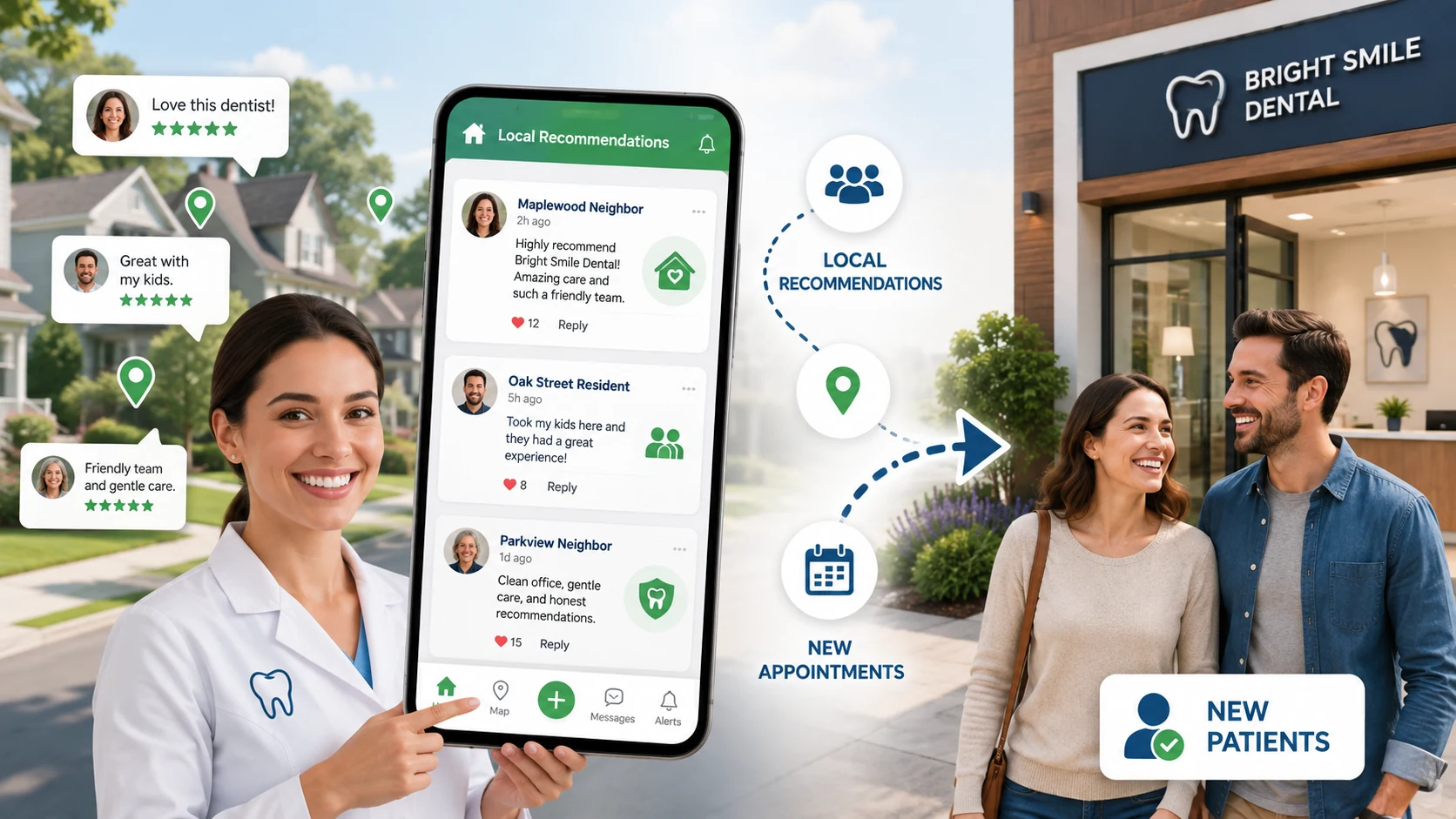 Nextdoor for dentists turns neighbor recommendations into new patients, but only when your dental practice earns those recommendations on a claimed Nextdoor Business Page, and this guide shows practice owners, office managers, and dental marketing teams how to do it inside HIPAA, FTC, and Nextdoor’s own policy limits. It is not a channel you win by posting more. It is a channel you win by being the name a neighbor types when someone else asks. Nextdoor for dentists turns neighbor recommendations into new patients, but only when your dental practice earns those recommendations on a claimed Nextdoor Business Page, and this guide shows practice owners, office managers, and dental marketing teams how to do it inside HIPAA, FTC, and Nextdoor’s own policy limits. It is not a channel you win by posting more. It is a channel you win by being the name a neighbor types when someone else asks.
That distinction just became a rule, not a preference. On August 19, 2026, Nextdoor changed its self-promotion policy: business promotion can no longer come from a personal neighbor account in the main feed. It has to come from a free Business Page. For dental practices, this quietly retires one of the most common tactics in the category — the dentist or office manager answering “can anyone recommend a good dentist?” from their own account.
Already strong on Google? Keep reading. Nextdoor is a separate surface with separate rules and a separate audience. If your core local search presence is the weaker link, start with local SEO for dentists first, then come back here.
Below you will find what Nextdoor actually is in 2026 (with the engagement numbers that matter, not the vanity ones), how Faves and recommendations really work, the FTC and HIPAA lines you cannot cross when asking for or replying to them, what Nextdoor Ads will and will not let a dental practice say, and a 30-day plan you can hand to a team member on Monday.
Written for: dental practice owners, office managers, DSO marketing leads, and specialty practices evaluating whether Nextdoor deserves a place in the marketing mix.
Short on time? Start here: what changed in August 2026, the FTC rules for asking, the HIPAA rules for replying, what Nextdoor Ads will let you say, or skip to the 30-day plan.
TL;DR
If you only do six things, do these:
| 1. |
Claim and verify the Business Page - it is free, and as of August 2026 it is the only compliant place to promote your practice on Nextdoor
|
| 2. |
Stop posting from personal accounts - a dentist or team member promoting the practice in the main feed now gets downranked, not deleted, and you will be notified
|
| 3. |
Ask every patient the same way - uniform asks are compliant; incentives tied to sentiment are not, and staff or family recommendations require disclosure
|
| 4. |
Never confirm treatment in a public reply - two dental practices have paid federal settlements for disclosing patient information in review responses
|
| 5. |
Do not upload your patient list for ad targeting - a patient roster is protected health information, and Nextdoor is not your business associate
|
| 6. |
Measure Faves, page views, and booked visits - not impressions, and not the 100 million registered-user headline |
Table of Contents
What Nextdoor actually is in 2026 (and the numbers that matter)
Nextdoor is an address-verified neighborhood network. Every account is tied to a real residential address, which is what makes a recommendation there feel different from a review left by a stranger three states away. The company reports over 100 million verified neighbors and more than 340,000 neighborhoods, and says roughly one in three U.S. households are active on the platform.
Now the number most agencies skip. Nextdoor Holdings reports Platform Weekly Active Users separately from registered accounts. For the quarter ended June 30, 2026, Platform WAU was 22.9 million — an all-time high, up 5 percent year over year — against that 100 million-plus registered base. That works out to roughly one in five registered neighbors opening Nextdoor in a given week. That ratio, not the registration headline, is the honest denominator when you size the opportunity for a practice serving a five mile radius.
What we typically find: a practice that models Nextdoor off the 100 million figure sets a budget and a timeline it will never hit, then declares the channel dead in ninety days. A practice that models it off weekly actives treats Nextdoor as a slow-compounding trust asset, funds it accordingly, and is still collecting recommendations two years later.
The product itself changed in July 2025. Nextdoor rebuilt around three pillars — Alerts (real time weather, outages, and public safety), News (headlines from more than 3,500 vetted local publishers), and Faves (an AI recommendation layer that summarizes years of neighbor conversation into direct answers). That third pillar matters more than it sounds, and we return to it in the local SEO and AI search section.
For most practices, Nextdoor sits alongside — never instead of — a healthy Google presence and a working social media marketing program. It is a reputation channel first and a reach channel a distant second.
> Back to Table of Contents
The August 2026 policy change that rewrites the dental playbook
On August 19, 2026, Nextdoor published an update to its self-promotion policy. The substance is short: promoting a business, service, or paid opportunity from a personal neighbor account is no longer permitted in the main feed. That covers posts, comments, and unsolicited direct messages. The same promotion is welcome — from a free Business Page.
What this changes for a dental practice:
| • |
The personal-account reply is out - a dentist, associate, hygienist, or office manager commenting “we’d love to see you, call our office” on a neighbor’s request now violates policy
|
| • |
Enforcement is throttling, not deletion - flagged posts stay up exactly as written, the author gets an email and an on-post banner, and far fewer neighbors see it
|
| • |
Patients are unaffected - a neighbor asking who to call, or recommending a practice they love, is still fully welcome from a personal account
|
| • |
Groups are exempt - Nextdoor Groups set their own promotion rules, decided by group admins
|
| • |
Paid products are unaffected - Opportunity Alerts and Nextdoor Ads operate independently of this change |
There is a subtler trap in the same announcement. Nextdoor says its systems look at patterns rather than individual posts, and that a neighbor who recommends the same business a little too enthusiastically can occasionally be flagged in error. Read that in a dental context: if you coach five team members to post recommendations for your practice across the same set of neighborhoods, you are manufacturing exactly the pattern the system is built to catch — and you have a separate FTC problem, covered in the section on earning recommendations.
Nextdoor also confirmed it is revamping its annual Faves Awards program for a launch in fall 2026, and that Business Pages were made more prominent and more discoverable across 2026. If you have been sitting on an unclaimed page, the run-up to that program is the wrong time to still be sitting on it. The full text is worth ten minutes: Nextdoor’s self-promotion policy update.
> Back to Table of Contents
Faves, recommendations, and reviews are three different things
The word “Fave” now carries three distinct meanings on Nextdoor, and a fourth term, the written recommendation, keeps getting folded in with them. Conflating any of the four is the fastest way to build the wrong strategy.
The four terms, separated:
| • |
A Fave - a one-tap endorsement, functionally a follow. The count displays next to your business name across the platform, and Nextdoor states that the more Faves you earn, the more likely you are to appear in its search results
|
| • |
A recommendation - free-text written by a neighbor about their experience. Written recommendations do not increase your Fave count; they are separate content that appears on your page
|
| • |
Neighborhood Faves Awards - the annual program that selects winners by neighborhood, city, and subcategory based on Faves, recommendations, and mentions collected over a lookback period. Dentists have been an award category
|
| • |
Faves, the AI feature - the recommendation engine launched in the July 2025 redesign, which synthesizes neighbor conversation into direct answers to questions like “who is a good dentist near me?” |
Nextdoor’s 2025 internal data reports 6.9 million Faves across 1.7 million businesses Fave’d, and states that award winners have 38 times more Business Page views, 62 percent more recommendations, and 32 percent more clicks on their Nextdoor Ads. Treat those as vendor-reported figures rather than independent research — useful for direction, not for forecasting.
The strategic read: Faves drive in-platform discoverability and give you a free audience to post to. Written recommendations drive persuasion and, as you will see below, are the only part of this that search engines can read. You need both, and they are earned differently. Faves come from asking. Recommendations come from asking specifically, at the right moment, the same way your team already handles generating five-star Google reviews. If your practice has no repeatable system for either yet, our roundup of dental reputation strategies is the right place to start.
> Back to Table of Contents
How to set up a dental Nextdoor Business Page correctly
Claiming is free and takes minutes, but the details determine whether the page ever earns anything. You must be an owner, employee, or authorized representative, and you claim through Nextdoor’s business portal using a personal account you can toggle between.
Set these up before you ask a single patient for anything:
| 1. |
Exact-match name, address, and phone - character-for-character identical to your Google Business Profile and your website footer, including suite numbers and abbreviations
|
| 2. |
Correct categories - choose the category that matches how neighbors describe you, not how your practice management software classifies you. A pediatric practice categorized only as “Dentist” loses the parent-specific matching
|
| 3. |
Real photos, not stock - exterior with signage so neighbors recognize the building, operatory, reception, and team. Neighbors are checking whether this is the place they drive past
|
| 4. |
Hours that reflect reality - including the days you are genuinely closed, because a wrong-hours visit generates the one kind of recommendation you do not want
|
| 5. |
Your unique recommendation link - Nextdoor generates one under the Page tab. Save it where your front desk can reach it in two seconds
|
| 6. |
Service list in patient language - “same day crowns” and “emergency appointments,” not procedure codes |
The photo requirement is the one practices shortcut most. Stock imagery reads as stock to a neighbor who drives past your building every day, and it undercuts the exact local credibility Nextdoor exists to create. If you do not have a usable library, professional dental practice photography pays for itself across your website, your Google Business Profile, and every listing you claim after this one.
Multi-location groups need one page per location. Nextdoor is built on physical address, so a single group-level page will not surface a satellite office to the neighborhoods around it. Each location gets its own claimed page, its own address data, and its own recommendation link, with a naming convention that stays consistent across every directory you appear in. Groups already running this playbook on Google will recognize the pattern from Google Business Profile for multi-location dental groups, and it is the same discipline built into our DSO marketing solutions.
Treat the page as a citation, not just a profile. A Nextdoor Business Page is a directory listing that carries your practice name, address, and phone into the wider local search ecosystem. Inconsistent data there quietly undermines the rest of your footprint, which is why we handle it inside the same workflow as NAP consistency and a full dental citation SEO program rather than as a one-off social task. Nextdoor is one entry on a longer list of dental directories worth claiming, and the ones you skip are the ones that quietly go stale.
> Back to Table of Contents
How to earn Nextdoor recommendations without violating FTC review rules
This is where dental practices get into trouble, because the instinct that works in retail is illegal in healthcare marketing.
The FTC’s Rule on the Use of Consumer Reviews and Testimonials, codified at 16 CFR Part 465, took effect October 21, 2024. It converted practices the FTC previously pursued case by case into a rule carrying civil penalties. The maximum penalty tied to these violations is 53,088 dollars per violation, a figure that held steady into 2026 after the Office of Management and Budget cancelled the 2026 inflation adjustment.
The five provisions that touch a dental Nextdoor program:
| • |
Section 465.2(c), procured insider reviews on third-party platforms - it is a violation to procure a review from your officers, managers, employees, agents, or their immediate relatives for posting on a third-party platform when you knew or should have known it misrepresents that the reviewer exists, was actually a patient, or had the experience described. A team member who has never been treated at your practice writing a recommendation lands here
|
| • |
Section 465.4, buying reviews - you may not provide compensation or incentives in exchange for, or conditioned expressly or by implication on, a review expressing a particular sentiment. The rule defines the compensation broadly enough to include discounts, coupons, and contest entries, so a whitening credit or a raffle ticket for “a nice recommendation” is squarely inside it
|
| • |
Section 465.5, insider disclosure - an officer or manager writing a recommendation about their own practice without a clear and conspicuous disclosure of the relationship is a violation. Owners count as officers. When an owner or manager solicits recommendations from staff or immediate relatives, the safe path is instructing every prospective reviewer to disclose the relationship clearly, then correcting any that post without it
|
| • |
Section 465.7, review suppression - this covers responding to a review with a groundless legal threat, intimidation, or a knowingly false public accusation in order to stop it or get it removed. It also covers a practice’s own website implying that a filtered testimonial widget shows most or all reviews received
|
| • |
Section 465.8, fake influence indicators - purchasing or procuring engagement signals you knew or should have known were fake, which extends to purchased Faves |
The rule does not prohibit asking. The insider provisions carve out generalized solicitations to patients inviting them to post about their experience. The compliant pattern is uniform: every patient, same moment, same script, same link, no screening by predicted sentiment, no incentive attached.
One detail practices routinely miss: when a disclosure is required, the rule’s definition of clear and conspicuous says it must be unavoidable in an interactive medium. A disclosure a reader has to click a link or hover to see does not qualify. If a team member does post, the relationship has to appear in the recommendation text itself.
A compliant front desk ask sounds like this: “A lot of our neighbors find us on Nextdoor. If you have a minute, we’d appreciate you sharing your experience there — here’s the link.” No gift card. No “if you had a five-star visit.” No follow-up that changes based on how happy they seemed. If your growth plan leans on giveaways, read how to run a legal dental social media contest before you attach one to anything review-adjacent, and build your offers the way we outline in new patient specials without discounting.
Two more layers sit on top of the FTC rule. The ADA Principles of Ethics and Code of Professional Conduct, Section 5.F, holds that no dentist shall advertise or solicit patients in any communication that is false or misleading in any material respect, and the ADA’s guidance is explicit that endorsements must reflect the endorser’s actual experience with disclosure of any material connection. State dental boards then layer their own testimonial and advertising restrictions, which vary meaningfully by state. Check yours against our overview of state dental board advertising rules before you launch, and read the ADA’s marketing and advertising guidance alongside our breakdown of FTC advertising rules for dentists.
If word of mouth is the goal, build the internal engine first. A structured patient referral program produces the enthusiasm that shows up on Nextdoor later; the reverse almost never happens.
> Back to Table of Contents
The HIPAA rules for replying to Nextdoor recommendations
Two dental practices have already paid federal settlements for getting this wrong on a different review platform, and the reasoning transfers to Nextdoor without modification.
In October 2019, the HHS Office for Civil Rights announced a 10,000 dollar settlement with a Dallas practice that had disclosed a patient’s last name along with treatment plan, insurance, and cost details while responding to a Yelp review. In December 2022, OCR announced a 23,000 dollar settlement and a two year corrective action plan with a California practice whose owner had responded to reviews by supplying full names where patients had used pseudonyms, plus visit and insurance details the patients had never posted. OCR’s stated position was blunt: providers cannot disclose protected health information when responding to negative online reviews.
What is and is not permitted in a public reply:
| • |
Permitted - thanking someone generally, stating your policies, inviting offline contact, describing what your practice does in general terms
|
| • |
Not permitted - confirming the person is a patient, naming procedures, referencing appointment history, correcting their account of treatment, discussing insurance or balances
|
| • |
Still not permitted when they disclosed it first - a patient waiving their own privacy in a public post does not authorize you to repeat or expand on it
|
| • |
Still not permitted with a pseudonym - supplying a real name where a neighbor used a display name is itself the disclosure |
A safe response template: “Thank you for taking the time to share this. We take every piece of feedback seriously and we’d welcome the chance to talk it through directly — please call our office and ask for our practice manager.” That sentence works for a glowing recommendation and a scathing one, and it never says whether the writer is a patient.
There is a Nextdoor-specific wrinkle that makes this sharper. Neighbor recommendation text appears on public, logged-out, search-engine-readable Nextdoor pages, not just inside the app. A reply that confirms treatment is not a private message to one neighbor. It is indexable content.
The custom audience trap. Nextdoor Ads Manager offers audience building from your own customer data. For a dental practice, that customer list is a patient roster, and a patient roster is protected health information. Uploading it to an advertising platform is a disclosure of that information to a third party for a marketing purpose, which generally requires written patient authorization, and the platform is not acting as your business associate when it happens. Advertising platforms as a rule do not sign business associate agreements. Treat patient-list upload as off the table unless your health care counsel says otherwise in writing.
Build the response workflow before the recommendations start arriving, using the same discipline as our dental patient review response SOP and the broader guardrails in HIPAA compliance for dental marketing. The adjacent exposures worth auditing at the same time are covered in HIPAA privacy risks in dental digital marketing.
> Back to Table of Contents
What Nextdoor Ads can and cannot do for a dental practice
Nextdoor Ads Manager is a self-serve auction platform. You set a campaign objective, then build an ad group with placements, audience, bid, daily budget, duration, and schedule, then creative, then publish. Placements include the newsfeed, the For Sale and Free section, and a desktop right-hand rail. Targeting options Nextdoor advertises include household income, homeownership, and interests.
The advertising policy, effective April 1, 2025, constrains dental creative more than most channels.
| • |
No before-and-after imagery for cosmetic procedures - this rules out the veneer, whitening, and smile makeover pairs that anchor most cosmetic dental creative, along with any image showing unexpected or unlikely results
|
| • |
No implying knowledge of a viewer’s health condition - copy such as “missing teeth?” or “struggling with gum disease?” runs directly at the prohibition on asserting or implying knowledge of medical or health conditions
|
| • |
Health care ads must comply with the practitioner’s own rules - Nextdoor requires medical and dental advertising to satisfy all laws, regulations, and professional codes applicable to the practitioner and the service
|
| • |
No targeting under 18 - health and medical advertising cannot be served to minors, which shapes how pediatric and orthodontic practices frame audience and message toward parents
|
| • |
No fear tactics or negative self-perception - copy engineered around insecurity or shame about appearance is prohibited
|
| • |
AI-generated media must be disclosed - synthetic imagery, audio, or video requires disclosure
|
| • |
Landing pages must be complete and original - no under-construction pages, no PDF or image-only destinations, and lead generation requires a published privacy policy |
One capability gap worth knowing before you budget. Nextdoor sells Opportunity Alerts, a paid subscription that notifies a business in real time when a neighbor posts asking for their category of service. It covers roughly thirty categories — plumbing, HVAC, roofing, landscaping, hair salons, pet grooming, and similar. Dental and medical are not among them.
You cannot buy the alert that fires when a neighbor asks for a dentist. You can only be the practice already named when someone else answers. The current list is published on Nextdoor’s Opportunity Alerts page, and the full creative rules are in the Nextdoor Ads Policy.
Two specialties feel these limits hardest. Because health and medical advertising cannot be served to anyone under 18, every message has to be written to the parent rather than the patient, which reshapes the creative brief for pediatric dentist marketing and for orthodontist marketing more than it changes anything else on this list.
For most practices, Nextdoor paid media should be tested only after the organic page is earning recommendations, and it should be measured against, not funded out of, your dental PPC budget. If you are weighing where paid social fits at all, our comparison of organic versus paid social media for dental practices frames the tradeoff.
> Back to Table of Contents
Where Nextdoor fits in local SEO and AI search visibility
This section contains the part of Nextdoor most dental marketers have never checked, and it cuts both ways.
The upside: Nextdoor publishes indexable city-level dentist pages. Nextdoor maintains public topic pages at addresses in the form of a dentist page for a given city and state. They are server-rendered, viewable logged out, and carry titles and meta descriptions built around finding the best dentist in that city with verified reviewers.
Each page lists local practices with name, street address, and an excerpt from a neighbor recommendation, marks practices with none as awaiting their first recommendation, and cross-links to neighboring cities and related categories with breadcrumb structured data. In other words, the recommendation a patient writes about you becomes crawlable text on a page competing for local dentist queries.
The catch: it only works if you have recommendations. A claimed page with zero recommendations appears on that city page as an empty slot next to competitors who have text. This is the single strongest argument for treating recommendations as a standing operational habit rather than a campaign. It is also a reminder that the surrounding city and neighborhood queries are winnable on property you actually control, which is the work behind dentist service area SEO.
The downside most people miss: Nextdoor is largely walled off from AI crawlers. Checking Nextdoor’s robots.txt directly in August 2026 shows Googlebot governed by its own narrow rule set that blocks only a short list of signup, account, and unsubscribe paths, leaving the Business Page and city topic paths crawlable. But OpenAI’s GPTBot is disallowed sitewide, and the catch-all rule for every unnamed crawler disallows the entire site.
Practically, that means your Nextdoor recommendations can support classic Google visibility, but they are not feeding the generative crawlers that increasingly sit between a patient and a provider choice. Directives like these can change without notice, so re-verify before you build a strategy on them.
And Nextdoor built its own answer engine instead. The Faves feature uses a model trained on more than a decade of proprietary neighborhood conversation to answer local recommendation questions directly. That is a closed generative surface: Google cannot index it and outside AI systems cannot cite it. The only currency that buys visibility inside it is accumulated, authentic neighbor conversation about your practice.
What this means for your channel mix: Nextdoor is a citation and reputation asset that supports the Google surfaces you already compete on, plus a separate closed recommendation surface you can only enter organically. It does not replace the fundamentals covered in dental SEO, and it is not a substitute for the work in preparing your dental practice for AI search.
> Back to Table of Contents
How to measure whether Nextdoor is actually working
Nextdoor rewards patience, which makes it dangerously easy to keep funding on faith. Set the scoreboard first.
Track these five, monthly:
| 1. |
Faves earned - your in-platform discoverability signal and your free posting audience
|
| 2. |
Written recommendations added - the persuasion and search-visible asset, tracked separately from Faves
|
| 3. |
Business Page views - available in your business dashboard
|
| 4. |
Referred sessions and form starts - tag every link from your Business Page and posts with campaign parameters so the traffic lands in a named channel in your analytics rather than in direct or unassigned
|
| 5. |
Booked and kept visits attributed to Nextdoor - the only number that pays payroll |
Fix attribution at the front desk, not in the dashboard. Nextdoor’s influence is frequently invisible to analytics: a neighbor reads a recommendation, then searches your practice name in Google, and the visit records as branded organic. Add Nextdoor as an explicit option in your “how did you hear about us” field, ask it verbally at check-in, and log the answer as a single final outcome.
In GA4, remember the destination events are configured as key events, and reserve the word conversions for Google Ads reporting; our Google Analytics 4 guide for dental websites walks through that setup. Pair it with dental call tracking by source so the calls Nextdoor influences are captured at the source instead of disappearing into that branded-search bucket.
Set the review window honestly. Recommendations accrue at the pace of patient visits, not ad spend. Judge the organic program at six months and twelve months, not at thirty days. Judge paid campaigns on the same cadence you judge every other paid channel.
Whatever Nextdoor sends you still has to survive the phone. If answer rates or follow-up are the bottleneck, the channel gets blamed for a problem it did not cause — which is the argument for auditing your patient pipeline and tightening the new patient experience before adding another source of inquiries.
> Back to Table of Contents
A 30-day Nextdoor plan for dental practices
Hand this to one owner. It is roughly two hours in week one and twenty minutes a week after that.
Week 1: Claim and clean
| • |
Claim and verify the Business Page, then connect it to a personal account so staff can toggle
|
| • |
Match name, address, and phone character-for-character to your Google Business Profile
|
| • |
Upload exterior, reception, operatory, and team photos; set accurate hours and categories
|
| • |
Copy your unique recommendation link into your front desk script document and your post-visit email template |
Week 2: Write the rules down
| • |
Adopt a one-sentence uniform recommendation ask, used with every patient regardless of how the visit went
|
| • |
Adopt the public reply template and train whoever holds the login on what may never appear in a reply
|
| • |
Put in writing that no team member promotes the practice from a personal account, and that no team member or relative posts a recommendation without disclosing the relationship
|
| • |
Confirm your state dental board’s testimonial and advertising rules and note any state-specific language you must include |
Week 3: Start earning
| • |
Begin the uniform ask at checkout and in post-visit follow-up
|
| • |
Publish two Business Page posts that are useful rather than promotional: a holiday hours notice and a genuinely local item such as a youth mouthguard fitting night before fall sports
|
| • |
Record your baseline Faves, recommendations, and page views |
Week 4: Measure and decide
| • |
Compare current Faves, recommendations, and page views to your week three baseline
|
| • |
Confirm Nextdoor is appearing as a selectable source in your intake log
|
| • |
Review whether your practice now shows a recommendation excerpt on Nextdoor’s city dentist page
|
| • |
Decide on paid testing only if the organic page is earning; otherwise repeat weeks three and four |
Write the week two documents once and reuse them. The templates in our guide to dental marketing SOPs give you a format that survives staff turnover, and our list of dental community event marketing ideas will supply a year of week three post material.
Before you scale any of this, know where you stand across the rest of your local footprint. A local SEO audit will usually tell you whether Nextdoor is your gap or a distraction from a larger one.
> Back to Table of Contents
Mistakes that get dental practices flagged, throttled, or fined
Every one of these is common, and every one is avoidable.
The list, ranked by how expensive it gets:
| • |
Confirming treatment in a public reply - the federal-settlement mistake, and the easiest one to make while trying to be helpful
|
| • |
Uploading a patient list for ad targeting - a protected health information disclosure to a vendor that is not your business associate
|
| • |
Incentivizing recommendations - discounts, credits, drawings, or gift cards tied to posting
|
| • |
Undisclosed team and family recommendations - the coordinated staff push that trips both the FTC insider provision and Nextdoor pattern detection
|
| • |
Promoting from a personal account - now a policy violation that quietly throttles reach
|
| • |
Before-and-after cosmetic ad creative - prohibited in Nextdoor advertising regardless of consent or disclaimers
|
| • |
Mismatched name, address, and phone - a slow, invisible tax on every local search surface you compete in
|
| • |
Claiming the page and abandoning it - an empty page next to competitors with recommendations reads as a signal, and not a good one |
What we commonly see: the practices that do well on Nextdoor are not the ones posting most often. They are the ones whose front desk asks every patient the same way, whose replies never say more than they should, and whose page has been quietly accumulating neighbor text for eighteen months. That is unglamorous, and it is the whole strategy.
Where this guide stops: it does not enumerate state-specific dental board advertising rules, which differ materially and change; it does not cover Nextdoor’s enterprise or managed-service offerings for large DSO footprints, which sit closer to the territory of DSO reputation management at scale; and it does not model spend, because auction pricing varies by market and Nextdoor does not publish rates a practice could plan against.
> Back to Table of Contents
Talk with WEO Media about your local reputation strategy
Nextdoor is one surface in a local reputation system that also includes your Google Business Profile, your citations, your review workflow, and the front desk that has to convert what all of it produces. If you would like a second set of eyes on how those pieces fit together for your practice, our team can help you build the plan and the compliance guardrails to run it. Learn more about our dental reputation management services, or contact WEO Media to start a conversation.
> Back to Table of Contents
FAQs
Is Nextdoor worth it for a dental practice?
For most general and family practices serving a defined residential radius, yes, as a reputation and citation asset rather than a reach channel. The Business Page is free, it reinforces your name, address, and phone across local search, and neighbor recommendations become publicly indexable text on Nextdoor city pages. Practices should size expectations off weekly active users rather than total registered accounts, and should judge the organic program at six to twelve months.
Can a dentist respond to a neighbor asking for a recommendation on Nextdoor?
Not from a personal account. As of the policy update published August 19, 2026, promoting your own business from a personal neighbor account is not allowed in the main feed, including posts, comments, and unsolicited direct messages. Promotion must come from a claimed Business Page. Flagged content is not deleted, but it reaches far fewer neighbors and the author receives a notice.
Can dental practices use Nextdoor Opportunity Alerts?
No. Opportunity Alerts is limited to a published list of roughly thirty service categories covering home services, auto, salons, and pet services. Dental and medical categories are not eligible. A dental practice cannot buy real-time notification when a neighbor asks for a dentist, which is why earning recommendations that prompt other neighbors to name you is the only reliable path.
Can I offer patients a discount for a Nextdoor recommendation?
No. The FTC rule at 16 CFR Part 465, effective October 21, 2024, prohibits providing compensation or incentives in exchange for, or conditioned expressly or by implication on, reviews expressing a particular sentiment. Maximum civil penalties tied to these violations reach 53,088 dollars per violation. Generalized, uniform requests to all patients to share their experience are permitted; incentives and sentiment-screened asks are not.
Can my staff or family members leave recommendations for our practice?
Only with clear and conspicuous disclosure of the relationship. Section 465.5 of the FTC rule makes it a violation for an officer or manager to write a review of their own business without disclosing the material relationship, and for an officer or manager to solicit reviews from employees or immediate relatives without instructing them to disclose. Coordinated staff recommendations also create the repetitive pattern Nextdoor says its systems flag.
What can a dental practice legally say when replying to a Nextdoor review?
Thank the person generally, state your policies, and invite offline contact. Never confirm that the writer is a patient, name procedures, reference appointment history, correct their account of treatment, or mention insurance or balances. This holds even if the person disclosed those details themselves. Two dental practices have settled with the HHS Office for Civil Rights over protected health information disclosed in review responses, paying 10,000 dollars in 2019 and 23,000 dollars in 2022.
What is the difference between a Fave and a recommendation on Nextdoor?
A Fave is a one-tap endorsement that functions like a follow; the count displays next to your business name and Nextdoor states that more Faves improve your chances of appearing in its search results. A recommendation is free text a neighbor writes about their experience, and written recommendations do not increase your Fave count. Faves drive in-platform discoverability; recommendations drive persuasion and are the part search engines can read.
Do Nextdoor recommendations help my dental SEO?
Indirectly, in two ways. Your Business Page acts as a local citation carrying consistent name, address, and phone data, and Nextdoor publishes public city-level dentist topic pages that display practices alongside excerpts from neighbor recommendations, which Googlebot is permitted to crawl. Note that Nextdoor blocks OpenAI’s GPTBot sitewide and disallows unnamed crawlers entirely, so this content supports classic search visibility more than external AI answer engines.
Can I upload my patient list to target Nextdoor ads?
Treat this as prohibited unless your health care attorney approves it in writing. Nextdoor Ads Manager supports audiences built from your own customer data, but for a dental practice that list is a patient roster and therefore protected health information. Uploading it discloses protected health information to a third party for a marketing purpose, which generally requires written patient authorization, and the platform is not acting as your business associate when it happens. Advertising platforms as a rule do not sign business associate agreements.
Can I run before-and-after smile photos in Nextdoor ads?
No. Nextdoor’s advertising policy, effective April 1, 2025, states that advertisements marketing cosmetic procedures cannot contain before-and-after images or images showcasing unexpected or unlikely results. The policy also prohibits copy that asserts or implies knowledge of a viewer’s medical or health condition, which affects common dental ad phrasing about missing teeth or gum disease, and requires health care advertising to comply with all professional codes applicable to the practitioner. |
|